
Automated Drug Compounding Systems Market Size In 2026: Regional Growth, Key Segments And Future Outlook
Built to provide research that’s more actionable and strategically valuable, The Business Research Company’s 2026 market reports include market attractiveness analysis, total addressable market sizing, company benchmarking matrices, interactive Excel dashboards, broader supply chain intelligence, emerging startup tracking, and in-depth product insights.
Automated Drug Compounding Systems Market Forecast: Value Set To Climb From $2.08 Billion To $3.28 Billion
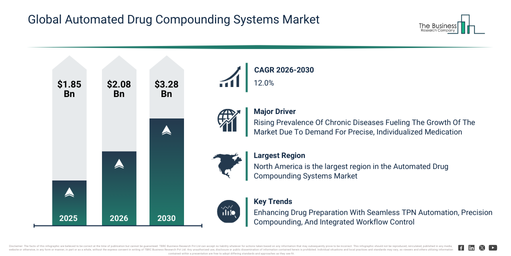
The automated drug compounding systems market has seen considerable growth in recent years. It is projected to expand from $1.85 billion in 2025 to $2.08 billion in 2026, reflecting a compound annual growth rate (CAGR) of 12.3%. The historical drivers of this expansion include the increasing deployment of automated systems in hospital pharmacies, the heightened necessity to minimize medication errors, a stronger emphasis on sterile and precise drug preparation, the increasing workload for pharmacy staff, and the rising demand for more efficient compounding processes.
The automated drug compounding systems market is projected to experience swift expansion over the coming years, with its size anticipated to reach $3.28 billion by 2030, driven by a compound annual growth rate (CAGR) of 12.0%. This growth during the forecast period is primarily attributed to increasing investment in healthcare automation, greater integration of software and automation tools, a rising demand for standardization in drug compounding, an elevated focus on minimizing contamination risks, higher hospital spending on automation infrastructure, and the growing need for enhanced operational efficiency in pharmacies. Key trends foreseen in this period include advancements in robotic-assisted drug compounding technologies, innovations in software integration for pharmacy management, the incorporation of AI for error reduction in compounding processes, improvements in real-time monitoring and quality control systems, and novel developments in automated sterile compounding techniques.
Get A Free Sample Report With In-Depth Market Insights:
Automated Drug Compounding Systems Market Demand Drivers Opening New Revenue Streams
The growing occurrence of chronic diseases is projected to drive the expansion of the automated drug compounding systems market in the future. These conditions, which are long-term health issues that progress gradually, like diabetes, heart disease, and arthritis, often demand continuous medical care and lifestyle adjustments. Unhealthy habits such as poor diet, lack of physical activity, and smoking contribute significantly to the increase in chronic diseases, raising the risk of conditions including diabetes, heart disease, and obesity. Automated systems assist in managing chronic diseases by precisely creating personalized medications tailored to individual patient needs, thereby enhancing treatment accuracy and consistency, minimizing errors, and improving long-term therapeutic results. For example, in June 2024, the National Health Service, a UK-based government department, reported that 3,615,330 individuals registered with a general practitioner (GP) were diagnosed with non-diabetic hyperglycemia or pre-diabetes in 2023, representing an 18% increase from 3,065,825 cases in 2022. Consequently, the rising prevalence of chronic diseases is a key factor propelling the growth of the automated drug compounding systems market. The scarcity of skilled pharmacy personnel is anticipated to fuel the growth of the automated drug compounding systems market moving forward. This shortage signifies a limited availability of proficient pharmacists and technicians capable of safely preparing and dispensing medications across various healthcare settings. The rise in this deficit stems from increasing patient demands and the growing incidence of chronic diseases, which necessitate precise pharmaceutical care. Automated drug compounding systems mitigate the reliance on skilled pharmacy staff by enabling accurate, consistent, and efficient medication preparation with minimal human input, thereby decreasing errors and reducing the workload for pharmacy personnel. For instance, in August 2024, according to the National Center for Health Workforce Studies, a US-based health workforce research organization, projections indicate a shortage of 4,980 pharmacists over the next 15 years through 2036, while overall demand for pharmacists is expected to grow 3% from 2022 to 2032, raising concerns amid declining application trends. Thus, the lack of skilled pharmacy staff is a significant factor driving the expansion of the automated drug compounding systems market.
Automated Drug Compounding Systems Market Segment Analysis Spotlighting Growth Areas
The automated drug compounding systems market covered in this report is segmented –
1) By Product: Robotic Compounding Systems, Automated Liquid Compounding Systems, Tablet And Capsule Dispensers, Injectable Compounding Robots, IV Admixture Systems, Oral Liquid Compounding Systems
2) By Component: Equipment, Software, Consumables, Services
3) By Technology: Robotic-Based Systems, Semi-Automated Systems, Gravimetric Dosing Systems, Volumetric Dosing Systems, Hybrid Dosing Systems
4) By End-User: Hospitals, Clinics, Retail Pharmacies, Compounding Pharmacies, Pharmaceutical Manufacturers
Subsegments:
1) By Robotic Compounding Systems: Fully Automated Sterile Compounding Robots, Hazardous Drug Compounding Robots, Non-Hazardous Drug Compounding Robots, High-Throughput Pharmacy Robots, Closed-System Robotic Compounding Units
2) By Automated Liquid Compounding Systems: Large-Volume Parenteral (LVP) Compounding Systems, Small-Volume Parenteral (SVP) Compounding Systems, Multi-Drug Liquid Compounding Units, Volumetric And Gravimetric Liquid Compounding Systems, Pediatric Liquid Dosing Compounding Systems
3) By Tablet and Capsule Dispensers: Automated Tablet Counting Dispensers, Unit-Dose Packaging Systems, Multi-Dose Blister Dispensing Units, Capsule Filling and Dispensing Systems, High-Speed Pharmacy Dispensing Robots
4) By Injectable Compounding Robots: Chemotherapy Drug Compounding Robots, TPN (Total Parenteral Nutrition) Compounding Robots, High-Precision Syringe Preparation Robots, Sterile Injectable Filling Robots, Hazardous Injectable Handling Systems
5) By IV Admixture Systems: Automated IV Bag Filling Systems, IV Nutrition (TPN) Admixture Systems, IV Antibiotic Admixture Devices, Pharmacy Cleanroom IV Automation Units, Closed-System IV Compounding Systems
6) By Oral Liquid Compounding Systems: Pediatric Oral Liquid Compounding Machines, Flavoring & Suspension Mixing Systems, Multi-Ingredient Oral Liquid Compounding Units, Gravimetric Oral Solution Compounding Systems, Low-Volume Oral Dosing Compounding Systems
Automated Drug Compounding Systems Market Trends Powering Strategic Industry Growth
Leading enterprises within the automated drug compounding systems market are concentrating on creating sophisticated solutions, such as total parenteral nutrition (TPN) automation systems, aiming to enhance the precision, security, and operational effectiveness in crafting individualized intravenous preparations. Specifically, a total parenteral nutrition (TPN) automation system functions as a compounding platform that not only automates the blending and dispensing of total parenteral nutrition (TPN) solutions but also incorporates tools for prescription validation and workflow oversight to minimize human errors and guarantee sterile, superior-quality preparation. As an illustration, in May 2025, MediServ Co. Ltd. introduced the APEX TPN Compounding System in Riyadh, marking the beginning of a novel period of exactitude and automation for parenteral nutrition processes. This system, demonstrated with its EasyComp integration software, improves the total parenteral nutrition (TPN) procedure by connecting validated prescriptions directly to sterile, precise compounding, thereby streamlining pharmacy activities and decreasing manual workloads.
Automated Drug Compounding Systems Market Industry Leaders And Competitive Landscape
Major companies operating in the automated drug compounding systems market are Becton Dickinson and Company, Baxter International Inc., B. Braun Melsungen AG, Fresenius Kabi AG, ICU Medical Inc., Omnicell Inc., Eckert & Ziegler SE, Swisslog Healthcare AG, EQUASHIELD Medical Ltd., Trasis S.A., Loccioni Group S.p.A., ARxIUM Inc., Comecer S.p.A., Tema Sinergie S.p.A., Epic Medical Pte. Ltd., IBA Radiopharma Solutions S.A., Steriline S.r.l., Elysia-Raytest GmbH, Curifylabs OY, Kapsam Health Solutions Pvt. Ltd.
View The Full Automated Drug Compounding Systems Market Report:
Automated Drug Compounding Systems Market Regional Analysis And Leading Geography
North America was the largest region in the automated drug compounding Systems market in 2025. Asia-Pacific is expected to be the fastest-growing region in the forecast period. The regions covered in the automated drug compounding systems market report are Asia-Pacific, South East Asia, Western Europe, Eastern Europe, North America, South America, Middle East, Africa.
Reach Out To Our Team:
The Business Research Company: https://www.thebusinessresearchcompany.com/
Americas: +1 310-496-7795
Asia: +44 7882 955267 & +91 8897263534
Europe: +44 7882 955267
Email us at: marketing@tbrc.info
Follow us on:
LinkedIn: https://in.linkedin.com/company/the-business-research-company
YouTube: https://www.youtube.com/channel/UC24_fI0rV8cR5DxlCpgmyFQ
Global Market Model: https://www.thebusinessresearchcompany.com/global-market-model