Bio-Stimulation Therapies Market Outlook 2026–2030: Growth Trends, Market Dynamics And Emerging Opportunities
Backed by market attractiveness analysis, total addressable market sizing, company benchmarking matrices, interactive Excel dashboards, wider supply chain intelligence, emerging startup coverage, and detailed product-level insights, The Business Research Company’s 2026 market reports are designed to offer research that is more actionable and strategically valuable than ever.
Bio-Stimulation Therapies Market Forecast: What Value Will The Market Reach By 2030?
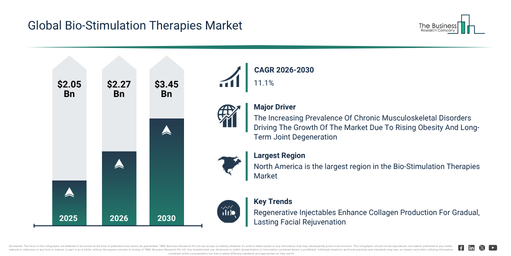
The bio-stimulation therapies market has experienced rapid expansion in recent years. It is anticipated to increase from $2.05 billion in 2025 to $2.27 billion in 2026, demonstrating a compound annual growth rate (CAGR) of 10.8%. The historical growth of this market can be attributed to the rising demand for cosmetic and aesthetic procedures, the expansion of dermatology clinics and med spas, the acceptance of collagen-stimulating injectables, heightened patient awareness concerning non-surgical treatments, and technological innovations in energy-based devices.
The bio-stimulation therapies market is expected to experience significant expansion over the next few years. It is projected to reach $3.45 billion in 2030, exhibiting a compound annual growth rate (CAGR) of 11.1%. The forecasted growth can be linked to factors such as the increasing demand for regenerative medicine therapies, the greater adoption of stem cell and autologous treatments, a rising need for minimally invasive orthopedic interventions, the broadening of wound care applications, and growing investments in advanced biostimulation technologies. Prominent trends within this forecast period include the expanding use of autologous biostimulation therapies, a surging demand for energy-based collagen induction devices, an increasing preference for poly-l-lactic acid and polycaprolactone stimulators, the expansion of minimally invasive aesthetic procedures, and a heightened focus on orthopedic and wound healing applications.
Get A Free Sample Report With In-Depth Market Insights:
Bio-Stimulation Therapies Market Industry Drivers: What’s Behind The Revenue Growth?
A rise in chronic musculoskeletal disorders is projected to propel the expansion of the bio-stimulation therapies market throughout the forecast period. These disorders, referred to as MSKs, involve various conditions impacting muscles, bones, joints, tendons, ligaments, and nerves, frequently leading to persistent pain, swelling, rigidity, and impaired physical capability. Several factors contribute to the increasing incidence of chronic MSKs, such as an aging demographic, inactive routines, job-related stress, and a growing prevalence of obesity. Bio-stimulation therapies aid in managing musculoskeletal disorders by engaging the body’s inherent healing processes, fostering cellular renewal, mitigating inflammation, and expediting tissue recovery in bones, muscles, tendons, and ligaments. For instance, data from the Office for Health Improvement and Disparities, a UK-based government department, revealed that approximately 18.4% of people aged 16 and over in the United Kingdom reported experiencing a long-term musculoskeletal condition in 2023, an increase from 17.6% in 2022. Consequently, the growing occurrence of chronic musculoskeletal disorders is a key impetus for the bio-stimulation therapies market’s growth.
Bio-Stimulation Therapies Market Segments: Where Is Growth Concentrated?
The bio-stimulation therapies market covered in this report is segmented –
1) By Therapy Type: Poly-L-Lactic Acid-Based Collagen Stimulators, Calcium Hydroxylapatite-Based Biostimulators, Polycaprolactone-Based Stimulators, Polymethyl Methacrylate Combined With Collagen Fillers, Energy-Based Collagen Induction, Autologous Biostimulation
2) By Application: Aesthetic And Cosmetic Treatments, Dermatology, Orthopedics And Musculoskeletal Disorders, Wound Healing, Other Applications
3) By End User: Dermatology Clinics, Plastic Surgery Centers, Med Spas And Aesthetic Chains, Hospitals And Ambulatory Centers, Independent Injectors
Subsegments:
1) By Poly-L-Lactic Acid-Based Collagen Stimulators: Injectable Fillers, Micro-Threads, Implants
2) By Calcium Hydroxylapatite-Based Biostimulators: Injectable Microspheres, Bone Fillers, Soft Tissue Volumizers
3) By Polycaprolactone-Based Stimulators: Injectable Fillers, Biodegradable Scaffolds, Collagen Induction Devices
4) By Polymethyl Methacrylate Combined With Collagen Fillers: Injectable Fillers, Permanent Implants, Volume Enhancers
5) By Energy-Based Collagen Induction: Radiofrequency Devices, Ultrasound Devices, Laser Devices
6) By Autologous Biostimulation: Platelet-Rich Plasma Therapy, Stem Cell Therapy, Autologous Tissue Grafts
#Bio-Stimulation Therapies Market Growth Trends: What’s Shaping The Future Outlook?
Key players in the bio-stimulation therapies market are concentrating on developing innovative solutions, such as regenerative biostimulator injectables, to boost natural collagen production, enhance long-term aesthetic outcomes, and facilitate minimally invasive tissue regeneration. Regenerative biostimulator injectables are minimally invasive cosmetic treatments that stimulate the body’s inherent collagen production to gradually restore volume, improve skin structure, and promote durable tissue regeneration. For example, in April 2025, Galderma Group AG, a Switzerland-based dermatology company, unveiled Sculptra, a regenerative biostimulator injectable, in China, targeting its rapidly expanding aesthetics market. The product operates by encouraging the body’s natural collagen creation to replenish facial volume and refine skin texture progressively. Supported by over 25 years of clinical evidence, Sculptra delivers gradual, long-lasting results in contrast to traditional dermal fillers. It offers a minimally invasive choice for facial rejuvenation, providing natural-looking improvements that unfold progressively.
Bio-Stimulation Therapies Market Competitive Landscape: Who Leads The Industry?
Major companies operating in the bio-stimulation therapies market are AbbVie Inc, Boston Scientific Corporation, Galderma S.A., Cynosure Inc., Ipsen S.A., Merz Aesthetics Inc., Lumenis Ltd., InMode Ltd., Alma Lasers, Sinclair Pharma plc, Medytox Inc., Anika Therapeutics Inc., Cutera Inc., Suneva Medical Inc., Candela Corporation, Prollenium Medical Technologies Inc., Teoxane S.A., Bloomage BioTechnology Corporation Limited, EndyMed Medical Ltd., BIOPLUS CO LTD.
View The Full Bio-Stimulation Therapies Market Report:
Bio-Stimulation Therapies Market Geographic Landscape: Which Region Dominates Industry Growth?
North America was the largest region in the bio-stimulation therapies market in 2025. Asia-Pacific is expected to be the fastest-growing region in the forecast period. The regions covered in the bio-stimulation therapies market report are Asia-Pacific, South East Asia, Western Europe, Eastern Europe, North America, South America, Middle East, Africa.
Reach Out To Our Team:
The Business Research Company: https://www.thebusinessresearchcompany.com/
Americas: +1 310-496-7795
Asia: +44 7882 955267 & +91 8897263534
Europe: +44 7882 955267
Email us at: marketing@tbrc.info
Follow us on:
LinkedIn: https://in.linkedin.com/company/the-business-research-company
YouTube: https://www.youtube.com/channel/UC24_fI0rV8cR5DxlCpgmyFQ
Global Market Model: https://www.thebusinessresearchcompany.com/global-market-model
[KClientError] [REQ_ERR: OPERATION_TIMEDOUT] [KTrafficClient] Something is wrong.