
Coronary Physiology Systems Market Size Forecast: How The Industry Is Expected To Grow From 2026 To 2030
Backed by market attractiveness analysis, total addressable market sizing, company benchmarking matrices, interactive Excel dashboards, wider supply chain intelligence, emerging startup coverage, and detailed product-level insights, The Business Research Company’s 2026 market reports are designed to offer research that is more actionable and strategically valuable than ever.
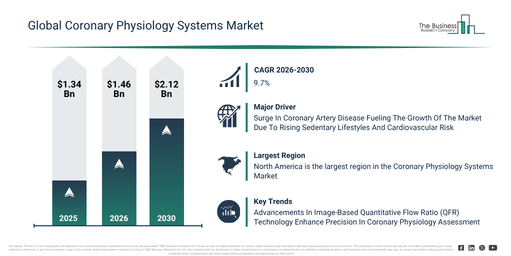
Coronary Physiology Systems Market Growth From $1.46 Billion In 2026 To $2.12 Billion By 2030 At A CAGR Of 9.7%
The coronary physiology systems market size has experienced strong growth in recent years. It is anticipated to increase from $1.34 billion in 2025 to $1.46 billion in 2026, exhibiting a compound annual growth rate (CAGR) of 9.5%. The historical growth of this market can be attributed to the rising incidence of coronary artery disease, the expanding application of invasive diagnostic procedures, the widespread adoption of fractional flow reserve (FFR) measurement, the enlargement of catheterization laboratories in healthcare facilities, and the increasing requirement for precise hemodynamic assessment.
The coronary physiology systems market is anticipated to experience robust expansion over the next few years, with projections indicating it will reach $2.12 billion by 2030, exhibiting a compound annual growth rate (CAGR) of 9.7%. This growth during the forecast period is fueled by the increasing embrace of integrated physiology and imaging platforms, the expanding utilization of wireless and dual sensor guidewires, a surge in demand for non-invasive iFR and CFR measurements, the proliferation of ambulatory surgical centers offering cardiac diagnostics, and the adoption of AI-driven data analysis for coronary physiology. Prominent trends for the forecast period include the rising adoption of wireless pressure guidewires, a growing need for integrated physiology and imaging systems, increased use of flow measurement systems for microvascular assessment, the broadening of non-invasive coronary physiology modalities, and an elevated focus on real-time data management and analysis software.
Get A Free Sample Report With In-Depth Market Insights:
Coronary Physiology Systems Market Growth Catalysts And Demand Drivers
The rising occurrence of coronary artery disease is propelling expansion in the coronary physiology systems market. This condition, coronary artery disease, involves the narrowing or blockage of coronary arteries from plaque accumulation, which in turn diminishes blood flow and oxygen delivery to the heart muscle. Sedentary lifestyles contribute to the growing incidence of coronary artery disease, given that limited physical activity promotes obesity, elevated blood pressure, and compromised cardiovascular well-being, thus escalating the likelihood of plaque formation in the coronary arteries. These coronary physiology systems aid in diagnosing coronary artery disease through offering accurate measurements of blood flow and pressure within the coronary arteries, empowering clinicians to precisely evaluate the extent of arterial obstructions and formulate knowledgeable choices for specific treatments. As an illustration, the Centers for Disease Control and Prevention, a US-based government agency, reported in October 2024 that cardiovascular disease was responsible for 919,032 deaths in 2023, which amounted to approximately one-third of all fatalities. Among these, coronary heart disease remained the predominant type, with about one in six cardiovascular deaths affecting adults under the age of 65. Consequently, the rising occurrence of coronary artery disease is fostering expansion within the coronary physiology systems market.
Coronary Physiology Systems Market Segment Outlook: Which Categories Are Growing Fastest?
The coronary physiology systems market covered in this report is segmented –
1) By Product Type: Pressure Wire Systems, Flow Measurement Systems, Integrated Systems, Other Product Types
2) By Modality: Invasive, Non-Invasive
3) By Application: Fractional Flow Reserve (FFR), Instantaneous Wave-Free Ratio (iFR), Coronary Flow Reserve (CFR), Other Applications
4) By End-User: Hospitals, Ambulatory Surgical Centers, Specialty Clinics, Other End-Users
Subsegments:
1) By Pressure Wire Systems: Wireless Pressure Guidewires, Wired Pressure Guidewires, Dual Sensor Pressure Guidewires, Temperature Sensor Enabled Pressure Guidewires
2) By Flow Measurement Systems: Coronary Flow Reserve Measurement Systems, Doppler Flow Velocity Systems, Thermodilution Based Flow Systems, Microvascular Resistance Measurement Systems
3) By Integrated Systems: Combined Physiology And Imaging Systems, Console Integrated Physiology Platforms, Co-Registration Systems, Multimodality Hemodynamic Monitoring Systems
4) By Other Product Types: Physiology Consoles, Data Management And Analysis Software, Accessories And Disposables, Calibration And Interface Modules
Coronary Physiology Systems Market Trends Shaping Long-Term Demand
Leading companies operating within the coronary physiology systems market are focusing on developing advanced image-based functional assessment solutions. These solutions aim to improve procedural efficiency, reduce reliance on invasive pressure wires, and enhance clinical decision-making during coronary interventions. Image-based functional assessment solutions are sophisticated diagnostic systems that interpret medical imaging data to determine the physiological significance of a condition, allowing functional evaluation without the use of invasive instruments. For instance, in April 2025, Medis Medical Imaging Systems, a Netherlands-based medical imaging software company, launched Medis QFR 3.0 in the United States. This latest image-based functional assessment version enhances workflow automation, delivers improved image processing capabilities, and provides faster, more accurate functional assessment of coronary lesions, thereby supporting interventional cardiologists in optimizing treatment strategies for patients with coronary artery disease.
Coronary Physiology Systems Market Competitive Analysis Of Leading Industry Participants
Major companies operating in the coronary physiology systems market are Abbott Laboratories, Medtronic plc, Siemens Healthineers AG, Koninklijke Philips N.V., GE HealthCare Technologies Inc., Boston Scientific Corporation, Terumo Corporation, Meril Life Sciences Pvt. Ltd., MicroPort Scientific Corporation, HeartFlow Inc., ACIST Medical Systems Inc., Pie Medical Imaging B.V., CathWorks Ltd., Insight Lifetech Co. Ltd., Keya Medical Co. Ltd., Opsens Inc., RADI Medical Systems AB, Medis Medical Imaging Systems B.V., Remedial Life Sciences Pvt. Ltd., Kamal Medtech Pvt. Ltd.
View The Full Coronary Physiology Systems Market Report:
Coronary Physiology Systems Market Geographic Distribution And Regional Opportunities
North America was the largest region in the coronary physiology systems market in 2025. Asia-Pacific is expected to be the fastest-growing region in the forecast period. The regions covered in the coronary physiology systems market report are Asia-Pacific, South East Asia, Western Europe, Eastern Europe, North America, South America, Middle East, Africa.
Reach Out To Our Team:
The Business Research Company: https://www.thebusinessresearchcompany.com/
Americas: +1 310-496-7795
Asia: +44 7882 955267 & +91 8897263534
Europe: +44 7882 955267
Email us at: marketing@tbrc.info
Follow us on:
LinkedIn: https://in.linkedin.com/company/the-business-research-company
YouTube: https://www.youtube.com/channel/UC24_fI0rV8cR5DxlCpgmyFQ
Global Market Model: https://www.thebusinessresearchcompany.com/global-market-model