Month: September 2024

  • High Flow Needle Sets Market Forecast Until 2033 – Estimated Market Size And Growth Rate

    High Flow Needle Sets Market Forecast Until 2033 – Estimated Market Size And Growth Rate

    The Business Research Company’s global market reports provide comprehensive analysis on the various markets in 27 industries across 60 geographies.

    Market Growth Overview

    • Current Size and Growth Rate:
      • The high flow needle sets market was valued at $1.07 billion in 2023.
      • It is projected to grow to $1.16 billion in 2024, reflecting a compound annual growth rate (CAGR) of 9.3%.
      • The growth is driven by advancements in medical procedures, chronic disease prevalence, demographic shifts, and healthcare infrastructure improvements.
    • Future Projections:
      • By 2028, the market is expected to reach $1.67 billion.
      • This represents a CAGR of 9.4% during the forecast period.
      • Key growth factors include medical procedure modernization, increasing minimally invasive surgeries, and expanding global healthcare access.

    View More On The High Flow Needle Sets Market Report 2024 –

    https://www.thebusinessresearchcompany.com/report/high-flow-needle-sets-global-market-report

    Impact of Rising Surgical Procedures

    • Growth Driver:
      • The increasing number of surgical procedures is a significant factor driving market growth.
      • Surgeons perform these procedures to diagnose, treat, or repair tissues and organs, aiming to enhance patient health.
    • Contributing Factors:
      • An aging population, technological advancements, chronic disease prevalence, and improved access to healthcare contribute to the rise in surgeries.
      • High-flow needle sets are crucial for rapid fluid, medication, or blood product administration during surgeries.
    • Example:
      • A report from the Aesthetic Society noted a 54% increase in surgical procedures in 2021, highlighting the growing demand for high-flow needle sets.

    Major Companies in the Market

    • Key Players:
      • Cardinal Health Inc.
      • Thermo Fisher Scientific Inc.
      • Fresenius Medical Care AG & Co. KGaA
      • Becton Dickinson and Company
      • Baxter International Inc.
    • Others:
      • Medline Industries Inc., Terumo Corporation, Nipro Corporation, and more.

    Innovations in High Flow Needle Sets

    • Portable Syringe Infusion Systems:
      • Companies are developing portable systems to enhance patient mobility and ease of use.
      • Example: Koru Medical Systems’ FreedomEdge Syringe Infusion System, approved in October 2021, offers controlled, subcutaneous administration with flexible dosing schedules.
    • Technological Developments:
      • Innovations include advancements in infusion technology and integration with digital health solutions.

    Strategic Acquisitions

    • ICU Medical and Smiths Medical:
      • In January 2022, ICU Medical acquired Smiths Medical, expanding its product line to include high flow intravenous administration sets and needles.
      • This acquisition enhances ICU Medical’s capabilities in infusion therapy and vascular access.

    Market Segmentation

    • By Product Type:
      • 26 Gauge High Flow Needle Sets
      • 24 Gauge High Flow Needle Sets
    • By Volume/Capacity:
      • Less than 10 ml
      • Between 10-100 ml
      • Greater than 100 ml
    • By Material:
      • Stainless Steel
      • Polycarbonate
    • By End Use:
      • Hospitals
      • Ambulatory Surgical Centers
      • Diagnostic Centers
      • Other End-Users

    Regional Insights

    • Current Market Leader:
      • North America was the largest market region in 2023.
    • Future Growth Region:
      • Asia-Pacific is expected to be the fastest-growing region during the forecast period.

    The high flow needle sets market is set for continued robust growth driven by increasing surgical procedures, technological advancements, and strategic industry expansions.

    Request A Sample Of The Global High Flow Needle Sets Market Report 2024:
    https://www.thebusinessresearchcompany.com/sample_request?id=15821&type=smp
  • Key Takeaways From The Global Clinical Trial Equipment And Ancillary Solutions Market Forecast 2024

    Key Takeaways From The Global Clinical Trial Equipment And Ancillary Solutions Market Forecast 2024

    The Business Research Company’s market reports offer an in-depth analysis on the market’s growth potential, major drivers, key trends and more.

    Current Market Dynamics

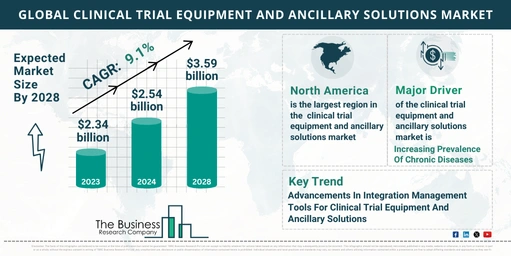
    • Market Size: The market increased from $2.34 billion in 2023 to $2.54 billion in 2024.
    • Growth Rate: This represents a compound annual growth rate (CAGR) of 8.7%.
    • Historical Drivers:
      • Rising prevalence of chronic diseases.
      • Increasing research expenditure.
      • Expansion in the pharmaceutical and medical sectors.
      • Growing emphasis on patient-centric clinical trials.

    Future Market Projections

    • Projected Growth: The market is expected to reach $3.59 billion by 2028.
    • Forecast CAGR: Reflects a CAGR of 9.1%.
    • Future Drivers:
      • Continued rise in chronic diseases.
      • Increasing spending on research.
      • Expansion of the pharmaceutical and medical sectors.
      • Growth in patient-centric clinical trials.

    Read More On The Clinical Trial Equipment And Ancillary Solutions Market Report 2024 –
    https://www.thebusinessresearchcompany.com/report/clinical-trial-equipment-and-ancillary-solutions-global-market-report

    Impact of Chronic Diseases

    • Market Growth: The increasing prevalence of chronic diseases is a significant driver for the clinical trial equipment and ancillary solutions market.
    • Chronic Diseases:
      • Conditions such as cancer, diabetes, and cardiovascular diseases are becoming more prevalent due to lifestyle changes, environmental factors, and genetic predispositions.
      • Clinical trial equipment and ancillary solutions are critical in managing these diseases by enabling early detection, personalized treatment approaches, and improved monitoring and outcomes.
      • Example: In January 2024, the Australian Institute of Health and Welfare reported that chronic kidney disease contributed to approximately 20,000 fatalities in Australia in 2021, representing 12% of the total mortality rate.

    Technological Advancements

    • Integration Platforms: Companies are focusing on developing integration platforms to enhance workflow efficiency across clinical trial systems and technologies.
      • Example: In March 2022, Vibrent Health developed the Ancillary Studies Tool Suite as part of its Digital Health Research Platform, designed to seamlessly integrate digital apps, sensors, and data collection platforms into longitudinal cohort research, optimizing workflow and enhancing collaboration.

    Strategic Acquisitions

    • Thermo Fisher Scientific’s Acquisition of PPD Inc.: In December 2021, Thermo Fisher Scientific acquired PPD Inc. for $17.4 billion to expand its clinical development portfolio.
      • Purpose: The acquisition enables Thermo Fisher to offer a comprehensive suite of services across the clinical development spectrum, from safety assessments to clinical trial logistics and drug development.
      • PPD Inc.: A US-based company specializing in clinical trial equipment and ancillary solutions, enhancing Thermo Fisher’s capabilities in this space.

    Market Segmentation

    • By Type:
      • Diagnostic Equipment
      • Laboratory Instruments
      • Ancillary Solutions
    • By Service:
      • Rental and Leasing Services
      • Supply and Logistics Services
      • Regulatory Compliance Services
      • Software Services
    • By End-User:
      • Pharmaceutical and Biotechnology Companies
      • Contract Research Organizations (CROs)
      • Medical Device Companies
      • Others

    Regional Insights

    • North America: The largest region in the clinical trial equipment and ancillary solutions market in 2023.
    • Asia-Pacific: Expected to be the fastest-growing region during the forecast period.

    The clinical trial equipment and ancillary solutions market is poised for strong growth, driven by the rising prevalence of chronic diseases, increasing research spending, and technological advancements. The market’s expansion is further supported by strategic acquisitions and the development of innovative integration platforms, which are expected to enhance workflow efficiency and collaboration in clinical trials.

    Request for A Sample Of The Global Clinical Trial Equipment And Ancillary Solutions Market Report:
    https://www.thebusinessresearchcompany.com/sample_request?id=15764&type=smp

  • Global Cervical Pillows Market Report 2024 – Top Market Trends And Opportunities

    Global Cervical Pillows Market Report 2024 – Top Market Trends And Opportunities

    The Business Research Company’s market reports offer an in-depth analysis on the market’s growth potential, major drivers, key trends and more.

    The cervical pillows market has experienced significant growth, expanding from $3.96 billion in 2023 to $4.17 billion in 2024, with a compound annual growth rate (CAGR) of 5.4%.

    • Historic Growth Drivers:
      • Increased prevalence of neck and cervical spine disorders.
      • Expansion of e-commerce platforms.
      • Growing interest in alternative bedding options.
      • Increased studies on spinal alignment and neck support.

    Future Market Outlook: Continued Expansion
    The cervical pillows market is projected to reach $5.18 billion by 2028, with a CAGR of 5.6%.

    • Key Factors Driving Future Growth:
      • Growing awareness of the importance of proper neck support for spinal health.
      • Rising demand for supportive pillows due to occupations involving prolonged sitting or repetitive neck movements.
      • Increasing healthcare costs and the convenience of purchasing cervical pillows online.

    Read More On The Cervical Pillows Market Report 2024 –
    https://www.thebusinessresearchcompany.com/report/cervical-pillows-global-market-report

    Rising Cervical and Back Pain Prevalence: A Market Catalyst
    The increasing prevalence of cervical and back pain is a key driver of the cervical pillows market.

    • Impact of Cervical and Back Pain:
      • Common conditions like cervical and back pain can lead to discomfort and sleep disturbances, increasing the demand for cervical pillows.
      • These issues are exacerbated by sedentary lifestyles, increased use of electronic devices, poor posture, and aging populations.
    • Statistical Insights:
      • In 2020, 619 million people globally experienced lower back pain, and this number is expected to rise to 843 million by 2050.
      • The highest growth rates in back pain cases are projected in Asia and Africa.

    Healthcare Expenditure and Market Growth
    Rising healthcare spending is another factor propelling the cervical pillows market.

    • Healthcare Spending Impact:
      • Increased health expenditures, driven by demographic shifts, technological advancements, and the prevalence of chronic diseases, emphasize preventive care.
      • This focus on preventive care leads to greater demand for products like cervical pillows that promote good sleep posture and ergonomics.
    • Economic Impact:
      • In 2022, U.S. healthcare spending increased by 4.1% to $4.5 trillion, accounting for 17.3% of the country’s GDP.

    Technological Advancements in Cervical Pillows
    Innovation plays a crucial role in the cervical pillows market, with companies developing products with unique features to enhance comfort and spinal alignment.

    • Innovative Designs:
      • Products like butterfly-shaped cervical pillows offer multiple benefits tailored to improve sleep quality and address cervical spine issues.
      • For example, Sleepsia launched a cervical pillow in 2021 that features a butterfly shape, providing exceptional support and alignment for the cervical spine.

    Market Segmentation and Regional Insights
    The cervical pillows market is segmented by product type, material type, function, application, and distribution channel.

    • Market Segments:
      • Product Type: Standard Pillow, Rolls, Water-Based Pillow, Other Product Types.
      • Material Type: Foam, Fiber-Filled.
      • Function: Displacement, Support.
      • Application: Cervical Spondylosis, Whiplash Injuries, Temporomandibular Disorders, Other Applications.
      • Distribution Channel: Hospitals, Retail Pharmacies, E-Commerce.
    • Regional Insights:
      • North America was the largest region in the cervical pillows market in 2023.
      • Asia-Pacific is expected to be the fastest-growing region during the forecast period, driven by increasing awareness and demand for cervical health products.

    Request for A Sample Of The Global Cervical Pillows Market Report:
    https://www.thebusinessresearchcompany.com/sample_request?id=15761&type=smp

  • Healthcare Mobile Robots Market Forecast Until 2033 – Estimated Market Size And Growth Rate

    Healthcare Mobile Robots Market Forecast Until 2033 – Estimated Market Size And Growth Rate

    The Business Research Company’s global market reports provide comprehensive analysis on the various markets in 27 industries across 60 geographies.

    Market Growth and Projections

    • Current Market Size:
      • The healthcare mobile robots market was valued at $4.03 billion in 2023.
      • Expected to reach $4.79 billion in 2024, with a compound annual growth rate (CAGR) of 18.9%.
    • Future Outlook:
      • By 2028, the market is projected to grow to $9.68 billion, reflecting a CAGR of 19.2%.
      • Growth driven by integration with electronic health records, customization, user training, environmental sustainability, and an aging population.

    Driving Factors

    • Demand for Automation:
      • Automation in healthcare mobile robots improves efficiency and reduces operational costs.
      • Rising automation demand is due to advancements in technology, need for productivity, and addressing labor shortages.
    • Example:
      • A report from the International Federation of Robotics indicated the deployment of 517,385 new industrial robots in 2022, highlighting the broad acceptance and implementation of automation technologies.

    View More On The Healthcare Mobile Robots Market Report 2024 –
    https://www.thebusinessresearchcompany.com/report/healthcare-mobile-robots-global-market-report

    Major Companies

    • Key Players:
      • Toyota Motor Corporation
      • Panasonic Corporation
      • Medtronic plc
      • GE Healthcare
      • Omron Corporation
    • Others:
      • ABB Ltd., Stryker Corporation, Intuitive Surgical Inc., and more.

    Innovations in Mobile Robots

    • Omnidirectional Driving Capabilities:
      • Companies are developing robots with advanced driving technology to improve efficiency in healthcare settings.
    • Notable Example:
      • In March 2022, Oceaneering International launched several robots, including:
        • UniMover D 100: Designed for light goods, featuring on-demand obstacle avoidance.
        • UniMover O 600: Equipped with omnidirectional capabilities for maneuvering in tight spaces.
        • MaxMover CB D 2000: Replaces conventional forklifts with enhanced load handling and control.

    Strategic Acquisitions

    • Zebra Technologies and Fetch Robotics:
      • In August 2021, Zebra Technologies acquired Fetch Robotics for $305 million.
      • The acquisition aims to enhance Zebra’s capabilities in intelligent automation and supply chain efficiency.
      • Fetch Robotics develops autonomous mobile robots suited for various sectors, including healthcare.

    Market Segmentation

    • By Type:
      • Hospital Robots
      • Care Robots
      • Imaging Assistance
      • Rehabilitation and Mobility
      • Teleoperation and Telepresence Systems
      • Surgical Robots
      • Walking Assisting Robots
      • Other Types
    • By Component:
      • Hardware
      • Software
      • Support and Service
    • By End-User:
      • Hospitals
      • Ambulatory Surgical Centers
      • Rehabilitation Centers
      • Other End-Users

    Regional Insights

    • Current Leader:
      • North America was the dominant region in the healthcare mobile robots market in 2023.
    • Future Growth:
      • The market is expected to continue growing rapidly in North America, with advancements and increasing adoption driving future expansion.

    The healthcare mobile robots market is poised for significant growth, driven by technological advancements, increased automation, and strategic acquisitions. The sector’s expansion reflects broader trends in healthcare efficiency and innovation.

    Request A Sample Of The Global Healthcare Mobile Robots Market Report 2024:
    https://www.thebusinessresearchcompany.com/sample_request?id=15819&type=smp

  • Key Trends And Drivers In The Hair Growth Supplement And Treatment Market 2024

    Key Trends And Drivers In The Hair Growth Supplement And Treatment Market 2024

    The Business Research Company’s global market reports provide comprehensive analysis on the various markets in 27 industries across 60 geographies.

    Market Growth and Projections

    • Current Market Size:
      • The market was valued at $8.19 billion in 2023.
      • Expected to grow to $8.97 billion in 2024, with a compound annual growth rate (CAGR) of 9.5%.
    • Future Outlook:
      • Projected to reach $13.01 billion by 2028, reflecting a CAGR of 9.7%.
      • Growth driven by rising consumer awareness, increasing disposable incomes, technological advancements, and the influence of social media on beauty standards.

    Key Drivers of Growth

    • Thyroid Disorders:
      • The rise in thyroid disorders is propelling market growth.
      • Thyroid imbalances often lead to hair thinning or loss, driving demand for supplements and treatments.
    • Example:
      • In January 2024, Cancer Australia reported an increase in thyroid cancer deaths, with a projected total of 143 deaths in 2022. This underscores the growing need for effective hair loss solutions linked to thyroid conditions.

    View More On The Hair Growth Supplement And Treatment Market Report 2024 –
    https://www.thebusinessresearchcompany.com/report/hair-growth-supplement-and-treatment-global-market-report

    Major Trends in the Market

    • Technological Advancements:
      • Adoption of new technologies and innovative ingredients.
      • Focus on improving delivery systems and enhancing ingredient absorption.
    • Vegan and Plant-Based Products:
      • Rising demand for vegan hair supplements catering to health-conscious consumers.
    • Example:
      • In September 2021, Sulo Nutrition launched vegan gummies enriched with biotin, amla extracts, zinc, and vitamin B12 to support hair health.

    Leading Companies

    • Key Players:
      • Johnson & Johnson Services Inc.
      • Procter & Gamble Company
      • L’Oreal SA
      • Unilever Plc
    • Others:
      • Merck and Co. Inc., Amway Corp., Church & Dwight Co Inc., and more.

    Recent Developments

    • Unilever PLC Acquisition:
      • In May 2022, Unilever PLC acquired a majority stake in Nutrafol, expanding its health and wellness portfolio.
      • Nutrafol is known for its hair growth supplements, adding depth to Unilever’s product offerings.

    Market Segmentation

    • By Type:
      • Supplements
      • Pharmaceuticals
      • Devices
    • By Form:
      • Tablets and Capsules
      • Gummies and Soft Gels
      • Liquids
      • Powders
    • By Distribution Channel:
      • Hypermarkets or Supermarkets
      • Specialty Stores
      • Drugstores and Pharmacies
      • Online Retail
    • By End User:
      • Men
      • Women

    Regional Insights

    • Current Leader:
      • Asia-Pacific was the largest market region in 2023.
    • Future Growth:
      • Europe is expected to be the fastest-growing region in the forecast period.

    The hair growth supplement and treatment market is set for significant growth, driven by increasing awareness, innovative product developments, and rising prevalence of conditions affecting hair health. With ongoing advancements and strategic acquisitions, the market is well-positioned to expand further in the coming years.

    Request A Sample Of The Global Hair Growth Supplement And Treatment Market Report 2024:
    https://www.thebusinessresearchcompany.com/sample_request?id=15815&type=smp

  • Overview Of The Epileptic Seizures Treatment Market 2024: Size, Drivers, And Trends

    Overview Of The Epileptic Seizures Treatment Market 2024: Size, Drivers, And Trends

    The Business Research Company’s global market reports are now updated with the latest market sizing information for the year 2024 and forecasted to 2033

    According to The Business Research Company’s Epileptic Seizures Treatment Global Market Report 2023, the epileptic seizures treatment market is expected to show promising growth in the forecast period.

    Market Growth and Projections

    • Current Market Size:
      • Valued at $3.21 billion in 2023.
      • Expected to reach $3.42 billion in 2024, with a compound annual growth rate (CAGR) of 6.4%.
    • Future Outlook:
      • Projected to grow to $4.43 billion by 2028, reflecting a CAGR of 6.7%.
      • Growth driven by precision medicine, emerging therapies, telemedicine, and regulatory support.

    Key Drivers of Growth

    • Rising Prevalence of Epilepsy:
      • Epilepsy is a neurological disorder characterized by recurrent, unprovoked seizures.
      • The increasing prevalence is linked to higher survival rates from brain injuries and a growing aging population.
    • Example:
      • According to the World Health Organization (February 2024), approximately 50 million people worldwide have epilepsy, with about 5 million new diagnoses each year.

    View More On The Epileptic Seizures Treatment Market Report 2024 –
    https://www.thebusinessresearchcompany.com/report/epileptic-seizures-treatment-global-market-report

    Major Trends in the Market

    • Personalized Medicine:
      • Focus on precision medicine and tailored treatment approaches.
    • Digital Health Integration:
      • Use of digital health solutions and telemedicine for remote monitoring and care.
    • Emerging Therapeutic Modalities:
      • Development of innovative therapies, including cannabis-based drugs.

    Leading Companies

    • Key Players:
      • Pfizer Inc.
      • Johnson & Johnson Service Inc.
      • Sanofi S.A.
      • Novartis AG
      • GlaxoSmithKline plc.
    • Others:
      • Medtronic plc, Teva Pharmaceutical Industries Ltd., UCB S.A., Eisai Co. Ltd., and more.

    Recent Developments

    • Cannabis-Based Drugs:
      • Development of cannabis-based treatments for epilepsy, especially for cases resistant to conventional medications.
    • Example:
      • In January 2024, Akumentis Healthcare Ltd. launched Clasepi, a cannabis-based oral solution for treating severe epilepsy in children, particularly effective in cases where traditional medications have failed.
    • UCB Acquisition:
      • In March 2022, UCB SA acquired Zogenix Inc. for $1.9 billion, enhancing its portfolio with new treatments for severe epilepsy, including Dravet syndrome.

    Market Segmentation

    • By Type:
      • Treatment Practices
      • Emerging Drugs
      • Individual Therapies
    • By Seizure Type:
      • Partial Seizures
      • Generalized Seizures
      • Unclassified Seizures
    • By Route of Administration:
      • Oral or Buccal
      • Nasal
      • Rectal
      • Parenteral
    • By Distribution Channel:
      • Hospital Pharmacies
      • Retail Pharmacies
      • Online Pharmacies

    Regional Insights

    • Current Leader:
      • North America was the largest region in 2023.
    • Future Growth:
      • Asia-Pacific is expected to be the fastest-growing region in the forecast period.

    The epileptic seizures treatment market is evolving with advancements in personalized medicine, innovative therapies, and expanding digital health solutions. The increasing prevalence of epilepsy and ongoing research into new treatment modalities are expected to drive continued growth in the market.

    Request A Sample Of The Global Epileptic Seizures Treatment Market Report 2024:
    https://www.thebusinessresearchcompany.com/sample_request?id=15803&type=smp

  • Understand How The Empty Intravenous (IV) Bags Market Is Poised To Grow Through 2024-2033

    Understand How The Empty Intravenous (IV) Bags Market Is Poised To Grow Through 2024-2033

    The Business Research Company’s global market reports are now updated with the latest market sizing information for the year 2024 and forecasted to 2033

    As per The Business Research Company’s Empty Intravenous (IV) Bags Global Market Report 2023, the empty intravenous (IV) bags market is expected to show significant growth in the forecast period.

    The empty intravenous (IV) bags market has seen significant growth in recent years and is poised for continued expansion. Here’s a comprehensive overview of the market trends, drivers, and projections.

    Market Growth Overview

    • Current Size and Growth: The market grew from $5.63 billion in 2023 to $6.36 billion in 2024, with a compound annual growth rate (CAGR) of 13.0%.
    • Future Projections: Expected to reach $10.41 billion by 2028, at a CAGR of 13.1%. This robust growth reflects increased demand across various healthcare applications.

    Key Drivers of Market Expansion

    • Surgical Procedures: The rising number of surgical procedures is a significant driver. Advances in medical technology, an aging population, and increased healthcare access contribute to the growing need for IV bags during surgeries. In January 2023, the International Society of Aesthetic Plastic Surgery (ISAPS) reported a 19.3% increase in total medical procedures in 2021, highlighting the rising demand for IV bags in surgical settings.
    • Chronic Diseases: The high prevalence of chronic diseases fuels demand for IV bags. Chronic conditions, which are increasing due to aging populations and lifestyle factors, require continuous medical interventions and home infusion therapies. The National Library of Medicine projected that the number of individuals with chronic diseases would rise to 142.66 million by 2050.
    • Home Healthcare Market: The growing home healthcare market is boosting the need for IV bags. As more patients receive treatments at home, there is an increasing demand for IV solutions for personalized medication, nutrition support, and hydration.

     View More On The Empty Intravenous (IV) Bags Market Report 2024 –
    https://www.thebusinessresearchcompany.com/report/empty-intravenous-iv-bags-global-market-report

    Major Trends Shaping the Market

    • Smart IV Bags: Innovations include smart IV bags with sensors to monitor and manage fluid administration, enhancing patient safety and accuracy.
    • Biodegradable IV Bags: There is a growing trend towards eco-friendly and biodegradable IV bags to reduce environmental impact.
    • Improved Sterility: Advances in sterility and contamination prevention are critical for maintaining the safety and effectiveness of IV therapies.
    • Integration with EHR: Integration with electronic health records (EHR) is improving the efficiency of IV therapy management and patient monitoring.

    Strategic Developments

    • Technological Innovations: Companies are focusing on developing advanced IV bag technologies. For instance, in March 2021, Fagron Sterile Services launched a new IV Bag Platform to meet the demand for compounded sterile medications during the COVID-19 pandemic. This platform includes latex-free bags with extended beyond-use dating and various medication presentations.

    Major Companies

    Key players in the empty intravenous (IV) bags market include:

    • Pfizer Inc.
    • Baxter International Inc.
    • Grifols S.A.
    • Medisca Inc.
    • Bioteque Corporation
    • BAUSCH Advanced Technology Group
    • Jorgensen Laboratories LLC
    • Technoflex
    • Sippex IV bags
    • AdvaCare Pharma Limited
    • Tacy Medical Inc.
    • Polycine GmbH

    Market Segmentation

    The empty intravenous (IV) bags market is segmented into:

    • By Product: Polyvinyl Chloride, Non-Polyvinyl Chloride
    • By Type: Single Chamber, Multi-Chamber
    • By Material: Polypropylene, Polyester Ether, Ethylene Vinyl Acetate (EVA), Other Materials
    • By Capacity: 50 ML – 100 ML, 100 ML – 250 ML, 250 ML – 500 ML, Above 500 ML
    • By Application: Hospital, Clinic, Other Applications

    Regional Insights

    • North America: Was the largest region in 2023, driven by high healthcare infrastructure and demand.
    • Asia-Pacific: Expected to be the fastest-growing region due to expanding healthcare services and rising patient populations.

    Conclusion

    The empty intravenous (IV) bags market is experiencing strong growth, driven by increasing surgical procedures, the prevalence of chronic diseases, and the expansion of home healthcare. Innovations in technology and trends towards more sustainable and smart solutions are shaping the future of the market. For detailed insights, consulting comprehensive market reports and analyses is recommended.

    Request A Sample Of The Global Empty Intravenous (IV) Bags Market Report 2024:
    https://www.thebusinessresearchcompany.com/sample_request?id=15800&type=smp

  • Key Trends And Drivers In The Clot Management Devices Market 2024

    Key Trends And Drivers In The Clot Management Devices Market 2024

    The Business Research Company’s market reports offer an in-depth analysis on the market’s growth potential, major drivers, key trends and more.

    Current Market Dynamics

    • Market Size: The clot management devices market increased from $1.63 billion in 2023 to $1.72 billion in 2024.
    • Growth Rate: This represents a compound annual growth rate (CAGR) of 6%.
    • Historical Drivers:
      • Rising aging population.
      • Regulatory approvals and clinical trials.
      • Growing awareness and screening programs.
      • Increasing prevalence of cardiovascular diseases.

    Future Market Projections

    • Projected Growth: The market is expected to grow to $2.19 billion by 2028.
    • Forecast CAGR: Reflects a CAGR of 6.2%.
    • Future Drivers:
      • Rising healthcare expenditure.
      • Enhanced healthcare infrastructure.
      • Favorable regulatory and reimbursement policies.
      • Expansion of telemedicine and remote monitoring.
      • Rising adoption of personalized medicine.

    Read More On The Clot Management Devices Market Report 2024 –
    https://www.thebusinessresearchcompany.com/report/clot-management-devices-global-market-report

    Impact of Hospital Demand

    • Market Growth: The increasing demand for hospitals is propelling the growth of the clot management devices market.
    • Hospital Demand:
      • Factors such as aging populations, urbanization, healthcare access, population growth, and medical tourism contribute to this demand.
      • Clot management devices play a crucial role in treating conditions like deep vein thrombosis, pulmonary embolism, and ischemic strokes, offering effective and minimally invasive solutions.
      • Example: In May 2024, the number of hospitals in the US increased to 6,120 from 5,129 in 2022, according to the American Health Care Association, highlighting the growing need for clot management devices.

    Technological Innovation in Clot Management Devices

    • AI-Enhanced Technologies: Companies are focusing on developing innovative technologies like computer-assisted vacuum thrombectomy (CAVT) systems to enhance clot management.
      • Example: In April 2024, Penumbra Inc. launched Lightning Flash 2.0, a state-of-the-art clot aspiration and vacuum thrombectomy technology integrated with AI for rapid and precise clot removal, significantly improving patient outcomes.

    Strategic Acquisitions in the Market

    • Boston Scientific’s Acquisition of Devoro Medical: In September 2021, Boston Scientific acquired Devoro Medical to strengthen its thrombectomy and clot management solutions.
      • Purpose: This acquisition allows Boston Scientific to expand its portfolio of treatment options for thrombotic disorders, enhancing its position in the market.
      • Devoro Medical: A US-based company specializing in medical devices for treating peripheral veins and arteries with different clot morphologies and vessel diameters.

    Market Segmentation

    • By Product Type:
      • Neurovascular Embolectomy Devices
      • Embolectomy Balloon Catheters
      • Percutaneous Thrombectomy Devices
      • Catheter-Directed Thrombolysis (CDT) Devices
      • Inferior Vena Cava Filters (IVCF)
    • By Percutaneous Thrombectomy Devices Type:
      • Aspiration Thrombectomy Devices
      • Percutaneous Mechanical Thrombectomy Devices
    • By End User:
      • Diagnostic Centers
      • Hospitals

    Regional Insights

    • North America: The largest region in the clot management devices market in 2023.
    • Asia-Pacific: Expected to be the fastest-growing region during the forecast period.

    The clot management devices market is set for continued growth, driven by technological advancements, rising hospital demand, and strategic acquisitions. The market’s expansion is supported by the increasing prevalence of cardiovascular diseases, regulatory approvals, and the growing adoption of minimally invasive treatment options.

    Request for A Sample Of The Global Clot Management Devices Market Report:
    https://www.thebusinessresearchcompany.com/sample_request?id=15768&type=smp

  • Global Closed System Transfer Devices Market Report 2024 – Top Market Trends And Opportunities

    Global Closed System Transfer Devices Market Report 2024 – Top Market Trends And Opportunities

    The Business Research Company’s market reports offer an in-depth analysis on the market’s growth potential, major drivers, key trends and more.

    The closed system transfer devices (CSTDs) market has been expanding swiftly in recent years. It is expected to grow from $0.91 billion in 2023 to $1.04 billion in 2024, with a compound annual growth rate (CAGR) of 14.2%.

    • Key Growth Factors:
      • Increased approvals of oncology drugs.
      • Rising focus on occupational safety in healthcare settings.
      • Growing need to curb needlestick injuries and exposure to hazardous drugs.
      • Increased awareness about the dangers of cytotoxic drug exposure.
      • Expansion in the chemotherapy patient population.

    Future Market Projections: Sustained Expansion

    The CSTDs market is expected to maintain its rapid growth trajectory, reaching $1.78 billion by 2028, with a CAGR of 14.3%.

    • Drivers of Future Growth:
      • Rising cancer incidence globally.
      • Increased need for monitoring compliance in drug management.
      • Growing awareness and implementation of CSTDs for hazardous drug transportation.
      • Escalation in drug approvals, particularly for cancer treatments.

    Read More On The Closed System Transfer Devices  Market Report 2024 https://www.thebusinessresearchcompany.com/report/closed-system-transfer-devices-global-market-report

    Rising Cancer Incidence: A Significant Market Driver

    The increasing incidence of cancer is a crucial factor driving the growth of the CSTDs market.

    • Impact of Cancer:
      • Cancer cases are increasing due to factors such as lifestyle changes, environmental exposures, and infections.
      • CSTDs are vital in cancer treatment, protecting healthcare workers and patients from the risks associated with chemotherapy drugs.
      • Their use ensures a safer healthcare environment and improves treatment outcomes for cancer patients.
    • Statistics Highlight:
      • The global cancer burden is expected to reach 28.4 million cases by 2040, a 47% increase from 2020.
      • In the United States alone, 1,958,310 new cancer cases and 609,820 cancer-related deaths were projected for 2023.

    Innovations in CSTDs: Enhancing Safety and Efficacy

    Innovation is key in advancing the safety and efficacy of CSTDs in drug handling.

    • Next-Generation Devices:
      • Companies are developing advanced CSTDs to meet the evolving needs of healthcare settings.
      • For instance, B. Braun Medical Inc. launched the OnGuard 2 CSTD, which integrates enhanced features for easy operation and compliance with quality standards for handling hazardous drugs.
    • Product Example:
      • The OnGuard 2 CSTD was specifically tested with actual hazardous drugs for vapor containment, positioning it as a leader in CSTD air-cleaning technology.

    Strategic Partnerships: Expanding Market Reach

    Strategic agreements and partnerships are further propelling the CSTDs market.

    • Notable Agreement:
      • In April 2021, Fresenius Kabi entered into an exclusive U.S. distribution agreement with Corvida Medical for the HALO CSTD.
      • The HALO system is designed to prevent environmental contamination and exposure to drug vapors during the handling of hazardous drugs like chemotherapy.

    Market Segmentation and Regional Insights

    The CSTDs market is segmented by type, technology, closing mechanism, and end user.

    • Market Segments:
      • Type: Needleless Systems, Membrane-to-Membrane Systems.
      • Technology: Diaphragm-Based, Compartmentalized, Filtration.
      • Closing Mechanism: Color-to-Color Alignment Systems, Push-to-Turn Systems, Click-to-Lock Systems, Luer-Lock Systems.
      • End User: Hospitals and Clinics, Oncology Centers, Other End Users.
    • Regional Insights:
      • North America was the largest region in the CSTDs market in 2023.
      • Asia-Pacific is expected to be the fastest-growing region during the forecast period, highlighting its increasing significance in global healthcare.

    Request for A Sample Of The Global Closed System Transfer Devices Market Report:
    https://www.thebusinessresearchcompany.com/sample_request?id=15767&type=smp

  • Key Insights On The Clinical Trial Site Management Organizations Market 2024 – Size, Driver, And Major Players

    Key Insights On The Clinical Trial Site Management Organizations Market 2024 – Size, Driver, And Major Players

    The Business Research Company’s market reports offer an in-depth analysis on the market’s growth potential, major drivers, key trends and more.

    The clinical trial site management organizations (SMOs) market has seen significant growth in recent years. It is projected to grow from $6.21 billion in 2023 to $6.71 billion in 2024, with a compound annual growth rate (CAGR) of 8.1%.

    • Key Drivers:
      • Increasing demand for drug discoveries.
      • High prevalence of chronic diseases.
      • Growing number of clinical trials for novel drugs and therapies.
      • Expansion of pharmaceutical industries.

    Future Outlook: Continued Expansion and Innovation

    The market is expected to continue its strong growth, reaching $9.23 billion in 2028, with a CAGR of 8.3%.

    • Growth Factors:
      • Rising drug development processes.
      • Increasing complexities in clinical trial phases.
      • Growing preference for outsourcing clinical trials to Contract Research Organizations (CROs).

    Read More On The Clinical Trial Site Management Organizations Market Report 2024 –

    https://www.thebusinessresearchcompany.com/report/clinical-trial-site-management-organizations-global-market-report

    Trends Shaping the Future of Clinical Trial Site Management

    Several major trends are expected to shape the clinical trial SMO market in the coming years.

    • Key Trends:
      • Adoption of decentralized and virtual trials.
      • Focus on therapeutic areas like oncology and cardiology.
      • Consolidation and partnerships among key players.
      • Technological advancements in trial management.
      • Global expansion into emerging markets.
      • Emphasis on patient-centricity in trials.

    Rising Demand for Drug Discoveries: A Key Market Driver

    The rising demand for drug discoveries is a primary driver of market growth.

    • Drug Discovery Overview:
      • Focus on identifying and developing new medications.
      • Driven by unmet medical needs, emerging pathogens, and drug resistance.
      • Aging populations also contribute to increased demand for pharmaceutical research.
    • Impact on SMOs:
      • Optimizes coordination and oversight of clinical trials.
      • Ensures compliance, effective data collection, and patient recruitment.

    AI Integration: Revolutionizing Clinical Trial Site Management

    AI integration is transforming how SMOs operate, particularly in virtual trials.

    • AI in Trials:
      • Enhances recruitment and engagement processes.
      • Streamlines data collection and accelerates trial timelines.
      • Improves patient outreach and participation.
    • Industry Example:
      • In October 2023, Elligo Health Research introduced myTrialsConnect, an AI-driven platform for clinical trial recruitment and engagement.

    Strategic Acquisitions: Novotech’s Expansion

    Strategic acquisitions are another factor driving market growth.

    • Notable Acquisition:
      • In January 2023, Novotech acquired EastHoRN Clinical Services.
      • This acquisition expands Novotech’s global reach, offering comprehensive CRO services across Europe, the US, and Asia-Pacific.

    Market Segmentation and Regional Insights

    The clinical trial SMO market is segmented by services, phases, and therapeutic areas.

    • Service Segments:
      • Site Management, Project Management, Regulatory, Onsite Monitoring.
    • Phases:
      • Phase I, Phase II, Phase III, Phase IV.
    • Therapeutic Areas:
      • Oncology, Cardiology, CNS, Pain Management, Endocrine, Others.
    • Regional Insights:
      • Asia-Pacific was the largest region in the market in 2023, highlighting the region’s growing importance in global clinical trials.

    Request for A Sample Of The Global Clinical Trial Site Management Organizations Market Report:

    https://www.thebusinessresearchcompany.com/sample_request?id=15766&type=smp