Month: March 2026

  • Global Point Of Care Hematology Diagnostics Market Set for Strong Expansion Reaching $4.39 Billion by 2030 at 8.6% CAGR

    Global Point Of Care Hematology Diagnostics Market Set for Strong Expansion Reaching $4.39 Billion by 2030 at 8.6% CAGR

    The Business Research Company’s 2026 market reports include new capabilities such as market attractiveness scoring and analysis, total addressable market analysis, company scoring matrix, interactive excel data dashboard, improved supply chain analysis, upcoming startups in the market, and overview of key products, aimed at improving the depth, usability, and strategic value of the insights delivered.

    How Large Is The Point Of Care Hematology Diagnostics Market Projected To Become By 2030 Based On Its 2026 Valuation?

    The market size for point of care hematology diagnostics has demonstrated robust growth in recent years. Forecasts indicate it will expand from $2.9 billion in 2025 to $3.16 billion in 2026, at a compound annual growth rate (CAGR) of 9.0%. The expansion observed in the historic period is attributable to several factors, including a reliance on centralized laboratory testing, the escalating burden of anemia and blood disorders, an uptick in hospital emergency admissions, the imperative for faster diagnostic turnaround, and restricted access to laboratory infrastructure in rural areas.

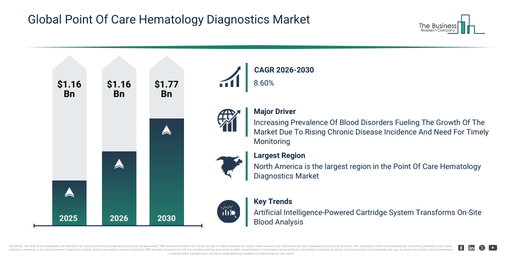
    The point of care hematology diagnostics market size is projected for substantial expansion in the coming years, with expectations to reach $4.39 billion in 2030, exhibiting a compound annual growth rate (CAGR) of 8.6%. This anticipated growth is driven by factors such as the increasing prevalence of chronic and infectious diseases, the expansion of point of care testing initiatives, a heightened need for rapid diagnostic solutions in emergency medical situations, ongoing technological progress in compact hematology analyzers, and the development of decentralized healthcare delivery systems. Key trends influencing the market during this period involve the growing adoption of quick bedside blood testing, a rising demand for decentralized diagnostics, particularly in urgent care environments, the increasing utilization of portable and handheld hematology devices, the spread of point of care testing into areas with limited resources, and an emphasis on achieving faster turnaround times for critical clinical decisions.

    Download the Free Sample Report to Explore Key Market Insights:

    https://www.thebusinessresearchcompany.com/sample.aspx?id=27388&type=smp

    What Drivers Are Shaping The Future Growth Of The Point Of Care Hematology Diagnostics Market?

    The growing prevalence of blood conditions is anticipated to propel the expansion of the point-of-care hematology diagnostics market moving forward. Blood disorders are defined as ailments that affect the components of blood, including red blood cells, white blood cells, platelets, or plasma. The increasing incidence of these disorders primarily results from the rising occurrence of chronic diseases, which directly impact blood health and require continuous monitoring. Point-of-care hematology diagnostics assist in the timely identification and tracking of blood disorders by providing rapid, accurate results at or near the patient’s care site, thus enabling quicker clinical decisions and improved disease management. For instance, in November 2024, The American Society of Hematology, a US-based Non-profit organization, projected that global leukemia cases could increase to approximately 519,540 by 2050. Therefore, the escalating incidence of blood disorders is driving the growth of the point-of-care hematology diagnostics market.

    What Segment Groups Are Identified Within The Point Of Care Hematology Diagnostics Market?

    The point of care hematology diagnostics market covered in this report is segmented –

    1) By Type: Complete Blood Count, Coagulation Testing, Hemoglobin Testing, Anemia Diagnosis, Other Types

    2) By Mode Of Prescription: Prescription Based Product, Over-The-Counter Based Product

    3) By End User: Diagnostic Centers, Hospitals, Blood Banks, Transfusion Centers, Other End Users

    Subsegments:

    1) By Complete Blood Count: White Blood Cell Count, Red Blood Cell Count, Platelet Count, Hematocrit, Hemoglobin Concentration, Mean Corpuscular Volume (MCV)

    2) By Coagulation Testing: Prothrombin Time (PT), Activated Partial Thromboplastin Time (aPTT), International Normalized Ratio (INR), D-Dimer Test, Fibrinogen Level

    3) By Hemoglobin Testing: Total Hemoglobin, Glycated Hemoglobin (HbA1c), Oxyhemoglobin, Carboxyhemoglobin, Methemoglobin

    4) By Anemia Diagnosis: Iron Studies, Vitamin B12 Levels, Folate Levels, Reticulocyte Count, Ferritin Test, Transferrin Saturation

    5) By Other Types: Blood Typing And Crossmatching, Erythrocyte Sedimentation Rate, Malaria Parasite Detection, Sickle Cell Screening, C-Reactive Protein Testing

    What Trends Are Advancing Progress In The Point Of Care Hematology Diagnostics Market?

    Companies operating significantly within the point-of-care hematology diagnostics market are concentrating on developing advanced products, such as cartridge-based AI-powered hematology analyzers. Their goal is to provide swift, precise, and on-site blood analysis to enhance patient care. These cartridge-based AI-powered hematology analyzers are compact diagnostic instruments that employ single-use reagent cartridges and artificial intelligence algorithms to quickly and accurately analyze blood samples directly at the point of care. For example, in September 2024, Zoetis Inc., a US-based veterinary health company, introduced Vetscan OptiCell, a cartridge-based, AI-powered hematology analyzer developed for veterinary applications. This innovative system delivers rapid, reference laboratory-quality complete blood count (CBC) results in mere minutes at the point of care, while also decreasing maintenance and hands-on time. It incorporates advanced AI-driven image analysis and viscoelastic focusing technology to precisely align cells for clear imaging, thereby enabling accurate blood cell classification and automated abnormality detection, which ensures efficient and reliable veterinary diagnostics.

    Which Companies Hold Significant Positions In The Point Of Care Hematology Diagnostics Market?

    Major companies operating in the point of care hematology diagnostics market are F. Hoffmann-La Roche Ltd., Abbott Laboratories, Danaher Corporation, Siemens Healthineers AG, Shenzhen Mindray Bio-Medical Electronics Co. Ltd., Sysmex Corporation, HORIBA Ltd., Nova Biomedical Corp., S.D. Sight Diagnostics Ltd., EKF Diagnostics Holdings plc., BioMedomics Inc., PixCell Medical Technologies Ltd., Boule Diagnostics AB, Nihon Kohden Corporation, Edan Instruments Inc., A Menarini Industrie Farmaceutiche Srl, Becton Dickinson and Company, Ortho Clinical Diagnostics, Khema Diagnostics, Bio-Rad Laboratories Inc.

    Read the full point of care hematology diagnostics market report here:

    https://www.thebusinessresearchcompany.com/report/point-of-care-hematology-diagnostics-global-market-report

    Which Geographic Regions Are Influencing Demand In The Point Of Care Hematology Diagnostics Market?

    North America was the largest region in the point of care hematology market in 2025. Asia-Pacific is expected to be the fastest-growing region in the forecast period. The regions covered in the point of care hematology diagnostics market report are Asia-Pacific, South East Asia, Western Europe, Eastern Europe, North America, South America, Middle East, Africa.

    Request A Tailored Point Of Care Hematology Diagnostics Market Research Report For Competitive Advantage:

    https://www.thebusinessresearchcompany.com/customise?id=27388&type=smp

    Browse Through More Reports Similar to the Global Point Of Care Hematology Diagnostics Market 2026, By The Business Research Company

    Architectural And Structural Metals Market Report 2026

    https://www.thebusinessresearchcompany.com/report/architectural-and-structural-metals-global-market-report

    Architectural And Structural Metals Market Report 2026

    https://www.thebusinessresearchcompany.com/report/architectural-and-structural-metals-global-market-report

    Buildings Construction Market Report 2026

    https://www.thebusinessresearchcompany.com/report/buildings-construction-global-market-report

    Get in touch with us:

    The Business Research Company: https://www.thebusinessresearchcompany.com/

    Americas +1 310-496-7795

    Asia +44 7882 955267 & +91 8897263534

    Europe +44 7882 955267

    Email us at info@tbrc.info

    Follow us on:

    LinkedIn: https://in.linkedin.com/company/the-business-research-company

    YouTube: https://www.youtube.com/channel/UC24_fI0rV8cR5DxlCpgmyFQ

    Global Market Model: https://www.thebusinessresearchcompany.com/global-market-model
  • Point Of Care Devices Market Growth Expected to Reach $48.88 Billion by 2030 with 9.1% CAGR

    Point Of Care Devices Market Growth Expected to Reach $48.88 Billion by 2030 with 9.1% CAGR

    The Business Research Company’s 2026 market reports include new capabilities such as market attractiveness scoring and analysis, total addressable market analysis, company scoring matrix, interactive excel data dashboard, improved supply chain analysis, upcoming startups in the market, and overview of key products, aimed at improving the depth, usability, and strategic value of the insights delivered.

    What Market Value Is Anticipated For The Point Of Care Devices Market Over The Period 2026–2030?

    The point of care devices market has demonstrated significant growth in recent years. It is anticipated to expand from $31.46 billion in 2025 to $34.44 billion in 2026, exhibiting a compound annual growth rate (CAGR) of 9.5%. This historical growth can be linked to factors such as limited access to centralized laboratories, the increasing prevalence of chronic diseases, the demand for quicker clinical decision-making, the development of primary healthcare facilities, and a growing need for bedside diagnostics.

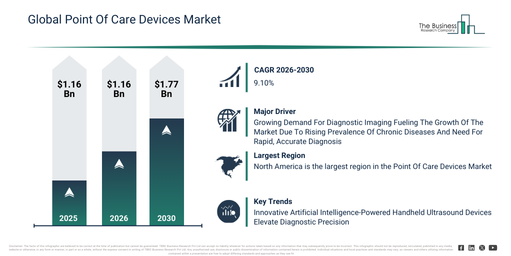
    The point of care devices market is projected to experience substantial expansion in the coming years, reaching a size of $48.88 billion in 2030, demonstrating a compound annual growth rate (CAGR) of 9.1%. This anticipated growth during the forecast period is fueled by several factors, including breakthroughs in microfluidics and biosensors, the expanding use of wearable and remote monitoring solutions, the rise of home healthcare environments, growing requirements for infectious disease surveillance, and the incorporation of digital health platforms. Key developments expected in this timeframe encompass the greater uptake of rapid diagnostic testing at healthcare facilities, a surging demand for home-use and self-testing equipment, the ongoing miniaturization of diagnostic and monitoring instruments, an increasing emphasis on decentralized healthcare provision, and the broadening application of point of care testing within emergency and critical care contexts.

    Download the Free Sample Report to Explore Key Market Insights:

    https://www.thebusinessresearchcompany.com/sample.aspx?id=27387&type=smp

    Which Economic Or Industry Drivers Are Impacting The Point Of Care Devices Market?

    An increasing need for diagnostic imaging is anticipated to drive the expansion of the point-of-care devices market in the future. Diagnostic imaging involves methods and procedures that generate visual depictions of a body’s internal structures for purposes of clinical analysis and medical treatment. This escalating demand for diagnostic imaging stems from the growing occurrence of chronic illnesses that necessitate prompt and precise diagnosis. Point-of-care devices improve diagnostic imaging capabilities through their compact and portable designs, rendering them highly suitable for use in clinics, at the patient’s bedside, and in remote healthcare environments. These devices shorten the processing time by delivering swift and precise imaging outcomes, thereby enhancing clinical decision-making and the efficiency of patient care. As an illustration, in November 2024, data from the National Health Service, a UK-based government agency, indicated that 47.2 million imaging tests were reported in England in the year leading up to March 2024, representing an increase of 4.8% from the 45.0 million recorded in the preceding year. Consequently, the escalating requirement for diagnostic imaging is fueling the expansion of the point-of-care devices market.

    How Is The Point Of Care Devices Market Divided Into Its Major Segments?

    The point of care devices market covered in this report is segmented –

    1) By Type Of Device: Diagnostic Devices, Therapeutic Devices, Monitoring Devices, Treatment Devices, Support Devices

    2) By Technology: Biochemical Technology, Microfluidics, Immunoassay Technology, Nucleic Acid Testing, Wearable Technology

    3) By Application: Cardiology, Diabetes Management, Infectious Diseases, Oncology, Pediatrics

    4) By Distribution Channel: Direct Sales, Distributors, Online Sales, Retail Pharmacies, Healthcare Institutions

    5) By End User: Hospitals, Clinics, Home Care Settings, Diagnostic Laboratories, Emergency Medical Services (EMS)

    Subsegments:

    1) By Diagnostic Devices: Blood Glucose Monitors, Hematology Analyzers, Coagulation Analyzers, Urinalysis Devices, Molecular Diagnostics

    2) By Therapeutic Devices: Infusion Pumps, Respiratory Therapy Devices, Pain Management Devices, Wound Care Devices, Dialysis Devices

    3) By Monitoring Devices: Vital Signs Monitors, Cardiac Monitors, Pulse Oximeters, Temperature Monitors, Respiratory Monitors

    4) By Treatment Devices: Defibrillators, Surgical Devices, Laser Therapy Devices, Physical Therapy Devices

    5) By Support Devices: Sample Collection Devices, Specimen Transport Devices, Data Management Devices, Calibration And Maintenance Devices

    How Are Trends Transforming The Point Of Care Devices Market Landscape?

    Leading companies within the point-of-care devices market are focusing on developing technologically advanced solutions, such as artificial intelligence-enhanced handheld ultrasound systems, to improve diagnostic accuracy and portability. These artificial intelligence-enhanced handheld ultrasound systems are portable imaging devices that employ AI algorithms to assist in capturing and interpreting ultrasound images for faster and more accurate diagnoses. For instance, in October 2023, Koninklijke Philips N.V., a Netherlands-based healthcare technology company, launched the Compact 5000 Series, an AI-enhanced point-of-care ultrasound system. This portable device delivers superior image quality paired with advanced AI-driven automation for measurements and streamlined workflows, enabling fast and accurate diagnostics across various healthcare settings. It features user-friendly controls, supports multiple transducers, and integrates smoothly with telemedicine platforms to facilitate collaborative remote clinical care.

    Who Are The Prominent Organizations Shaping The Point Of Care Devices Market?

    Major companies operating in the point of care devices market are Johnson & Johnson, F. Hoffmann-La Roche AG, Thermo Fisher Scientific Inc., Abbott Laboratories, Danaher Corporation, Siemens Healthineers AG, Becton Dickinson and Company, Hologic Inc., BioMérieux SA, Quidel Corporation, OraSure Technologies Inc., Nova Biomedical Corporation, Sekisui Diagnostics LLC, Abaxis Inc., EKF Diagnostics Holdings plc, Trinity Biotech plc, Chembio Diagnostics Inc., PTS Diagnostics LLC, MeMed, Alere Inc., Diagnostics For All Inc.

    Read the full point of care devices market report here:

    https://www.thebusinessresearchcompany.com/report/point-of-care-devices-global-market-report

    What Are The Top-Performing Regions Within The Point Of Care Devices Market?

    North America was the largest region in the point of care devices market in 2025. Asia-Pacific is expected to be the fastest-growing region in the forecast period. The regions covered in the point of care devices market report are Asia-Pacific, South East Asia, Western Europe, Eastern Europe, North America, South America, Middle East, Africa.

    Request A Tailored Point Of Care Devices Market Research Report For Competitive Advantage:

    https://www.thebusinessresearchcompany.com/customise?id=27387&type=smp

    Browse Through More Reports Similar to the Global Point Of Care Devices Market 2026, By The Business Research Company

    Artificial Intelligence Ai In Asset Management Market Report 2026

    https://www.thebusinessresearchcompany.com/report/artificial-intelligence-ai-in-asset-management-global-market-report

    Artificial Intelligence Ai In Retail Market Report 2026

    https://www.thebusinessresearchcompany.com/report/artificial-intelligence-ai-in-retail-global-market-report

    Ai In Fintech Market Report 2026

    https://www.thebusinessresearchcompany.com/report/ai-in-fintech-global-market-report

    Get in touch with us:

    The Business Research Company: https://www.thebusinessresearchcompany.com/

    Americas +1 310-496-7795

    Asia +44 7882 955267 & +91 8897263534

    Europe +44 7882 955267

    Email us at info@tbrc.info

    Follow us on:

    LinkedIn: https://in.linkedin.com/company/the-business-research-company

    YouTube: https://www.youtube.com/channel/UC24_fI0rV8cR5DxlCpgmyFQ

    Global Market Model: https://www.thebusinessresearchcompany.com/global-market-model
  • Poc Hba1C Testing Market Forecast 2026–2035 Reflecting Expansion Opportunities Across Industries

    Poc Hba1C Testing Market Forecast 2026–2035 Reflecting Expansion Opportunities Across Industries

    The Business Research Company’s 2026 market reports include new capabilities such as market attractiveness scoring and analysis, total addressable market analysis, company scoring matrix, interactive excel data dashboard, improved supply chain analysis, upcoming startups in the market, and overview of key products, aimed at improving the depth, usability, and strategic value of the insights delivered.

    What Is The Expected Market Size Of The Poc Hba1C Testing Market From 2026 To 2030?

    The poc hba1c testing market size has seen rapid growth over recent years. It is anticipated to expand from $1.02 billion in 2025 to $1.14 billion in 2026, demonstrating a compound annual growth rate (CAGR) of 11.9%. This historical growth is attributable to factors such as the increasing global prevalence of diabetes, greater clinical reliance on long-term glucose monitoring, the expansion of outpatient diagnostic services, heightened awareness regarding early diabetes diagnosis, and the availability of compact diagnostic instruments.

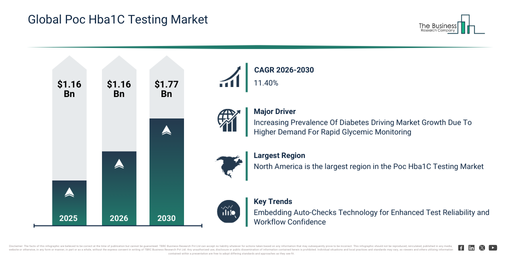
    The poc hba1c testing market size is anticipated to experience substantial expansion in the coming years. By 2030, this market is projected to reach $1.76 billion, exhibiting a compound annual growth rate (CAGR) of 11.4%. This projected expansion is driven by factors such as the greater embrace of decentralized diagnostics, a surging need for home care testing options, the broadening of digital diabetes management initiatives, a heightened emphasis on preventive healthcare, and increased funding for rapid diagnostic innovations. Key developments anticipated during this timeframe involve the wider integration of rapid point-of-care hba1c devices, an increase in the utilization of portable and handheld testing systems, a heightened desire for at-home diabetes monitoring, the broadening of integrated poc diagnostic platforms, and a strengthened commitment to test precision and consistency.

    Download the Free Sample Report to Explore Key Market Insights:

    https://www.thebusinessresearchcompany.com/sample.aspx?id=6833&type=smp

    What Major Drivers Are Influencing Demand In The Poc Hba1C Testing Market?

    The escalating occurrence of diabetes is propelling the expansion of the point-of-care (POC) HbA1C testing market. Diabetes, a chronic metabolic condition, is characterized by elevated blood glucose levels, which require ongoing monitoring to prevent severe complications such as neuropathy, cardiovascular disease, and renal impairment. This global increase in diabetes cases is primarily fueled by factors including sedentary lifestyles, unhealthy dietary patterns, obesity, and an aging population. The rising prevalence of diabetes consequently bolsters the POC HbA1C testing market by amplifying the demand for rapid, convenient, and accurate assessments of glycemic control in various settings like clinics, pharmacies, and home-care, thereby enabling prompt treatment decisions. For instance, in 2025, according to the International Diabetes Federation, a Belgium-based health organization, in 2024, approximately 589 million adults aged 20-79 were living with diabetes, with the total number projected to reach 853 million by 2050, and more than 4 in 5 adults with diabetes residing in low and middle income countries. Therefore, the expanding prevalence of diabetes is significantly driving the growth of the POC hba1c testing market.

    Which Segments Are Included In The Analysis Of The Poc Hba1C Testing Market?

    The poc hba1c testing market covered in this report is segmented –

    1) By Type of Product: Instruments, Consumables

    2) By Technology: Ion-Exchange HPLC, Enzymatic Assay, Affinity Binding Chromatography, Immunoassay, Other Technologies

    3) By End User: Hospitals, Physician Office Or Outpatient Center, Home Care, Other End Users

    Subsegments:

    1) By Instruments: Handheld HbA1c Testing Devices, Portable HbA1c Analyzers, Desktop HbA1c Testing Systems, Integrated Point Of Care Testing Systems

    2) By Consumables: Test Strips, Control Solutions, Reagents, Calibration Solutions, Sample Collection Devices

    Which Trends Are Impacting The Growth Of The Poc Hba1C Testing Market?

    Leading companies in the point-of-care (POC) HbA1c testing market are increasingly incorporating integrated internal verification systems to guarantee test accuracy, minimize error potential, and build confidence in near-patient diagnostics. These self-monitoring features consistently check environmental factors, sample quality, and assay performance during each test to prevent incorrect outcomes or sample wastage. For instance, in July 2024, Siemens Healthineers, a Germany-based company specializing in medical technology, unveiled its next-generation point-of-care Atellica DCA Analyser. The Atellica DCA Analyzer utilizes its unique Auto-Checks Technology, which performs a series of internal calibrations and validations throughout the testing process, including environmental calibration, airflow and thermal verification, sample volume and integrity checks, optical clarity, and precision evaluations. This automated self-supervision ensures that every HbA1c result, delivered in just 4–5 minutes, meets lab-equivalent quality standards, while also lessening the need for constant operator oversight. By embedding these automatic checks, the Atellica DCA helps to reduce pre-analytical errors, boost result reliability, and facilitate the expansion of point of care (POC) testing in environments with limited laboratory facilities.

    Which Key Industry Participants Are Active In The Poc Hba1C Testing Market?

    Major companies operating in the poc hba1c testing market are F. Hoffmann-La Roche Ltd, Siemens Healthineers AG, Bio-Rad Laboratories Inc, Menarini Group, Danaher Corporation, Tosoh Bioscience Inc, ARKRAY Inc, i-SENS Inc, Abbott Laboratories, Trinity Biotech plc, Aina Blood Monitoring System, Getein Biotech Inc, Sugentech Inc, Alere Inc, EKF Diagnostics, HemoCue, PTS Diagnostics, Osang Healthcare, Ortho Clinical Diagnostics, Ascensia, Platinum Equity (LifeScan), Becton Dickinson and Company, Kainico Ltd, Evia Medical Technologies, Agamatrix Inc, Bionime Corporation

    Read the full poc hba1c testing market report here:

    https://www.thebusinessresearchcompany.com/report/poc-hba1c-testing-global-market-report

    Which Region Shows The Strongest Potential For Future Growth In The Poc Hba1C Testing Market?

    North America was the largest region in the POC HbA1C testing market in 2025. Africa is expected to be the fastest-growing region in the forecast- period. The regions covered in the poc hba1c testing market report are Asia-Pacific, South East Asia, Western Europe, Eastern Europe, North America, South America, Middle East, Africa.

    Request A Tailored Poc Hba1C Testing Market Research Report For Competitive Advantage:

    https://www.thebusinessresearchcompany.com/customise?id=6833&type=smp

    Browse Through More Reports Similar to the Global Poc Hba1C Testing Market 2026, By The Business Research Company

    Hemoglobin A1C Hba1C Testing Market Report 2026

    https://www.thebusinessresearchcompany.com/report/hemoglobin-a1c-hba1c-testing-global-market-report

    Poc Cholesterol Test Market 2026

    https://www.thebusinessresearchcompany.com/report/poc-cholesterol-test-market

    Hemoglobin A1C Testing Devices Market Report 2026

    https://www.thebusinessresearchcompany.com/report/hemoglobin-a1c-testing-devices-global-market-report

    Get in touch with us:

    The Business Research Company: https://www.thebusinessresearchcompany.com/

    Americas +1 310-496-7795

    Asia +44 7882 955267 & +91 8897263534

    Europe +44 7882 955267

    Email us at info@tbrc.info

    Follow us on:

    LinkedIn: https://in.linkedin.com/company/the-business-research-company

    YouTube: https://www.youtube.com/channel/UC24_fI0rV8cR5DxlCpgmyFQ

    Global Market Model: https://www.thebusinessresearchcompany.com/global-market-model
  • Global Pneumothorax Treatment Devices Market Analysis for 2026–2030 with Strategic Forecast Insights for Businesses

    Global Pneumothorax Treatment Devices Market Analysis for 2026–2030 with Strategic Forecast Insights for Businesses

    The Business Research Company’s 2026 market reports include new capabilities such as market attractiveness scoring and analysis, total addressable market analysis, company scoring matrix, interactive excel data dashboard, improved supply chain analysis, upcoming startups in the market, and overview of key products, aimed at improving the depth, usability, and strategic value of the insights delivered.

    What Market Valuation Is Forecasted For The Pneumothorax Treatment Devices Market By 2030 Starting From Its 2026 Size?

    The pneumothorax treatment devices market has experienced significant growth in recent times. This market is projected to expand from $3.98 billion in 2025 to $4.39 billion by 2026, demonstrating a compound annual growth rate (CAGR) of 10.3%. Factors contributing to its historical growth include an increase in traumatic chest injuries, more road accident cases, improvements in hospital emergency infrastructure, the adoption of chest tube procedures, and the expansion of critical care units.

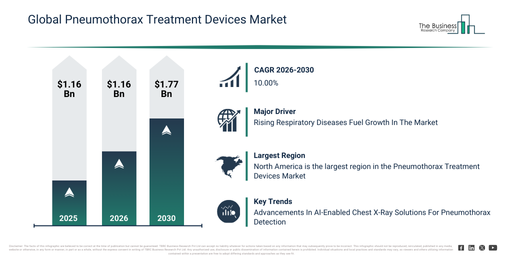
    The pneumothorax treatment devices market is anticipated to undergo significant expansion over the next few years. It will grow to $6.43 billion in 2030 at a compound annual growth rate (CAGR) of 10.0%. This projected growth can be attributed to several factors such as the rise in portable emergency devices, advancements in thoracic vent systems, increased intensive care unit admissions, the necessity for more rapid lung re-expansion, and the broadening reach of emergency medical services. Prominent trends expected during this forecast period include the swift decompression of lungs in emergencies, the development of portable devices for pneumothorax management, the adoption of minimally invasive chest drainage, enhancements in air leak control systems, and the simplification of bedside treatment kits.

    Download the Free Sample Report to Explore Key Market Insights:

    https://www.thebusinessresearchcompany.com/sample.aspx?id=20929&type=smp

    Which Market Drivers Are Supporting The Expansion Of The Pneumothorax Treatment Devices Market?

    The growing prevalence of respiratory ailments is projected to boost the pneumothorax treatment devices market. Respiratory diseases are health conditions that affect the lungs and airways, thereby impairing breathing and the exchange of oxygen. Increases in respiratory diseases can be linked to factors such as air pollution, smoking, viral infections, and heightened exposure to allergens. Pneumothorax treatment devices find application in these conditions to manage collapsed lungs and restore normal respiratory function. For instance, in September 2025, according to the Australian Bureau of Statistics, an Australia-based government agency, deaths involving influenza increased from 611 deaths in 2023 to 806 deaths in 2024 and further to 1,057 deaths in the year to August 2025, representing a 73% increase from 2023 to the comparable August 2025 period. Deaths involving respiratory syncytial virus (RSV) rose from 380 deaths in 2023 to 468 deaths in 2024 and 399 deaths in the year to August 2025. Therefore, the increasing number of respiratory diseases drives the growth of the pneumothorax treatment devices market.

    Which Segment Categories Define The Pneumothorax Treatment Devices Market?

    The pneumothorax treatment devices market covered in this report is segmented –

    1) By Type: Ventilator Devices, Thoracic Vent Devices, Other Types

    2) By Application: Traumatic Pneumothorax, Spontaneous Pneumothorax, Other Applications

    3) By End-User: Hospitals, Ambulatory Surgical Centers, Other End Users

    Subsegments:

    1) By Ventilator Devices: Portable Ventilators, Non-Invasive Ventilators, Invasive Ventilators

    2) By Thoracic Vent Devices: Chest Drainage Systems, Heimlich Valves, One-Way Chest Valve Systems

    3) By Other Types: Needle Aspiration Devices, Pleural Catheters, Oxygen Therapy Devices

    What Major Market Trends Are Driving Changes In The Pneumothorax Treatment Devices Market?

    Major companies active in the pneumothorax treatment devices market are prioritizing the development of technologically advanced offerings, like chest X-ray solutions, to maintain their competitive edge. Chest X-ray solutions refer to various imaging systems, equipment, and associated technologies designed to capture detailed radiographic images of the chest area, encompassing the lungs, heart, ribs, and surrounding anatomical structures. As an illustration, in September 2023, Qure.ai, a US-based health tech enterprise, announced that it secured 510(k) FDA clearance for its novel chest X-ray solution, qXR-PTX-PE. This particular solution is crafted to assist in the prompt detection of pneumothorax (PTX) and pleural effusion (PE). The AI-powered software enhances patient care pathways in intensive care units (ICUs) and emergency rooms (ERs) by providing timely notifications to healthcare providers. The qXR-PTX-PE solution analyzes chest X-ray images for crucial findings, significantly boosting triage efficiency in emergency situations, where these conditions pose substantial risks to patient health.

    Who Are The Top Companies Competing In The Pneumothorax Treatment Devices Market?

    Major companies operating in the pneumothorax treatment devices market are Cardinal Health Inc., Medtronic PLC, Siemens Healthineers AG, Medline Industries Inc., Fujifilm Holdings Corporation, Becton Dickinson and Company (BD), GE HealthCare Technologies Inc., Stryker Corporation, Boston Scientific Corporation, Draegerwerk AG & Co. KGaA, Cook Medical Inc., B. Braun Melsungen AG, Utah Medical Products Inc., Rocket Medical plc, Nobelpharma Co. Ltd., Sinapi Biomedical Inc., UreSil Inc., ATMOS MedizinTechnik GmbH & Co. KG, Betaglue Technologies S.p.A., Selio Medical Inc.

    Read the full pneumothorax treatment devices market report here:

    https://www.thebusinessresearchcompany.com/report/pneumothorax-treatment-devices-global-market-report

    How Is The Pneumothorax Treatment Devices Market Distributed Across Key Geographic Regions?

    North America was the largest region in the pneumothorax treatment devices market in 2025. The regions covered in the pneumothorax treatment devices market report are Asia-Pacific, South East Asia, Western Europe, Eastern Europe, North America, South America, Middle East, Africa.

    Request A Tailored Pneumothorax Treatment Devices Market Research Report For Competitive Advantage:

    https://www.thebusinessresearchcompany.com/customise?id=20929&type=smp

    Browse Through More Reports Similar to the Global Pneumothorax Treatment Devices Market 2026, By The Business Research Company

    Pneumococcal Vaccine Market Report 2026

    https://www.thebusinessresearchcompany.com/report/pneumococcal-vaccine-global-market-report

    Respiratory Devices And Equipment Therapeutic Market Report 2026

    https://www.thebusinessresearchcompany.com/report/respiratory-devices-and-equipment-therapeutic-global-market-report

    Respiratory Devices And Equipment Therapeutic And Diagnostic Market Report 2026

    https://www.thebusinessresearchcompany.com/report/respiratory-devices-and-equipment-therapeutic-and-diagnostic-global-market-report

    Get in touch with us:

    The Business Research Company: https://www.thebusinessresearchcompany.com/

    Americas +1 310-496-7795

    Asia +44 7882 955267 & +91 8897263534

    Europe +44 7882 955267

    Email us at info@tbrc.info

    Follow us on:

    LinkedIn: https://in.linkedin.com/company/the-business-research-company

    YouTube: https://www.youtube.com/channel/UC24_fI0rV8cR5DxlCpgmyFQ

    Global Market Model: https://www.thebusinessresearchcompany.com/global-market-model
  • Platelet Aggregation Devices Market Outlook 2026–2035 Driven by Key Growth Factors and Industry Projections

    Platelet Aggregation Devices Market Outlook 2026–2035 Driven by Key Growth Factors and Industry Projections

    The Business Research Company’s 2026 market reports include new capabilities such as market attractiveness scoring and analysis, total addressable market analysis, company scoring matrix, interactive excel data dashboard, improved supply chain analysis, upcoming startups in the market, and overview of key products, aimed at improving the depth, usability, and strategic value of the insights delivered.

    How Is The Market Size Of The Platelet Aggregation Devices Market Expected To Change Between 2026 And 2030?

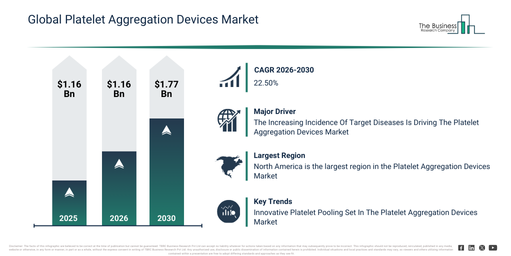
    The market for platelet aggregation devices has shown significant expansion in recent years. This sector is projected to increase from $1.04 billion in 2025 to $1.31 billion in 2026, achieving a compound annual growth rate (CAGR) of 25.4%. Historically, this growth can be ascribed to several factors, including growth in cardiovascular disease prevalence, expansion of clinical diagnostic laboratories, increasing use of antiplatelet therapies, rising demand for coagulation testing, and advancements in hematology diagnostics.

    The platelet aggregation devices market size is anticipated to experience substantial expansion over the next few years. It is projected to achieve a value of $2.94 billion in 2030, demonstrating a compound annual growth rate (CAGR) of 22.5%. This growth throughout the forecast period stems from the increasing adoption of personalized medicine, greater investments in advanced diagnostics, a rising requirement for rapid platelet function testing, an increase in research concerning blood disorders, and ongoing innovations in diagnostic technologies. Significant trends during the forecast period include the expanding use of automated platelet function analyzers, a growing need for high-throughput testing systems, increasing integration of digital data management, the proliferation of multi-channel aggregation devices, and an intensified focus on diagnostic accuracy.

    Download the Free Sample Report to Explore Key Market Insights:

    https://www.thebusinessresearchcompany.com/sample.aspx?id=15896&type=smp

    What Underlying Factors Are Accelerating The Growth Of The Platelet Aggregation Devices Market?

    The rising occurrence of target diseases is projected to propel the platelet aggregation devices market forward. Target diseases are specific health conditions, such as cancer, cardiovascular diseases, and diabetes, which receive focused prevention, diagnosis, and treatment efforts due to their substantial public health impact. Platelet aggregation devices contribute to reducing the incidence of these target diseases by enabling early detection and effective management of thrombotic risks, thereby preventing complications like heart attacks and strokes among susceptible populations. For example, in February 2024, data released by the International Agency for Research on Cancer (IARC), a France-based specialized cancer agency of the World Health Organization (WHO), revealed that the world experienced approximately 20 million new cancer cases and 9.7 million deaths in 2022. Projections indicate a 77% increase to over 35 million new cases by 2050. Lung cancer was the most common globally with 2.5 million new cases (12.4%), followed by female breast cancer (2.3 million cases, 11.6%), colorectal cancer (1.9 million cases, 9.6%), prostate cancer (1.5 million, 7.3%), and stomach cancer (970,000, 4.9%). Therefore, the increasing prevalence of target diseases is driving the expansion of the platelet aggregation devices market.

    How Is The Platelet Aggregation Devices Market Structured Across Different Segments?

    The platelet aggregation devices market covered in this report is segmented –

    1) By Product: Reagents, Systems, Consumables And Accessories

    2) By Channel Configuration: Four Channel, Dual Channel, Eight Channel

    3) By Technology: Optical, Impedance, Other Technologies

    4) By Application: Clinical Applications, Research Applications, Cardiovascular Applications, Other Applications

    5) By End-User: Standalone Hospitals, Diagnostic Laboratories, Research And Academic Institutes, Other End Users

    Subsegments:

    1) By Reagents: Platelet Aggregation Assay Reagents, Coagulation And Anticoagulation Reagents

    2) By Systems: Platelet Aggregation Testing Systems, Automated Platelet Aggregation Systems

    3) By Consumables And Accessories: Sample Collection Kits, Testing Plates And Cuvettes, Calibration Kits

    Which Trends Are Shaping The Future Of The Platelet Aggregation Devices Market?

    Leading companies within the platelet aggregation devices market are intensifying their efforts to develop advanced solutions, notably by introducing innovative products such as the inaugural platelet pooling set, designed to help stabilize the U.S. platelet supply and meet increasing requirements. A platelet pooling set is a specialized medical instrument utilized in plateletpheresis procedures to gather and concentrate platelets from multiple donors into a single unit for transfusion therapy. For example, in February 2023, Terumo BCT Inc., a US-based company specializing in blood components and cellular technology, announced the approval of its IMUGARD WB Platelet Pooling Set by the Food and Drug Administration (FDA), a US-based federal agency. This innovation offers an extended shelf life for platelets, with FDA clearance for seven-day storage, and enables the recovery of platelets from whole blood donations, thereby enhancing flexibility and availability in the platelet aggregation devices market. This product launch signifies a considerable technological advancement by addressing the demand for improved platelet availability, more efficient supply management, and supporting the strained U.S. platelet supply to fulfill increasing needs in critical medical procedures like chemotherapy and organ transplants.

    Which Major Players Dominate The Platelet Aggregation Devices Market?

    Major companies operating in the platelet aggregation devices market are Roche Holding AG, Cytiva (Danaher Corp.), Siemens Healthineers, Sysmex Corporation, WerfenLife S.A., Haemonetics Corporation, Helena Laboratories Corporation, Sarstedt AG And Co. KG, Sekisui Diagnostics LLC, Diagnostica Stago, Accriva Diagnostics Holdings Inc., Sentinel CH. SpA, ADInstruments, Chrono-Log Corporation, Bio/Data Corporation, Haemochrom Diagnostica GmbH, AggreDyne Inc., Hart Biologicals Ltd., Stago, Instrumentation Laboratory

    Read the full platelet aggregation devices market report here:

    https://www.thebusinessresearchcompany.com/report/platelet-aggregation-devices-global-market-report

    Which Region Is Projected To Dominate The Platelet Aggregation Devices Market During The Forecast Period?

    North America was the largest region in the platelet aggregation devices market in 2025. Asia-Pacific is expected to be the fastest-growing region in the forecast period. The regions covered in the platelet aggregation devices market report are Asia-Pacific, South East Asia, Western Europe, Eastern Europe, North America, South America, Middle East, Africa.

    Request A Tailored Platelet Aggregation Devices Market Research Report For Competitive Advantage:

    https://www.thebusinessresearchcompany.com/customise?id=15896&type=smp

    Browse Through More Reports Similar to the Global Platelet Aggregation Devices Market 2026, By The Business Research Company

    Platelet Rich Plasma Market Report 2026

    https://www.thebusinessresearchcompany.com/report/platelet-rich-plasma-global-market-report

    Platelet Shaker Market Report 2026

    https://www.thebusinessresearchcompany.com/report/platelet-shaker-global-market-report

    Thrombectomy Devices Market Report 2026

    https://www.thebusinessresearchcompany.com/report/thrombectomy-devices-global-market-report

    Get in touch with us:

    The Business Research Company: https://www.thebusinessresearchcompany.com/

    Americas +1 310-496-7795

    Asia +44 7882 955267 & +91 8897263534

    Europe +44 7882 955267

    Email us at info@tbrc.info

    Follow us on:

    LinkedIn: https://in.linkedin.com/company/the-business-research-company

    YouTube: https://www.youtube.com/channel/UC24_fI0rV8cR5DxlCpgmyFQ

    Global Market Model: https://www.thebusinessresearchcompany.com/global-market-model
  • Plastic Surgery Instruments Market Developments and Growth Opportunities Across 2026–2030

    Plastic Surgery Instruments Market Developments and Growth Opportunities Across 2026–2030

    The Business Research Company’s 2026 market reports include new capabilities such as market attractiveness scoring and analysis, total addressable market analysis, company scoring matrix, interactive excel data dashboard, improved supply chain analysis, upcoming startups in the market, and overview of key products, aimed at improving the depth, usability, and strategic value of the insights delivered.

    What Is The Market Size Of The Plastic Surgery Instruments Market In 2026 And What Value Is Projected For 2030?

    The plastic surgery instruments market has experienced substantial expansion in recent years. This market is projected to expand from $1.19 billion in 2025 to $1.28 billion in 2026, demonstrating a compound annual growth rate (CAGR) of 7.5%. Historically, this growth has been driven by several factors, including an increase in cosmetic and reconstructive surgical procedures, the proliferation of specialized surgical clinics, a rising desire for aesthetic improvements, a greater availability of skilled plastic surgeons, and ongoing innovations in surgical instrument production.

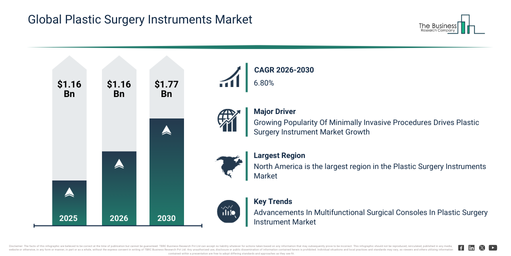
    The plastic surgery instruments market size is anticipated to undergo significant expansion in the upcoming years. It is projected to reach $1.66 billion by 2030, demonstrating a compound annual growth rate (CAGR) of 6.8%. This growth during the forecast period is primarily driven by an increase in medical tourism activities, the rising acceptance of minimally invasive procedures, a heightened focus on patient safety and outcomes, the growth of outpatient surgical centers, and continuous innovation in cosmetic surgery technologies. Major developments expected in the forecast period include an escalating demand for minimally invasive surgical instruments, the increasing adoption of disposable surgical tools, a growing utilization of precision-engineered instruments, the expansion of advanced non-surgical cosmetic devices, and an enhanced emphasis on sterilization and safety standards.

    Download the Free Sample Report to Explore Key Market Insights:

    https://www.thebusinessresearchcompany.com/sample.aspx?id=17231&type=smp

    Which Growth Drivers Are Contributing To The Progress Of The Plastic Surgery Instruments Market?

    The anticipated expansion of the plastic surgery instrument market is significantly influenced by the increasing adoption of minimally invasive procedures. These procedures involve medical interventions carried out via small incisions, leading to reduced tissue trauma and quicker patient recuperation in contrast to conventional surgical methods. Their increasing appeal stems from benefits like condensed recovery timelines, diminished complication risks, enhanced safety protocols, and the amplified impact of social media on aesthetic preferences. Within minimally invasive procedures, plastic surgery instruments are crucial, facilitating precise manipulation and contributing to shorter patient recovery periods through the use of small incisions and focused techniques. An illustrative example is Intuitive Surgical Inc., a US-based robotic product manufacturer, which reported approximately 415 da Vinci surgical systems (robotic systems employing a minimally invasive surgical approach) in the fourth quarter of 2023 as of January 2024, marking a 12% rise over the 2022 figures. Consequently, the expanding preference for minimally invasive procedures is a key driver for the growth of the plastic surgery instrument market.

    What Are The Key Segments Of The Plastic Surgery Instruments Market?

    The plastic surgery instruments market covered in this report is segmented –

    1) By Surgical Instruments: Scalpels, Forceps, Scissors, Retractors, Needle Holders, Other Surgical Instruments

    2) By Non-Surgical Instruments: Dermabrasion Instruments, Laser Devices, Cryotherapy Devices, Electrosurgical Instruments, Other Non-Surgical Instruments

    3) By Accessories: Needles, Sutures, Disposables, Cannulas, Other Accessories

    Subsegments:

    1) By Scalpels: Disposable Scalpels, Reusable Scalpels, Safety Scalpels

    2) By Forceps: Grasping Forceps, Hemostatic Forceps, Dressing Forceps, Surgical Forceps

    3) By Scissors: Dissecting Scissors, Tissue Scissors, Iris Scissors, Bandage Scissors

    4) By Retractors: Handheld Retractors, Self-Retaining Retractors, Bone Retractors

    5) By Needle Holders: Fine Needle Holders, Heavy-Duty Needle Holders, Cross-Lock Needle Holders

    6) By Other Surgical Instruments: Surgical Sponges, Suction Instruments, Surgical Drills, Electrosurgical Instruments

    What Key Trends Are Influencing The Development Of The Plastic Surgery Instruments Market?

    Prominent companies within the plastic surgery instrument market are concentrating on creating advanced products, including multifunctional surgical consoles, to achieve a competitive edge. A multifunctional surgical console brings together various surgical tools and technologies into one unit, boosting the efficiency and accuracy of cosmetic procedures. For instance, in January 2023, Apyx Medical Corporation, a U.S.-based energy technology company, introduced the Apyx One Console, a multifunctional generator specifically for cosmetic surgical procedures. This innovative product integrates different energy modalities, allowing surgeons to conduct diverse procedures with a single device, thereby streamlining operations and improving patient outcomes. Such developments address the rising demand for minimally invasive surgeries and the necessity for enhanced surgical precision. The overall shift towards multifunctional and advanced instruments is propelling market growth, notwithstanding difficulties like high costs and regulatory obstacles.

    Who Are The Leading Companies Operating In The Plastic Surgery Instruments Market?

    Major companies operating in the plastic surgery instruments market are B. Braun Melsungen AG, Zimmer Biomet Holdings Inc., Integra LifeSciences Corporation, KLS Martin Group, Surgicon Pvt. Ltd., Mentor Worldwide LLC, Sklar Surgical Instruments, Tekno-Medical Optik-Chirurgie GmbH, Hayden Medical Inc., Millennium Surgical Corp., Blink Medical Ltd., Bolton Surgical Ltd., Anthony Products Inc., Surgipro Inc., Surtex Instruments Ltd., MSI Precision Instruments, ECA Medical Instruments, Novo Surgical Inc., Marina Medical Instruments Inc., Ekal Surgical Works, Wexler Surgical

    Read the full plastic surgery instruments market report here:

    https://www.thebusinessresearchcompany.com/report/plastic-surgery-instruments-global-market-report

    What Are The Leading Geographic Regions In The Plastic Surgery Instruments Market?

    North America was the largest region in the plastic surgery instruments market in 2025. Asia-Pacific is expected to be the fastest-growing region in the forecast period. The regions covered in the plastic surgery instruments market report are Asia-Pacific, South East Asia, Western Europe, Eastern Europe, North America, South America, Middle East, Africa.

    Request A Tailored Plastic Surgery Instruments Market Research Report For Competitive Advantage:

    https://www.thebusinessresearchcompany.com/customise?id=17231&type=smp

    Browse Through More Reports Similar to the Global Plastic Surgery Instruments Market 2026, By The Business Research Company

    Medical Plastics Market Report 2026

    https://www.thebusinessresearchcompany.com/report/medical-plastics-global-market-report

    Open Surgery Instruments Market Report 2026

    https://www.thebusinessresearchcompany.com/report/open-surgery-instruments-global-market-report

    High Performance Medical Plastics Market Report 2026

    https://www.thebusinessresearchcompany.com/report/high-performance-medical-plastics-global-market-report

    Get in touch with us:

    The Business Research Company: https://www.thebusinessresearchcompany.com/

    Americas +1 310-496-7795

    Asia +44 7882 955267 & +91 8897263534

    Europe +44 7882 955267

    Email us at info@tbrc.info

    Follow us on:

    LinkedIn: https://in.linkedin.com/company/the-business-research-company

    YouTube: https://www.youtube.com/channel/UC24_fI0rV8cR5DxlCpgmyFQ

    Global Market Model: https://www.thebusinessresearchcompany.com/global-market-model
  • Global Plasmonic Laser Ablation Device Market Forecast 2026–2035 Presenting Long-Term Industry Expansion Insights

    Global Plasmonic Laser Ablation Device Market Forecast 2026–2035 Presenting Long-Term Industry Expansion Insights

    The Business Research Company’s 2026 market reports include new capabilities such as market attractiveness scoring and analysis, total addressable market analysis, company scoring matrix, interactive excel data dashboard, improved supply chain analysis, upcoming startups in the market, and overview of key products, aimed at improving the depth, usability, and strategic value of the insights delivered.

    What Will Be The Estimated Market Valuation Of The Plasmonic Laser Ablation Device Market By The End Of 2030?

    The plasmonic laser ablation device market has experienced substantial growth recently. It is anticipated to expand from $1.5 billion in 2025 to $1.65 billion in 2026, achieving a compound annual growth rate (CAGR) of 10.4%. The factors contributing to its historical growth include the initial advancements in laser ablation technologies, a growing application of lasers in medical procedures, increased nanotechnology research across academic and industrial fields, a need for high-precision manufacturing tools, and the integration of conventional YAG and CO2 laser systems.

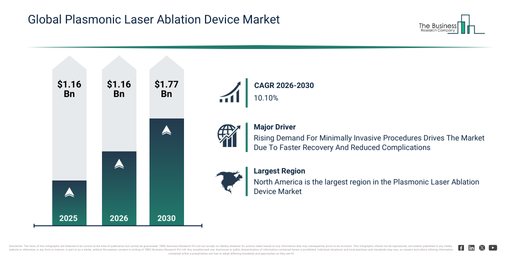
    The plasmonic laser ablation device market size is anticipated to undergo significant expansion over the next few years. It is projected to achieve a value of $2.43 billion in 2030, demonstrating a compound annual growth rate (CAGR) of 10.1%. The expected growth during this period is largely due to innovations in plasmonic and nanoparticle-mediated technologies, increasing investment in precision medicine and nanomedicine, the broader application of industrial microfabrication, the rising adoption of ultrafast laser systems, and the integration of AI-enabled process optimization. Prominent trends observed for the forecast duration include the growing embrace of nanoscale precision material removal, the increasing utilization of femtosecond and ultrafast laser systems, a heightened demand for minimally invasive medical procedures, the expansion of plasmonic applications in advanced material processing, and an increased focus on achieving accuracy while reducing thermal damage.

    Download the Free Sample Report to Explore Key Market Insights:

    https://www.thebusinessresearchcompany.com/sample.aspx?id=27386&type=smp

    What Primary Drivers Are Shaping The Development Of The Plasmonic Laser Ablation Device Market?

    The expanding requirement for minimally invasive procedures is anticipated to propel the future growth of the plasmonic laser ablation device market. These procedures are medical methods conducted through small cuts or natural bodily openings, employing specialized instruments to diminish pain, scarring, and time needed for recovery. The rise in minimally invasive procedures is due to their quicker recovery periods, enabling patients to resume regular activities sooner with fewer issues. Plasmonic laser ablation devices are employed in these procedures for highly accurate and focused tissue removal, leading to minimal heat damage to nearby areas. This method reduces the size of incisions and speeds up healing. For instance, in June 2024, the American Society of Plastic Surgeons, a US-based professional society, reported that approximately 25.4 million minimally invasive procedures were carried out in 2023, representing a 7% increase from 2022. Consequently, the rising demand for minimally invasive procedures is stimulating the expansion of the plasmonic laser ablation device market. The increasing outlay on healthcare is expected to stimulate the expansion of the plasmonic laser ablation device market moving forward. Healthcare expenditure encompasses the overall financial investment by individuals, governments, and organizations in medical services, treatments, and health-related assets. This expenditure is escalating due to an aging demographic, as older individuals often require more frequent and expensive medical attention for enduring conditions and illnesses linked to age. Greater healthcare spending facilitates the advancement and adoption of sophisticated technologies, such as plasmonic laser ablation devices, by allocating funds for research, acquisition, and incorporation into clinical practice. For example, in April 2025, the American Medical Association, a professional association located in the US, stated that health spending in the U.S. increased by 7.5% in 2023, reaching $4.9 trillion, or $14,570 per person, which signifies a notable rise compared to the 4.6% growth recorded in 2022. Therefore, the growing healthcare expenditures are propelling the growth of the plasmonic laser ablation device market.

    Which Segment Classifications Shape The Plasmonic Laser Ablation Device Market?

    The plasmonic laser ablation device market covered in this report is segmented –

    1) By Device Type: Pulsed Plasmonic Laser Ablation Devices, Continuous Wave Plasmonic Laser Ablation Devices, Femtosecond Plasmonic Laser Ablation Devices, Nanosecond Plasmonic Laser Ablation Devices

    2) By Technology: Surface Plasmon Resonance (SPR) Technology, Nanoparticle Mediated Laser Ablation

    3) By Application: Medical Applications, Material Processing, Research And Development

    4) By End-User: Hospitals And Medical Clinics, Research Institutes And Universities, Manufacturing Or Semiconductor Industries, Other End-Users

    Subsegments:

    1) By Pulsed Plasmonic Laser Ablation Devices: Q-Switched Pulsed Plasmonic Laser Ablation Devices, Mode-Locked Pulsed Plasmonic Laser Ablation Devices, Tunable Pulsed Plasmonic Laser Ablation Devices, High-Power Pulsed Plasmonic Laser Ablation Devices

    2) By Continuous Wave Plasmonic Laser Ablation Devices: Low-Power Continuous Wave Plasmonic Laser Ablation Devices, High-Power Continuous Wave Plasmonic Laser Ablation Devices, Fiber-Based Continuous Wave Plasmonic Laser Ablation Devices, Diode-Based Continuous Wave Plasmonic Laser Ablation Devices

    3) By Femtosecond Plasmonic Laser Ablation Devices: Ti:Sapphire Femtosecond Plasmonic Laser Ablation Devices, Yb-Doped Femtosecond Plasmonic Laser Ablation Devices, Fiber Femtosecond Plasmonic Laser Ablation Devices, Compact Femtosecond Plasmonic Laser Ablation Devices

    4) By Nanosecond Plasmonic Laser Ablation Devices: Solid-State Nanosecond Plasmonic Laser Ablation Devices, Fiber Nanosecond Plasmonic Laser Ablation Devices, Diode-Pumped Nanosecond Plasmonic Laser Ablation Devices, Q-Switched Nanosecond Plasmonic Laser Ablation Devices

    How Are Trends Impacting The Plasmonic Laser Ablation Device Market?

    Which Companies Are Expanding Their Footprint In The Plasmonic Laser Ablation Device Market?

    Major companies operating in the plasmonic laser ablation device market are Mitsubishi Electric Corporation, Boston Scientific Corporation, Trumpf Group, Coherent Corp., Han’s Laser Technology Industry Group Co. Ltd., Lumentum Holdings Inc., Thorlabs Inc., Edmund Optics Inc, Jenoptik AG, Universal Laser Systems Inc., Cincinnati Incorporated, Epilog Laser, RPMC Lasers, Dongguan Mactron Technology Co. Ltd., Aesthetic World, Astanza Laser LLC, Boss Laser LLc, Quantum Composers, Laser Photonics Corporation, Medioxra LLP

    Read the full plasmonic laser ablation device market report here:

    https://www.thebusinessresearchcompany.com/report/plasmonic-laser-ablation-device-global-market-report

    How Does The Plasmonic Laser Ablation Device Market Perform Across Major Global Regions?

    North America was the largest region in the plasmonic laser ablation device market in 2025. Asia-Pacific is expected to be the fastest-growing region in the forecast period. The regions covered in the plasmonic laser ablation device market report are Asia-Pacific, South East Asia, Western Europe, Eastern Europe, North America, South America, Middle East, Africa.

    Request A Tailored Plasmonic Laser Ablation Device Market Research Report For Competitive Advantage:

    https://www.thebusinessresearchcompany.com/customise?id=27386&type=smp

    Browse Through More Reports Similar to the Global Plasmonic Laser Ablation Device Market 2026, By The Business Research Company

    Precast Construction Market Report 2026

    https://www.thebusinessresearchcompany.com/report/precast-construction-global-market-report

    Ready Mix Concrete Market Report 2026

    https://www.thebusinessresearchcompany.com/report/ready-mix-concrete-global-market-report

    Insulated Concrete Form Market Report 2026

    https://www.thebusinessresearchcompany.com/report/insulated-concrete-form-global-market-report

    Get in touch with us:

    The Business Research Company: https://www.thebusinessresearchcompany.com/

    Americas +1 310-496-7795

    Asia +44 7882 955267 & +91 8897263534

    Europe +44 7882 955267

    Email us at info@tbrc.info

    Follow us on:

    LinkedIn: https://in.linkedin.com/company/the-business-research-company

    YouTube: https://www.youtube.com/channel/UC24_fI0rV8cR5DxlCpgmyFQ

    Global Market Model: https://www.thebusinessresearchcompany.com/global-market-model
  • Plaque Modification Devices Market Outlook 2026–2030 Exploring New Business Opportunities

    Plaque Modification Devices Market Outlook 2026–2030 Exploring New Business Opportunities

    The Business Research Company’s 2026 market reports include new capabilities such as market attractiveness scoring and analysis, total addressable market analysis, company scoring matrix, interactive excel data dashboard, improved supply chain analysis, upcoming startups in the market, and overview of key products, aimed at improving the depth, usability, and strategic value of the insights delivered.

    What Market Size Growth Is Projected For The Plaque Modification Devices Market During The Forecast Period 2026–2030?

    The plaque modification devices market size has demonstrated significant expansion in recent years. It is projected to increase from $1.49 billion in 2025 to $1.62 billion in 2026, exhibiting a compound annual growth rate (CAGR) of 8.5%. The expansion witnessed in the historic period can be linked to the rising prevalence of atherosclerosis, an increase in angioplasty procedures, an aging global population, the growth in peripheral artery disease, and advancements within interventional cardiology.

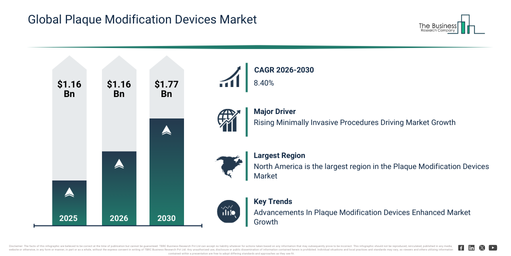
    The plaque modification devices market is anticipated to experience substantial expansion over the coming years. Its value is projected to reach $2.23 billion by 2030, exhibiting a compound annual growth rate (CAGR) of 8.4%. This growth during the forecast period is fueled by factors such as AI-guided vascular imaging, an increase in complex vascular interventions, the need for safer procedures, a rise in outpatient interventions, and breakthroughs in plaque removal devices. Noteworthy trends for the same period encompass minimally invasive plaque removal techniques, precision atherectomy technologies, enhanced embolic protection, sophisticated catheter-based systems, and devices designed to reduce procedure time.

    Download the Free Sample Report to Explore Key Market Insights:

    https://www.thebusinessresearchcompany.com/sample.aspx?id=20928&type=smp

    Which Major Factors Are Driving The Expansion Of The Plaque Modification Devices Market?

    The expansion of the plaque modification devices market is anticipated to be propelled by an increasing volume of minimally invasive procedures moving forward. These procedures are defined as medical or surgical methods characterized by smaller cuts, less tissue damage, and diminished physical impact in contrast to conventional open operations. The growth in minimally invasive procedures stems from technological progress, such as high-definition imaging and robotic systems, which enhance accuracy, along with greater patient desire for quicker recuperation and less scarring. Plaque modification devices improve the safety and effectiveness of minimally invasive procedures by allowing for accurate removal of arterial obstructions and broadening treatment options for individuals with intricate vascular issues. As an example, in January 2024, Intuitive Surgical Inc., a US-based producer of robotic goods, announced the deployment of 415 da Vinci surgical systems (robotic surgical systems that use a minimally invasive surgical approach) during the fourth quarter of 2023, marking a 12% rise over 2022. Consequently, the increasing volume of minimally invasive procedures is fueling the expansion of the plaque modification devices market.

    What Market Segments Are Evaluated Within The Plaque Modification Devices Market?

    The plaque modification devices market covered in this report is segmented –

    1) By Type: Atherectomy Devices, Thrombectomy Devices, Chronic Total Occlusion Devices, Embolic Protection Devices

    2) By Application: Coronary Artery Disease, Peripheral Artery Disease, Neurovascular Diseases

    3) By End User: Hospitals, Ambulatory Surgical Centers, Other End Users

    Subsegments:

    1) By Atherectomy Devices: Rotational Atherectomy Devices, Directional Atherectomy Devices, Laser Atherectomy Devices, Orbital Atherectomy Devices

    2) By Thrombectomy Devices: Mechanical Thrombectomy Devices, Aspiration Thrombectomy Devices, Manual Thrombectomy Devices, Hybrid Thrombectomy Devices

    3) By Chronic Total Occlusion (CTO) Devices: CTO Crossing Guidewires, CTO Balloons, CTO Catheters, CTO Support Systems

    4) By Embolic Protection Devices: Distal Protection Devices, Proximal Protection Devices, Filter-Based Embolic Protection Devices, Balloon-Based Embolic Protection Devices

    What Industry Trends Are Redefining The Plaque Modification Devices Market?

    Major companies operating in the plaque modification devices market are focusing on developing advanced solutions, such as intravascular image-guided, catheter-based systems, to gain a competitive edge. Intravascular image-guided refers to medical procedures or interventions that use imaging technology to guide instruments or devices inside blood vessels. For instance, in August 2024, Avinger, a US-based medical device company, launched the Pantheris LV image-guided directional atherectomy system, designed specifically for treating peripheral artery disease (PAD) in larger blood vessels such as the superficial femoral and popliteal arteries. It offers unique features, including higher-speed plaque excision for efficient removal of challenging occlusive tissue, a proprietary jog mechanism for enhanced plaque apposition, and an advanced guidewire management system to streamline user operation.

    Who Are The Top Market Participants Influencing The Plaque Modification Devices Market?

    Major companies operating in the plaque modification devices market are Cardinal Health, Johnson & Johnson, Abbott Laboratories, Siemens Healthineers, Philips Healthcare, Becton Dickinson, Stryker Corporation, Boston Scientific, Terumo Corporation, Edward Lifesciences Corporation, Teleflex Incorporated, Merit Medical Systems Inc., MicroPort Scientific Corporation, Asahi Intecc Co. Ltd., AngioDynamics, Cardiovascular Systems Inc. (CSI), ACIST Medical Systems Inc., Endologix Inc., Avinger Inc., SoundBite Medical Solutions Inc.

    Read the full plaque modification devices market report here:

    https://www.thebusinessresearchcompany.com/report/plaque-modification-devices-global-market-report

    Which Region Currently Holds The Largest Share Of The Plaque Modification Devices Market?

    North America was the largest region in the plaque modification devices market in 2025. Asia-Pacific is expected to be the fastest-growing region in the forecast period. The regions covered in the plaque modification devices market report are Asia-Pacific, South East Asia, Western Europe, Eastern Europe, North America, South America, Middle East, Africa.

    Request A Tailored Plaque Modification Devices Market Research Report For Competitive Advantage:

    https://www.thebusinessresearchcompany.com/customise?id=20928&type=smp

    Browse Through More Reports Similar to the Global Plaque Modification Devices Market 2026, By The Business Research Company

    Dental Implants Market Report 2026

    https://www.thebusinessresearchcompany.com/report/dental-implants-global-market-report

    Platelet Aggregation Devices Market Report 2026

    https://www.thebusinessresearchcompany.com/report/platelet-aggregation-devices-global-market-report

    Biopsy Devices Market Report 2026

    https://www.thebusinessresearchcompany.com/report/biopsy-devices-global-market-report

    Get in touch with us:

    The Business Research Company: https://www.thebusinessresearchcompany.com/

    Americas +1 310-496-7795

    Asia +44 7882 955267 & +91 8897263534

    Europe +44 7882 955267

    Email us at info@tbrc.info

    Follow us on:

    LinkedIn: https://in.linkedin.com/company/the-business-research-company

    YouTube: https://www.youtube.com/channel/UC24_fI0rV8cR5DxlCpgmyFQ

    Global Market Model: https://www.thebusinessresearchcompany.com/global-market-model
  • Global Plantar Fasciitis Sleeve Market Report 2026–2035 Highlighting Expansion Outlook and Forecast Opportunities

    Global Plantar Fasciitis Sleeve Market Report 2026–2035 Highlighting Expansion Outlook and Forecast Opportunities

    The Business Research Company’s 2026 market reports include new capabilities such as market attractiveness scoring and analysis, total addressable market analysis, company scoring matrix, interactive excel data dashboard, improved supply chain analysis, upcoming startups in the market, and overview of key products, aimed at improving the depth, usability, and strategic value of the insights delivered.

    How Will The Market Size Of The Plantar Fasciitis Sleeve Market Evolve From 2026 To 2030?

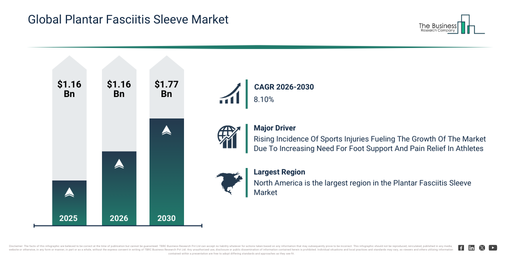
    The plantar fasciitis sleeve market has experienced robust expansion over recent years. Projections indicate a rise from $0.84 billion in 2025 to $0.91 billion in 2026, achieving a compound annual growth rate (CAGR) of 8.4%. Historically, this growth has stemmed from factors such as an increasing occurrence of plantar fasciitis, greater consciousness regarding foot health, the embrace of non-invasive treatments, heightened engagement in sports, and advancements in sleeve material technology.

    The plantar fasciitis sleeve market is projected to experience robust expansion over the coming years. This market is anticipated to reach a valuation of $1.24 billion by 2030, exhibiting a compound annual growth rate (CAGR) of 8.1%. Factors contributing to this growth during the forecast period include the advent of smart and adjustable sleeves, the integration of wearable sensors, an expanding sports and athletics sector, the creation of multi-purpose sleeve designs, and the broadening of online distribution avenues. Key trends foreseen in this period encompass compression sleeves, night splints, arch support sleeves, gel sleeves, and custom orthotic sleeves.

    Download the Free Sample Report to Explore Key Market Insights:

    https://www.thebusinessresearchcompany.com/sample.aspx?id=28299&type=smp

    What Key Drivers Are Influencing The Growth Of The Plantar Fasciitis Sleeve Market?

    The rising occurrence of sports-related injuries is anticipated to boost the expansion of the plantar fasciitis sleeve market. These injuries encompass physical harm sustained during athletic endeavors or workouts, varying from slight sprains and strains to more serious fractures or dislocations. The escalation in sports injuries stems from repeated stress or improper movements overpowering the body’s inherent capacity to mend and safeguard tissues, leading to cumulative damage. For individuals experiencing such injuries, a plantar fasciitis sleeve offers support for the foot arch, alleviates strain, and relieves heel discomfort during physical activity or recuperation. As an illustration, data from November 2023, provided by Howden Group Holdings Ltd, a UK-based insurance intermediary company, revealed a 170% surge in the severity of ankle injuries within the English Premier League between October 2022 and January 2023. Additionally, calf or shin injuries rose by 200% and hamstring injuries by 130% subsequent to the FIFA World Cup Qatar 2022. Consequently, the growing frequency of sports injuries is propelling the growth of the plantar fasciitis sleeve market. The increasing rates of obesity are projected to stimulate the expansion of the plantar fasciitis sleeve market. Obesity rates define the proportion of a populace deemed overweight or obese based on their body mass index (BMI). These rates are escalating because of unhealthy eating habits, particularly a high consumption of processed foods and sugary beverages, which leads to the accumulation of excess calories as body fat. For individuals with obesity, plantar fasciitis sleeves provide additional foot support and cushioning, easing pressure on the plantar fascia and enhancing comfort during activities involving weight-bearing, which is vital for managing joint stress in heavier individuals. For example, in May 2025, the Office for Health Improvement & Disparities, a UK-based government department, reported a consistent upward trend, with approximately 64.5 percent of adults in England classified as overweight or living with obesity in 2023–2024, an increase from 64.0 percent in 2022–2023. Thus, the growing prevalence of obesity is a key driver for the plantar fasciitis sleeve market.

    Which Segment Areas Are Covered In The Plantar Fasciitis Sleeve Market Analysis?

    The plantar fasciitis sleeve market covered in this report is segmented –

    1) By Product Type: Compression Sleeves, Arch Support Sleeves, Gel Sleeves

    2) By Material: Neoprene, Fabric, Silicone, Other Materials

    3) By Application: Sports And Athletics, Medical Use, Personal Use, Other Applications

    4) By Distribution Channel: Online Stores, Pharmacies, Specialty Stores, Other Distribution Channels

    Subsegments:

    1) By Compression Sleeves: Ankle Compression Sleeves, Full Foot Compression Sleeves, Graduated Compression Sleeves, Open-Toe Compression Sleeves, Closed-Toe Compression Sleeves

    2) By Arch Support Sleeves: Elastic Arch Support Sleeves, Gel-Padded Arch Support Sleeves, Adjustable Strap Arch Sleeves, Low-Profile Arch Sleeves, Multi-Zone Compression Arch Sleeves

    3) By Gel Sleeves: Heel Cushion Gel Sleeves, Silicone Gel Sleeves, Open-Heel Gel Sleeves

    What Key Developments And Trends Are Impacting The Plantar Fasciitis Sleeve Market?

    Which Global Companies Are Actively Competing In The Plantar Fasciitis Sleeve Market?

    Major companies operating in the plantar fasciitis sleeve market are 3M Company, BSN Medical GmbH, Össur hf., SIGVARIS Group AG, United Pacific Industries Limited, Bauerfeind AG, Cramer Products Inc., Darco International Inc., Spenco Medical Corporation, The Strassburg Sock Company Inc., Feetures Inc., Medi-Dyne Healthcare Products Ltd., ShoeInsoles.co.uk Limited, Scholl’s Wellness Company LLC, Algeos Limited, Zensah LLC, Copper Compression LLC, Stable Step LLC, Vive Health LLC, ING Source Inc.

    Read the full plantar fasciitis sleeve market report here:

    https://www.thebusinessresearchcompany.com/report/plantar-fasciitis-sleeve-global-market-report

    Which Region Is Expected To Register The Fastest Growth In The Plantar Fasciitis Sleeve Market?

    North America was the largest region in the plantar fasciitis sleeve market in 2025. Asia-Pacific is expected to be the fastest-growing region in the forecast period. The regions covered in the plantar fasciitis sleeve market report are Asia-Pacific, South East Asia, Western Europe, Eastern Europe, North America, South America, Middle East, Africa.

    Request A Tailored Plantar Fasciitis Sleeve Market Research Report For Competitive Advantage:

    https://www.thebusinessresearchcompany.com/customise?id=28299&type=smp

    Browse Through More Reports Similar to the Global Plantar Fasciitis Sleeve Market 2026, By The Business Research Company

    Compression Sleeves Market Report 2026

    https://www.thebusinessresearchcompany.com/report/compression-sleeves-global-market-report

    Automotive Fascia Market Report 2026

    https://www.thebusinessresearchcompany.com/report/automotive-fascia-global-market-report

    Scar Treatment Market Report 2026

    https://www.thebusinessresearchcompany.com/report/scar-treatment-global-market-report

    Get in touch with us:

    The Business Research Company: https://www.thebusinessresearchcompany.com/

    Americas +1 310-496-7795

    Asia +44 7882 955267 & +91 8897263534

    Europe +44 7882 955267

    Email us at info@tbrc.info

    Follow us on:

    LinkedIn: https://in.linkedin.com/company/the-business-research-company

    YouTube: https://www.youtube.com/channel/UC24_fI0rV8cR5DxlCpgmyFQ

    Global Market Model: https://www.thebusinessresearchcompany.com/global-market-model
  • Pipetting Robots Market Growth Prospects 2026–2030 with Innovation Trends and Competitive Landscape

    Pipetting Robots Market Growth Prospects 2026–2030 with Innovation Trends and Competitive Landscape

    The Business Research Company’s 2026 market reports include new capabilities such as market attractiveness scoring and analysis, total addressable market analysis, company scoring matrix, interactive excel data dashboard, improved supply chain analysis, upcoming startups in the market, and overview of key products, aimed at improving the depth, usability, and strategic value of the insights delivered.

    What Is The Forecasted Market Value Of The Pipetting Robots Market Across 2026–2030?

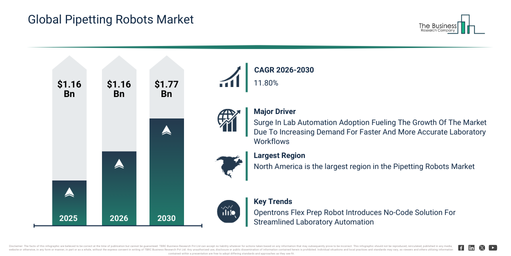
    The market size for pipetting robots has seen rapid expansion in recent years. It is forecast to increase from $1.09 billion in 2025 to $1.22 billion in 2026, achieving a compound annual growth rate (CAGR) of 12.0%. This historical growth can be attributed to several factors including the rise in laboratory automation, increasing research demands, the necessity for reproducibility, the limitations of manual pipetting, and the ongoing expansion of life science research.

    The pipetting robots market is projected for substantial expansion in the coming years, with its size expected to reach $1.9 billion by 2030, exhibiting a compound annual growth rate (CAGR) of 11.8%. This anticipated growth during the forecast period is largely due to factors such as the broadening scope of drug discovery, advancements in genomics and proteomics, an increasing need for laboratory efficiency, enhanced integration with LIMS systems, and the rise in clinical diagnostics testing. Key trends expected over this period encompass high-throughput liquid handling, a focus on minimizing errors from manual pipetting, the adoption of automated laboratory workflows, ensuring consistent volume dispensing accuracy, and the development of scalable modular robot platforms.

    Download the Free Sample Report to Explore Key Market Insights:

    https://www.thebusinessresearchcompany.com/sample.aspx?id=30354&type=smp

    What Major Growth Drivers Are Shaping The Outlook Of The Pipetting Robots Market?

    The increasing integration of laboratory automation is projected to boost the expansion of the pipetting robots market in the future. Laboratory automation involves employing machinery, software, and automated instruments to execute lab procedures like testing, measuring, and sample processing with reduced human intervention, enabling laboratories to operate more swiftly, precisely, and with fewer mistakes within a unified, efficient workflow. The uptake of lab automation is increasing due to the demand from laboratories for quicker and more precise handling of expanding sample quantities, a need that automation addresses by minimizing manual labor and enhancing overall productivity in an uninterrupted workflow. Pipetting robots contribute to lab automation by autonomously executing accurate and repetitive liquid-handling operations, thereby elevating precision, rapidity, and uniformity while decreasing human input. An example illustrating this trend is from August 2024, when the Pistoia Alliance, a US-based not-for-profit organization, reported that the adoption of lab automation, including artificial intelligence and machine learning (AI/ML), climbed from 54% in 2023 to 68% in 2024. This signifies that among 200 labs surveyed, the count utilizing advanced systems grew from 108 to 136, showing a 14-point increase in a single year. Consequently, the increasing embrace of lab automation is fueling the expansion of the pipetting robots market.

    What Segmentation Levels Are Considered In The Pipetting Robots Market?

    The pipetting robots market covered in this report is segmented –

    1) By Type: Automated Pipetting Systems, Semi-Automated Pipetting Systems, Multichannel Pipetting Robots, Single Channel Pipetting Robots

    2) By Technology: Microplate Pipetting Robots, Multisample Pipetting Robotic Systems, Robotic Liquid Handling Systems, Automated Workstations, Custom Pipetting Systems

    3) By Operating Environment: Laboratory Environment, Clean Room Environment, Clinical Environment

    4) By Application: Drug Discovery, Clinical Diagnostics, Genomics and Proteomics, Food And Beverage Testing, Environmental Testing

    5) By End-User: Pharmaceutical Companies, Biotechnology Firms, Academic And Research Institutions, Contract Research Organizations (CROs), Hospitals And Clinical Laboratories

    Subsegments:

    1) By Automated Pipetting Systems: Bench Top Automated Pipetting Systems, Integrated Automated Pipetting Workstations, High Throughput Automated Pipetting Systems, Compact Automated Pipetting Systems

    2) By Semi Automated Pipetting Systems: Electronic Assist Semi Automated Pipetting Systems, Motor Driven Semi Automated Pipetting Systems, Adjustable Volume Semi Automated Pipetting Systems, Fixed Volume Semi Automated Pipetting Systems

    3) By Multichannel Pipetting Robots: Low Channel Count Multichannel Pipetting Robots, High Channel Count Multichannel Pipetting Robots, Plate Based Multichannel Pipetting Robots, Tube Based Multichannel Pipetting Robots

    4) By Single Channel Pipetting Robots: Portable Single Channel Pipetting Robots, Bench Top Single Channel Pipetting Robots, High Precision Single Channel Pipetting Robots, Entry Level Single Channel Pipetting Robots

    What Trends Are Projected To Affect The Pipetting Robots Market?

    Leading companies within the pipetting robots market are concentrating on creating advanced solutions, including no-code robotic systems, to streamline laboratory automation. A no-code robotic solution signifies an accessible platform that permits scientists to configure and carry out pipetting assignments without requiring programming skills, consequently enhancing workflow effectiveness and reducing human errors. For example, in September 2024, Opentrons Labworks Inc., a US-based lab automation firm, unveiled the Opentrons Flex Prep robot, accompanied by new no-code software. This development allows individuals to create, view, and run pipetting tasks in under a minute directly through a touchscreen display, offering both ease of use and greater capacity. This technology is designed to work with Opentrons’ established lab automation products, which provide an intuitive, economical, and adaptable liquid-handling experience. The Flex Prep elevates laboratory output, ensures accurate liquid movement, and enables scientists to concentrate on more crucial components of their research.

    Which Leading Firms Are Contributing To The Growth Of The Pipetting Robots Market?

    Major companies operating in the pipetting robots market are Thermo Fisher Scientific Inc., Agilent Technologies Inc., Mettler-Toledo International Inc., Beckman Coulter Inc., Tecan Group Ltd., Eppendorf AG, Hamilton Company, INTEGRA Biosciences AG, Gilson Incorporated, SPT Labtech Ltd., Opentrons Labworks Inc., Formulatrix Inc., HighRes Biosolutions Inc., BioTek Instruments Inc., Analytik Jena GmbH + Co KG, BRAND GmbH + Co KG, Dynamic Devices Ltd., Revvity Inc., Hudson Robotics, Andrew Alliance SA, Zinsser Analytic GmbH

    Read the full pipetting robots market report here:

    https://www.thebusinessresearchcompany.com/report/global-pipetting-robots-market-report

    Which Regions Are Projected To Dominate The Pipetting Robots Market In The Coming Years?

    North America was the largest region in the pipetting robots market in 2025. Asia-Pacific is expected to be the fastest-growing region in the forecast period. The regions covered in the pipetting robots market report are Asia-Pacific, South East Asia, Western Europe, Eastern Europe, North America, South America, Middle East, Africa.

    Request A Tailored Pipetting Robots Market Research Report For Competitive Advantage:

    https://www.thebusinessresearchcompany.com/customise?id=30354&type=smp

    Browse Through More Reports Similar to the Global Pipetting Robots Market 2026, By The Business Research Company

    Spoolable Pipes Market Report 2026

    https://www.thebusinessresearchcompany.com/report/spoolable-pipes-global-market-report

    Pipeline Construction Market Report 2026

    https://www.thebusinessresearchcompany.com/report/pipeline-construction-global-market-report

    Flexible Pipe Market Report 2026

    https://www.thebusinessresearchcompany.com/report/flexible-pipe-global-market-report

    Get in touch with us:

    The Business Research Company: https://www.thebusinessresearchcompany.com/

    Americas +1 310-496-7795

    Asia +44 7882 955267 & +91 8897263534

    Europe +44 7882 955267

    Email us at info@tbrc.info

    Follow us on:

    LinkedIn: https://in.linkedin.com/company/the-business-research-company

    YouTube: https://www.youtube.com/channel/UC24_fI0rV8cR5DxlCpgmyFQ

    Global Market Model: https://www.thebusinessresearchcompany.com/global-market-model