Month: March 2026

  • Ataxia Market Growth Expected to Reach $61.91 Billion by 2030 with 8.9% CAGR

    Ataxia Market Growth Expected to Reach $61.91 Billion by 2030 with 8.9% CAGR

    The Business Research Company’s 2026 market reports include new capabilities such as market attractiveness scoring and analysis, total addressable market analysis, company scoring matrix, interactive excel data dashboard, improved supply chain analysis, upcoming startups in the market, and overview of key products, aimed at improving the depth, usability, and strategic value of the insights delivered.

    What Market Size Growth Is Projected For The Ataxia Market During The Forecast Period 2026–2030?

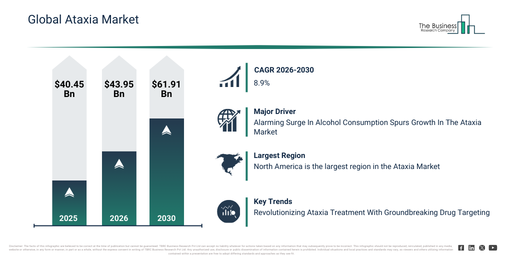
    The ataxia market has demonstrated robust growth over recent years. It is anticipated to expand from $40.45 billion in 2025 to $43.95 billion in 2026, reflecting a compound annual growth rate (CAGR) of 8.6%. This historical growth can be linked to several factors, including enhanced recognition of neurological disorders, the increasing availability of diagnostic imaging, intensified research into rare neurological diseases, a rising clinical understanding of ataxia subtypes, and the provision of various supportive care options.

    The ataxia market is anticipated to show significant expansion over the coming years. It is projected to reach $61.91 billion by 2030, exhibiting a compound annual growth rate (CAGR) of 8.9%. This growth during the forecast period is attributable to factors such as increased investments in gene-based therapies, the rising embrace of personalized neurology treatments, the widening scope of digital monitoring for neurological conditions, a heightened focus on rare disease drug development, and increased collaborative efforts in neurological research. Prominent trends within this period are expected to include a greater emphasis on genetic testing and counseling, an increase in the adoption of symptomatic treatment approaches, the expanding application of advanced neurodiagnostic tools, the broadening of long-term disease management strategies, and an intensified focus on early diagnosis.

    Download the Free Sample Report to Explore Key Market Insights:

    https://www.thebusinessresearchcompany.com/sample.aspx?id=12218&type=smp

    Which Economic Or Industry Drivers Are Impacting The Ataxia Market?

    Future expansion of the ataxia market is anticipated, fueled by increasing alcohol intake. Drinking ethanol-containing beverages, typically by mouth, constitutes alcohol consumption. Chronic alcohol abuse leads to cerebellar degeneration, a common form of acquired toxic ataxia. Individuals suffering from alcoholism often exhibit gait ataxia and postural tremors in their lower limbs. For example, GOV.UK, a UK government body, reported in August 2024 that preliminary alcohol duty revenue from wine and other fermented items for the May to July 2024 period reached $1,523 million (£1,154 million). This represents a $42 million (£32 million) (2.9%) rise compared to the corresponding period of the previous year. Consequently, the increased consumption of alcohol is a key factor propelling the expansion of the ataxia market.

    What Market Segments Are Evaluated Within The Ataxia Market?

    The ataxia market covered in this report is segmented –

    1) By Disease Type: Friedreich’s Ataxia, Ataxia-telangiectasia, Episodic Ataxia, Other Disease Types

    2) By Product: Treatment, Diagnosis

    3) By Dosage Form: Solid, Liquids, Other Dosage Forms

    4) By Route Of Administration: Oral, Parenteral, Other Routes Of Administration

    5) By End User: Hospital, Clinics, Home Healthcare, Other End-Users

    Subsegments:

    1) By Friedreich’s Ataxia: Genetic Counseling And Testing, Symptomatic Treatments

    2) By Ataxia-telangiectasia: Immunotherapy, Supportive Care

    3) By Episodic Ataxia: Medications For Episodes, Long-term Management Strategies

    4) By Other Disease Types: Spinocerebellar Ataxias (SCAs), Ataxia Due To Vitamin Deficiencies Or Toxins

    What Trends Are Affecting The Expansion Of The Ataxia Market?

    Leading companies in the ataxia market are concentrating on developing innovative solutions, such as pioneering oral drug therapies, to address the increasing demand for effective treatment options that can decelerate disease progression and enhance functional outcomes in rare neurodegenerative conditions. These oral therapies offer a convenient, non-invasive alternative to traditional supportive care approaches, which primarily manage symptoms without modifying underlying disease pathways. For instance, in February 2023, Reata Pharmaceuticals, a US-based biotechnology company, announced the FDA’s (the U.S. Food and Drug Administration’s) approval of SKYCLARYS (omavaloxolone). It is the first and only drug indicated for patients with Friedreich’s ataxia in adults and adolescents aged 16. At Week 48, treatment with the oral, once-daily medication SKYCLARYS led to statistically significant lower mFARS (modified Friedreich’s Ataxia Rating Scale) scores (reduced impairment) compared to placebo. The diagnosis of Friedreich’s ataxia, an extremely rare inherited neurological condition, usually occurs around adolescence.

    Who Are The Top Market Participants Influencing The Ataxia Market?

    Major companies operating in the ataxia market are Pfizer Inc., Johnson & Johnson Services Inc., Eisai Co. Ltd., Genentech Inc., CRISPR Therapeutics AG, Eli Lilly & Company, GlaxoSmithKline Plc, Larimar Therapeutics Inc., Capsida Biotherapeutics Inc., Intellia Therapeutics Inc., Bluebird bio Inc., Editas Medicine Inc., Healx, Acorda Therapeutics Inc., H. Lundbeck A/S, Reata Pharmaceuticals Inc., PTC Therapeutics, Ionis Pharmaceuticals Inc., IntraBio, Biogen Inc., Novartis AG, Sanofi, Roche Holding Ltd., Teva Pharmaceuticals, Zydus Lifesciences Ltd

    Read the full ataxia market report here:

    https://www.thebusinessresearchcompany.com/report/ataxia-global-market-report

    What Are The Top-Performing Regions Within The Ataxia Market?

    North America was the largest region in the ataxia market in 2025. Asia-Pacific is expected to be the fastest-growing region in the ataxia market report during the forecast period. The regions covered in the ataxia market report are Asia-Pacific, South East Asia, Western Europe, Eastern Europe, North America, South America, Middle East, Africa.

    Request A Tailored Ataxia Market Research Report For Competitive Advantage:

    https://www.thebusinessresearchcompany.com/customise?id=12218&type=smp

    Browse Through More Reports Similar to the Global Ataxia Market 2026, By The Business Research Company

    Molecular Breeding Global Market Report

    https://www.thebusinessresearchcompany.com/report/molecular-breeding-global-market-report

    Genetic Testing Services Global Market Report

    https://www.thebusinessresearchcompany.com/report/genetic-testing-services-global-market-report

    Prenatal And Newborn Genetic Testing Global Market Report

    https://www.thebusinessresearchcompany.com/report/prenatal-and-newborn-genetic-testing-global-market-report

    Get in touch with us:

    The Business Research Company: https://www.thebusinessresearchcompany.com/

    Americas +1 310-496-7795

    Asia +44 7882 955267 & +91 8897263534

    Europe +44 7882 955267

    Email us at info@tbrc.info

    Follow us on:

    LinkedIn: https://in.linkedin.com/company/the-business-research-company

    YouTube: https://www.youtube.com/channel/UC24_fI0rV8cR5DxlCpgmyFQ

    Global Market Model: https://www.thebusinessresearchcompany.com/global-market-model
  • Artificial Intelligence (AI) Heart Sound Digital Twin Analytics Market Outlook 2026–2030 with Major Growth Drivers and Emerging Industry Trends

    Artificial Intelligence (AI) Heart Sound Digital Twin Analytics Market Outlook 2026–2030 with Major Growth Drivers and Emerging Industry Trends

    The Business Research Company’s 2026 market reports include new capabilities such as market attractiveness scoring and analysis, total addressable market analysis, company scoring matrix, interactive excel data dashboard, improved supply chain analysis, upcoming startups in the market, and overview of key products, aimed at improving the depth, usability, and strategic value of the insights delivered.

    How Much Is The Artificial Intelligence (AI) Heart Sound Digital Twin Analytics Market Expected To Grow In Terms Of Market Value Between 2026 And 2030?

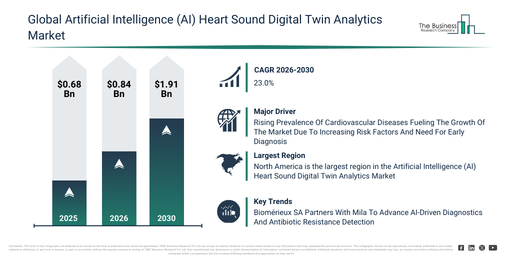
    The artificial intelligence (AI) heart sound digital twin analytics market size has grown exponentially in recent years. It will grow from $0.68 billion in 2025 to $0.84 billion in 2026 at a compound annual growth rate (CAGR) of 23.3%. The growth in the historic period can be attributed to growth in cardiovascular disease prevalence, advances in digital auscultation devices, increased use of ai in clinical diagnostics, expansion of remote patient monitoring, availability of large cardiac datasets.

    The artificial intelligence (AI) heart sound digital twin analytics market is projected to experience rapid expansion in the coming years. This market is anticipated to reach $1.91 billion by 2030, exhibiting a compound annual growth rate (CAGR) of 23.0%. Factors driving this growth during the forecast period include the escalating demand for prompt cardiac risk detection, the increasing uptake of personalized cardiology solutions, the broadening reach of cloud-based clinical analytics, a heightened emphasis on uninterrupted cardiac monitoring, and the greater incorporation of AI into clinical workflows. Key trends observed throughout this period encompass the wider acceptance of digital twin cardiac models, a surge in the application of AI-based heart sound analytics, the proliferation of remote cardiac monitoring tools, the increasing integration of wearable cardiac sensors, and a sharper focus on predictive cardiovascular diagnostics.

    Download the Free Sample Report to Explore Key Market Insights:

    https://www.thebusinessresearchcompany.com/sample.aspx?id=28119&type=smp

    Which Growth Drivers Are Contributing To The Progress Of The Artificial Intelligence (AI) Heart Sound Digital Twin Analytics Market?

    The increasing prevalence of cardiovascular conditions is anticipated to fuel the expansion of the artificial intelligence (AI) heart sound digital twin analytics market moving forward. These conditions encompass various disorders affecting the heart and blood vessels, such as coronary heart disease, heart failure, stroke, and hypertension. The rise in cardiovascular diseases is primarily linked to unhealthy diets, where excessive consumption of saturated fats, trans fats, added sugars, and sodium contributes to elevated blood pressure, obesity, and high cholesterol, all significant risk factors for heart-related ailments. Artificial intelligence (AI) heart sound digital twin analytics assist in diagnosing cardiovascular diseases by creating customized digital heart models for patients, making them highly effective for early detection and continuous monitoring. They help lessen clinical burdens by offering real-time heart sound analysis, thus enhancing diagnostic precision and individualized treatment. For instance, in September 2025, the American College of Cardiology (ACC), a US-based non-profit medical professional society, reported that CVD remains the leading cause of disability-adjusted life years (DALYs) and deaths estimated in the GBD globally. There were 437 million CVD DALYs in 2023. Consequently, the escalating occurrence of cardiovascular diseases is propelling the growth of the artificial intelligence (AI) heart sound digital twin analytics market. The growing demand for personalized healthcare approaches is projected to accelerate the expansion of the artificial intelligence (AI) heart sound digital twin analytics market in the future. Personalized medicine involves a medical strategy that customizes treatment and prevention plans to an individual’s unique genetic makeup, lifestyle, and environmental factors. This increasing demand for tailored medical interventions stems mainly from advancements in genomics, which enable precise identification of genetic variations and the development of specific treatments for individuals. Artificial intelligence (AI) heart sound digital twin analytics improve personalized medicine by providing patient-specific digital models of the heart, making them ideal for adapting treatments to individual cardiac profiles. They diminish diagnostic uncertainties by delivering real-time analysis of heart sounds, thereby enhancing treatment accuracy and patient outcomes. For instance, in February 2024, the Personalized Medicine Coalition (PMC), a US-based nonprofit organization, stated that the U.S. Food and Drug Administration (FDA) approved 26 new personalized medicines in 2023, a significant increase from the 12 approved in 2022. Therefore, the increasing adoption of personalized medicine is fueling the growth of the artificial intelligence (AI) heart sound digital twin analytics market.

    What Major Segment Divisions Exist Within The Artificial Intelligence (AI) Heart Sound Digital Twin Analytics Market?

    The artificial intelligence (AI) heart sound digital twin analytics market covered in this report is segmented –

    1) By Component: Software, Hardware, Services

    2) By Deployment Mode: On-Premises, Cloud

    3) By Application: Cardiology, Remote Patient Monitoring, Clinical Diagnostics, Research, Other Applications

    4) By End-User: Hospitals, Clinics, Research Institutes, Diagnostic Centers, Other End-Users

    Subsegments:

    1) By Software: AI Algorithms And Models, Predictive Analytics Platforms, Simulation And Modeling Tools, Data Integration And Management Software, Visualization And Reporting Dashboards

    2) By Hardware: Sensors, Digital Stethoscopes, Wearable Devices, Edge Devices Or Processing Units, Cloud Or Server Infrastructure

    3) By Services: Implementation And Integration Services, Consulting And Advisory Services, Training And Education Services, Support And Maintenance Services, Data-As-A-Service (DaaS)

    What Trends Are Affecting The Expansion Of The Artificial Intelligence (AI) Heart Sound Digital Twin Analytics Market?

    Companies operating in the artificial intelligence (AI) heart sound digital twin analytics market are primarily focused on creating advanced products, such as digital stethoscopes, to analyze heart sounds, facilitate early diagnosis, and support personalized patient care. A digital stethoscope functions as an electronic device that amplifies and records body sounds, offering noise reduction and connectivity with various apps for enhanced diagnosis and data sharing. As an example, in April 2025, Eko Health Inc., a US-based digital health company, introduced its CORE 500 digital stethoscope and Eko+ membership service in Canada. The CORE 500 digital stethoscope stands out as a highly advanced device, featuring patented audio technology with three listening modes, visualization of both ECG and heart sounds, and active noise cancellation for precise auscultation, alongside enabling effortless data capture, sharing, and monitoring. Furthermore, the Eko+ membership expands its utility with AI-powered murmur and arrhythmia detection, waveform visualization, guided examination flows, and secure sharing capabilities. This launch empowers Canadian clinicians with cutting-edge, AI-driven instruments designed to improve cardiac and pulmonary care and ultimately enhance patient outcomes.

    Which Companies Are Leading Innovation In The Artificial Intelligence (AI) Heart Sound Digital Twin Analytics Market?

    Major companies operating in the artificial intelligence (AI) heart sound digital twin analytics market are Medtronic plc, Tata Consultancy Services Limited (TCS), Siemens Healthineers AG, Fujifilm Healthcare Corporation, GE Healthcare Technologies Inc., Dassault Systemes SE, Synopsys Inc., Tempus Labs Inc., Biofourmis Inc., HeartFlow Inc., Viz.ai Inc., Aidoc Medical Ltd., Butterfly Network Inc., Eko Health Inc., Shenzhen Minttihealth Co. Ltd., Ultromics Limited, Thinklabs Medical LLC, Acorai AB, Sensydia Corporation, CardioSignal, Cardionics Inc., Ayu Devices Pvt. Ltd., Ai Health Highway India Pvt Ltd., Aevice Health Pte Ltd., CSD Labs, Sanolla Ltd., HeartTronics AI

    Read the full artificial intelligence (ai) heart sound digital twin analytics market report here:

    https://www.thebusinessresearchcompany.com/report/artificial-intelligence-ai-heart-sound-digital-twin-analytics-global-market-report

    What Are The Leading Geographic Regions In The Artificial Intelligence (AI) Heart Sound Digital Twin Analytics Market?

    North America was the largest region in the artificial intelligence (AI) heart sound digital twin analytics market in 2025. The regions covered in the artificial intelligence (AI) heart sound digital twin analytics market report are Asia-Pacific, South East Asia, Western Europe, Eastern Europe, North America, South America, Middle East, Africa.

    Request A Tailored Artificial Intelligence (AI) Heart Sound Digital Twin Analytics Market Research Report For Competitive Advantage:

    https://www.thebusinessresearchcompany.com/customise?id=28119&type=smp

    Browse Through More Reports Similar to the Global Artificial Intelligence (AI) Heart Sound Digital Twin Analytics Market 2026, By The Business Research Company

    Artificial Intelligence In Cardiology Global Market Report

    https://www.thebusinessresearchcompany.com/report/artificial-intelligence-in-cardiology-global-market-report

    Ai In Life Science Analytics Global Market Report

    https://www.thebusinessresearchcompany.com/report/ai-in-life-science-analytics-global-market-report

    Digital Twins In Healthcare Global Market Report

    https://www.thebusinessresearchcompany.com/report/digital-twins-in-healthcare-global-market-report

    Get in touch with us:

    The Business Research Company: https://www.thebusinessresearchcompany.com/

    Americas +1 310-496-7795

    Asia +44 7882 955267 & +91 8897263534

    Europe +44 7882 955267

    Email us at info@tbrc.info

    Follow us on:

    LinkedIn: https://in.linkedin.com/company/the-business-research-company

    YouTube: https://www.youtube.com/channel/UC24_fI0rV8cR5DxlCpgmyFQ

    Global Market Model: https://www.thebusinessresearchcompany.com/global-market-model
  • Astigmatism Market Forecast 2026–2035 Reflecting Expansion Opportunities Across Industries

    Astigmatism Market Forecast 2026–2035 Reflecting Expansion Opportunities Across Industries

    The Business Research Company’s 2026 market reports include new capabilities such as market attractiveness scoring and analysis, total addressable market analysis, company scoring matrix, interactive excel data dashboard, improved supply chain analysis, upcoming startups in the market, and overview of key products, aimed at improving the depth, usability, and strategic value of the insights delivered.

    How Will The Market Size Of The Astigmatism Market Evolve From 2026 To 2030?

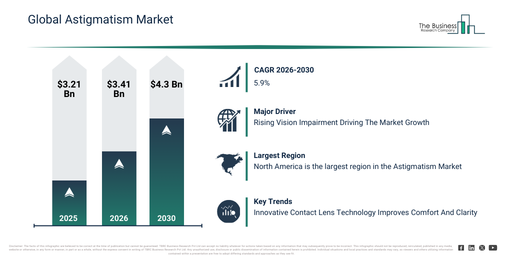
    The astigmatism market has experienced significant expansion in recent years. It is anticipated to expand from $3.21 billion in 2025 to $3.41 billion in 2026, achieving a compound annual growth rate (CAGR) of 6.2%. This historical growth can be attributed to the escalating occurrence of refractive errors, greater awareness of vision correction alternatives, the proliferation of ophthalmic clinics, the availability of economical corrective lenses, and enhancements in diagnostic precision.

    The astigmatism market size is projected to experience robust growth in the upcoming years. It is anticipated to expand to $4.3 billion by 2030, demonstrating a compound annual growth rate (CAGR) of 5.9%. This expansion during the forecast period is attributable to the increasing demand for tailored vision care, a rising embrace of laser-based corrective procedures, the widening availability of tele-ophthalmology services, a growing emphasis on preventive eye health, and the increasing application of AI-assisted diagnostics. Significant trends during this period include a greater adoption of customized corrective lenses, an increase in the use of advanced diagnostic imaging tools, a developing preference for minimally invasive vision correction, the expansion of digital eye testing solutions, and an enhanced focus on early vision screening.

    Download the Free Sample Report to Explore Key Market Insights:

    https://www.thebusinessresearchcompany.com/sample.aspx?id=21107&type=smp

    What Major Drivers Are Influencing Demand In The Astigmatism Market?

    The rising occurrence of vision impairment is anticipated to boost the expansion of the astigmatism market in the future. Vision impairment describes a state where an individual suffers from a partial or total loss of sight, which remains uncorrectable even with eyeglasses, contact lenses, or medical therapies. This increasing prevalence of vision impairment stems from factors such as an aging demographic, a rise in diabetes and various eye conditions, extensive use of screens, and insufficient availability of eye care in specific regions. Astigmatism itself contributes to vision impairment, leading to blurry or distorted sight because of an irregularly shaped cornea or lens, thereby preventing light from focusing correctly on the retina. As an illustration, a report from a U.S.-based national agency, cited by the World Health Organization in August 2024, indicated that a minimum of 2.2 billion individuals worldwide experience near or distance vision impairment. Moreover, global estimates show that only 36% of those with distance vision impairment caused by refractive error and a mere 17% of individuals with vision impairment due to cataract have accessed suitable interventions. Consequently, the growing occurrence of vision impairment is fueling the expansion of the astigmatism market.

    Which Segment Areas Are Covered In The Astigmatism Market Analysis?

    The astigmatism market covered in this report is segmented –

    1) By Type: Myopic Astigmatism, Hyperopic Astigmatism, Other Types

    2) By Treatments: Corrective Lenses, Orthokeratology, Surgeries, Other Treatments

    3) By End User: Hospitals, Clinics, Other End Users

    Subsegments:

    1) By Myopic Astigmatism: Simple Myopic Astigmatism, Compound Myopic Astigmatism

    2) By Hyperopic Astigmatism: Simple Hyperopic Astigmatism, Compound Hyperopic Astigmatism

    3) By Other Types: Regular Astigmatism, Irregular Astigmatism, Congenital Astigmatism, Post-surgical Astigmatism

    Which Trends Are Influencing The Astigmatism Market?

    Companies active within the astigmatism market are prioritizing the development of sophisticated technologies, such as water gradient technology, aiming to boost contact lens comfort, increase moisture retention, and offer improved vision for those with astigmatism. This technology describes a contact lens structure where water content progressively rises from the center to the outer surface, thereby improving moisture retention and user comfort. A notable example occurred in January 2023, when Alcon Inc., a pharmaceutical and medical device company based in Switzerland, introduced TOTAL30 for Astigmatism. This pioneering product stands as the inaugural reusable contact lens created with water gradient material, tailored specifically for individuals with astigmatism. Studies underscore that comfort is a critical element influencing both the overall lens-wearing experience and long-term customer loyalty.

    Which Global Companies Are Actively Competing In The Astigmatism Market?

    Major companies operating in the astigmatism market are EssilorLuxottica SA, Novartis AG, HOYA Corporation, Alcon Inc, STAAR Surgical Company, Menicon Co Ltd, Rayner Intraocular Lenses Limited, Ophtec BV, Shamir Optical Industry Ltd, SEED Co Ltd, Visionary Optics LLC, Santen Pharmaceutical Co Ltd, Carl Zeiss AG, NIDEK Co Ltd, Topcon Corporation, Ziemer Ophthalmic Systems AG, SCHWIND eye-tech-solutions GmbH, BVI Medical, LENSAR Inc, Avedro Inc

    Read the full astigmatism market report here:

    https://www.thebusinessresearchcompany.com/report/astigmatism-global-market-report

    Which Region Shows The Strongest Potential For Future Growth In The Astigmatism Market?

    North America was the largest region in the astigmatism market in 2025. Asia-Pacific is expected to be the fastest-growing region in the forecast period. The regions covered in the astigmatism market report are Asia-Pacific, South East Asia, Western Europe, Eastern Europe, North America, South America, Middle East, Africa.

    Request A Tailored Astigmatism Market Research Report For Competitive Advantage:

    https://www.thebusinessresearchcompany.com/customise?id=21107&type=smp

    Browse Through More Reports Similar to the Global Astigmatism Market 2026, By The Business Research Company

    Sigmoidoscope Global Market Report

    https://www.thebusinessresearchcompany.com/report/sigmoidoscope-global-market-report

    Hyperpigmentation Disorder Treatment Global Market Report

    https://www.thebusinessresearchcompany.com/report/hyperpigmentation-disorder-treatment-global-market-report

    Amblyopia Global Market Report

    https://www.thebusinessresearchcompany.com/report/amblyopia-global-market-report

    Get in touch with us:

    The Business Research Company: https://www.thebusinessresearchcompany.com/

    Americas +1 310-496-7795

    Asia +44 7882 955267 & +91 8897263534

    Europe +44 7882 955267

    Email us at info@tbrc.info

    Follow us on:

    LinkedIn: https://in.linkedin.com/company/the-business-research-company

    YouTube: https://www.youtube.com/channel/UC24_fI0rV8cR5DxlCpgmyFQ

    Global Market Model: https://www.thebusinessresearchcompany.com/global-market-model
  • One of the Major Drivers of the Artificial Intelligence (AI) Facial Skin Analyzer Market Is the Rising Demand For Personalized Skincare Fueling The Growth Of The Market Due To Advancements In AI-Based Skin Analysis

    One of the Major Drivers of the Artificial Intelligence (AI) Facial Skin Analyzer Market Is the Rising Demand For Personalized Skincare Fueling The Growth Of The Market Due To Advancements In AI-Based Skin Analysis

    The Business Research Company’s 2026 market reports include new capabilities such as market attractiveness scoring and analysis, total addressable market analysis, company scoring matrix, interactive excel data dashboard, improved supply chain analysis, upcoming startups in the market, and overview of key products, aimed at improving the depth, usability, and strategic value of the insights delivered.

    What Market Value Is Expected For The Artificial Intelligence (AI) Facial Skin Analyzer Market At The End Of The 2026–2030 Forecast Period?

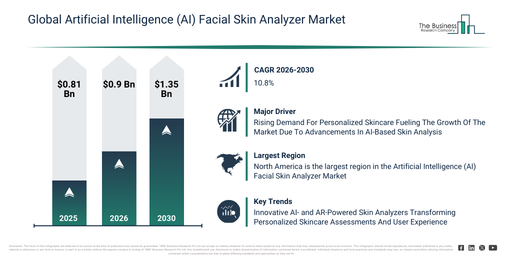
    The artificial intelligence (AI) facial skin analyzer market has experienced substantial expansion in recent years. This market is projected to expand from $0.81 billion in 2025 to reach $0.9 billion by 2026, demonstrating a compound annual growth rate (CAGR) of 11.2%. Historically, this growth has been driven by several factors, including a heightened consumer interest in skincare analysis, the proliferation of digital dermatology instruments, an increase in the adoption of cosmetic technology, the wider availability of high-resolution imaging devices, and a growing demand for customized beauty solutions.

    The artificial intelligence (AI) facial skin analyzer market size is projected to undergo significant expansion in the coming years. It is anticipated to attain a value of $1.35 billion by 2030, growing at a compound annual growth rate (CAGR) of 10.8%. This growth during the forecast period stems from factors such as the increasing integration of AI in aesthetic medicine, the rising use of virtual skincare consultations, the expansion of data-driven cosmetic formulation, the growing adoption in clinical dermatology settings, and the increasing demand for real-time skin monitoring solutions. Key trends influencing this period include the increasing adoption of AI-driven skin diagnostics, the rising integration of mobile-based skin analysis platforms, the growing use of 3D facial imaging technologies, the expansion of personalized skincare recommendation systems, and enhanced accuracy in multi-parameter skin assessment.

    Download the Free Sample Report to Explore Key Market Insights:

    https://www.thebusinessresearchcompany.com/sample.aspx?id=24469&type=smp

    What Primary Drivers Are Shaping The Development Of The Artificial Intelligence (AI) Facial Skin Analyzer Market?

    The increasing demand for personalized skincare solutions is expected to drive the expansion of the artificial intelligence (AI) facial skin analyzer market in the future. Personalized skincare involves custom-fitting products and regimens to an individual’s unique skin characteristics and specific concerns. The rise in personalized skincare solutions is attributed to the growing utilization of AI and skin analysis technologies, which enable customized product recommendations based on individual skin needs. Artificial Intelligence (AI) facial skin analyzers contribute to personalizing skincare by accurately assessing individual skin conditions and subsequently generating data-driven, bespoke product and treatment recommendations. As an illustration, figures from December 2024, provided by the US-based government agency Bureau of Labor Statistics, show that consumer spending on personal care products and services climbed from USD 866 in 2022 to USD 950 in 2023. This reflects a 9.7% year-over-year increase, building on a 12.3% rise observed in 2022. Therefore, the escalating demand for personalized skincare solutions is a primary driver for the growth of the artificial intelligence (AI) facial skin analyzer market.

    What Segment Types Make Up The Artificial Intelligence (AI) Facial Skin Analyzer Market?

    The artificial intelligence (AI) facial skin analyzer market covered in this report is segmented –

    1) By Product Type: Portable, Desktop

    2) By Device Type: Mobile App, Web-Based Platform, Standalone Device

    3) By Technology: Artificial intelligence (AI)-Based, Machine Learning, Deep Learning

    4) By Application: Skincare, Aesthetic Treatments, Cosmetics, Medical Diagnosis

    5) By End User: Healthcare, Personal Care, Other End-Users

    Subsegments:

    1) By Portable: Handheld Skin Analyzers, Smartphone-Compatible Devices, Wearable Skin Analyzers

    2) By Desktop: Multi-Parameter Skin Analyzers, 3D Imaging Skin Analyzers, Clinical-Grade Skin Analyzers

    Which Trends Are Influencing The Artificial Intelligence (AI) Facial Skin Analyzer Market?

    Leading companies in the artificial intelligence (AI) facial skin analyzer market are concentrating on developing innovative solutions, including AI and augmented reality (AR)-powered skin analyzers. These aim to offer real-time, personalized skincare assessments, enhance user engagement, and expand accessibility across consumer and professional segments. These AI and AR-driven analyzers utilize smart algorithms and augmented visuals to evaluate skin health and show immediate skincare effects, aiding users in making informed choices through interactive, customized analysis. For instance, in January 2024, Flipkart Private Limited, an India-based e-commerce company, unveiled the ModiFace Powered Skin Analyzer. This AI-driven tool is seamlessly integrated into Flipkart’s mobile platform, allowing users to conduct a facial skin analysis by simply taking a selfie and answering a few basic questions. The technology assesses crucial skin parameters such as pores, wrinkles, pigmentation, acne, and firmness, leveraging advanced artificial intelligence and augmented reality. Subsequently, it delivers customized skincare recommendations specifically tailored to each user’s skin profile, spanning seven stages: cleanse, prepare, treat, moisturize, care, targeted, and protect.

    Who Are The Key Players Driving Competition In The Artificial Intelligence (AI) Facial Skin Analyzer Market?

    Major companies operating in the artificial intelligence (AI) facial skin analyzer market are JANUS Pro, LUMINI LLC, FotoFinder Systems Inc., Revieve Inc., Canfield Scientific Inc., DermaCompare, HiMirror, SkinVision B.V., Haut.AI, Skintelligent, Perfect Corp, Quantificare, BeautyAI, SkinAI, Syensqo, OKKAMI, UVisio, Meicet Technology Co LTD, Coralai, Zemits, Aram Huvis Co Ltd, Courage + Khazaka Electronic GmbH, Microderm GLO, Pixience, BeautyBio

    Read the full artificial intelligence (ai) facial skin analyzer market report here:

    https://www.thebusinessresearchcompany.com/report/artificial-intelligence-ai-facial-skin-analyzer-global-market-report

    How Does The Artificial Intelligence (AI) Facial Skin Analyzer Market Perform Across Major Global Regions?

    North America was the largest region in the artificial intelligence (AI) facial skin analyzer market in 2025. Asia-Pacific is expected to be the fastest-growing region in the forecast period. The regions covered in the artificial intelligence (AI) facial skin analyzer market report are Asia-Pacific, South East Asia, Western Europe, Eastern Europe, North America, South America, Middle East, Africa.

    Request A Tailored Artificial Intelligence (AI) Facial Skin Analyzer Market Research Report For Competitive Advantage:

    https://www.thebusinessresearchcompany.com/customise?id=24469&type=smp

    Browse Through More Reports Similar to the Global Artificial Intelligence (AI) Facial Skin Analyzer Market 2026, By The Business Research Company

    Artificial Intelligence Server Global Market Report

    https://www.thebusinessresearchcompany.com/report/artificial-intelligence-server-global-market-report

    Edge Ai Software Global Market Report

    https://www.thebusinessresearchcompany.com/report/edge-ai-software-global-market-report

    Artificial Intelligence In Medicine Global Market Report

    https://www.thebusinessresearchcompany.com/report/artificial-intelligence-in-medicine-global-market-report

    Get in touch with us:

    The Business Research Company: https://www.thebusinessresearchcompany.com/

    Americas +1 310-496-7795

    Asia +44 7882 955267 & +91 8897263534

    Europe +44 7882 955267

    Email us at info@tbrc.info

    Follow us on:

    LinkedIn: https://in.linkedin.com/company/the-business-research-company

    YouTube: https://www.youtube.com/channel/UC24_fI0rV8cR5DxlCpgmyFQ

    Global Market Model: https://www.thebusinessresearchcompany.com/global-market-model
  • Global Assistive Technology For Low Vision Market Analysis for 2026–2030 with Strategic Forecast Insights for Businesses

    Global Assistive Technology For Low Vision Market Analysis for 2026–2030 with Strategic Forecast Insights for Businesses

    The Business Research Company’s 2026 market reports include new capabilities such as market attractiveness scoring and analysis, total addressable market analysis, company scoring matrix, interactive excel data dashboard, improved supply chain analysis, upcoming startups in the market, and overview of key products, aimed at improving the depth, usability, and strategic value of the insights delivered.

    What Is The Forecasted Market Value Of The Assistive Technology For Low Vision Market Across 2026–2030?

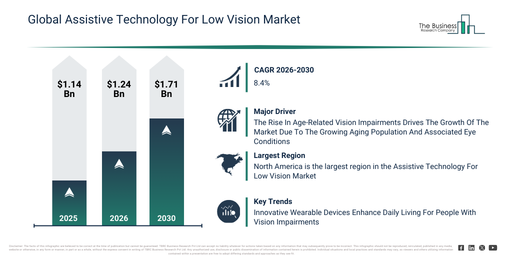
    The assistive technology for low vision market size has experienced significant expansion in recent years. It is anticipated to grow from $1.14 billion in 2025 to $1.24 billion in 2026, achieving a compound annual growth rate (CAGR) of 8.8%. The historical rise in this market can be attributed to factors such as a greater incidence of age-related vision impairment, increased accessibility of optical magnification devices, heightened understanding of assistive technologies, the proliferation of special education programs, and enhanced institutional support for individuals with visual disabilities.

    The assistive technology for low vision market size is anticipated to experience substantial growth over the coming years. This market is projected to expand to $1.71 billion by 2030, exhibiting a compound annual growth rate (CAGR) of 8.4%. The factors contributing to this anticipated expansion during the forecast period encompass an increasing global aging population, the rising uptake of digital assistive devices, greater investment in inclusive healthcare technologies, the broadening availability of remote and home-based care solutions, and ongoing progress in computer vision technologies. Noteworthy trends for the forecast period involve the expanding adoption of AI-enabled visual assistance tools, the increasing deployment of wearable low vision devices, the deeper integration of audio-visual assistive solutions, the proliferation of smartphone-based vision assistance applications, and a stronger emphasis on personalized vision support.

    Download the Free Sample Report to Explore Key Market Insights:

    https://www.thebusinessresearchcompany.com/sample.aspx?id=25700&type=smp

    Which Market Drivers Are Supporting The Expansion Of The Assistive Technology For Low Vision Market?

    The future expansion of the assistive technology for low-vision market is anticipated to be fueled by the growing occurrence of age-related vision impairments. These impairments describe the progressive reduction in sight that naturally accompanies aging, encompassing conditions like age-related macular degeneration, cataracts, glaucoma, and diabetic retinopathy. The rise in these vision issues primarily stems from the expanding elderly demographic, given that older individuals face a higher susceptibility to developing ocular conditions such as macular degeneration, cataracts, and glaucoma over time. Assistive technology for low vision addresses age-related vision impairments by improving residual visual capabilities and allowing older adults to preserve their autonomy in everyday tasks. For example, data from August 2023, supplied by the World Health Organization, a Switzerland-based specialized health agency of the United Nations, indicated that a minimum of 2.2 billion people worldwide suffer from either near or distance vision impairment. Nevertheless, estimations reveal that merely 36% of individuals with distance vision impairment due to refractive errors and only 17% of those with vision impairment caused by cataracts have accessed suitable treatment. Consequently, the expanding occurrence of age-related vision impairments is a significant factor propelling the expansion of the assistive technology for low-vision market.

    What Segmentation Levels Are Considered In The Assistive Technology For Low Vision Market?

    The assistive technology for low vision market covered in this report is segmented –

    1) By Product Type: Electronic Magnifiers, Screen Readers, Optical Magnifiers, Video Magnifiers, Smartphone Applications

    2) By Technology Type: Low-Tech Solutions, High-Tech Solutions, AI-Based Vision Assistance Systems, Wearable Technology, Augmented Reality Solutions

    3) By Application: Blind Schools, Enterprises And Social Organizations, Personal Use, Federations And Hospitals

    4) By Distribution Channel: Online Retail, Brick-And-Mortar Stores, Direct Sales, Third-Party Distributors, Wholesale Suppliers

    5) By End-User: Individuals, Educational Institutions, Healthcare Providers, Senior Care Facilities, Government Organizations

    Subsegments:

    1) By Electronic Magnifiers: Desktop Electronic Magnifiers, Portable Electronic Magnifiers, Wearable Electronic Magnifiers

    2) By Screen Readers: Windows-Based Screen Readers, Mac Operating System Based Screen Readers, Android-Based Screen Readers, Linux-Based Screen Readers

    3) By Optical Magnifiers: Handheld Magnifiers, Stand Magnifiers, Spectacle Magnifiers, Dome Magnifiers

    4) By Video Magnifiers: Closed-Circuit Television-Based Video Magnifiers, Head-Mounted Video Magnifiers, Portable Video Magnifiers

    5) By Smartphone Applications: Text-to-Speech Apps, Object Recognition Apps, Navigation And Wayfinding Apps, Magnification And Contrast Adjustment Apps

    What Trends Are Advancing Progress In The Assistive Technology For Low Vision Market?

    Leading companies in the assistive technology for low vision market are concentrating on developing innovative solutions, such as wearable electronic low vision devices, to enhance visual assistance and improve users’ quality of life. Wearable electronic low vision devices are portable gadgets worn by individuals that utilize technology like cameras and displays to improve visual clarity for those with vision impairments. For instance, in January 2023, eSight Corporation, a technology company based in Canada, introduced its latest assistive device, the eSight Go, specifically designed for people with legal blindness. This device features full high-definition organic light-emitting diode screens, a high-resolution smart autofocus camera, and a wide 45° field of view that maintains natural peripheral vision, allowing for full mobility. Its lightweight, wireless design supports up to 24x magnification and provides customizable color and contrast settings, offering enhanced visual clarity and comfort for extended daily use, particularly for those experiencing central vision loss.

    Which Leading Firms Are Contributing To The Growth Of The Assistive Technology For Low Vision Market?

    Major companies operating in the assistive technology for low vision market are Vispero Holdings LLC, HumanWare Group, Freedom Scientific Inc., Aira Tech Corp., Low Vision International AB, IrisVision Global Inc., SELVAS Healthcare Inc., KAPSYS PTE. LTD., Sight and Sound Technology, Envision Technologies B.V., American Thermoform Corporation, Dot Incorporation Ltd, Optelec B.V., ViewPlus Technologies Inc., VisionAid Technologies Limited., Access Ingenuity LLC, Zoomax Technology Co. Limited, OrCam Technologies Ltd., Chuck Cohen Technology Inc., Quantum Reading Learning Vision.

    Read the full assistive technology for low vision market report here:

    https://www.thebusinessresearchcompany.com/report/assistive-technology-for-low-vision-global-market-report

    How Is The Assistive Technology For Low Vision Market Distributed Across Key Geographic Regions?

    North America was the largest region in the assistive technology for low vision market in 2025. The regions covered in the assistive technology for low vision market report are Asia-Pacific, South East Asia, Western Europe, Eastern Europe, North America, South America, Middle East, Africa.

    Request A Tailored Assistive Technology For Low Vision Market Research Report For Competitive Advantage:

    https://www.thebusinessresearchcompany.com/customise?id=25700&type=smp

    Browse Through More Reports Similar to the Global Assistive Technology For Low Vision Market 2026, By The Business Research Company

    Vision Care Devices And Equipment Global Market Report

    https://www.thebusinessresearchcompany.com/report/vision-care-devices-and-equipment-global-market-report

    Robotic Vision Global Market Report

    https://www.thebusinessresearchcompany.com/report/robotic-vision-global-market-report

    Disabled And Elderly Assistive Technology Global Market Report

    https://www.thebusinessresearchcompany.com/report/disabled-and-elderly-assistive-technology-global-market-report

    Get in touch with us:

    The Business Research Company: https://www.thebusinessresearchcompany.com/

    Americas +1 310-496-7795

    Asia +44 7882 955267 & +91 8897263534

    Europe +44 7882 955267

    Email us at info@tbrc.info

    Follow us on:

    LinkedIn: https://in.linkedin.com/company/the-business-research-company

    YouTube: https://www.youtube.com/channel/UC24_fI0rV8cR5DxlCpgmyFQ

    Global Market Model: https://www.thebusinessresearchcompany.com/global-market-model
  • A key trend shaping the Artificial Intelligence (AI) Enhanced Remote Physiotherapy Market involves the Artificial Intelligence (AI)-Powered Digital Care Assistants Enhancing Patient Engagement And Rehabilitation

    A key trend shaping the Artificial Intelligence (AI) Enhanced Remote Physiotherapy Market involves the Artificial Intelligence (AI)-Powered Digital Care Assistants Enhancing Patient Engagement And Rehabilitation

    The Business Research Company’s 2026 market reports include new capabilities such as market attractiveness scoring and analysis, total addressable market analysis, company scoring matrix, interactive excel data dashboard, improved supply chain analysis, upcoming startups in the market, and overview of key products, aimed at improving the depth, usability, and strategic value of the insights delivered.

    What Is The Estimated Market Size Of The Artificial Intelligence (AI) Enhanced Remote Physiotherapy Market During 2026–2030?

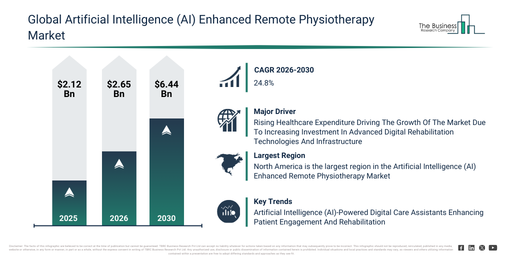
    The artificial intelligence (AI) enhanced remote physiotherapy market has seen substantial growth over recent years. Forecasts show it will expand from $2.12 billion in 2025 to $2.65 billion in 2026, demonstrating a compound annual growth rate (CAGR) of 25.1%. This historical market expansion is primarily due to the increased availability of telehealth services, a rise in musculoskeletal disorders, greater adoption of wearable health devices, the emergence of home-based care models, and advancements in remote monitoring technologies.

    The artificial intelligence (AI) enhanced remote physiotherapy market is projected to experience rapid expansion over the coming years. This market is anticipated to reach $6.44 billion by 2030, exhibiting a compound annual growth rate (CAGR) of 24.8%. This expansion during the projection period stems from heightened investments in AI-powered rehabilitation platforms, a growing need for ongoing therapy monitoring, the broadening of geriatric and chronic care initiatives, greater incorporation of physiotherapy into digital health ecosystems, and an intensified emphasis on preventive rehabilitation strategies. Key developments anticipated in this period encompass the increasing deployment of AI-based motion tracking, greater uptake of wearable physiotherapy devices, a rising need for tailored exercise regimens, the proliferation of remote rehabilitation solutions, and a stronger focus on therapy outcomes.

    Download the Free Sample Report to Explore Key Market Insights:

    https://www.thebusinessresearchcompany.com/sample.aspx?id=28907&type=smp

    Which Major Factors Are Driving The Expansion Of The Artificial Intelligence (AI) Enhanced Remote Physiotherapy Market?

    The escalating healthcare expenditure is anticipated to drive the expansion of the artificial intelligence (AI) enhanced remote physiotherapy market. This expenditure represents the total funds allocated by governments, individuals, and private entities for healthcare services, including medical treatments, equipment, infrastructure, and personnel. The increase in healthcare spending is attributed to the rising incidence of chronic diseases, which demand long-term and costly treatments. Such spending facilitates the adoption of artificial intelligence (AI)–enhanced remote physiotherapy by enabling greater investment in advanced technologies, digital infrastructure, and personalized rehabilitation solutions. For instance, in May 2024, the Office for National Statistics, a UK-based government department, reported that total healthcare expenditure saw a 5.6% increase in nominal terms from 2022 to 2023, marking a notable acceleration compared to the 0.9% growth observed in 2022. Consequently, the rising healthcare expenditure is propelling the growth of the artificial intelligence (AI) enhanced remote physiotherapy market.

    How Are The Various Segments Of The Artificial Intelligence (AI) Enhanced Remote Physiotherapy Market Categorized?

    The artificial intelligence (AI) enhanced remote physiotherapy market covered in this report is segmented –

    1) By Component: Software, Hardware, Services

    2) By Therapy Type: Musculoskeletal, Neurological, Cardiopulmonary, Pediatric, Geriatric, Other Therapy Types

    3) By Deployment Mode: Cloud-Based, On-Premises

    4) By Application: Rehabilitation, Pain Management, Preventive Care, Other Applications

    5) By End-User: Hospitals And Clinics, Homecare Settings, Rehabilitation Centers, Other End-Users

    Subsegments:

    1) By Software: Virtual Therapy Platforms, Artificial Intelligence Analytics Software, Exercise Prescription Software, Patient Monitoring Software

    2) By Hardware: Wearable Devices, Motion Sensors, Rehabilitation Robotics, Mobile Devices

    3) By Services: Remote Consultation Services, Data Analysis Services, Therapy Session Management Services, Training And Support Services

    What Trends Are Advancing Progress In The Artificial Intelligence (AI) Enhanced Remote Physiotherapy Market?

    Leading businesses within the artificial intelligence (AI) enhanced remote physiotherapy market are prioritizing the creation of sophisticated solutions, specifically AI-powered digital care assistants, with the aim of improving patient involvement and recovery results. These AI-powered digital care assistants function as intelligent virtual companions, utilizing artificial intelligence to deliver immediate guidance, encouragement, and customized feedback throughout physical therapy sessions. An example of this is Kaia Health, a US-based digital therapeutics company, which introduced Angela in June 2023, marking it as the industry’s inaugural AI-powered voice-based digital care assistant designed to aid patients undergoing at-home physiotherapy. This innovative system supports users via voice interaction, providing real-time motivation, exercise instructions, and educational information customized to individual requirements. Integrated into Kaia Health’s AI-based musculoskeletal (MSK) platform, it facilitates continuous remote support and monitors progress, thereby boosting therapy adherence, bettering rehabilitation results, and delivering a more engaging, human-like digital physiotherapy experience.

    Which Major Firms Influence Developments In The Artificial Intelligence (AI) Enhanced Remote Physiotherapy Market?

    Major companies operating in the artificial intelligence (AI) enhanced remote physiotherapy market are Hinge Health Inc., Sword Health, SPRY Inc., Kaia Health Technologies GmbH, XRHealth Inc., Moterum Technologies Inc., Physitrack Group AB., MIRA REHAB LIMITED, Band Connect Inc., CUREosity GmbH, BlueJay Mobile Health Inc., Kinomatic Pty Ltd., Vitrue Health Inc., BioSensics Inc., Wizecare Inc., Limber Health Inc., Akina Inc., Zerapy Inc., Preve Inc., Flok Health Inc.

    Read the full artificial intelligence (ai) enhanced remote physiotherapy market report here:

    https://www.thebusinessresearchcompany.com/report/artificial-intelligence-ai-enhanced-remote-physiotherapy-global-market-report

    Which Region Currently Holds The Largest Share Of The Artificial Intelligence (AI) Enhanced Remote Physiotherapy Market?

    North America was the largest region in the artificial intelligence (AI) enhanced remote physiotherapy market in 2025. Asia-Pacific is expected to be the fastest-growing region in the forecast period. The regions covered in the artificial intelligence (AI) enhanced remote physiotherapy market report are Asia-Pacific, South East Asia, Western Europe, Eastern Europe, North America, South America, Middle East, Africa.

    Request A Tailored Artificial Intelligence (AI) Enhanced Remote Physiotherapy Market Research Report For Competitive Advantage:

    https://www.thebusinessresearchcompany.com/customise?id=28907&type=smp

    Browse Through More Reports Similar to the Global Artificial Intelligence (AI) Enhanced Remote Physiotherapy Market 2026, By The Business Research Company

    Physiotherapy Services Global Market Report

    https://www.thebusinessresearchcompany.com/report/physiotherapy-services-global-market-report

    Ai In Medical Devices Global Market Report

    https://www.thebusinessresearchcompany.com/report/ai-in-medical-devices-global-market-report

    Physiotherapy Equipment And Accessories Global Market Report

    https://www.thebusinessresearchcompany.com/report/physiotherapy-equipment-and-accessories-global-market-report

    Get in touch with us:

    The Business Research Company: https://www.thebusinessresearchcompany.com/

    Americas +1 310-496-7795

    Asia +44 7882 955267 & +91 8897263534

    Europe +44 7882 955267

    Email us at info@tbrc.info

    Follow us on:

    LinkedIn: https://in.linkedin.com/company/the-business-research-company

    YouTube: https://www.youtube.com/channel/UC24_fI0rV8cR5DxlCpgmyFQ

    Global Market Model: https://www.thebusinessresearchcompany.com/global-market-model
  • A significant industry trend in the Arthrogryposis Market includes the Advancements In Growth-Modulation Technologies Improve Orthopedic Management In Arthrogryposis

    A significant industry trend in the Arthrogryposis Market includes the Advancements In Growth-Modulation Technologies Improve Orthopedic Management In Arthrogryposis

    The Business Research Company’s 2026 market reports include new capabilities such as market attractiveness scoring and analysis, total addressable market analysis, company scoring matrix, interactive excel data dashboard, improved supply chain analysis, upcoming startups in the market, and overview of key products, aimed at improving the depth, usability, and strategic value of the insights delivered.

    What Market Size Expansion Is Predicted For The Arthrogryposis Market Between 2026 And 2030?

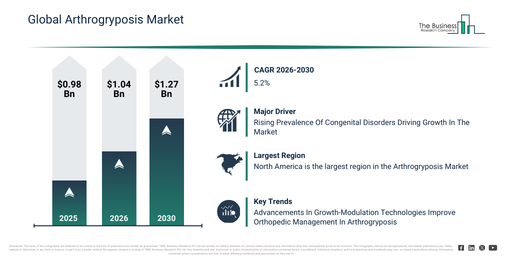
    The arthrogryposis market has experienced significant growth in recent years. It is anticipated to increase from $0.98 billion in 2025 to $1.04 billion in 2026, registering a compound annual growth rate (CAGR) of 5.5%. The expansion witnessed in the past can be attributed to a better clinical comprehension of congenital disorders, the enlargement of pediatric orthopedic care, improved availability of rehabilitation services, the adoption of physical therapy interventions, and the development of specialized treatment centers.

    The arthrogryposis market is anticipated to experience significant expansion in the coming years. It is projected to reach $1.27 billion by 2030, exhibiting a compound annual growth rate (CAGR) of 5.2%. This growth over the forecast period is primarily driven by heightened investments in rare disease research, a rising demand for customized rehabilitation programs, the broadening of early screening initiatives, an increased focus on improving long-term quality of life, and the greater integration of advanced diagnostic technologies. Key developments expected during this period include a stronger emphasis on prompt diagnosis and intervention, the increasing adoption of multidisciplinary treatment approaches, the expanding utilization of advanced imaging diagnostics, the development of more comprehensive long-term rehabilitation programs, and enhanced supportive care strategies.

    Download the Free Sample Report to Explore Key Market Insights:

    https://www.thebusinessresearchcompany.com/sample.aspx?id=21105&type=smp

    What Key Drivers Are Influencing The Growth Of The Arthrogryposis Market?

    The increasing occurrence of congenital disorders is anticipated to fuel the expansion of the arthrogryposis market in the future. Congenital disorders are defined as structural or functional anomalies that arise during fetal development and are present at birth. The rising prevalence of these disorders stems from factors such as advancements in prenatal diagnostics, exposure to environmental elements, genetic mutations, and shifts in lifestyle. Arthrogryposis aids in comprehending congenital disorders by emphasizing the significance of fetal movement, genetic predispositions, and neuromuscular development in the emergence of musculoskeletal abnormalities. For example, in February 2023, data from the World Health Organization, a Switzerland-based intergovernmental organization, indicated that approximately 240,000 newborns globally die from congenital disorders annually within their first 28 days of life. Moreover, congenital conditions are responsible for an estimated 170,000 child fatalities between the ages of 1 month and 5 years. Therefore, the growing prevalence of congenital disorders is stimulating growth in the arthrogryposis market.

    Which Market Segments Are Examined In The Arthrogryposis Market Study?

    The arthrogryposis market covered in this report is segmented –

    1) By Type: Classic Arthrogryposis, Distal Arthrogryposis, Amyoplasia

    2) By Treatment Type: Occupational Therapists, Physical Therapy, Surgery, Imaging Diagnostics

    3) By Patient Age: Children, Adults

    Subsegments:

    1) By Classic Arthrogryposis: Multiple Joint Involvement, Flexion Contractures, Severe Muscle Weakness, Progressive Arthrogryposis, Intellectual Impairment

    2) By Distal Arthrogryposis: Isolated Limb Involvement, Contractures of Hands and Feet, Distal Joint Contractures, Autosomal Dominant Inheritance

    3) By Amyoplasia: Severe Limb Contractures, Muscle Hypotonia (low muscle tone), No Cognitive Impairment, Symmetric Joint Involvement, Lack Of Muscle Development In Affected Limbs

    How Are Trends Transforming The Arthrogryposis Market Landscape?

    Leading companies in the arthrogryposis treatment market are concentrating on developing advanced orthopedic solutions, such as guided-growth systems, to improve deformity correction, reduce surgical burden, and support better functional outcomes for affected patients. These guided-growth systems allow for the controlled modulation of bone alignment during a child’s development, enabling clinicians to gradually correct joint contractures with minimal tissue disruption. For example, in June 2023, OrthoPediatrics Corp., a US-based pediatric orthopedic company, launched a growth modulation system that features guided implant technology. This technology offers precise intraoperative alignment control, minimally invasive implantation, patient-specific sizing options, compatibility with standard surgical instruments, and enhanced monitoring of growth progression. This technology, engineered to facilitate targeted deformity correction, provides clinicians with a more controlled and less invasive method for managing the joint abnormalities typically associated with arthrogryposis.

    Who Are The Primary Competitors In The Arthrogryposis Market?

    Major companies operating in the arthrogryposis market are Boston Children’s Hospital, Seattle Children’s Hospital, Shriners Hospitals for Children, Texas Scottish Rite Hospital for Children, Gillette Children’s Specialty Healthcare, Cleveland Clinic, Johns Hopkins Hospital, Mayo Clinic, Children’s Hospital of Philadelphia, Nationwide Children’s Hospital, Children’s Healthcare of Atlanta, Nemours Children’s Health, Phoenix Children’s Hospital, Cincinnati Children’s Hospital Medical Center, St Jude Children’s Research Hospital, Rady Children’s Hospital San Diego, Children’s National Hospital, Great Ormond Street Hospital, SickKids Hospital Toronto, Royal Children’s Hospital Melbourne

    Read the full arthrogryposis market report here:

    https://www.thebusinessresearchcompany.com/report/arthrogryposis-global-market-report

    Which Region Is Expected To Register The Fastest Growth In The Arthrogryposis Market?

    North America was the largest region in the arthrogryposis market in 2025. Asia-Pacific is expected to be the fastest-growing region in the forecast period. The regions covered in the arthrogryposis market report are Asia-Pacific, South East Asia, Western Europe, Eastern Europe, North America, South America, Middle East, Africa.

    Request A Tailored Arthrogryposis Market Research Report For Competitive Advantage:

    https://www.thebusinessresearchcompany.com/customise?id=21105&type=smp

    Browse Through More Reports Similar to the Global Arthrogryposis Market 2026, By The Business Research Company

    Immunohematology Global Market Report

    https://www.thebusinessresearchcompany.com/report/immunohematology-global-market-report

    Bioceramics Global Market Report

    https://www.thebusinessresearchcompany.com/report/bioceramics-global-market-report

    Chondroplasty Global Market Report

    https://www.thebusinessresearchcompany.com/report/chondroplasty-global-market-report

    Get in touch with us:

    The Business Research Company: https://www.thebusinessresearchcompany.com/

    Americas +1 310-496-7795

    Asia +44 7882 955267 & +91 8897263534

    Europe +44 7882 955267

    Email us at info@tbrc.info

    Follow us on:

    LinkedIn: https://in.linkedin.com/company/the-business-research-company

    YouTube: https://www.youtube.com/channel/UC24_fI0rV8cR5DxlCpgmyFQ

    Global Market Model: https://www.thebusinessresearchcompany.com/global-market-model
  • Assistive Technologies For Visually Impaired Market Outlook 2026–2035 Driven by Key Growth Factors and Industry Projections

    Assistive Technologies For Visually Impaired Market Outlook 2026–2035 Driven by Key Growth Factors and Industry Projections

    The Business Research Company’s 2026 market reports include new capabilities such as market attractiveness scoring and analysis, total addressable market analysis, company scoring matrix, interactive excel data dashboard, improved supply chain analysis, upcoming startups in the market, and overview of key products, aimed at improving the depth, usability, and strategic value of the insights delivered.

    What Market Size Increase Is Anticipated For The Assistive Technologies For Visually Impaired Market Over The 2026–2030 Period?

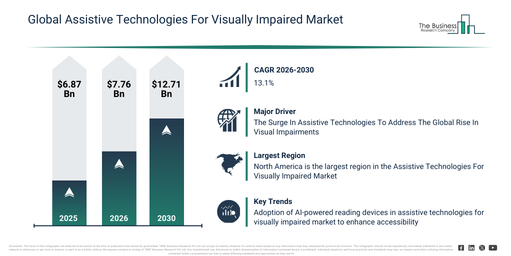
    The market for assistive technologies supporting the visually impaired has experienced rapid expansion in recent years. It is anticipated to increase from $6.87 billion in 2025 to $7.76 billion in 2026, with a compound annual growth rate of 12.9%. The historical growth can be linked to heightened awareness concerning accessibility needs for visual impairment, the expansion of special education programs, an increase in the availability of assistive devices, rising institutional support for disability inclusion, and broader penetration of screen reader technologies.

    The market size for assistive technologies tailored for the visually impaired is anticipated to undergo significant growth in the forthcoming years, projected to reach $12.71 billion by 2030, demonstrating a compound annual growth rate (CAGR) of 13.1%. This expansion during the forecast period can be attributed to the increasing incorporation of AI and computer vision, a rise in investments dedicated to inclusive technology development, the broadening of smart city accessibility programs, an escalating demand for customized assistive solutions, and the wider uptake of wearable assistive devices. Furthermore, key trends anticipated within this period encompass the growing acceptance of AI-driven assistive software, an increase in the utilization of smart and wearable navigation tools, a rising need for accessible digital learning resources, the spread of connected mobility assistance, and a heightened emphasis on user-focused assistive design.

    Download the Free Sample Report to Explore Key Market Insights:

    https://www.thebusinessresearchcompany.com/sample.aspx?id=13598&type=smp

    What Underlying Factors Are Accelerating The Growth Of The Assistive Technologies For Visually Impaired Market?

    The increasing occurrence of visual impairments and blindness is anticipated to drive the expansion of the assistive technologies for the visually impaired market moving forward. Visual impairment and blindness describe conditions where an individual has limited or no ability to see, affecting their vision to varying degrees. Assistive technologies enhance accessibility for individuals with these conditions, providing essential support, such as Braille displays, for improved navigation, access to information, and communication. For instance, in August 2023, data from the World Health Organization, a Switzerland-based United Nations specialized agency for global public health, indicated that worldwide, a significant 2.2 billion people experience vision impairment, with 1 billion of these cases being either preventable or inadequately treated. Additionally, refractive errors affect 36% of these individuals, and 17% contend with impairment caused by cataracts. Therefore, the growing incidence of visual impairments and blindness is propelling the growth of the assistive technologies for the visually impaired market.

    How Is The Assistive Technologies For Visually Impaired Market Segmented Across Key Categories?

    The assistive technologies for visually impaired market covered in this report is segmented –

    1) By Type: Educational Devices And Software, Mobility Devices, Low Vision Devices

    2) By Distribution Channel: Hospital Pharmacies, Retail Pharmacies, Optical Stores, Online Pharmacies

    3) By End User: Blind Schools, Enterprises And Social Organizations, Personal Use, Hospitals, Other End Users

    Subsegments:

    1) By Educational Devices And Software: Braille Notetakers, Screen Readers, Accessible Learning Software

    2) By Mobility Devices: Canes (Traditional And Smart Canes), GPS Navigation Devices, Wearable Technology For Navigation

    3) By Low Vision Devices: Magnifiers (Handheld And Electronic), Telescopic Lenses, Digital Magnification Devices

    How Are Trends Transforming The Assistive Technologies For Visually Impaired Market Landscape?

    Major companies operating in the assistive technologies for visually impaired market are concentrating on developing technological advancements like AI-powered handheld reading devices. These devices aim for real-time text recognition and scene understanding to enhance reading independence, improve usability, and reduce reliance on sighted assistance. An AI-powered handheld reading device utilizes a combination of computer vision and optical character recognition (OCR) to instantly convert printed, handwritten, or digital text into spoken feedback, much like a personal reader. This functionality allows for smoother, faster access to information, offers more language support, and reduces reliance on additional assistive tools. For instance, in November 2023, OrCam Technologies, an Israel-based assistive technology company, launched the OrCam Read 3, an AI-powered handheld reading device. This product reads text aloud from books, menus, screens, or any printed surface; supports 17 languages; offers point-and-click guidance to select text; and delivers real-time audio through its built-in speaker or headphones, enabling visually impaired users to read independently, quickly, and accurately while decreasing dependence on other assistive devices.

    Who Are The Dominant Players Shaping The Assistive Technologies For Visually Impaired Market Landscape?

    Major companies operating in the assistive technologies for visually impaired market are OrCam Technologies Ltd., Vispero, Freedom Scientific Inc., Humanware Pty. Ltd., Amedia Corporation, Aira Tech Corp., LVI Low Vision International AB, Maxi-Aids, Dolphin Computer Access Ltd., Eschenbach Optik GmbH, eSight Corporation, Zoomax Inc., Ash Technologies, ViewPlus Technologies Inc., Envision AI, Ai Squared Inc., Eyedaptic Inc., ABiSee Inc., American Thermoform Corporation, Boundless Assistive Technology, Torchit

    Read the full assistive technologies for visually impaired market report here:

    https://www.thebusinessresearchcompany.com/report/assistive-technologies-for-visually-impaired-global-market-report

    Which Region Is Projected To Dominate The Assistive Technologies For Visually Impaired Market During The Forecast Period?

    North America was the largest region in the assistive technologies for visually impaired market in 2025. Asia-Pacific is expected to be the fastest-growing region in the forecast period. The regions covered in the assistive technologies for visually impaired market report are Asia-Pacific, South East Asia, Western Europe, Eastern Europe, North America, South America, Middle East, Africa.

    Request A Tailored Assistive Technologies For Visually Impaired Market Research Report For Competitive Advantage:

    https://www.thebusinessresearchcompany.com/customise?id=13598&type=smp

    Browse Through More Reports Similar to the Global Assistive Technologies For Visually Impaired Market 2026, By The Business Research Company

    Disabled And Elderly Assistive Technology Global Market Report

    https://www.thebusinessresearchcompany.com/report/disabled-and-elderly-assistive-technology-global-market-report

    Elderly And Disabled Assistive Devices Global Market Report

    https://www.thebusinessresearchcompany.com/report/elderly-and-disabled-assistive-devices-global-market-report

    Vision Care Devices And Equipment Global Market Report

    https://www.thebusinessresearchcompany.com/report/vision-care-devices-and-equipment-global-market-report

    Get in touch with us:

    The Business Research Company: https://www.thebusinessresearchcompany.com/

    Americas +1 310-496-7795

    Asia +44 7882 955267 & +91 8897263534

    Europe +44 7882 955267

    Email us at info@tbrc.info

    Follow us on:

    LinkedIn: https://in.linkedin.com/company/the-business-research-company

    YouTube: https://www.youtube.com/channel/UC24_fI0rV8cR5DxlCpgmyFQ

    Global Market Model: https://www.thebusinessresearchcompany.com/global-market-model
  • Assisted Reproductive Technology Market Developments and Growth Opportunities Across 2026–2030

    Assisted Reproductive Technology Market Developments and Growth Opportunities Across 2026–2030

    The Business Research Company’s 2026 market reports include new capabilities such as market attractiveness scoring and analysis, total addressable market analysis, company scoring matrix, interactive excel data dashboard, improved supply chain analysis, upcoming startups in the market, and overview of key products, aimed at improving the depth, usability, and strategic value of the insights delivered.

    How Much Is The Assisted Reproductive Technology Market Expected To Grow In Terms Of Market Value Between 2026 And 2030?

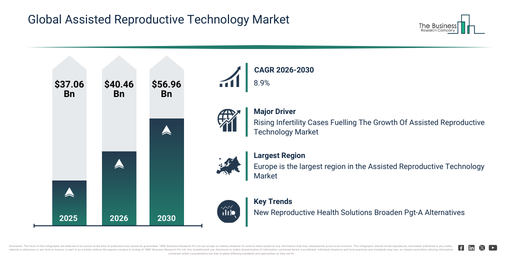
    The assisted reproductive technology market size has experienced significant expansion recently. It is projected to grow from $37.06 billion in 2025 to $40.46 billion in 2026, at a compound annual growth rate (CAGR) of 9.2%. Historically, this market’s expansion can be attributed to factors such as a rise in infertility prevalence, the trend of increasing maternal age, the proliferation of fertility clinics, the growing accessibility of assisted reproductive procedures, and enhanced societal acceptance of ART treatments.

    The assisted reproductive technology market is anticipated to experience substantial expansion over the coming years. This market is projected to reach $56.96 billion by 2030, exhibiting a compound annual growth rate (CAGR) of 8.9%. Factors contributing to this growth during the forecast period include a greater uptake of precision fertility diagnostics, heightened investments in fertility treatment infrastructure, wider use of genetic testing applications, a growing preference for minimally invasive procedures, and increased healthcare expenditure on reproductive health. Key trends expected within this period involve the rising implementation of advanced embryo screening techniques, increased utilization of frozen embryo and egg banking, an expanding demand for personalized fertility treatments, the broader integration of genetic testing in ART procedures, and a stronger emphasis on improving treatment success rates.

    Download the Free Sample Report to Explore Key Market Insights:

    https://www.thebusinessresearchcompany.com/sample.aspx?id=5489&type=smp

    Which Growth Drivers Are Contributing To The Progress Of The Assisted Reproductive Technology Market?

    The increasing number of infertility cases is anticipated to boost the assisted reproductive technology market in the coming years. Infertility is defined as the failure to achieve pregnancy after one year of frequent and unprotected sexual intercourse. This condition affects both men and women, typically diagnosed by the inability to conceive. Assisted reproductive technology (ART) is utilized for treating infertility, encompassing fertility therapies that work with both a woman’s egg and a man’s sperm. For instance, in April 2023, according to the World Health Organization (WHO), a Switzerland-based international public health organization, millions of people worldwide of reproductive age will face infertility, impacting their families and communities. Globally, an estimated 1 in 6 adults, or about 17.5% of the global adult population, experience infertility. Therefore, the rising incidence of infertility cases is a key driver for the growth of the assisted reproductive technology market.

    What Major Segment Divisions Exist Within The Assisted Reproductive Technology Market?

    The assisted reproductive technology market covered in this report is segmented –

    1) By Diagnosis: Hysterosalpingography, Ovarian Reserve Testing, Genetic Testing

    2) By Procedure Type: Fresh Non-Donor, Fresh Donor, Frozen Donor, Frozen Non-Donor, Embryo Or Egg Banking

    3) By End-User: Hospitals, Fertility Clinics, Other End-Users

    Subsegments:

    1) By Hysterosalpingography (HSG): X-ray HSG, Sonohysterography (SHG)

    2) By Ovarian Reserve Testing: Follicle Stimulating Hormone (FSH) Testing, Anti-Müllerian Hormone (AMH) Testing, Antral Follicle Count (AFC) via Ultrasound

    3) By Genetic Testing: Preimplantation Genetic Testing (PGT), Carrier Screening Tests, Genetic Compatibility Testing

    Which Trends Are Impacting The Growth Of The Assisted Reproductive Technology Market?

    Leading companies in the assisted reproductive technology market are concentrating on developing advanced solutions, such as next-generation sequencing (NGS)-based testing kits, to enhance chromosomal analysis, improve embryo selection, and elevate the success rates of fertility treatments. NGS-based preimplantation genetic testing involves research-use technologies that enable a thorough assessment of chromosomal abnormalities in embryos, supporting informed decision-making during IVF and ICSI procedures. For instance, in July 2023, Thermo Fisher Scientific Inc., a US-based biotechnology company, launched two next-generation sequencing-based products: the Ion ReproSeq PGT-A Kit and the Ion AmpliSeq Polyploidy Kit, to support preimplantation genetic testing for aneuploidy (PGT-A). These assays, designed for reproductive health laboratories, are the first research-use products of their kind and are compatible with the Ion Torrent Genexus Integrated Sequencer, facilitating a streamlined workflow from sample processing to aneuploidy analysis. PGT-A testing aids in identifying chromosomal abnormalities in embryo samples, and these new solutions aim to advance scientific understanding, improve pregnancy success rates, and promote healthier outcomes for future generations. The Genexus platform further simplifies the research process through integrated templating, sequencing, and data analysis, while the Ion AmpliSeq Polyploidy Panel kit offers enhanced quality control features to detect contamination, prevent sample mix-ups, and identify triploidy in embryos, reinforcing technological progress within the assisted reproductive technology market.

    Which Companies Are Leading Innovation In The Assisted Reproductive Technology Market?

    Major companies operating in the assisted reproductive technology market are Cooper Surgical Inc., Ferring Pharmaceuticals Ltd., Hamilton Thorne Ltd., Merck KGaA, Genea Limited, California Cryobank, European Sperm Bank, OvaScience Inc., Bloom IVF Centre, Vitrolife AB, FUJIFILM Irvine Scientific Inc., Nidacon International AB, Monash IVF Group Ltd., Cook Medical, INVO Bioscience Inc., Thermo Fisher Scientific Inc., Anecova Sa, Carolinas Fertility Institute, Microm Ltd., Inception Sciences Inc., Progyny Inc., Oxford Gene Technology IP Ltd., IVI-RMA Global, Boston IVF, CARE Fertility Group, Virtus Health, Reproductive Medicine Associates of New York, Shady Grove Fertility, CCRM Fertility, New Hope Fertility Center, Houston Fertility Institute, Pacific Fertility Center, RMA of New Jersey, Sher Fertility Institute, IVF Florida, ORM Fertility, HRC Fertility, Arizona Center for Reproductive Endocrinology & Infertility, San Diego Fertility Center, Fertility Centers of Illinois

    Read the full assisted reproductive technology market report here:

    https://www.thebusinessresearchcompany.com/report/assisted-reproductive-technology-global-market-report

    What Are The Leading Geographic Regions In The Assisted Reproductive Technology Market?

    Europe was the largest region in the assisted reproductive technology market in 2025. North America was the second-largest region in assisted reproductive technology market. The regions covered in the assisted reproductive technology market report are Asia-Pacific, South East Asia, Western Europe, Eastern Europe, North America, South America, Middle East, Africa.

    Request A Tailored Assisted Reproductive Technology Market Research Report For Competitive Advantage:

    https://www.thebusinessresearchcompany.com/customise?id=5489&type=smp

    Browse Through More Reports Similar to the Global Assisted Reproductive Technology Market 2026, By The Business Research Company

    Fertility Treatments Global Market Report

    https://www.thebusinessresearchcompany.com/report/fertility-treatments-global-market-report

    Fertility Services Global Market Report

    https://www.thebusinessresearchcompany.com/report/fertility-services-global-market-report

    Infertility Treatment Global Market Report

    https://www.thebusinessresearchcompany.com/report/infertility-treatment-global-market-report

    Get in touch with us:

    The Business Research Company: https://www.thebusinessresearchcompany.com/

    Americas +1 310-496-7795

    Asia +44 7882 955267 & +91 8897263534

    Europe +44 7882 955267

    Email us at info@tbrc.info

    Follow us on:

    LinkedIn: https://in.linkedin.com/company/the-business-research-company

    YouTube: https://www.youtube.com/channel/UC24_fI0rV8cR5DxlCpgmyFQ

    Global Market Model: https://www.thebusinessresearchcompany.com/global-market-model
  • A key trend shaping the Arthralgia Market involves the RMAT Designation Granted For Gene Therapy In Osteoarthritis Treatment

    A key trend shaping the Arthralgia Market involves the RMAT Designation Granted For Gene Therapy In Osteoarthritis Treatment

    The Business Research Company’s 2026 market reports include new capabilities such as market attractiveness scoring and analysis, total addressable market analysis, company scoring matrix, interactive excel data dashboard, improved supply chain analysis, upcoming startups in the market, and overview of key products, aimed at improving the depth, usability, and strategic value of the insights delivered.

    How Large Is The Arthralgia Market Projected To Become By 2030 Based On Its 2026 Valuation?

    The arthralgia market has experienced significant growth in recent years. It is anticipated to expand from $5.62 billion in 2025 to $6.09 billion in 2026, exhibiting a compound annual growth rate (CAGR) of 8.2%. Historically, this expansion has been driven by the increasing occurrence of joint-related conditions, a growing elderly population, heightened understanding of musculoskeletal well-being, the availability of more pharmaceutical options for pain management, and the growth of orthopedic care provided in outpatient settings.

    The arthralgia market is projected to experience substantial expansion over the upcoming years. By 2030, its valuation is anticipated to reach $8.26 billion, demonstrating a compound annual growth rate (CAGR) of 7.9%. This anticipated growth during the forecast period stems from several factors, including the escalating demand for tailored treatment plans, the expanding embrace of biologic and targeted therapies, the wider availability of at-home pain management options, an intensifying focus on sustained symptom management, and increased investments in research dedicated to joint health. Key trends defining this period encompass the growing acceptance of individualized pain management strategies, a rise in the application of combined treatment methods, an amplified emphasis on promptly diagnosing joint conditions, the proliferation of non-invasive options for pain relief, and improved patient-centric care models.

    Download the Free Sample Report to Explore Key Market Insights:

    https://www.thebusinessresearchcompany.com/sample.aspx?id=21104&type=smp

    What Major Growth Drivers Are Shaping The Outlook Of The Arthralgia Market?

    A growing number of rheumatoid arthritis instances is projected to stimulate the expansion of the arthralgia market in the future. Rheumatoid arthritis is a persistent autoimmune condition that predominantly impacts joints, causing inflammation, discomfort, and potential structural harm to them. The escalating prevalence of rheumatoid arthritis cases can be attributed to factors like an aging demographic, inherited susceptibility, shifts in lifestyle, and environmental elements including smoking and air contamination. Rheumatoid arthritis (RA) contributes to arthralgia by initiating long-term joint inflammation, which results in pain, rigidity, and gradual deterioration. As an illustration, data from February 2024, provided by Arthritis Australia, an Australia-based non-profit organization, indicates that by 2040, arthritis cases in Australia are anticipated to climb to 5.39 million from 4.11 million in 2025, with osteoarthritis projected to grow to 3.11 million from 2.35 million, and rheumatoid arthritis expected to reach 748,721. Consequently, the expanding incidence of rheumatoid arthritis is fueling the expansion of the arthralgia market.

    What Segment Groups Are Identified Within The Arthralgia Market?

    The arthralgia market covered in this report is segmented –

    1) By Cause: Osteoarthritis, Rheumatoid Arthritis, Gout, Psoriatic Arthritis, Lupus, Injuries, Infections, Other Causes

    2) By Treatment Type: Medications, Therapies, Surgical Interventions, Lifestyle And Home Remedies

    3) By Route Of Administration: Oral, Injectable, Topical, Transdermal

    4) By Distribution Channel: Hospital Pharmacies, Retail Pharmacies, Online Pharmacies

    5) By End User: Hospital, Clinics, Homecare Settings, Rehabilitation Centers

    Subsegments:

    1) By Osteoarthritis: Knee Osteoarthritis, Hip Osteoarthritis, Hand Osteoarthritis, Spine Osteoarthritis, Shoulder Osteoarthritis

    2) By Rheumatoid Arthritis: Seropositive Rheumatoid Arthritis, Seronegative Rheumatoid Arthritis, Juvenile Rheumatoid Arthritis, Early-Onset Rheumatoid Arthritis

    3) By Gout: Primary Gout, Secondary Gout, Gouty Arthritis

    4) By Psoriatic Arthritis: Symmetric Psoriatic Arthritis, Asymmetric Psoriatic Arthritis, Psoriatic Spondylitis, Distal Interphalangeal Predominant Psoriatic Arthritis

    5) By Lupus: Systemic Lupus Erythematosus (SLE), Discoid Lupus Erythematosus, Drug-induced Lupus, Neonatal Lupus

    6) By Injuries: Sports-related Injuries, Trauma and Fractures, Sprains and Strains, Tendon or Ligament Damage

    7) By Infections: Septic Arthritis, Viral Arthritis, Bacterial Infections, Fungal Infections

    8) By Other Causes: Fibromyalgia, Overuse Injuries, Sarcoidosis, Ankylosing Spondylitis, Crystal-induced Arthritis

    Which Trends Are Impacting The Growth Of The Arthralgia Market?

    Leading companies in the arthralgia market are prioritizing the creation of novel therapies, including RMAT-designated gene therapy, aiming to offer patients advanced solutions for sustained pain relief and enhanced joint function. An RMAT-designated gene therapy is a form of treatment granted Regenerative Medicine Advanced Therapy (RMAT) designation by the FDA, a status that accelerates the development and evaluation of groundbreaking gene therapies for severe or life-threatening ailments. For example, in March 2024, the U.S. Food and Drug Administration (FDA) awarded Regenerative Medicine Advanced Therapy (RMAT) designation to PCRX-201 (enekinragene inzadenovec), a product from Pacira BioSciences Inc., a US-based pharmaceutical firm. This candidate is an inventive intra-articular gene therapy that employs a helper-dependent adenovirus (HDAd) for addressing knee osteoarthritis. The therapy’s mechanism involves generating interleukin-1 receptor antagonists (IL-1Ra). Pacira expressed its satisfaction in securing the FDA’s inaugural RMAT designation for an osteoarthritis-focused gene therapy and highlighted the encouraging early clinical outcomes, indicating that PCRX-201 could potentially be a disease-modifying intervention.

    Which Companies Hold Significant Positions In The Arthralgia Market?

    Major companies operating in the arthralgia market are Pfizer Inc., Johnson & Johnson Services Inc., AbbVie Inc., Sanofi S.A., Bristol-Myers Squibb Company, AstraZeneca PLC, Novartis AG, GlaxoSmithKline PLC, Eli Lilly and Company, Amgen Inc., Teva Pharmaceutical Industries Ltd., Regeneron Pharmaceuticals Inc., Astellas Pharma Inc., Biogen Inc., UCB S.A., Hikma Pharmaceuticals PLC, Ferring Pharmaceuticals, KD Pharma Group S.A., SI-BONE Inc., Xalud Therapeutics Inc., Incannex Healthcare Limited, Cytonics Corporation

    Read the full arthralgia market report here:

    https://www.thebusinessresearchcompany.com/report/arthralgia-global-market-report

    Which Regions Are Projected To Dominate The Arthralgia Market In The Coming Years?

    North America was the largest region in the arthralgia market in 2025. The regions covered in the arthralgia market report are Asia-Pacific, South East Asia, Western Europe, Eastern Europe, North America, South America, Middle East, Africa.

    Request A Tailored Arthralgia Market Research Report For Competitive Advantage:

    https://www.thebusinessresearchcompany.com/customise?id=21104&type=smp

    Browse Through More Reports Similar to the Global Arthralgia Market 2026, By The Business Research Company

    Anthracite Global Market Report

    https://www.thebusinessresearchcompany.com/report/anthracite-global-market-report

    Artichokes Global Market Report

    https://www.thebusinessresearchcompany.com/report/artichokes-global-market-report

    Lenalidomide Global Market Report

    https://www.thebusinessresearchcompany.com/report/lenalidomide-global-market-report

    Get in touch with us:

    The Business Research Company: https://www.thebusinessresearchcompany.com/

    Americas +1 310-496-7795

    Asia +44 7882 955267 & +91 8897263534

    Europe +44 7882 955267

    Email us at info@tbrc.info

    Follow us on:

    LinkedIn: https://in.linkedin.com/company/the-business-research-company

    YouTube: https://www.youtube.com/channel/UC24_fI0rV8cR5DxlCpgmyFQ

    Global Market Model: https://www.thebusinessresearchcompany.com/global-market-model