Month: July 2026

  • Backseat Sunshade Curtains Market Growth Is Reshaping Competitive Advantage Across The Industry

    Backseat Sunshade Curtains Market Growth Is Reshaping Competitive Advantage Across The Industry

    Enhanced with market attractiveness analysis, total addressable market evaluation, company benchmarking matrices, interactive Excel dashboards, expanded supply chain intelligence, emerging startup coverage, and detailed product insights, The Business Research Company’s 2026 market reports deliver more actionable and strategically valuable research.

    #Backseat Sunshade Curtains Market Value Analysis: What Growth Is Expected Over The Forecast Period?#_x000D_

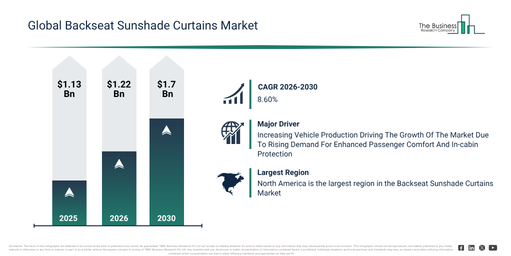
    The market size for backseat sunshade curtains has experienced robust growth in recent years. It is projected to expand from $1.13 billion in 2025 to $1.22 billion in 2026, demonstrating a compound annual growth rate (CAGR) of 8.4%. Historically, this growth has been driven by factors such as a growing consumer focus on passenger comfort, increasing adoption of automotive interior accessories, rising demand for glare reduction solutions in vehicles, expansion of passenger vehicle production globally, and a growing preference for privacy enhancement accessories._x000D_

    _x000D_

    The backseat sunshade curtains market is anticipated to show significant expansion in the upcoming years, with projections indicating a rise to $1.7 billion by 2030, reflecting a compound annual growth rate (CAGR) of 8.6%. This expected growth throughout the forecast period stems from factors such as the increasing desire for premium automotive interior customization, the growing uptake of electric passenger vehicles, rising investments in lightweight automotive materials, the expansion of smart and automated vehicle interior systems, and a heightened focus on technologies for heat reduction and cabin comfort. Noteworthy trends during this period include an increasing need for solutions that enhance rear passenger comfort, the rising adoption of retractable and space-efficient sunshade designs, a growing interest in UV protection and glare reduction accessories, the broadening availability of custom-fit interior sunshade curtain solutions, and a stronger preference for window shielding systems that are lightweight and simple to install._x000D_

    _x000D_

    #Download A Free Sample Report For Comprehensive Market Insights:#_x000D_

    https://www.thebusinessresearchcompany.com/sample_request?id=42198421&type=smp_x000D_

    _x000D_

    #Backseat Sunshade Curtains Market Industry Drivers: What Is Driving Revenue Growth?#_x000D_

    The expanding manufacturing of vehicles is anticipated to boost the backseat sunshade curtains market in the future. This manufacturing involves the large-scale creation of automobiles, such as passenger cars, SUVs, and commercial vehicles, addressing the rising global need for transportation. The growth in vehicle production stems from a greater desire for personal travel and ongoing improvements in automotive manufacturing processes. Backseat sunshade curtains are installed in vehicles to improve passenger comfort by lowering internal heat, cutting down on glare, and shielding occupants from harmful UV radiation, thus bettering the cabin experience. For example, in January 2026, data from the Society of Motor Manufacturers and Traders, a UK-based automotive industry association, showed that overall vehicle production climbed from 52,088 units in December 2024 to 55,284 units in December 2025. Consequently, the uptick in vehicle production is propelling the expansion of the backseat sunshade curtains market. The increase in global temperatures is anticipated to boost the backseat sunshade curtains market in the coming years. Global temperatures represent the average heat level recorded across the Earth’s surface, encompassing land and oceans, over a specific duration. This rise in global temperatures is occurring due to factors such as elevated carbon emissions and swift urban development, both of which lead to heat retention and warming patterns. Backseat sunshade curtains are utilized to diminish heat accumulation within vehicles by obstructing direct sunlight, thereby improving passenger comfort, safeguarding interiors from UV deterioration, and boosting energy efficiency through decreased dependence on air conditioning. For instance, in January 2025, the Copernicus Programme, a Belgium-based European Union Earth observation program, reported that in 2024, the global average temperature reached 15. 10°C, exceeding the previous record from 2023 by 0. 12°C, which points to an ongoing upward trend in global warming. Thus, the escalating global temperatures are fueling the expansion of the backseat sunshade curtains market._x000D_

    _x000D_

    #Backseat Sunshade Curtains Market Segmentation: How Is The Market Structured Across Key Categories?#_x000D_

    The backseat sunshade curtains market covered in this report is segmented – _x000D_

    _x000D_

    1) By Product Type: Retractable Sunshade Curtains, Static Sunshade Curtains, Magnetic Sunshade Curtains, Other Product Types_x000D_

    2) By Material: Polyester, Nylon, Mesh Fabric, Other Materials_x000D_

    3) By Vehicle Type: Passenger Cars, Commercial Vehicles, Other Vehicle Types_x000D_

    4) By Distribution Channel: Online Retail, Automotive Aftermarket Stores, Original Equipment Manufacturers_x000D_

    _x000D_

    Subsegments:_x000D_

    1) By Retractable Sunshade Curtains: Manual Retractable Sunshade Curtains, Automatic Retractable Sunshade Curtains, Roller Type Retractable Sunshade Curtains, Side Window Retractable Sunshade Curtains, Rear Window Retractable Sunshade Curtains_x000D_

    2) By Static Sunshade Curtains: Fixed Fabric Sunshade Curtains, Mesh Type Static Sunshade Curtains, Foldable Static Sunshade Curtains, Full Coverage Static Sunshade Curtains, Partial Coverage Static Sunshade Curtains_x000D_

    3) By Magnetic Sunshade Curtains: Clip On Magnetic Sunshade Curtains, Full Frame Magnetic Sunshade Curtains, Removable Magnetic Sunshade Curtains, Custom Fit Magnetic Sunshade Curtains, Universal Fit Magnetic Sunshade Curtains_x000D_

    4) By Other Product Types: Suction Cup Sunshade Curtains, Velcro Attachment Sunshade Curtains, Sliding Rail Sunshade Curtains, Snap Button Sunshade Curtains, Hybrid Design Sunshade Curtains_x000D_

    _x000D_

    _x000D_

    _x000D_

    _x000D_

    #Backseat Sunshade Curtains Market Competitive Landscape And Leading Companies#_x000D_

    Major companies operating in the backseat sunshade curtains market are Toyota Boshoku Corporation, Grupo Antolin-Irausa S. A., TS Tech Co. Ltd., Inteva Products LLC, Inalfa Roof Systems Group B. V., Kasai Kogyo Co. Ltd., Ashimori Industry Co. Ltd., MacNeil Automotive Products Limited, Covercraft Industries LLC, BOS GmbH & Co. KG, Macauto Industrial Co. Ltd., Creative Shades Industrial Co. Ltd., Auto Expressions Inc., Snap Shades Pty Ltd., Shyu Fuu Industrial Co. Ltd., EzyShade, Kinder Fluff, EcoNour Inc., Infinity Fox, Neodrift _x000D_

    _x000D_

    #Access The Complete Backseat Sunshade Curtains Market Report:#_x000D_

    https://www.thebusinessresearchcompany.com/report/backseat-sunshade-curtains-market-report_x000D_

    _x000D_

    #Backseat Sunshade Curtains Market Global Footprint: Which Region Holds Market Leadership?#_x000D_

    North America was the largest region in the backseat sunshade curtains market in 2025. Asia-Pacific is expected to be the fastest-growing region in the forecast period. The regions covered in the backseat sunshade curtains market report are Asia-Pacific, South East Asia, Western Europe, Eastern Europe, North America, South America, Middle East and Africa. _x000D_

    _x000D_

    _x000D_

    _x000D_

    _x000D_

    #Get in touch with us:#_x000D_

    _x000D_

    The Business Research Company: https://www.thebusinessresearchcompany.com/_x000D_

    Americas: +1 310-496-7795_x000D_

    Asia: +44 7882 955267 & +91 8897263534_x000D_

    Europe: +44 7882 955267_x000D_

    Email us at: marketing@tbrc.info_x000D_

    _x000D_

    #Follow us on:#_x000D_

    _x000D_

    LinkedIn: https://in.linkedin.com/company/the-business-research-company_x000D_

    YouTube: https://www.youtube.com/channel/UC24_fI0rV8cR5DxlCpgmyFQ_x000D_

    Global Market Model: https://www.thebusinessresearchcompany.com/global-market-model
  • Baby Clothing Resale Market Forecast Signals New Revenue Opportunities Through 2030

    Baby Clothing Resale Market Forecast Signals New Revenue Opportunities Through 2030

    Through market attractiveness analysis, total addressable market evaluation, company benchmarking matrices, interactive Excel dashboards, expanded supply chain intelligence, emerging startup coverage, and detailed product insights, The Business Research Company’s 2026 market reports provide more actionable and strategically valuable research.

    #Baby Clothing Resale Market Size Forecast: How Large Could The Market Become By 2030?#_x000D_

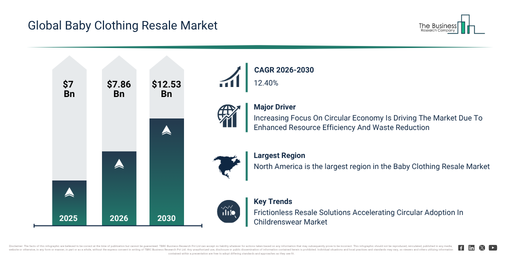
    The baby clothing resale market has observed rapid expansion in recent years. Its value is set to increase from $7 billion in 2025 to $7.86 billion in 2026, at a compound annual growth rate (CAGR) of 12.1%. This historical growth can be attributed to several factors, including the emergence of second hand apparel marketplaces, a growing awareness of sustainable consumption practices, the rising cost of new baby apparel, the proliferation of peer to peer resale platforms, and a shift towards minimalistic parenting lifestyles._x000D_

    _x000D_

    The baby clothing resale market is projected for significant expansion in the coming years. This market is forecast to reach $12.53 billion by 2030, exhibiting a compound annual growth rate (CAGR) of 12.4%. This anticipated growth during the forecast timeframe is driven by factors such as the greater acceptance of circular economy retail strategies, the development of AI-powered inventory management and pricing technologies, an increasing need for budget-friendly clothing options for children, the broadening reach of digital resale platforms in developing economies, and a heightened consumer emphasis on environmental sustainability and reducing waste. Key trends expected over this period encompass AI-supported pricing and grading systems for pre-owned clothing, platforms for second-hand baby clothing centered on the circular economy, rental and resale models for baby apparel offered through subscriptions, blockchain technology for verifying product authenticity and tracking ownership in resale transactions, and localized community groups for exchanging baby clothing directly between individuals._x000D_

    _x000D_

    #Download A Free Sample Report For Comprehensive Market Insights:#_x000D_

    https://www.thebusinessresearchcompany.com/sample_request?id=83979269&type=smp_x000D_

    _x000D_

    #Baby Clothing Resale Market Growth Factors: Which Forces Are Supporting Market Expansion?_x000D_

    The expanding emphasis on a circular economy is anticipated to fuel the expansion of the baby clothing resale market going forward. This economic framework aims to eliminate waste and maintain continuous resource utilization through the promotion of reuse, refurbishment, remanufacturing, and recycling within closed systems, thereby prolonging product lifespans and lessening reliance on finite resources. A primary catalyst for this heightened focus on the circular economy is the growing imperative for resource efficiency, as businesses and consumers strive to optimize raw material usage and minimize waste generation, which in turn lessens environmental impact, decreases production expenses over time, and bolsters long-term economic resilience amidst resource scarcity. The resale of baby clothing extends the utility of garments that children typically outgrow quickly, consequently diminishing textile waste and endorsing a more sustainable, resource-efficient consumption model that aligns with circular economy principles. For instance, as reported by the UK-based accountancy firm BDO LLP in June 2025, investment momentum within the circular economy experienced substantial growth, with disclosed capital climbing from approximately $1. 6 billion (£1. 3 billion) in 2023 to $2. 8 billion (£2. 2 billion) in 2024; average deal sizes also rose from $13. 5 million (£10. 7 million) to $22. 0 million (£17. 5 million); overall estimated funding reached around $3. 8 billion (£3. 0 billion) in 2024, with 131 of 183 transactions supported by generalist investors, indicating widespread market involvement. Consequently, the heightened emphasis on the circular economy is propelling the expansion of the baby clothing resale market going forward._x000D_

    _x000D_

    #Baby Clothing Resale Market Segmentation Trends And Revenue Drivers#_x000D_

    The baby clothing resale market covered in this report is segmented – _x000D_

    _x000D_

    1) By Product Type: Onesies, Tops, Bottoms, Outerwear, Sleepwear, Other Product Types_x000D_

    2) By Price Range: Economy, Mid-Range, Premium Or Luxury Resale_x000D_

    3) By Sales Channel: Online Platforms, Offline Stores_x000D_

    4) By Age Group: Newborn Zero To Three Months, Infants Three To Twelve Months, Toddlers One To Three Years, Preschool Three To Five Years_x000D_

    5) By End User: Individual Consumers, Resellers Or Retailers_x000D_

    _x000D_

    Subsegments:_x000D_

    1) By Onesies: Short Sleeve Onesies, Long Sleeve Onesies, Sleeveless Onesies, Printed Onesies, Organic Cotton Onesies, Snap Closure Onesies, Kimono Style Onesies, Seasonal Onesies Summer Or Winter, Multipack Onesies, Personalized Onesies_x000D_

    2) By Tops: T Shirts, Shirts, Tank Tops, Sweatshirts, Tunics, Blouses, Hooded Tops, Graphic Tops, Thermal Tops, Layering Tops_x000D_

    3) By Bottoms: Pants, Leggings, Shorts, Skirts, Joggers, Diaper Covers, Bloomers, Denim Bottoms, Thermal Bottoms, Adjustable Waist Bottoms_x000D_

    4) By Outerwear: Jackets, Coats, Hoodies, Sweaters, Cardigans, Snowsuits, Windcheaters, Rainwear, Fleece Outerwear, Quilted Outerwear_x000D_

    5) By Sleepwear: Pajama Sets, Sleep Gowns, Footed Sleepers, Romper Sleepwear, Night Suits, Swaddle Sleepwear, Thermal Sleepwear, Organic Sleepwear, Zipper Sleepwear, Seasonal Sleepwear_x000D_

    6) By Other Product Types: Rompers, Bodysuits Non Onesie Variants, Jumpsuits, Dungarees, Ethnic Wear, Occasion Wear, Swimwear, Loungewear, Gift Sets, Clothing Accessories Sets_x000D_

    _x000D_

    #Baby Clothing Resale Market Industry Trends: What Changes Are Reshaping Demand?#_x000D_

    Leading businesses within the baby clothing resale market are concentrating on creating sophisticated solutions, like instant credit resale platforms, to diminish transactional difficulties and foster circular purchasing patterns. An instant credit resale platform serves as a digital resale mechanism that allows customers to exchange their pre-owned items for immediate store credit, eliminating the need to wait for sales. For example, in August 2025, JoJo Maman Bébé, a UK-based retailer specializing in maternity and children’s wear, introduced JoJo Reloved, a dedicated resale platform. This platform enables clients to return their outgrown clothing via an online instrument or an in-store collection method and receive instant credit. Such initiatives boost convenience and reinforce circularity by facilitating the ongoing reuse of premium children’s apparel._x000D_

    _x000D_

    #Baby Clothing Resale Market Industry Leaders: Which Organizations Are Driving Competition?_x000D_

    Major companies operating in the baby clothing resale market are Rebelle, Depop Ltd., Poshmark Inc., thredUP Inc., OfferUp Inc., The Salvation Army, Swap. com Inc., Kidsy Inc., Moxie Jean LLC, Rebelstork LLC, Retykle Pte. Ltd., Once Upon A Child, Kid to Kid Franchise, GoodBuy Gear LLC, Oxfam Online Shop, Preloved. co. uk Ltd., ReWear, ChubChub Ltd., Little Loop Ltd., Second Hugs LLC _x000D_

    _x000D_

    #Access The Complete Baby Clothing Resale Market Report:#_x000D_

    https://www.thebusinessresearchcompany.com/report/baby-clothing-resale-market-report_x000D_

    _x000D_

    #Baby Clothing Resale Market Regional Distribution: Which Areas Drive Market Expansion?#_x000D_

    North America was the largest region in the baby clothing resale market in 2025. Asia Pacific is expected to be the fastest-growing region in the forecast period. The regions covered in the baby clothing resale market report are Asia-Pacific, South East Asia, Western Europe, Eastern Europe, North America, South America, Middle East and Africa. _x000D_

    _x000D_

    _x000D_

    _x000D_

    _x000D_

    #Get in touch with us:#_x000D_

    _x000D_

    The Business Research Company: https://www.thebusinessresearchcompany.com/_x000D_

    Americas: +1 310-496-7795_x000D_

    Asia: +44 7882 955267 & +91 8897263534_x000D_

    Europe: +44 7882 955267_x000D_

    Email us at: marketing@tbrc.info_x000D_

    _x000D_

    #Follow us on:#_x000D_

    _x000D_

    LinkedIn: https://in.linkedin.com/company/the-business-research-company_x000D_

    YouTube: https://www.youtube.com/channel/UC24_fI0rV8cR5DxlCpgmyFQ_x000D_

    Global Market Model: https://www.thebusinessresearchcompany.com/global-market-model
  • Autonomous Lift Modules Market Growth Is Accelerating As Industry Transformation Continues

    Autonomous Lift Modules Market Growth Is Accelerating As Industry Transformation Continues

    Delivering more actionable and strategically valuable research, The Business Research Company’s 2026 market reports feature market attractiveness analysis, total addressable market evaluation, company benchmarking matrices, interactive Excel dashboards, expanded supply chain intelligence, emerging startup coverage, and detailed product insights.

    #Autonomous Lift Modules Market Revenue Outlook: What CAGR Is Expected Through 2030?#_x000D_

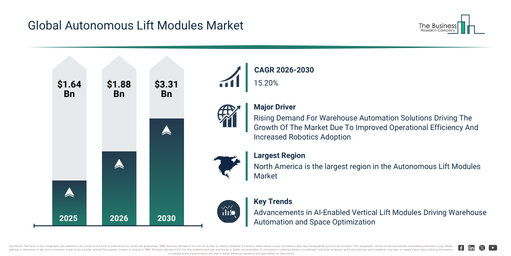
    The autonomous lift modules market size has seen rapid expansion in recent years. It is projected to increase from $1.64 billion in 2025 to $1.88 billion in 2026, achieving a compound annual growth rate (CAGR) of 14.9%. The growth observed in the historical period can be attributed to the advancement of traditional warehouse mechanization systems, the proliferation of global e-commerce logistics networks, escalating labor expenses within warehouse operations, the adoption of automated conveyor and storage systems, and a heightened demand for inventory accuracy and speed._x000D_

    _x000D_

    The autonomous lift modules market is projected to experience substantial expansion in the coming years, with its value expected to reach $3.31 billion by 2030, reflecting a compound annual growth rate (CAGR) of 15.2%. This anticipated growth is driven by factors such as the increasing adoption of smart warehouse automation, the rising integration of AI and robotics in logistics, the growing demand for omnichannel retail fulfillment, increased investment in autonomous supply chain infrastructure, and the need for scalable and modular warehouse systems. Major trends for the forecast period include AI-driven warehouse orchestration and optimization systems, robotic swarm coordination for automated storage and retrieval, energy-efficient and sustainable vertical storage optimization systems, autonomous lift platforms with predictive maintenance and self-diagnostic features, and modular and scalable warehouse automation deployment systems._x000D_

    _x000D_

    #Download A Free Sample Report For Comprehensive Market Insights:#_x000D_

    https://www.thebusinessresearchcompany.com/sample_request?id=36364021&type=smp_x000D_

    _x000D_

    #Autonomous Lift Modules Market Demand Drivers: What Is Fueling Industry Growth?#_x000D_

    The autonomous lift modules market is anticipated to expand due to the increasing demand for warehouse automation solutions. These solutions encompass advanced technologies such as robotics, automated storage and retrieval systems, and intelligent software, aimed at streamlining warehouse operations and minimizing manual intervention. The escalating need for warehouse automation arises from growing labor shortages and the necessity for quicker, more precise order fulfillment in logistics operations. Autonomous lift modules support warehouse automation by providing vertically integrated storage and retrieval systems, which enhance space utilization, facilitate automated picking, and improve inventory accuracy within warehouses. For instance, in October 2024, according to the International Federation of Robotics, a Germany-based robotics industry organization, global sales of professional service robots increased by 30% to over 205,000 units in 2023. Logistics applications alone accounted for more than 113,000 units, reflecting a 35% growth compared to the previous year. This expansion highlights the increasing adoption of automation technologies in logistics, thereby bolstering the demand for autonomous lift modules. Consequently, the rising demand for warehouse automation solutions is propelling the growth of the autonomous lift modules market._x000D_

    _x000D_

    #Autonomous Lift Modules Market Segment Analysis Highlighting Growth Areas#_x000D_

    The autonomous lift modules market covered in this report is segmented – _x000D_

    _x000D_

    1) By Product Type: Single Level, Multi Level_x000D_

    2) By Load Capacity: Light Duty, Medium Duty, Heavy Duty_x000D_

    3) By Application: Warehousing, Manufacturing, Distribution Centers, Retail, Healthcare, Other Applications_x000D_

    4) By End User: Automotive, Electronic Commerce, Food And Beverage, Pharmaceuticals, Logistics, Other End Users_x000D_

    _x000D_

    Subsegments:_x000D_

    1) By Single Level: Standard Single Level Lift Modules, Compact Single Level Lift Modules, Heavy Load Single Level Lift Modules, High Speed Single Level Lift Modules_x000D_

    2) By Multi Level: Dual Level Lift Modules, Multi Tray Lift Modules, High Capacity Multi Level Lift Modules, Automated Multi Level Lift Modules_x000D_

    _x000D_

    #Autonomous Lift Modules Market Innovation Trends: Which Developments Are Transforming The Industry?#_x000D_

    Major companies in the autonomous lift modules market are concentrating on developing innovative solutions, such as AI-enabled vertical lift modules equipped with intelligent control systems. This focus is driven by the increasing need for warehouse automation, improved space utilization, reduced labor expenses, and rapid order fulfillment within modern intralogistics operations. AI-enabled vertical lift modules represent advanced automated storage and retrieval systems that leverage vertical space to store items in trays, delivering them to operators via an elevator. These systems integrate intelligent software, sensors, and real-time data processing, distinguishing them from conventional shelving or manual racking systems that rely heavily on human effort and horizontal layouts. For instance, in January 2025, Kardex Holding AG, a Switzerland-based intralogistics solutions provider, unveiled its upgraded Kardex Shuttle Vertical Lift Module with Total Intelligence Concept (TIC). This sophisticated automated storage solution is engineered to enhance operational efficiency and system adaptability. The system features a modern software architecture combined with an intuitive 12.1-inch touch interface, which provides multilingual, context-sensitive picking assistance and minimizes operator errors. Its modular hardware and software design ensures scalability, allowing for seamless upgrades and integration with warehouse management systems and other digital ecosystems. Furthermore, the solution incorporates intelligent tray zoning, faster shutter operations, and predictive maintenance capabilities to reduce downtime and optimize order fulfillment processes._x000D_

    _x000D_

    #Autonomous Lift Modules Market Leading Companies: Who Holds Significant Market Presence?#_x000D_

    Major companies operating in the autonomous lift modules market are SSI SCHAEFER, Godrej Storage Solutions, Mecalux S. A., Kardex Group, RunningSys Inc., SencorpWhite Inc., Automha S. p. A., Modula S. p. A., Ferretto Group S. p. A., EffiMat Storage Technology A/S, Constructor Group AS, ICAM S. r. l., Hänel Storage Systems, Intertex Maschinenbau GmbH, Weland Solutions AB, AutoCrib Inc., Green Automated Solutions Inc., Randex Ltd., Omnia Technologies, FlexQube AB, Jiangxi Huifeng, Shenzhen Keming _x000D_

    _x000D_

    #Access The Complete Autonomous Lift Modules Market Report:#_x000D_

    https://www.thebusinessresearchcompany.com/report/autonomous-lift-modules-market-report_x000D_

    _x000D_

    #Autonomous Lift Modules Market Leading Geography: Which Region Generates The Most Revenue?#_x000D_

    North America was the largest region in the autonomous lift modules market in 2025. Asia Pacific is expected to be the fastest-growing region in the forecast period. The regions covered in the autonomous lift modules market report are Asia-Pacific, South East Asia, Western Europe, Eastern Europe, North America, South America, Middle East and Africa. _x000D_

    _x000D_

    _x000D_

    _x000D_

    _x000D_

    #Get in touch with us:#_x000D_

    _x000D_

    The Business Research Company: https://www.thebusinessresearchcompany.com/_x000D_

    Americas: +1 310-496-7795_x000D_

    Asia: +44 7882 955267 & +91 8897263534_x000D_

    Europe: +44 7882 955267_x000D_

    Email us at: marketing@tbrc.info_x000D_

    _x000D_

    #Follow us on:#_x000D_

    _x000D_

    LinkedIn: https://in.linkedin.com/company/the-business-research-company_x000D_

    YouTube: https://www.youtube.com/channel/UC24_fI0rV8cR5DxlCpgmyFQ_x000D_

    Global Market Model: https://www.thebusinessresearchcompany.com/global-market-model
  • Automotive Sensor And Camera Technologies Market Outlook Highlights The Next Major Growth Opportunities

    Automotive Sensor And Camera Technologies Market Outlook Highlights The Next Major Growth Opportunities

    Enhanced with market attractiveness analysis, total addressable market evaluation, company benchmarking matrices, interactive Excel dashboards, expanded supply chain intelligence, emerging startup coverage, and detailed product insights, The Business Research Company’s 2026 market reports deliver more actionable and strategically valuable research.

    #Automotive Sensor And Camera Technologies Market Growth Analysis: How Will Revenue Expand During The Forecast Period?#_x000D_

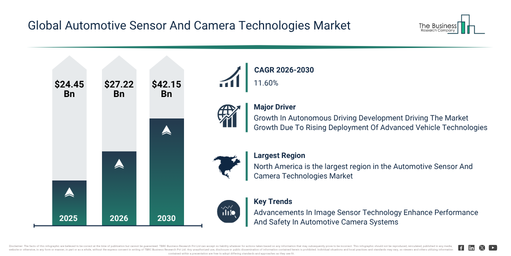
    The automotive sensor and camera technologies market size has experienced substantial growth in recent years. This market is forecasted to increase from $24.45 billion in 2025 to $27.22 billion in 2026, at a compound annual growth rate (CAGR) of 11.3%. Historically, this expansion can be linked to several factors, including the increased adoption of advanced driver assistance systems, the rising demand for compliance with vehicle safety regulations, the growing use of rear-view and parking cameras, the broader integration of automotive electronics, and advancements in sensor miniaturization technologies._x000D_

    _x000D_

    The automotive sensor and camera technologies market is anticipated to experience substantial growth over the coming years, projected to reach $42.15 billion by the year 2030, at a compound annual growth rate (CAGR) of 11.6%. This projected expansion through the forecast period is driven by factors such as the increasing commercialization of autonomous vehicles, a greater need for real-time environmental perception systems, the proliferation of electric and software-defined vehicles, heightened investment in smart mobility infrastructure, and the advancement of next-generation high-precision imaging sensors. Key trends anticipated during this period encompass the adoption of high-resolution CMOS imaging, the utilization of multi-sensor fusion to improve vehicle perception accuracy, the broader deployment of solid-state lidar systems for cost-effective implementation, sophisticated driver monitoring systems designed to detect fatigue and distraction, and a growing incorporation of thermal and night vision camera technologies into vehicles._x000D_

    _x000D_

    #Download A Free Sample Report For Comprehensive Market Insights:#_x000D_

    https://www.thebusinessresearchcompany.com/sample_request?id=31154502&type=smp_x000D_

    _x000D_

    #Automotive Sensor And Camera Technologies Market Growth Drivers: What Factors Are Accelerating Expansion?#_x000D_

    The expanding development of autonomous driving is set to boost the automotive sensor and camera technologies market in the future. This development encompasses the advancement and integration of technologies enabling vehicles to operate with minimal or no human intervention through sensors, cameras, AI, and software systems. The increase in autonomous driving development is driven by rising investments in advanced mobility solutions, as governments and private players focus on improving road safety and reducing human error via automation, which has accelerated the research, testing, and deployment of self-driving systems across developed regions. The increasing evolution of autonomous driving systems necessitates precise environment detection and real-time decision-making, capabilities that depend on advanced sensing and imaging components. For instance, in December 2024, according to the National Highway Traffic Safety Administration, a US-based government agency, it is estimated that by 2030, 4.5 million self-driving vehicles will operate on U. S. roads. Therefore, the growth in autonomous driving development is a primary factor propelling the growth of the automotive sensor and camera technologies market._x000D_

    _x000D_

    #Automotive Sensor And Camera Technologies Market Segment Performance And Strategic Opportunities#_x000D_

    The automotive sensor and camera technologies market covered in this report is segmented – _x000D_

    _x000D_

    1) By Product Type: Cameras, Radar Systems, Light Detection And Ranging Systems, Ultrasonic Sensors, Other Sensors_x000D_

    2) By Technology: Infrared Camera, Thermal Camera, Digital Camera_x000D_

    3) By Application: Advanced Driver Assistance Systems, Autonomous Vehicles, Vehicle Safety, Navigation Systems, Other Applications_x000D_

    4) By End Use: Passenger Vehicles, Commercial Vehicles, Electric Vehicles, Other End Users_x000D_

    _x000D_

    Subsegments:_x000D_

    1) By Cameras: Front View Cameras, Rear View Cameras, Surround View Cameras, Driver Monitoring Cameras, Night Vision Cameras_x000D_

    2) By Radar Systems: Short Range Radar Systems, Medium Range Radar Systems, Long Range Radar Systems, Imaging Radar Systems_x000D_

    3) By Light Detection And Ranging Systems: Mechanical Light Detection And Ranging Systems, Solid State Light Detection And Ranging Systems, Flash Light Detection And Ranging Systems, Micro Electro Mechanical Systems Light Detection And Ranging Systems_x000D_

    4) By Ultrasonic Sensors: Parking Ultrasonic Sensors, Proximity Ultrasonic Sensors, Blind Spot Ultrasonic Sensors, Reverse Detection Ultrasonic Sensors_x000D_

    5) By Other Sensors: Temperature Sensors, Pressure Sensors, Position Sensors, Speed Sensors, Inertial Sensors, Environmental Sensors_x000D_

    _x000D_

    #Automotive Sensor And Camera Technologies Market Trends: What Is Shaping Future Industry Growth?#_x000D_

    Leading companies operating in the automotive sensor and camera technologies market are prioritizing the development of advanced solutions, such as high-performance automotive image sensors, to enhance vehicle safety, improve visibility, and support sophisticated driver-assistance systems (ADAS). High-performance automotive image sensors are distinct semiconductor devices engineered to capture excellent quality images across various lighting and environmental conditions, enabling precise object detection and real-time surveillance for critical vehicle safety applications. For instance, in January 2024, OMNIVISION Technologies Inc., a US-based semiconductor company, introduced the OX01J image sensor, a high-performance product tailored for surround-view and rear-view automotive cameras. This sensor offers superior image quality, effective low-light operation, and a wide dynamic range, thereby ensuring reliable performance in demanding driving scenarios and contributing to better overall vehicle safety and increased driver awareness._x000D_

    _x000D_

    #Automotive Sensor And Camera Technologies Market Key Players: Which Companies Shape Industry Competition?#_x000D_

    Major companies operating in the automotive sensor and camera technologies market are QUALCOMM Incorporated, Texas Instruments Incorporated, Sony Group Corporation, Analog Devices Inc., NXP Semiconductors N. V., Infineon Technologies AG, Microchip Technology Incorporated, STMicroelectronics N. V., DENSO Corporation, ON Semiconductor Corporation, Aptiv PLC, Continental AG, Magna International Inc., Gentex Corporation, Allegro MicroSystems Inc., Melexis NV, Valeo SA, ams-OSRAM AG, Ambarella Inc., Luminar Technologies Inc. _x000D_

    _x000D_

    #Access The Complete Automotive Sensor And Camera Technologies Market Report:#_x000D_

    https://www.thebusinessresearchcompany.com/report/automotive-sensor-and-camera-technologies-market-report_x000D_

    _x000D_

    #Automotive Sensor And Camera Technologies Market Regional Outlook: Where Are The Largest Opportunities Located?#_x000D_

    North America was the largest region in the automotive sensor and camera technologies market in 2025. Asia-Pacific is expected to be the fastest-growing region in the forecast period. The regions covered in the automotive sensor and camera technologies market report are Asia-Pacific, South East Asia, Western Europe, Eastern Europe, North America, South America, Middle East and Africa. _x000D_

    _x000D_

    _x000D_

    _x000D_

    _x000D_

    #Get in touch with us:#_x000D_

    _x000D_

    The Business Research Company: https://www.thebusinessresearchcompany.com/_x000D_

    Americas: +1 310-496-7795_x000D_

    Asia: +44 7882 955267 & +91 8897263534_x000D_

    Europe: +44 7882 955267_x000D_

    Email us at: marketing@tbrc.info_x000D_

    _x000D_

    #Follow us on:#_x000D_

    _x000D_

    LinkedIn: https://in.linkedin.com/company/the-business-research-company_x000D_

    YouTube: https://www.youtube.com/channel/UC24_fI0rV8cR5DxlCpgmyFQ_x000D_

    Global Market Model: https://www.thebusinessresearchcompany.com/global-market-model
  • Automotive Rubber Seals Market Trends And Growth Drivers Point To Strong Future Potential

    Automotive Rubber Seals Market Trends And Growth Drivers Point To Strong Future Potential

    Through market attractiveness analysis, total addressable market evaluation, company benchmarking matrices, interactive Excel dashboards, expanded supply chain intelligence, emerging startup coverage, and detailed product insights, The Business Research Company’s 2026 market reports provide more actionable and strategically valuable research.

    #Automotive Rubber Seals Market Forecast: What Market Value Is Expected By 2030?#_x000D_

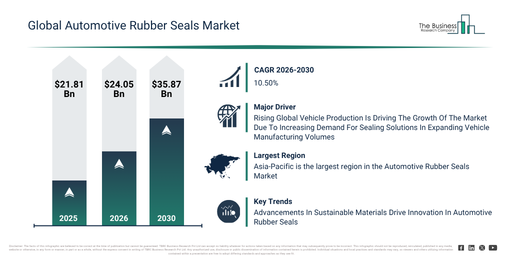
    The automotive rubber seals market size has seen significant growth in recent years. It is anticipated to expand from $21.81 billion in 2025 to $24.05 billion in 2026, achieving a compound annual growth rate (CAGR) of 10.3%. This historical growth can be linked to several factors, including the global increase in automotive production and vehicle ownership, the rising demand for passenger comfort and noise reduction, a growing emphasis on vehicle durability and component protection, the broader adoption of standard rubber sealing materials in manufacturing, and stricter regulatory requirements concerning vehicle safety and emissions control._x000D_

    _x000D_

    The automotive rubber seals market is projected for swift expansion in the upcoming years. This market is predicted to reach $35.87 billion by 2030, exhibiting a compound annual growth rate (CAGR) of 10.5%. This expansion during the projection period stems from several factors: the increasing uptake of electric vehicles necessitating sophisticated sealing, a heightened need for lightweight and fuel-efficient car parts, greater incorporation of intelligent and adaptable sealing substances, broadened investment in self-driving and interconnected vehicle systems, and an intensifying emphasis on eco-friendly and reusable elastomer composites. Key developments anticipated during this timeframe involve a greater embrace of sophisticated lightweight rubber sealing materials specifically for electric cars, a burgeoning requirement for noise, vibration, and harshness (NVH) reduction technologies in passenger vehicles, enhanced integration of finely engineered seals to boost vehicle aerodynamics, expanded deployment of weather-resistant elastomer seals in challenging climates, and a strengthening inclination towards highly durable sealing systems for commercial vehicle uses._x000D_

    _x000D_

    #Download A Free Sample Report For Comprehensive Market Insights:#_x000D_

    https://www.thebusinessresearchcompany.com/sample_request?id=23940050&type=smp_x000D_

    _x000D_

    #Automotive Rubber Seals Market Growth Factors Supporting Long-Term Expansion#_x000D_

    The future expansion of the automotive rubber seals market is anticipated to be driven by the rising global output of vehicles. Global vehicle production encompasses the aggregate count of automobiles, comprising both passenger and commercial vehicles, manufactured annually by companies across the world. This surge in worldwide vehicle manufacturing is attributed to robust consumer spending and the revival of production in key developed nations, following the stabilization of supply chains. Automotive rubber seals play a crucial role by providing effective sealing between vehicle parts, thereby preventing the ingress of water, dust, air, and noise, while also improving durability, thermal insulation, vibration dampening, and overall occupant comfort. For example, data from July 2024, released by the US-based government agency, the Board of Governors of the Federal Reserve System, indicated a rise in total vehicle output from 10.92 million units in the first quarter of 2024 to 11.30 million units in the second quarter. Consequently, the increasing global vehicle production is a primary catalyst for the growth observed in the automotive rubber seals market._x000D_

    _x000D_

    #Automotive Rubber Seals Market Segment Landscape And Growth Potential_x000D_

    The automotive rubber seals market covered in this report is segmented – _x000D_

    _x000D_

    1) By Product Type: Door Seals, Window Seals, Trunk Seals, Hood Seals, Sunroof Seals_x000D_

    2) By Material Type: Ethylene Propylene Diene Monomer Rubber, Silicone Rubber, Thermoplastic Elastomers, Nitrile Rubber_x000D_

    3) By Sales Channel: Original Equipment Manufacturer, Aftermarket_x000D_

    4) By Vehicle Type: Passenger Cars, Light Commercial Vehicles, Medium And Heavy Commercial Vehicles_x000D_

    _x000D_

    Subsegments:_x000D_

    1) By Door Seals: Primary Door Seals, Secondary Door Seals, Beltline Seals, Glass Run Channels, Corner Molding Seals_x000D_

    2) By Window Seals: Inner Window Seals, Outer Window Seals, Quarter Window Seals, Sliding Window Seals, Fixed Window Seals_x000D_

    3) By Trunk Seals: Primary Trunk Seals, Secondary Trunk Seals, Tailgate Seals, Liftgate Seals, Weatherstrip Seals_x000D_

    4) By Hood Seals: Engine Compartment Seals, Hood Perimeter Seals, Air Intake Seals, Heat Shield Seals, Dust Seals_x000D_

    5) By Sunroof Seals: Glass Panel Seals, Frame Seals, Sliding Roof Seals, Tilt Sunroof Seals, Drain Channel Seals_x000D_

    _x000D_

    #Automotive Rubber Seals Market Industry Trends Shaping Future Revenue Growth#_x000D_

    Major companies operating in the automotive rubber seals market are prioritizing the development of eco-friendly and high-performance solutions, including seals made with significant recycled rubber content. This focus is aimed at reducing environmental impact while upholding durability and performance standards. High recycled rubber content refers to the incorporation of reclaimed elastomer materials into seal manufacturing, which enhances resource efficiency and lowers the carbon footprint without diminishing sealing effectiveness. As an illustration, in December 2025, Toyoda Gosei Co., Ltd., a Japan-based automotive components manufacturer, launched automotive parts featuring high recycled rubber content, with the goal of improving sustainability in vehicle production. These products are designed to maintain essential sealing properties, such as resistance to heat, weather, and deformation, while also contributing to circular economy initiatives and decreasing dependency on virgin raw materials in automotive applications._x000D_

    _x000D_

    #Automotive Rubber Seals Market Competitive Landscape: Who Are The Leading Companies?#_x000D_

    Major companies operating in the automotive rubber seals market are SKF AB, Dana Incorporated, Toyoda Gosei Co. Ltd., Hutchinson SA, NOK Corporation, Trelleborg AB, Minth Group Limited, Cooper-Standard Holdings Inc., Anhui Zhongding Sealing Parts Co. Ltd., Henniges Automotive Holdings Inc., Standard Profil Automotive GmbH, ElringKlinger AG, Dätwyler Holding Inc., Freudenberg SE, Veritas AG, Nishikawa Rubber Co. Ltd., Kinugawa Rubber Industrial Co. Ltd., Hwaseung R&A Co. Ltd., PPAP Automotive Limited, Shida Seal Group Co. Ltd., SaarGummi Automotive GmbH, Faltec Co. Ltd. _x000D_

    _x000D_

    #Access The Complete Automotive Rubber Seals Market Report:#_x000D_

    https://www.thebusinessresearchcompany.com/report/automotive-rubber-seals-market-report_x000D_

    _x000D_

    #Automotive Rubber Seals Market Geographic Landscape: Which Region Dominates Industry Growth?#_x000D_

    Asia-Pacific was the largest region in the automotive rubber seals market in 2025. Europe is expected to be the fastest-growing region in the forecast period. The regions covered in the automotive rubber seals market report are Asia-Pacific, South East Asia, Western Europe, Eastern Europe, North America, South America, Middle East and Africa. _x000D_

    _x000D_

    _x000D_

    _x000D_

    _x000D_

    #Get in touch with us:#_x000D_

    _x000D_

    The Business Research Company: https://www.thebusinessresearchcompany.com/_x000D_

    Americas: +1 310-496-7795_x000D_

    Asia: +44 7882 955267 & +91 8897263534_x000D_

    Europe: +44 7882 955267_x000D_

    Email us at: marketing@tbrc.info_x000D_

    _x000D_

    #Follow us on:#_x000D_

    _x000D_

    LinkedIn: https://in.linkedin.com/company/the-business-research-company_x000D_

    YouTube: https://www.youtube.com/channel/UC24_fI0rV8cR5DxlCpgmyFQ_x000D_

    Global Market Model: https://www.thebusinessresearchcompany.com/global-market-model

  • Automotive Returnable Racks Market Expansion Is Reshaping Competitive Dynamics Across The Industry

    Automotive Returnable Racks Market Expansion Is Reshaping Competitive Dynamics Across The Industry

    Delivering more actionable and strategically valuable research, The Business Research Company’s 2026 market reports feature market attractiveness analysis, total addressable market evaluation, company benchmarking matrices, interactive Excel dashboards, expanded supply chain intelligence, emerging startup coverage, and detailed product insights.

    #Automotive Returnable Racks Market Size Outlook: How Fast Will Revenue Grow Through 2030?#_x000D_

    The automotive returnable racks market has experienced robust expansion in recent years. Its size is projected to increase from $2.33 billion in 2025 to $2.49 billion in 2026, achieving a compound annual growth rate (CAGR) of 7.1%. Historically, this growth can be ascribed to several factors, including the expansion of global automotive production activities, a stronger emphasis on reducing packaging waste, a surging demand for efficient automotive logistics systems, the broadening of automotive supply chain networks, and the increasing adoption of reusable material handling solutions._x000D_

    _x000D_

    The automotive returnable racks market size is predicted to experience significant expansion in the coming years. It is projected to reach $3.3 billion by 2030, showing a compound annual growth rate (CAGR) of 7.3%. This anticipated growth is driven by several factors, including increased investments in smart warehouse infrastructure, a growing need for sustainable automotive logistics solutions, wider implementation of electric vehicle component transportation systems, the advancement of automated material handling technologies, and a heightened focus on cost-effective returnable packaging systems. Notable trends expected during this period encompass the rising adoption of reusable packaging solutions in automotive logistics, an increased demand for systems that prevent damage during component transit, the growing utilization of lightweight and foldable returnable rack designs, the expansion of closed-loop automotive supply chain networks, and a developing preference for modular and stackable automotive storage racks._x000D_

    _x000D_

    #Download A Free Sample Report For Comprehensive Market Insights:#_x000D_

    https://www.thebusinessresearchcompany.com/sample_request?id=18210600&type=smp_x000D_

    _x000D_

    #Automotive Returnable Racks Market Demand Drivers Creating New Revenue Opportunities_x000D_

    The escalating need for environmentally friendly packaging solutions is anticipated to boost the automotive returnable racks market in the future. Sustainable packaging involves materials and systems crafted to minimize environmental footprint by cutting down on waste, energy usage, and greenhouse gas emissions across the entire product lifecycle. This increasing requirement for sustainable packaging is fueled by greater environmental consciousness and governmental regulations, as it lessens the use of resources and waste production compared to traditional packaging, thereby fostering environmentally sound supply chain operations. Automotive returnable racks facilitate this trend by providing reusable logistics systems that decrease single-use packaging waste and conserve materials through their repeated application in automotive transportation and storage processes. For example, in 2023, as per the Reusable Packaging Association, a US-based nonprofit trade association dedicated to advancing reusable industrial packaging, reusable transport packaging resulted in approximately 39% less energy consumption and 95% less solid waste on average compared to single-use options, all while allowing for numerous reuse cycles. Consequently, the growing demand for sustainable packaging is a key factor propelling the expansion of the automotive returnable racks market. The escalating manufacturing of electric vehicles is projected to stimulate the expansion of the automotive returnable racks market moving forward. Electric vehicles (EVs) are defined as automobiles powered either partially or entirely by electricity, utilizing electric motors in place of conventional internal combustion engines. The uptick in EV production is propelled by supportive government frameworks and incentives, which promote cleaner transportation through financial aid, tax advantages, and stringent emission controls, thereby encouraging manufacturers to scale up their EV output. Automotive returnable racks support this development by facilitating the secure, efficient, and reusable conveyance of delicate EV components, such as batteries and electronic modules, consequently boosting supply chain efficiency and minimizing potential damage during manufacturing and logistics. For instance, in January 2024, the US Energy Information Administration, a US-based government agency, reported that sales of hybrid, plug-in hybrid, and battery electric vehicles (BEVs) collectively represented 16.3% of all light-duty vehicle sales in the United States in 2023, an increase from 12.9% in 2022. Therefore, the increasing production of electric vehicles is a significant factor driving the growth of the automotive returnable racks market._x000D_

    _x000D_

    #Automotive Returnable Racks Market Categorization By Product Type And Application#_x000D_

    The automotive returnable racks market covered in this report is segmented – _x000D_

    _x000D_

    1) By Product Type: Steel Racks, Aluminum Racks, Plastic Racks, Other Product Types_x000D_

    2) By Material: Metal, Plastic, Composite, Other Materials_x000D_

    3) By Distribution Channel: Direct Sales, Distributors, Online Sales_x000D_

    4) By Application: Passenger Vehicles, Commercial Vehicles, Other Applications_x000D_

    5) By End-User: Original Equipment Manufacturers, Aftermarket, Other End-Users_x000D_

    _x000D_

    Subsegments:_x000D_

    1) By Steel Racks: Welded Steel Racks, Bolted Steel Racks, Heavy Duty Steel Racks, Galvanized Steel Racks_x000D_

    2) By Aluminum Racks: Lightweight Aluminum Racks, Extruded Aluminum Racks, Corrosion Resistant Aluminum Racks, Modular Aluminum Racks_x000D_

    3) By Plastic Racks: Injection Molded Plastic Racks, High Density Polyethylene Racks, Collapsible Plastic Racks, Stackable Plastic Racks_x000D_

    4) By Other Product Types: Composite Material Racks, Hybrid Material Racks, Customized Automotive Racks, Foldable Returnable Racks_x000D_

    _x000D_

    _x000D_

    _x000D_

    _x000D_

    #Automotive Returnable Racks Market Company Landscape And Strategic Competition#_x000D_

    Major companies operating in the automotive returnable racks market are CHEP, SSI Schaefer Group, Nefab Group, Rehrig Pacific Company, Craemer Group, CABKA Group, ORBIS Corporation, IPL Plastics Plc, Monoflo International, GEBHARDT Logistic Solutions GmbH, Loscam International Holdings Co. Ltd., Buckhorn Inc., CEVA Logistics Automotive Division, TranPak Inc., Avatan Packaging Oy, Karl H. Bartels GmbH, Schoeller Allibert, Clip-Lok SimPak, Stakapal Limited, Flextur _x000D_

    _x000D_

    #Access The Complete Automotive Returnable Racks Market Report:#_x000D_

    https://www.thebusinessresearchcompany.com/report/automotive-returnable-racks-market-report_x000D_

    _x000D_

    #Automotive Returnable Racks Market Largest Region: Which Geography Holds The Highest Market Share?_x000D_

    Asia-Pacific was the largest region in the automotive returnable racks market in 2025. Asia-Pacific is expected to be the fastest-growing region in the forecast period. The regions covered in the automotive returnable racks market report are Asia-Pacific, South East Asia, Western Europe, Eastern Europe, North America, South America, Middle East and Africa. _x000D_

    _x000D_

    _x000D_

    _x000D_

    _x000D_

    #Get in touch with us:#_x000D_

    _x000D_

    The Business Research Company: https://www.thebusinessresearchcompany.com/_x000D_

    Americas: +1 310-496-7795_x000D_

    Asia: +44 7882 955267 & +91 8897263534_x000D_

    Europe: +44 7882 955267_x000D_

    Email us at: marketing@tbrc.info_x000D_

    _x000D_

    #Follow us on:#_x000D_

    _x000D_

    LinkedIn: https://in.linkedin.com/company/the-business-research-company_x000D_

    YouTube: https://www.youtube.com/channel/UC24_fI0rV8cR5DxlCpgmyFQ_x000D_

    Global Market Model: https://www.thebusinessresearchcompany.com/global-market-model
  • Automated Optical Inspection Market Forecast Reveals Where Future Industry Value Will Be Created

    Automated Optical Inspection Market Forecast Reveals Where Future Industry Value Will Be Created

    Enhanced with market attractiveness analysis, total addressable market evaluation, company benchmarking matrices, interactive Excel dashboards, expanded supply chain intelligence, emerging startup coverage, and detailed product insights, The Business Research Company’s 2026 market reports deliver more actionable and strategically valuable research.

    #Automated Optical Inspection Market Size, Value And Growth Trends Through 2030#_x000D_

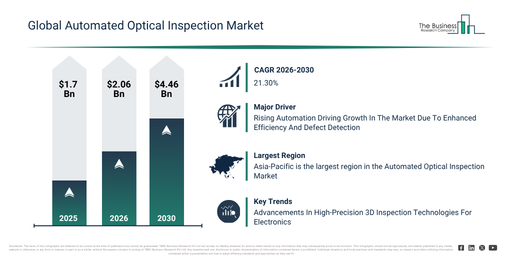
    The automated optical inspection market size has observed substantial expansion in recent years. Forecasts indicate it will progress from $1.7 billion in 2025 to $2.06 billion in 2026, exhibiting a compound annual growth rate (CAGR) of 21.0%. The historical growth of this market is attributable to several key factors, including an increase in PCB production volumes, the rising intricacy of electronic assemblies, the necessity for enhanced product quality and reliability, a shift from manual to automated inspection techniques, and the general growth in consumer electronics manufacturing._x000D_

    _x000D_

    The automated optical inspection market is projected for significant expansion in the coming years. This market is anticipated to reach $4.46 billion by 2030, exhibiting a compound annual growth rate (CAGR) of 21.3%. This expansion during the forecast timeframe is driven by factors such as the implementation of 3d and hybrid aoi technologies, the growing need from electric vehicle electronics, the broadening scope of semiconductor packaging inspection, the increasing requirement for real-time quality monitoring, and the incorporation of aoi with smart factory systems. Key trends anticipated over this period encompass a heightened demand for high-speed pcb inspection systems, the miniaturization of electronic components necessitating greater inspection precision, the increasing uptake of 3d aoi systems for intricate assemblies, a growing focus on achieving zero-defect manufacturing standards, and the integration of multi-angle imaging for improved defect identification._x000D_

    _x000D_

    #Download A Free Sample Report For Comprehensive Market Insights:#_x000D_

    https://www.thebusinessresearchcompany.com/sample_request?id=46711572&type=smp_x000D_

    _x000D_

    #Automated Optical Inspection Market Expansion Supported By Key Demand Factors#_x000D_

    The increasing need for automation is projected to boost the growth of the automated optical inspection market in the coming years. Automation refers to the application of machines, computers, or technology to carry out tasks with minimal or no human intervention. Automation is expanding to lessen human errors by ensuring tasks are performed uniformly and reliably. Automated optical inspection assists automation by quickly and accurately inspecting products for defects, thereby reducing manual inspection and ensuring consistent quality in production processes. For instance, in April 2024, according to the International Federation of Robotics, a Germany-based international organization, in the United States, manufacturing companies significantly boosted their automation efforts, with total industrial robot installations rising 12% to 44,303 units in 2023. Therefore, the escalating demand for automation is driving the expansion of the automated optical inspection market._x000D_

    _x000D_

    #Automated Optical Inspection Market Segment Analysis And Revenue Opportunities#_x000D_

    The automated optical inspection market covered in this report is segmented – _x000D_

    _x000D_

    1) By Component: Hardware, Software, Services_x000D_

    2) By Technology: Inline Automated Optical Inspection, Offline Automated Optical Inspection_x000D_

    3) By Application: Printed Circuit Board Inspection, Flat Panel Display Inspection, Integrated Circuit Substrate Inspection, Other Applications_x000D_

    4) By Industry Vertical: Consumer Electronics, Automotive, Industrial, Medical Devices, Aerospace And Defense, Other Industry Verticals_x000D_

    _x000D_

    Subsegments:_x000D_

    1) By Hardware: Area Scan Cameras, Line Scan Cameras, High Resolution Sensors_x000D_

    2) By Software: Anomaly Detection Modules, Image Acquisition Software, Image Processing Libraries_x000D_

    3) By Services: System Commissioning, Hardware Setup And Calibration, Software Configuration_x000D_

    _x000D_

    #Automated Optical Inspection Market Growth Trends Influencing Competitive Dynamics#_x000D_

    Leading enterprises within the automated optical inspection market are concentrating on the creation of sophisticated solutions, such as high-resolution hybrid 3D automated optical inspection systems, to enable precise, rapid, and dependable fault detection in complex electronic assemblies through advanced imaging and measurement techniques. These High-resolution hybrid 3D automated optical inspection systems are characterized as inspection tools that integrate multi-directional projection, laser scanning, and advanced image processing to construct accurate three-dimensional models of electronic components, thereby enhancing defect identification and quality assurance. For example, in January 2024, Yamaha Motor Co. Ltd., a Japan-based manufacturing company, introduced the YRi-V TypeHS 3D automated optical inspection system, specifically designed for electronic component mounting factories. This advanced system offers high-speed and high-precision inspection, utilizing a 25-megapixel high-resolution camera for superior image clarity, advanced CPU and GPU processing for quicker data analysis, and a hybrid 3D inspection approach combining an 8-direction projector with a line laser to accurately detect reflective and ultra-small components, making it well-suited for next-generation electronics manufacturing environments._x000D_

    _x000D_

    #Automated Optical Inspection Market Leading Players Shaping Industry Direction#_x000D_

    Major companies operating in the automated optical inspection market are Yamaha Motor Co. Ltd., Nordson Corporation, Chroma ATE Inc., Mycronic Group, Camtek Ltd., NVIDIA Corp., Koh Young Technology Inc., Takano Co Ltd., ViTrox Corporation Berhad, Test Research Inc., Viscom AG, Saki Corporation, Parmi Co Ltd., GÖPEL Electronic GmbH, ZhenHuaXing Technology (Shenzhen) Co. Ltd., JUTZE Intelligence Technology Co Ltd., Machine Vision Products, Utechzone Co Ltd., Pemtron Corporation, Jet Technology Co. Ltd., Mirtec Co. Ltd., Marantz Electronics, Omron Corporation, AOI Systems Ltd., Smart Vision Co Ltd. _x000D_

    _x000D_

    #Access The Complete Automated Optical Inspection Market Report:#_x000D_

    https://www.thebusinessresearchcompany.com/report/automated-optical-inspection-market-report_x000D_

    _x000D_

    #Automated Optical Inspection Market Regional Analysis: Which Region Leads By Revenue?#_x000D_

    Asia-Pacific was the largest region in the automated optical inspection market in 2025. North America is expected to be the fastest-growing region in the forecast period. The regions covered in the automated optical inspection market report are Asia-Pacific, South East Asia, Western Europe, Eastern Europe, North America, South America, Middle East and Africa. _x000D_

    _x000D_

    _x000D_

    _x000D_

    _x000D_

    #Get in touch with us:#_x000D_

    _x000D_

    The Business Research Company: https://www.thebusinessresearchcompany.com/_x000D_

    Americas: +1 310-496-7795_x000D_

    Asia: +44 7882 955267 & +91 8897263534_x000D_

    Europe: +44 7882 955267_x000D_

    Email us at: marketing@tbrc.info_x000D_

    _x000D_

    #Follow us on:#_x000D_

    _x000D_

    LinkedIn: https://in.linkedin.com/company/the-business-research-company_x000D_

    YouTube: https://www.youtube.com/channel/UC24_fI0rV8cR5DxlCpgmyFQ_x000D_

    Global Market Model: https://www.thebusinessresearchcompany.com/global-market-model
  • Automated Milking Systems Market Growth Through 2030 Creates New Strategic Opportunities

    Automated Milking Systems Market Growth Through 2030 Creates New Strategic Opportunities

    Through market attractiveness analysis, total addressable market evaluation, company benchmarking matrices, interactive Excel dashboards, expanded supply chain intelligence, emerging startup coverage, and detailed product insights, The Business Research Company’s 2026 market reports provide more actionable and strategically valuable research.

    #Automated Milking Systems Market CAGR Analysis And Future Market Development#_x000D_

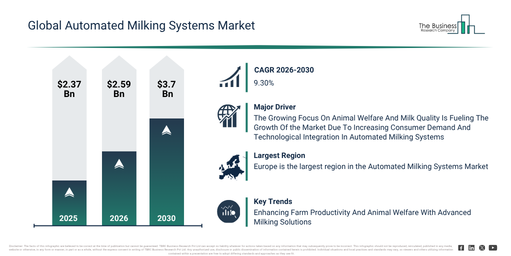
    The automated milking systems market size has demonstrated robust growth in recent years. It is projected to expand from $2.37 billion in 2025 to $2.59 billion in 2026, exhibiting a compound annual growth rate (CAGR) of 9.1%. This historical growth can be attributed to several factors: increasing labor shortages in dairy farming operations, rising demand for high quality milk production, the growing adoption of precision livestock farming practices, the expanding global commercial dairy farm infrastructure, and an increasing focus on animal welfare and hygiene standards._x000D_

    _x000D_

    The automated milking systems market size is projected to experience substantial expansion over the coming years. Its value is anticipated to reach $3.7 billion by 2030, exhibiting a compound annual growth rate (CAGR) of 9.3%. This growth during the forecast period can be attributed to several factors, including increasing investments in AI-powered herd management technologies, the rising uptake of cloud-based platforms for dairy monitoring, a heightened demand for automated and scalable dairy farming solutions, the wider deployment of smart sensors in livestock management, and an increasing emphasis on sustainable and energy-efficient dairy operations. Key trends emerging in this period involve the increasing adoption of robotic milking units to enhance labor efficiency in dairy operations, a growing need for real-time systems to monitor cow health and milk yield, a heightened focus on boosting dairy farm productivity and operational efficiency, the expanding integration of automated teat cleaning and milk storage technologies, and a growing preference for multi-stall automated milking systems on larger dairy farms._x000D_

    _x000D_

    #Download A Free Sample Report For Comprehensive Market Insights:#_x000D_

    https://www.thebusinessresearchcompany.com/sample_request?id=69977070&type=smp_x000D_

    _x000D_

    #Automated Milking Systems Market Growth Drivers And Industry Catalysts_x000D_

    An increasing emphasis on animal welfare and the quality of milk is anticipated to drive the expansion of the automated milking systems market in the coming years. This dedication to animal welfare and milk quality involves the industry’s initiatives to guarantee the well-being and appropriate care of dairy animals, concurrently upholding stringent benchmarks for milk safety, content, and cleanliness. The heightened attention to animal welfare and milk quality stems from rising consumer demand for dairy products that are both ethically sourced and safe, compelling producers to implement improved animal care methods and more rigorous milk quality criteria. This intensifying demand for animal welfare and milk quality proves especially beneficial for automated milking systems, given that these technologies facilitate accurate monitoring, uniform milking procedures, and live health data, thereby directly contributing to both the welfare of cows and the production of premium milk. As an illustration, in July 2024, the Government of Canada, a Canada-based federal administration, announced that Dairy Farmers of Canada is slated to obtain funding of up to $2.64 million (CAD 3.57) million across a five-year period. This funding aims to improve its DairyTrace platform, thereby bolstering its capacities in animal health monitoring, milk quality assurance, and traceability, which in turn supports farm sustainability and builds public confidence. Consequently, the increased emphasis on animal welfare and milk quality serves as a primary driver for the expansion of the automated milking systems market._x000D_

    _x000D_

    #Automated Milking Systems Market Segmentation And Category Breakdown#_x000D_

    The automated milking systems market covered in this report is segmented – _x000D_

    _x000D_

    1) By Offering: Hardware, Software, Services_x000D_

    2) By System Type: Single-Stall Unit, Multi-Stall Unit, Rotary System_x000D_

    3) By Herd Size: Up to One Hundred, One Hundred to One Thousand, Above One Thousand_x000D_

    4) By Application: Dairy Farms, Research Institutes, Other Applications_x000D_

    _x000D_

    Subsegments:_x000D_

    1) By Hardware: Milking Robots, Milk Storage Tanks, Teat Cleaning Units, Sensors And Detectors, Other Hardware_x000D_

    2) By Software: Herd Management Software, Milk Monitoring Software, Data Analytics Platforms, Cloud Based Management Software, Other Software_x000D_

    3) By Services: Installation Services, Maintenance Services, Training Services, Consulting Services, Other Services_x000D_

    _x000D_

    #Automated Milking Systems Market Trends Influencing Long-Term Demand_x000D_

    Leading companies within the automated milking systems market are dedicating efforts to developing advanced solutions, such as future-ready automated milking robots, with the aim of boosting farm productivity, enhancing animal welfare, and improving operational efficiency. These future-proof automated milking robots are defined as robotic milking systems built with sophisticated precision, AI-driven monitoring, options for modular upgrades, and seamless digital integration to deliver superior efficiency, better animal health, and adaptability to the evolving demands of dairy farming. For example, in June 2025, Lely, an agricultural robotics company based in the Netherlands, unveiled Astronaut A5 Next and Astronaut Max. The Astronaut A5 Next includes an adaptive operating system with over-the-air software updates, a high-precision robot arm featuring laser and camera vision for improved teat detection, and an automatic milk filter to automate remaining manual milking tasks, thereby enhancing milk quality monitoring, animal comfort, and ease of service. Conversely, Astronaut Max is engineered for large-scale farms, offering the capability to manage up to 18 Astronaut robots from a single control room, centralizing milking and cleaning activities, increasing milking capacity, reducing labor needs, and ensuring continuous operation even during service and cleaning routines._x000D_

    _x000D_

    #Automated Milking Systems Market Competitive Analysis Of Major Industry Participants#_x000D_

    Major companies operating in the automated milking systems market are Tetra Laval Group, GEA Group, Lely Holding S. à r. l., Nedap N. V., Paul Mueller Company, Dairymaster Ltd., BouMatic LLC, System Happel GmbH, Stellapps Technologies Pvt Ltd., MSD Animal Health, Fabdec Ltd., Afimilk Ltd., Milkplan SA, Hanskamp AgroTech BV, Modern Dairy Machines (MDM), ADF Milking Ltd., LAKTO Dairy Technologies, AMS Galaxy USA, BECO Dairy Automation Inc., Vansun Milking, Milkomax, Milky Way Farm _x000D_

    _x000D_

    #Access The Complete Automated Milking Systems Market Report:#_x000D_

    https://www.thebusinessresearchcompany.com/report/automated-milking-systems-market-report_x000D_

    _x000D_

    #Automated Milking Systems Market Geographic Distribution And Regional Opportunities#_x000D_

    Europe was the largest region in the automated milking systems market in 2025. Asia-Pacific is expected to be the fastest-growing region in the forecast period. The regions covered in the automated milking systems market report are Asia-Pacific, South East Asia, Western Europe, Eastern Europe, North America, South America, Middle East and Africa. _x000D_

    _x000D_

    _x000D_

    _x000D_

    _x000D_

    #Get in touch with us:#_x000D_

    _x000D_

    The Business Research Company: https://www.thebusinessresearchcompany.com/_x000D_

    Americas: +1 310-496-7795_x000D_

    Asia: +44 7882 955267 & +91 8897263534_x000D_

    Europe: +44 7882 955267_x000D_

    Email us at: marketing@tbrc.info_x000D_

    _x000D_

    #Follow us on:#_x000D_

    _x000D_

    LinkedIn: https://in.linkedin.com/company/the-business-research-company_x000D_

    YouTube: https://www.youtube.com/channel/UC24_fI0rV8cR5DxlCpgmyFQ_x000D_

    Global Market Model: https://www.thebusinessresearchcompany.com/global-market-model
  • Augmented Reality (AR) For Ramp Operations Market Growth Outlook Reveals A CAGR Of 27.1% And A Market Value Of $34.42 Billion By 2030

    Augmented Reality (AR) For Ramp Operations Market Growth Outlook Reveals A CAGR Of 27.1% And A Market Value Of $34.42 Billion By 2030

    Enhanced with market attractiveness analysis, total addressable market evaluation, company benchmarking matrices, interactive Excel dashboards, expanded supply chain intelligence, emerging startup coverage, and detailed product insights, The Business Research Company’s 2026 market reports deliver more actionable and strategically valuable research.

    #Augmented Reality (AR) For Ramp Operations Market Forecast Highlighting Growth From $13.19 Billion To $34.42 Billion#_x000D_

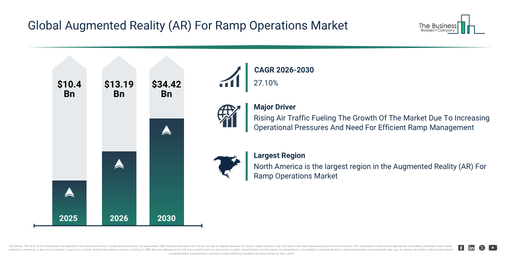
    The market size for augmented reality (AR) in ramp operations has witnessed significant expansion in recent years. It is projected to climb from $10.4 billion in 2025 to $13.19 billion in 2026, demonstrating a compound annual growth rate (CAGR) of 26.9%. This growth observed in previous periods stems from factors such as increasing airport modernization initiatives, a rise in the adoption of digital aviation tools, a growing emphasis on reducing aircraft turnaround time, the early integration of wearable devices into ground handling, and the expansion of commercial aviation infrastructure._x000D_

    _x000D_

    The augmented reality (AR) for ramp operations market size is projected to undergo significant expansion in the next few years, forecast to reach $34.42 billion by 2030 at a compound annual growth rate (CAGR) of 27.1%. This growth during the forecast period is driven by increasing demand for real-time airport operational efficiency, the rising integration of AR with AI-powered airport systems, the expansion of smart airport and digital twin ecosystems, growing investment in automated ground handling technologies, and the rising need for enhanced safety and situational awareness in ramp operations. Key trends in this period include the rising adoption of AR-enabled real-time ramp coordination systems, the integration of wearable AR devices for hands-free aircraft handling operations, the expansion of remote assistance and digital twin solutions in airport ground operations, the increasing deployment of AR-based training and simulation for ramp agents, and the growth of cloud-based AR platforms for airport operational monitoring and analytics._x000D_

    _x000D_

    #Download A Free Sample Report For Comprehensive Market Insights:#_x000D_

    https://www.thebusinessresearchcompany.com/sample_request?id=40678309&type=smp_x000D_

    _x000D_

    #Augmented Reality (AR) For Ramp Operations Market Growth Momentum: Which Factors Are Influencing Demand?#_x000D_

    The growing volume of air traffic is projected to stimulate the expansion of the augmented reality (AR) for ramp operations market moving forward. Air traffic encompasses the global transit of aircraft and passengers, whereas airport expansion involves the enhancement and enlargement of airport facilities to accommodate increasing demand. The rise in air traffic is a consequence of burgeoning passenger numbers and more frequent flights, which intensifies operational pressures on airports. Augmented reality (AR) for ramp operations supports air traffic by boosting ground handling efficiency through real-time visual guidance, streamlining the coordination of aircraft turnaround processes, reducing delays, and improving overall airport capacity utilization. For instance, in July 2025, the Airports Council International (ACI), a Canada-based trade association of airport operators, stated that passenger traffic reached 9.4 billion travellers in 2024, indicating an 8.4% rise from 2023 and exceeding pre-pandemic volumes. Therefore, the increasing air traffic is a key driver for the growth of the augmented reality (AR) for ramp operations market._x000D_

    _x000D_

    #Augmented Reality (AR) For Ramp Operations Market Segment Landscape: Which Areas Lead Market Development?#_x000D_

    The augmented reality (ar) for ramp operations market covered in this report is segmented – _x000D_

    _x000D_

    1) By Component: Hardware, Software, Services_x000D_

    2) By Device Type: Smart Glasses or Head-Mounted Displays, Mobile or Tablet Interfaces, Mixed Reality Devices_x000D_

    3) By Deployment Mode: On-Premises, Cloud_x000D_

    4) By Application: Aircraft Marshalling, Baggage Handling, Maintenance And Inspection, Training And Simulation, Safety And Security, Other Applications_x000D_

    5) By End User: Commercial Airports, Ground Handling Agencies, Cargo Operators, Military And Defense_x000D_

    _x000D_

    Subsegments:_x000D_

    1) By Hardware: Head-Mounted Displays, Smart Glasses, Tablets And Mobile Devices, Sensors And Cameras, Projection Systems, Wearable Devices, Tracking Systems_x000D_

    2) By Software: Augmented Reality Visualization Software, Remote Assistance Software, Workflow Management Software, Simulation And Training Software, Data Integration Software, Navigation And Guidance Software, Maintenance Support Software_x000D_

    3) By Services: Consulting Services, System Integration Services, Deployment And Implementation Services, Support And Maintenance Services, Training And Education Services, Managed Services_x000D_

    _x000D_

    _x000D_

    _x000D_

    _x000D_

    #Augmented Reality (AR) For Ramp Operations Market Industry Leaders And Market Competition#_x000D_

    Major companies operating in the augmented reality (ar) for ramp operations market are The Boeing Company, Airbus SE, Lockheed Martin Corporation, Honeywell International Inc, Thales Group, Qatar Airways Group, Zebra Technologies Corporation, SATS Ltd., Swissport International AG, Zoho Corporation (Zoho Lens), PTC Inc., Société Internationale de Télécommunications Aéronautiques, Air India SATS Airport Services Pvt. Ltd., EON Reality Inc., Scope AR Inc., AeroGround Flughafen München GmbH, Vuzix Corporation, Aeroport Handling, Atheer Inc. _x000D_

    _x000D_

    #Access The Complete Augmented Reality (AR) For Ramp Operations Market Report:#_x000D_

    https://www.thebusinessresearchcompany.com/report/augmented-reality-ar-for-ramp-operations-market-report_x000D_

    _x000D_

    #Augmented Reality (AR) For Ramp Operations Market Regional Analysis And Leading Geography#_x000D_

    North America was the largest region in the augmented reality (AR) for ramp operations market in 2025. Asia-Pacific is expected to be the fastest-growing region in the forecast period. The regions covered in the augmented reality (AR) for ramp operations market report are Asia-Pacific, South East Asia, Western Europe, Eastern Europe, North America, South America, Middle East and Africa. _x000D_

    _x000D_

    _x000D_

    _x000D_

    _x000D_

    #Get in touch with us:#_x000D_

    _x000D_

    The Business Research Company: https://www.thebusinessresearchcompany.com/_x000D_

    Americas: +1 310-496-7795_x000D_

    Asia: +44 7882 955267 & +91 8897263534_x000D_

    Europe: +44 7882 955267_x000D_

    Email us at: marketing@tbrc.info_x000D_

    _x000D_

    #Follow us on:#_x000D_

    _x000D_

    LinkedIn: https://in.linkedin.com/company/the-business-research-company_x000D_

    YouTube: https://www.youtube.com/channel/UC24_fI0rV8cR5DxlCpgmyFQ_x000D_

    Global Market Model: https://www.thebusinessresearchcompany.com/global-market-model
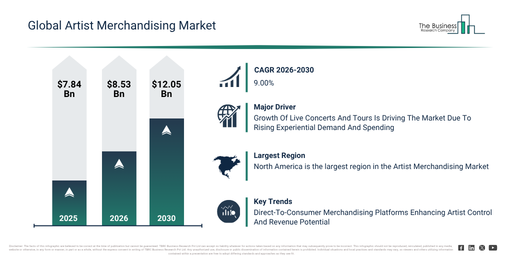
  • Artist Merchandising Market Set To Grow From $8.53 Billion In 2026 To $12.05 Billion By 2030 At A CAGR Of 9%

    Artist Merchandising Market Set To Grow From $8.53 Billion In 2026 To $12.05 Billion By 2030 At A CAGR Of 9%

    Enhanced with market attractiveness analysis, total addressable market evaluation, company benchmarking matrices, interactive Excel dashboards, expanded supply chain intelligence, emerging startup coverage, and detailed product insights, The Business Research Company’s 2026 market reports deliver more actionable and strategically valuable research.

    #Artist Merchandising Market Expected To Reach $12.05 Billion By 2030 At 9% CAGR#_x000D_

    The artist merchandising market size has witnessed strong expansion in recent years. It is anticipated to increase from $7.84 billion in 2025 to $8.53 billion in 2026, demonstrating a compound annual growth rate (CAGR) of 8.8%. The historical growth of this market can be linked to the rise in physical music and band merchandise sales, the broadening global concert and touring culture, the development of licensed character and artist branding, the enhanced retail footprint of entertainment merchandise, and the establishment of fan club-driven product ecosystems._x000D_

    _x000D_

    The artist merchandising market is poised for significant expansion in the upcoming years. Projections indicate it will reach a value of $12.05 billion by 2030, demonstrating a compound annual growth rate (CAGR) of 9.0%._x000D_

    _x000D_

    This projected growth is primarily driven by factors such as the expanding landscape of digital and virtual merchandise ecosystems, an increasing call for sustainable and ethically produced goods, the advancement of AI-driven personalized merchandise design, wider integration of metaverse-based artist branding, and more robust direct-to-consumer artist monetization strategies. Key trends anticipated during this period encompass artist-led direct-to-fan merchandising platforms, the introduction of limited edition and scarcity-focused merchandise releases, a shift towards sustainable and eco-friendly merchandise manufacturing, the emergence of social media-driven influencer and creator merchandise ecosystems, and the availability of personalized and on-demand print-on-demand merchandise customization._x000D_

    _x000D_

    #Download A Free Sample Report For Comprehensive Market Insights:#_x000D_

    https://www.thebusinessresearchcompany.com/sample_request?id=81397106&type=smp_x000D_

    _x000D_

    #Artist Merchandising Market Industry Drivers: What Is Driving Revenue Growth?#_x000D_

    The expansion of live concerts and tours is anticipated to boost the artist merchandising market in the future. Live concerts and tours are defined as structured series of musical or performance events held in various places, where artists engage audiences directly through their work, incorporating logistics, venue management, and audience interaction for engaging, real-time entertainment. A primary reason for the increase in live concerts and tours is the growing consumer demand for experiential entertainment, as audiences now prefer memorable, direct interactions to passive viewing, encouraging organizers and artists to broaden their touring efforts to satisfy this need and enhance audience ties. Artist merchandising improves income streams and strengthens brand recognition during live events, consequently boosting the commercial feasibility and attractiveness of concerts and tours. For example, in March 2025, according to iMusician, a Switzerland-based digital music distribution company, approximately 151 million attendees participated in nearly 550,000 Live Nation Entertainment events in 2024. This reflected a 4% year-over-year increase, alongside a 3% rise in fourth-quarter revenue, reaching 23 billion United States dollars, with operating income hitting 825 million, adjusted operating cash flow surpassing 2.15 billion, and the concert segment’s adjusted operating income surging by 65% to 530 million, achieving margins of 2.8%. Consequently, the expansion of live concerts and tours fuels the growth of the artist merchandising market._x000D_

    _x000D_

    #Artist Merchandising Market Segment Breakdown: Which Categories Generate The Most Revenue?#_x000D_

    The artist merchandising market covered in this report is segmented – _x000D_

    _x000D_

    1) By Product Type: Apparel, Accessories, Posters And Art Prints, Physical Media, Collectibles, Digital Merchandise, Home Décor_x000D_

    2) By Price Range: Economy, Mid-Range, Premium Or Luxury_x000D_

    3) By Distribution Channel: Online Stores, Physical Retail Stores, Concerts And Events, Other Distribution Channels_x000D_

    4) By End User: Musicians, Visual Artists, Performing Artists, Other End Users_x000D_

    _x000D_

    Subsegments:_x000D_

    1) By Apparel: Graphic T-Shirts, Tour T-Shirts, Oversized And Streetwear Apparel, Hoodies And Sweatshirts, Varsity And Bomber Jackets, Snapback And Baseball Caps, Beanies And Winter Wear, Performance And Activewear, Kids And Infant Apparel, Limited Edition Designer Collaborations_x000D_

    2) By Accessories: Tote Bags And Backpacks, Crossbody And Sling Bags, Bracelets And Wristbands, Necklaces And Chains, Rings And Earrings, Keychains And Lanyards, Phone Cases And Tech Accessories, Sunglasses, Belts And Fashion Accessories, Festival And Event Accessories_x000D_

    3) By Posters And Art Prints: Tour Posters, Limited Edition Prints, Signed Posters, Canvas Art Prints, Digital Download Prints, Vintage Or Reprint Posters, Lyric Art Prints, Photography Prints, Fan Art Collaborations, Wall Sticker Posters_x000D_

    4) By Physical Media: Standard Vinyl Records, Colored And Special Edition Vinyl, Box Set Collections, Compact Discs Standard And Deluxe Editions, Cassette Tapes, Autographed Media, Remastered Editions, Anniversary Releases, Bundled Media Packages, Collector’s Editions_x000D_

    5) By Collectibles: Autographed Memorabilia, Limited Edition Figurines, Artist Action Figures, Trading Cards, Tour Memorabilia, Replica Instruments Or Props, Collaboration Collectibles, Anniversary Collectibles, Fan Club Exclusive Items, Mystery Boxes_x000D_

    6) By Digital Merchandise: Music Non Fungible Tokens, Digital Art Non Fungible Tokens, Virtual Concert Tickets, Exclusive Digital Albums, Augmented Reality And Virtual Reality Merchandise, Metaverse Wearables, Digital Collectible Cards, Subscription Based Digital Content, Fan Tokens, Mobile Application Exclusive Content_x000D_

    7) By Home Décor: Wall Art And Canvas Prints, Decorative Posters, Bedding Sets Sheets And Pillow Covers, Mugs And Drinkware, Lamps And Lighting Décor, Rugs And Carpets, Clocks And Wall Accessories, Kitchenware Merchandise, Bathroom Accessories, Customized Home Merchandise_x000D_

    _x000D_

    #Artist Merchandising Market Growth Trends: What Is Influencing The Future Outlook?_x000D_

    Companies within the artist merchandising sector are actively concentrating on the creation of sophisticated solutions, specifically digital merchandising platforms, to optimize direct-to-consumer sales and enhance artist independence. A digital merchandising platform functions as a software-driven solution that assists in the creation, management, production, and direct selling of branded merchandise, leveraging integrated digital tools and on-demand services. For instance, in October 2025, DistroKid, a US-based digital music distribution enterprise, introduced Direct, its own digital merchandising platform. This platform allows artists to establish customized online stores while delegating production and shipping through on-demand manufacturing systems, thereby minimizing logistical demands. Additionally, it enables artists to retain all revenue from merchandise sales, which strengthens their financial autonomy and promotes closer ties with their audience._x000D_

    _x000D_

    #Artist Merchandising Market Key Players And Strategic Industry Positioning#_x000D_

    Major companies operating in the artist merchandising market are Sony Music Entertainment Inc., Live Nation Entertainment Inc., Universal Music Group N. V., Warner Music Group Corp., Gildan Activewear Inc., The Araca Group LLC, Fifth Sun Inc., Global Merchandising Services LLC, Sandbag Ltd., EMP Merchandising GmbH & Co. KG, King Ice LLC, Manhead Merch LLC, Probity Merch LLC, Bravado International Group, Mad Merch LLC, Merch Traffic LLC, Merchbar Inc., Rock Off Ltd., BSI Merch & Artist Services LLC, Armada Merchandising LLC, BodyThredz LLC _x000D_

    _x000D_

    #Access The Complete Artist Merchandising Market Report:#_x000D_

    https://www.thebusinessresearchcompany.com/report/artist-merchandising-market-report_x000D_

    _x000D_

    #Artist Merchandising Market Regional Distribution: Which Areas Drive Market Expansion?#_x000D_

    North America was the largest region in the artist merchandising market in 2025. Asia Pacific is expected to be the fastest-growing region in the forecast period. The regions covered in the artist merchandising market report are Asia-Pacific, South East Asia, Western Europe, Eastern Europe, North America, South America, Middle East and Africa. _x000D_

    _x000D_

    _x000D_

    _x000D_

    _x000D_

    #Get in touch with us:#_x000D_

    _x000D_

    The Business Research Company: https://www.thebusinessresearchcompany.com/_x000D_

    Americas: +1 310-496-7795_x000D_

    Asia: +44 7882 955267 & +91 8897263534_x000D_

    Europe: +44 7882 955267_x000D_

    Email us at: marketing@tbrc.info_x000D_

    _x000D_

    #Follow us on:#_x000D_

    _x000D_

    LinkedIn: https://in.linkedin.com/company/the-business-research-company_x000D_

    YouTube: https://www.youtube.com/channel/UC24_fI0rV8cR5DxlCpgmyFQ_x000D_

    Global Market Model: https://www.thebusinessresearchcompany.com/global-market-model