2D Cell Culture Market Outlook For 2026–2030 Covering Growth Drivers And Industry Trends
The Business Research Company’s 2026 market reports feature enhanced tools like market attractiveness analysis, TAM assessment, and company scoring matrices, along with interactive dashboards, deeper supply chain insights, and startup coverage strengthening the depth, usability, and strategic value of insights.
What Is The Estimated Market Size Of The 2D Cell Culture Market In 2026, And How Will Its Value Evolve By 2030?
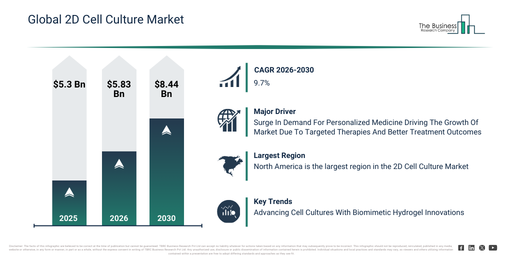
The 2d cell culture market size has demonstrated significant growth in recent years. It is projected to expand from $5.3 billion in 2025 to $5.83 billion in 2026, achieving a compound annual growth rate (CAGR) of 10.0%. This historical growth can be attributed to the widespread adoption of monolayer culture techniques, its extensive utilization in early-stage drug discovery, the availability of cost-effective plasticware, academic research’s dependence on 2d models, and the implementation of standardized laboratory protocols.
The 2d cell culture market size is projected to experience robust expansion over the coming years. It is anticipated to grow to $8.44 billion in 2030, achieving a compound annual growth rate (CAGR) of 9.7%. This projected growth during the forecast period is attributable to factors such as increasing integration with automated imaging systems, rising demand from biopharmaceutical pipelines, the expansion of toxicology and safety testing, increased utilization in regenerative medicine studies, and its continued relevance alongside 3d culture models. Prominent trends for the forecast period include the increasing use of standardized cell culture consumables, the rising adoption of automated 2d culture platforms, a growing demand for high-reproducibility assays, the expansion of high-throughput screening applications, and an enhanced focus on cost-efficient cell-based research.
Access Your Free Sample Report For In-Depth Market Analysis:
https://www.thebusinessresearchcompany.com/sample.aspx?id=28896&type=smp
What Key Drivers Are Fueling The Growth Of The 2D Cell Culture Market?
The expanding need for personalized medicine is projected to stimulate the expansion of the 2D cell culture market in the coming years. Personalized medicine is defined as a healthcare strategy that customizes treatment and prevention plans based on an individual’s distinct genetic profile, lifestyle, and surroundings, moving away from a universal approach. The increased interest in personalized medicine stems from improved therapeutic results, offering specific treatments that are more potent and lead to fewer adverse reactions. Consequently, patients experience quicker recovery and an enhanced quality of life. The requirement for personalized medicine fuels the necessity for 2D cell culture because it facilitates researchers in cultivating and examining cells specific to a patient, thereby allowing for the investigation of individual drug reactions and the creation of customized therapeutic approaches. For example, in February 2024, the Personalized Medicine Coalition, a US-based non-profit group, reported that in 2023, the FDA sanctioned 16 novel personalized therapies for individuals with rare conditions, which was a notable rise from the six approved in 2022. Hence, the escalating demand for personalized medicine is fueling the expansion of the 2D cell culture market.
What Are The Main Segments Within The 2D Cell Culture Market Segment Structure?
The 2d cell culture market covered in this report is segmented –
1) By Type: Skin Cell, Lung Cell, Brain Cell, Kidney Cell, Liver Cell, Breast Cell, Other Types
2) By Technology: 2D Cell Culture Platforms, Microfluidics Technology, Automated Cell Culture Systems, Incubation and Analysis Systems, Culture Monitoring and Control Systems
3) By Application: Pharmaceutical, Stem Cell Research, Bioproduction, Food Application, Bioenergy, Environment Testing and Toxicology, Agriculture
4) By End-User: Pharmaceutical Companies, Biotechnology Companies, Contract Research Organizations, Academic Research Institutes
Subsegments:
1) By Skin Cell: Epidermal Cell, Dermal Cell, Melanocyte, Keratinocyte
2) By Lung Cell: Alveolar Cell, Bronchial Cell, Pneumocyte
3) By Brain Cell: Neuron, Astrocyte, Microglia, Oligodendrocyte
4) By Kidney Cell: Glomerular Cell, Tubular Cell, Podocyte
5) By Liver Cell: Hepatocyte, Kupffer Cell, Stellate Cell
6) By Breast Cell: Luminal Cell, Myoepithelial Cell, Basal Cell
7) By Other Types: Endothelial Cell, Fibroblast, Stem Cell, Immune Cell
What Trends Are Influencing The 2D Cell Culture Market?
Leading companies within the 2D cell culture market are prioritizing the creation of advanced biomaterials, such as thin hydrogel coatings for 2D substrates, to improve cell adhesion, replicate native tissue environments, and boost experimental consistency. These specialized surface layers, referred to as thin hydrogel coatings for 2D substrates, offer a biomimetic, cell-friendly environment crucial for enhancing cell attachment, growth, and function in 2D cultures. For instance, in September 2025, TheWell Bioscience Inc., a US-based Biotechnology company, launched an innovative, xeno-free biomimetic hydrogel system. This platform is engineered to support both 2D and 3D neuronal cell cultures, as well as in vivo injectable delivery. Its primary goal is to advance neuroregenerative research by closely imitating the natural cellular environment. The technology also finds application in precision medicine, cell therapy, and biomanufacturing. Collectively, it marks a notable advancement in developing effective cell-based therapies.
Who Are The Companies Participating In The 2D Cell Culture Market?
Major companies operating in the 2d cell culture market are Tecan Group Ltd., Roche Holding AG, Thermo Fisher Scientific Inc., Takara Bio Inc., Danaher Corporation, Merck KGaA, GE Healthcare, Corning Incorporated, Becton Dickinson and Company (BD), Lonza Group AG, Agilent Technologies Inc., Sartorius AG, PerkinElmer Inc., Bio-Rad Laboratories Inc., Eppendorf AG, Bio-Techne Corporation, STEMCELL Technologies Inc., Greiner Bio-One International AG, Promega Corporation, BICO Group AB, Cedarlane Laboratories Ltd., Creative Bioarray Inc., PromoCell GmbH, Biolamina AB, HiMedia Laboratories Pvt. Ltd., 3H Biomedical AB, Cell Microsystems Inc., AlveoliX AG.
Get The Full 2D Cell Culture Market Report:
https://www.thebusinessresearchcompany.com/report/2d-cell-culture-global-market-report
Which Region Leads The 2D Cell Culture Market In Terms Of Market Share?
North America was the largest region in the 2D cell culture market in 2025. Asia-Pacific is expected to be the fastest-growing region in the forecast period. The regions covered in the 2d cell culture market report are Asia-Pacific, South East Asia, Western Europe, Eastern Europe, North America, South America, Middle East, Africa.
Request A Customized 2D Cell Culture Market Report For Competitive Insights:
https://www.thebusinessresearchcompany.com/report/2d-cell-culture-global-market-report
Browse Through More Reports Similar to the Global 2D Cell Culture Market 2026, By The Business Research Company
Cell Cultures Market Report 2026
https://www.thebusinessresearchcompany.com/report/cell-cultures-global-market-report
Cell Culture Media Market Report 2026
https://www.thebusinessresearchcompany.com/report/cell-culture-media-global-market-report
3D Cell Culture Technologies Market Report 2026
https://www.thebusinessresearchcompany.com/report/3d-cell-culture-technologies-global-market-report
Get in touch with us:
The Business Research Company: https://www.thebusinessresearchcompany.com/
Americas +1 310-496-7795
Asia +44 7882 955267 & +91 8897263534
Europe +44 7882 955267
Email us at: marketing@tbrc.info
Follow us on:
LinkedIn: https://in.linkedin.com/company/the-business-research-company
YouTube: https://www.youtube.com/channel/UC24_fI0rV8cR5DxlCpgmyFQ
Global Market Model: https://www.thebusinessresearchcompany.com/global-market-model