The Business Research Company’s 2026 market reports feature enhanced tools like market attractiveness analysis, TAM assessment, and company scoring matrices, along with interactive dashboards, deeper supply chain insights, and startup coverage strengthening the depth, usability, and strategic value of insights.
What Will Be The Estimated Market Size Of The 3D Cell Culture Technologies Market By 2030?
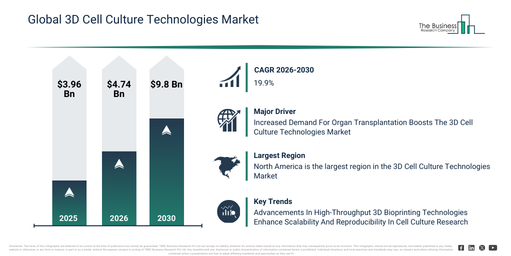
The 3D cell culture technologies market has experienced rapid growth in its size during recent years. It is projected to expand from $3.96 billion in 2025 to $4.74 billion in 2026, at a compound annual growth rate (CAGR) of 19.7%. The growth observed in the historic period can be attributed to the growing use of cell culture in vaccine production, increasing cancer research activities, limitations of 2d cell culture models, rising academic research funding, and the expansion of biotechnology research infrastructure.
The 3D cell culture technologies market size is expected to experience rapid growth in the coming years, with projections indicating it will reach $9.8 billion in 2030, driven by a compound annual growth rate (CAGR) of 19.9%. This expansion during the forecast period can be attributed to advancements in 3D bioreactor technologies, increasing investment in regenerative medicine, the growth of pharmaceutical drug discovery pipelines, the rising adoption of personalized medicine, and technological improvements in scaffold materials. Major trends anticipated in the same period include the increasing adoption of 3D cell culture in cancer research, the rising use of organoids and spheroids for disease modeling, a growing demand for advanced drug screening platforms, the expansion of stem cell and regenerative medicine research, and a higher preference for in vitro models over animal testing.
Download A Free Sample Report For Comprehensive Market Insights:
https://www.thebusinessresearchcompany.com/sample.aspx?id=2462&type=smp
What Core Drivers Are Transforming The 3D Cell Culture Technologies Market?
The escalating need for organ transplantation is anticipated to fuel the expansion of the 3D cell culture technologies market. This technology involves creating three-dimensional cellular structures that accurately emulate the architecture and functionality of natural tissues or organs, thereby facilitating both tissue and organ regeneration alongside drug toxicology screening. The growth in organ transplantation procedures stems from the rising instances of organ failure coupled with medical technological advancements that enhance the feasibility of such transplants. 3D cell culture technologies bolster this progression by supplying models for organ development, regenerative therapies, and preclinical testing. For instance, in January 2024, the United Network for Organ Sharing (UNOS), a US-based nonprofit organization, announced that the United States performed a record 46,632 organ transplants in 2023, surpassing previous annual figures and indicating continuous nationwide growth in transplant activities. Thus, the heightened requirement for organ transplantation is a key driver for the growth of the 3D cell culture technologies market.
Which Segment Groups Define The 3D Cell Culture Technologies Market Landscape?
The 3D cell culture technologies market covered in this report is segmented –
1) By Type: Scaffold-Based, Scaffold-Free, 3D Bioreactors
2) By Application: Cancer Research, Stem Cell Research, Drug Discovery, Regenerative Medicine
3) By End Users: Research Laboratories and Institutes, Biotechnology and Pharmaceutical Companies, Other End Users
Subsegments:
1) By Scaffold-Based: Natural Scaffolds, Synthetic Scaffolds, Hybrid Scaffolds
2) By Scaffold-Free: Spheroid-Based, Organoid-Based
3) By 3D Bioreactors: Spinner Flask Bioreactors, Rotating Wall Bioreactors, Microcarrier-Based Bioreactors, Hollow Fiber Bioreactors
What Trends Are Affecting The 3D Cell Culture Technologies Market Dynamics?
Leading companies within the 3D cell culture technologies market are concentrating on developing sophisticated high-throughput scalability systems to boost both effectiveness and consistency. Such scalability denotes platforms capable of swiftly producing a substantial volume of 3D cell models that maintain uniform quality, consequently lowering sample variation and per-sample expenses. As an illustration, Inventia Life Science, an Australian provider of 3D cell culture technologies, introduced RASTRUM Allegro in January 2025, a system equipped with drop-on-demand bioprinting and advanced precision robotics. This system has the capacity to create a 96-well plate in approximately 6 minutes and a 384-well plate in 9 minutes, enabling a daily throughput exceeding 35 plates. It achieves post-print intra- and inter-plate coefficient of variation (CV) below 10 percent and downstream assay CVs below 19 percent, ensuring highly consistent outcomes. Furthermore, the platform is tailored for patient-derived samples, facilitating the generation of up to 3.5 times more 3D models from a restricted quantity of cells, which in turn decreases the cost per well and enhances its utility for translational research.
Which Organizations Are Operating Within The 3D Cell Culture Technologies Market?
Major companies operating in the 3D cell culture technologies market are Becton Dickinson and Company, Corning Incorporated, Eppendorf AG, Merck KGaA, Thermo Fisher Scientific Inc., Lonza Group AG, HiMedia Laboratories Pvt. Ltd., PromoCell GmbH, CellGenix GmbH, Greiner Bio-One International GmbH, Irvine Scientific Sales Company Inc., American Type Culture Collection (ATCC), Miltenyi Biotec B.V. & Co. KG, Sartorius AG, CN Bio Innovations, Nortis Inc., Kiyatec, Nanofiber Solutions, Known Medicine, Synthecon Inc., 3D Biotek LLC, 3D Cell Culture Innovations LLC, 3D Matrix Inc., Allevi Inc., BioSpherix Ltd., Emulate Inc., MicroTissues Inc., Sumitomo Bakelite
Access The Complete 3D Cell Culture Technologies Market Report:
https://www.thebusinessresearchcompany.com/report/3d-cell-culture-technologies-global-market-report
Which Region Holds The Largest Share In The 3D Cell Culture Technologies Market?
North America was the largest region in the 3D cell culture technologies market in 2025. Western Europe was the second largest region in the 3D cell culture technologies market. The regions covered in the 3D cell culture technologies market report are Asia-Pacific, South East Asia, Western Europe, Eastern Europe, North America, South America, Middle East, Africa.
Access 3D Cell Culture Technologies Market Report for Deeper Competitive Insights
https://www.thebusinessresearchcompany.com/customise?id=2462&type=smp
Browse Through More Reports Similar to the Global 3D Cell Culture Technologies Market 2026, By The Business Research Company
Cell Cultures Global Market Report 2026
https://www.thebusinessresearchcompany.com/report/cell-cultures-global-market-report
Cell Cultures Global Market Report 2026
https://www.thebusinessresearchcompany.com/report/cell-cultures-global-market-report
Cell Culture Media Global Market Report 2026
https://www.thebusinessresearchcompany.com/report/cell-culture-media-global-market-report
Get in touch with us:
The Business Research Company: https://www.thebusinessresearchcompany.com/
Americas: +1 310-496-7795
Asia: +44 7882 955267 & +91 8897263534
Europe: +44 7882 955267
Email us at: marketing@tbrc.info
Follow us on:
LinkedIn: https://in.linkedin.com/company/the-business-research-company
YouTube: https://www.youtube.com/channel/UC24_fI0rV8cR5DxlCpgmyFQ
Global Market Model: https://www.thebusinessresearchcompany.com/global-market-model