
Critical Market Drivers Shaping the Outlook for Phenylketonuria (PKU) Market from 2025-2034: Increasing Cases Of Genetic Disorders Driving The Growth Of The Market
Claim your 30% discount on Global Market Reports with code ONLINE30. Limited time only.
How Fast Is The Phenylketonuria (PKU) Market Expected to Grow Between 2025 And 2029?
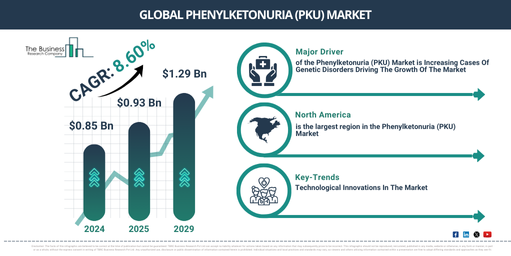
There has been a robust growth in the phenylketonuria (PKU) market size recently. The market is projected to grow from $0.85 billion in 2024 to $0.93 billion in 2025, at a compound annual growth rate (CAGR) of 8.8%. This growth during the historic period has been largely driven by increasing newborn screening programs, rising awareness regarding metabolic disorders, dietary management for PKU, the expanding availability of medical foods, and regulatory endorsements for PKU treatments.
In the upcoming years, the market size for phenylketonuria (PKU) is projected to experience robust growth, escalating to a value of$1.29 billion by 2029 with an anticipated compound annual growth rate (CAGR) of 8.6%. This growth within the forecast period could be due to the increased preference for gene therapy, the rise of enzyme replacement therapies, an upsurge in rare disease research funding, increasing interest in personalized medical solutions, and state support for PKU treatments. The period looks promising with the emergence of trends such as the creation of RNA-based therapies, the incorporation of digital health strategies for PKU management, an increase in collaborations between biotech firms and research organizations, attention towards non-dietary treatment options, and the broadening scope of telehealth services specific to PKU patients.
Download a free sample to assess the report’s scope and structure:
https://www.thebusinessresearchcompany.com/sample.aspx?id=21257&type=smp
What Are the Core Growth Drivers Propelling the Phenylketonuria (PKU) Market Forward?
The escalation in instances of genetic disorders is projected to drive the expansion of the phenylketonuria (PKU) market in the future. Genetic disorders are health conditions triggered by anomalies within a person’s DNA, including mutations, deletions, and duplications of genes or chromosomes. The surge in genetic disorders is linked to elements such as an increase in maternal age, environmental factors, progressive diagnostic technologies, and enhanced awareness, all of which contribute to better detection rates. Phenylketonuria offers insight into genetic disorders through the demonstration of inherited enzyme deficiencies that can result in serious metabolic complexities. For instance, as reported by Gene People, a registered UK-based charity, in March 2024, it is estimated that genetic conditions impact 1 in 25 children, affecting over 2.4 million children and adults in the UK. In addition, approximately 30,000 newborns and children in the UK receive a genetic disorder diagnosis each year. Consequently, the burgeoning instances of genetic disorders are steering the growth trajectory of the phenylketonuria (PKU) market.
What Segment Types Define the Phenylketonuria (PKU) Market Structure?
The phenylketonuria (pku)market covered in this report is segmented –
1) By Type: Hyperphenylalaninemia; Mild Phenylketonuria (PKU); Moderate And Variant; Classic Phenylketonuria (PKU)
2) By Treatment Type: Enzyme Replacement Therapy; Gene Therapy; Medication; Dietary Therapy
3) By Diagnosis: Genetic Testing; Biochemical Testing; Newborn Screening
4) By End-User: Specialty Clinics; Research Institutes; Home Healthcare; Hospitals
Subsegments:
1) By Hyperphenylalaninemia: Mild Hyperphenylalaninemia; Moderate Hyperphenylalaninemia; Severe Hyperphenylalaninemia
2) By Mild Phenylketonuria (PKU): Mild PKU with dietary management; Mild PKU with enzyme supplementation
3) By Moderate And Variant: Moderate PKU with medication; Variant PKU with treatment variations
4) By Classic Phenylketonuria (PKU): Classic PKU with strict dietary management; Classic PKU with enzyme replacement therapy
Request customized data on this market:
https://www.thebusinessresearchcompany.com/customise?id=21257&type=smp
Which Geographic Areas Hold the Strongest Growth Potential in the Phenylketonuria (PKU) Market?
North America was the largest region in the phenylketonuria (PKU) market in 2024. Europe is expected to be the fastest-growing region in the forecast period. The regions covered in the phenylketonuria (PKU) market report are Asia-Pacific, Western Europe, Eastern Europe, North America, South America, Middle East, Africa.
Which Emerging Trends that Are Influencing thePhenylketonuria (PKU) Industry Evolution?
Leading firms in the phenylketonuria (PKU) industry are concentrating on innovative product development by harnessing various technologies, like physiognomic technology, to augment the effectiveness and safety of PKU therapies. These advancements mimic human physiological conditions to improve drug absorption and metabolism. Physiomimic technology involves a complete range of hardware, expendable items, and testing procedures created to emulate intricate human biology and accurately foresee human responses to drugs. For instance, Relief Therapeutics Holding SA, a Swiss biopharmaceutical firm, launched PKU Golike in October 2022. PKU Golike, a cutting-edge medical food product, was crafted using the patented, pharmaceutical-grade Physiomimic technology intended for dietary management of phenylketonuria (PKU). This product comes in the form of granules, packets, and medical food bars and features a unique coating that facilitates the physiological absorption of amino acids, like natural proteins, while successfully concealing their unpleasant taste, smell, and aftertaste.
View the full report here:
https://www.thebusinessresearchcompany.com/report/phenylketonuria-pku-global-market-report
What Is the Definition of the Phenylketonuria (PKU) Market?
Phenylketonuria (PKU) is a rare inherited metabolic disorder in which the body cannot break down an amino acid called phenylalanine (Phe) found in many protein-containing foods. This inability is due to a deficiency or malfunction of the phenylalanine hydroxylase (PAH) enzyme, which normally converts phenylalanine into another amino acid called tyrosine.
Purchase the full report and get a swift delivery:
https://www.thebusinessresearchcompany.com/purchaseoptions.aspx?id=21257
About The Business Research Company:
With over 15000+ reports from 27 industries covering 60+ geographies, The Business Research Company has built a reputation for offering comprehensive, data-rich research and insights. Armed with 1,500,000 datasets, the optimistic contribution of in-depth secondary research, and unique insights from industry leaders, you can get the information you need to stay ahead in the game.
Get in touch with us:
The Business Research Company: https://www.thebusinessresearchcompany.com/
Americas +1 310-496-7795
Europe +44 7882 955267
Asia & Others +44 7882 955267 & +91 8897263534
Email us at info@tbrc.info
Follow us on:
LinkedIn: https://in.linkedin.com/company/the-business-research-company
YouTube: https://www.youtube.com/channel/UC24_fI0rV8cR5DxlCpgmyFQ
Global Market Model: https://www.thebusinessresearchcompany.com/global-market-model

