Unlock Global Insights – Save 20% on Market Reports with Code ONLINE20
What Are The Forecasted Market Size Estimates For The Disability Devices Market Between 2025 And 2029?
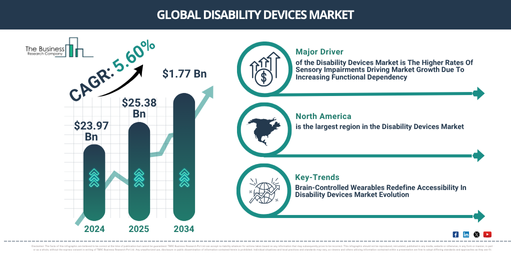
The disability devices market size has demonstrated strong growth in recent years. It is anticipated to increase from $23.97 billion in 2024 to $25.38 billion in 2025, with a compound annual growth rate (CAGR) of 5.9%. This historical growth can be attributed to rising global awareness of disability inclusion, an increasing incidence of chronic conditions such as diabetes and arthritis, the worldwide increase in life expectancy, the initial development of regulatory frameworks that promote accessibility, and growing healthcare expenditure in high-income countries.
The disability devices market size is expected to undergo significant expansion over the next few years, with projections indicating it will reach $31.60 billion by 2029, demonstrating a compound annual growth rate (CAGR) of 5.6%. This growth during the forecast period is propelled by factors such as the accelerating aging population within emerging markets, increased investments in inclusive healthcare infrastructure, the broadening of universal health coverage programs, a stronger emphasis on rehabilitation services in national health agendas, and the rising global burden of non-communicable diseases. Prominent trends for the forecast period include the adoption of artificial intelligence for adaptive functionalities, the integration of the Internet of Things for device monitoring, advancements in lightweight and durable materials, an increase in modular and customizable device designs, and the miniaturization of components to enhance portability.
Unlock Your Free Sample Report for Exclusive Market Data:
https://www.thebusinessresearchcompany.com/sample.aspx?id=25754&type=smp
What Are The Key Drivers Of Growth In The Disability Devices Market?
An anticipated increase in sensory impairments is projected to fuel expansion within the disability devices market. These impairments involve a partial or total decline in one or more senses, predominantly impacting sight, hearing, or other sensory capabilities, thereby considerably hindering an individual’s capacity to comprehend, process, or react to external cues. The rising prevalence of sensory impairments largely stems from influences like an aging population, ongoing health issues, and increased exposure to environmental hazards. These circumstances frequently cause sensory functions to decline progressively and become more widespread as people age, resulting in a higher occurrence of such impairments. Disability devices are essential for managing the increasing challenges posed by sensory impairments, as they boost functional abilities, foster self-reliance, and enhance the overall well-being of those impacted. For example, data from November 2024, as per The Hull Joint Strategic Needs Assessment (JSNA) published by the UK’s Hull City Council, indicates that sensory impairment contributes to 6.0% of healthy life years lost. This burden is more pronounced in older demographics, increasing from 2.5% for individuals under 50 to 12.9% for those aged 70 and above in hull. Furthermore, projections suggest that severe visual impairment among individuals aged 75 and older will increase from 2,100 to 3,100 by 2040, primarily owing to demographic aging. Consequently, the escalating incidence of sensory impairments is a key factor propelling the expansion of the disability devices market.
How Is The Disability Devices Market Classified Into Different Segments?
The disability devices market covered in this report is segmented –
1) By Device Type: Vision Aids, Hearing Aids, Mobility Aids, Other Devices Types
2) By Material: Plastic, Metal, Wood, Fabric
3) By Application: Home Care Settings, Hospitals, Ambulatory Care Centers And Rehabilitation Centers
4) By End User: Elderly, Physically Challenged, Visually Impaired, Hearing Impaired
Subsegments:
1) By Vision Aids: Magnifiers, Braille Readers, Screen Reading Software, Smart Glasses
2) By Hearing Aids: Behind-The-Ear (BTE), In-The-Ear (ITE), Receiver-In-Canal (RIC), Cochlear Implants
3) By Mobility Aids: Wheelchairs, Walkers And Rollators, Crutches, Mobility Scooters
4) By Other Device Types: Communication Aids, Cognitive Aids, Environmental Control Devices, Prosthetic Devices
Which Key Trends Are Expected To Influence The Disability Devices Market In The Coming Years?
Leading firms within the disability devices sector are prioritizing the creation of sophisticated technologies, including brain-controlled assistive wearables, with the goal of increasing accessibility and strengthening user independence through intuitive, non-invasive methods of control. Specifically, a brain-controlled assistive wearable functions as an apparatus that employs neural and physiological indicators, enabling individuals facing physical or motor challenges to engage with digital platforms via non-verbal, movement-driven instructions. As an illustration, during March 2024, AAVAA Inc., a neurotechnology company based in Canada, introduced its Brain-Computer Interface (BCI) System designed for Smart Glasses. This system empowers users to control digital equipment through eye movements, facial expressions, and head movements by processing brain and biological signals. Characterized by its lightweight sensors and an efficient computational design, the system integrates smoothly into eyewear, thereby providing improved utility across applications such as assistive technologies, smart homes, augmented reality, and virtual reality.
Which Leading Players Are Enhancing Their Disability Devices Market Presence Worldwide?
Major companies operating in the disability devices market are Medline Industries LP, Sonova Holding AG, William Demant Holding A/S, GN Store Nord A/S, Ottobock SE & Co. KGaA, Hollister Inc., Cochlear Ltd., Arjo AB, Invacare Corporation, GN Hearing A/S, MED-EL Elektromedizinische Geräte Gesellschaft m.b.H., DRIVE MEDICAL GMBH & CO. KG, Permobil AB, Pride Mobility Products Corporation, Steeper Group, GF Health Products Inc., WHILL Inc., Carex Health Brands Inc., Merits Health Products, MEYRA Group, Hearing Health & Technology Matters LLC, Magic Mobility Pty Ltd, LEVO AG, Batec Mobility S.L., BetterLiving.
Download The Full Report For Exclusive Market Findings:
https://www.thebusinessresearchcompany.com/report/disability-devices-global-market-report
How Does The Disability Devices Market Perform Across Key Geographic Regions?
North America was the largest region in the disability devices market in 2024. Asia-Pacific is expected to be the fastest-growing region in the forecast period. The regions covered in the disability devices market report are Asia-Pacific, Western Europe, Eastern Europe, North America, South America, Middle East, Africa.
Request A Customized Version Of The Disability Devices Market Report:
https://www.thebusinessresearchcompany.com/customise?id=25754&type=smp
Browse Through More Reports Similar to the Global Disability Devices Market 2025, By The Business Research Company
Elderly And Disabled Assistive Devices Global Market Report 2025
Specialty Devices Global Market Report 2025
https://www.thebusinessresearchcompany.com/report/specialty-devices-global-market-report
Portable Medical Devices Global Market Report 2025
https://www.thebusinessresearchcompany.com/report/portable-medical-devices-global-market-report
Get in touch with us:
The Business Research Company: https://www.thebusinessresearchcompany.com/
Americas +1 310-496-7795
Asia +44 7882 955267 & +91 8897263534
Europe +44 7882 955267
Email us at info@tbrc.info
Follow us on:
LinkedIn: https://in.linkedin.com/company/the-business-research-company
YouTube: https://www.youtube.com/channel/UC24_fI0rV8cR5DxlCpgmyFQ
Global Market Model: https://www.thebusinessresearchcompany.com/global-market-model