
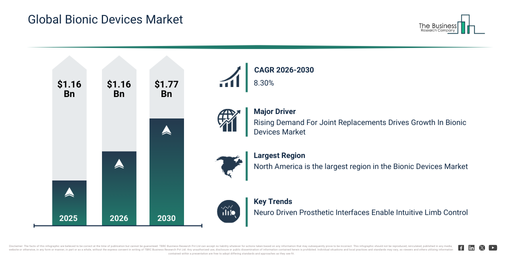
A key trend shaping the Bionic Devices Market involves the Neuro Driven Prosthetic Interfaces Enable Intuitive Limb Control
The Business Research Company’s 2026 market reports include new capabilities such as market attractiveness scoring and analysis, total addressable market analysis, company scoring matrix, interactive excel data dashboard, improved supply chain analysis, upcoming startups in the market, and overview of key products, aimed at improving the depth, usability, and strategic value of the insights delivered.
How Large Is The Bionic Devices Market Projected To Become By 2030 Based On Its 2026 Valuation?
The bionic devices market has experienced robust growth in recent years. It is projected to increase from $5.88 billion in 2025 to $6.37 billion in 2026, achieving a compound annual growth rate (CAGR) of 8.4%. This past growth can be attributed to an increase in limb loss due to accidents and trauma, the early adoption of electronic and myoelectric prosthetics, the expansion of rehabilitation and assistive technology programs, advancements in actuator and sensor engineering, and the rising clinical acceptance of functional restoration devices.
The bionic devices market is projected to experience substantial growth over the coming years, reaching a valuation of $8.76 billion by 2030, exhibiting a compound annual growth rate (CAGR) of 8.3%. This anticipated expansion is driven by several factors, including the increasing need for prosthetic movements that are both highly responsive and lifelike, alongside greater investment in neural interface and brain-machine control research. Furthermore, the broader integration of bionic devices into rehabilitation medicine, a heightened emphasis on enhancing quality of life and achieving mobility independence, and the ongoing development of customized, patient-specific bionic devices contribute to this upward trajectory. Key trends expected during this period involve the greater incorporation of sensor-based and neural-controlled prosthetic systems, the increasing uptake of advanced bionic limbs to improve mobility and dexterity, and the expanding application of myoelectric and actuator-driven assistive technologies. Additionally, there will be an expansion of bionic solutions for organ support and functional restoration, coupled with a strong emphasis on patient-centric design, comfort, and achieving realistic movement performance.
Download the Free Sample Report to Explore Key Market Insights:
https://www.thebusinessresearchcompany.com/sample.aspx?id=18523&type=smp
Which Market Drivers Are Supporting The Expansion Of The Bionic Devices Market?
The increasing need for joint replacements is anticipated to drive the expansion of the bionic devices market in the future. These procedures involve surgically substituting impaired or diseased joints with artificial implants to reinstate functionality and alleviate discomfort. The growth in joint replacements stems from factors such as an aging demographic, the rising incidence of osteoarthritis, and continuous improvements in surgical methods and implant substances. Bionic devices used in joint replacement contribute to improved mobility and function, mitigate pain, and provide personalized, long-lasting solutions through integrated advanced technology. As an illustration, in November 2024, data from the American Academy of Orthopaedic Surgeons, a US-based non-profit organization, indicated that in 2023, ASCs recorded 62,110 total joint arthroplasty care procedural cases, signifying a 70% increase relative to 2022. Consequently, the escalating demand for joint replacements is fueling the expansion of the bionic devices market.
What Segment Groups Are Identified Within The Bionic Devices Market?
The bionic devices market covered in this report is segmented –
1) By Device Type: Upper-Limb Prosthetics, Lower-Limb Prosthetics, Exoskeletons, Bionic Organs, Soft Robotics & Assistive Devices
2) By Technology: Sensor-Based Devices, Actuator-Based Devices, Neural-Controlled Interfaces, Hybrid Systems
3) By Application: Rehabilitation, Daily Assistance, Military/Industrial, Medical Enhancement
4) By End User: Individuals with Disabilities, Hospitals and Rehabilitation Centers, Research & Clinical Institutions, Specialized Clinics
Subsegments:
1) By Upper-Limb Prosthetics: Myoelectric Hands, Robotic Arms, Partial Finger Prosthetics
2) By Lower-Limb Prosthetics: Robotic Legs & Feet, Knee Prosthetics, Ankle-Foot Prosthetics
3) By Exoskeletons: Rehabilitation Exoskeletons, Industrial/Load-Bearing Exoskeletons, Military/Defense Exoskeletons
4) By Bionic Organs: Artificial Heart Systems, Cochlear Implants, Retinal Implants
5) By Soft Robotics & Assistive Devices: Soft Robotic Gloves, Wearable Support Devices, Assistive Devices for Fine Motor Skills
What Trends Are Advancing Progress In The Bionic Devices Market?
Major companies in the bionic devices market are directing their attention towards neuro-driven interfaces, including minimally invasive neural control systems for prosthetic limbs. These systems are adept at translating residual nerve or muscle signals into prosthetic movement with high precision and reduced surgical risk. For example, in April 2025, Ottobock, a Germany-based prosthetics company, spearheaded a US$19 million Series A funding round for Phantom Neuro, a neurotechnology firm, to advance its Phantom X interface. The Phantom X is a muscle-machine link designed for subcutaneous implantation, reading electrical impulses from residual nerves and converting them into commands for prosthetic limbs or exoskeletons. Its notable features include 94% decoding accuracy across 11 hand/wrist movements, a strip implant design that is less invasive than a full brain implant, and rapid calibration, enabling users to restore up to 85% functionality after just 10 minutes of calibration.
Which Companies Hold Significant Positions In The Bionic Devices Market?
Major companies operating in the bionic devices market are Ottobock SE and Co. KGaA, Hanger Inc., Cochlear Limited, Ossur hf., Bionx Medical Technologies Inc., Berlin Heart GmbH, Cyberdyne Inc., Ekso Bionics Holdings Inc., Open Bionics Ltd., Jarvik Heart Inc., Axosuits Srl, Bioservo Technologies AB, Carmat SA, ActiveLink Inc., ReWalk Robotics Ltd., B-Temia Inc., Bionik Laboratories Corp., COAPT LLC, Pixium Vision SA, Mobius Bionics LLC, Nano Retina Inc.
Read the full bionic devices market report here:
https://www.thebusinessresearchcompany.com/report/bionic-devices-global-market-report
How Is The Bionic Devices Market Distributed Across Key Geographic Regions?
North America was the largest region in the bionic devices market in 2025. Asia-Pacific is expected to be the fastest-growing region in the forecast period. The regions covered in the bionic devices market report are Asia-Pacific, South East Asia, Western Europe, Eastern Europe, North America, South America, Middle East, Africa.
Request A Tailored Bionic Devices Market Research Report For Competitive Advantage:
https://www.thebusinessresearchcompany.com/customise?id=18523&type=smp
Browse Through More Reports Similar to the Global Bionic Devices Market 2026, By The Business Research Company
Bionics Market Report 2026
https://www.thebusinessresearchcompany.com/report/bionics-global-market-report
Medical Device Technologies Market Report 2026
https://www.thebusinessresearchcompany.com/report/medical-device-technologies-global-market-report
Space Technology Spacetech Market Report 2026
https://www.thebusinessresearchcompany.com/report/space-technology-spacetech-global-market-report
Get in touch with us:
The Business Research Company: https://www.thebusinessresearchcompany.com/
Americas +1 310-496-7795
Asia +44 7882 955267 & +91 8897263534
Europe +44 7882 955267
Email us at info@tbrc.info
Follow us on:
LinkedIn: https://in.linkedin.com/company/the-business-research-company
YouTube: https://www.youtube.com/channel/UC24_fI0rV8cR5DxlCpgmyFQ
Global Market Model: https://www.thebusinessresearchcompany.com/global-market-model
[KClientError] [REQ_ERR: OPERATION_TIMEDOUT] [KTrafficClient] Something is wrong.