Global Bispecific T-Cell Engagers Market Expected to Reach $4.18 Billion by 2030 at 21.2% CAGR
The Business Research Company’s 2026 market reports include new capabilities such as market attractiveness scoring and analysis, total addressable market analysis, company scoring matrix, interactive excel data dashboard, improved supply chain analysis, upcoming startups in the market, and overview of key products, aimed at improving the depth, usability, and strategic value of the insights delivered.
What Will Be The Estimated Market Valuation Of The Bispecific T-Cell Engagers Market By The End Of 2030?
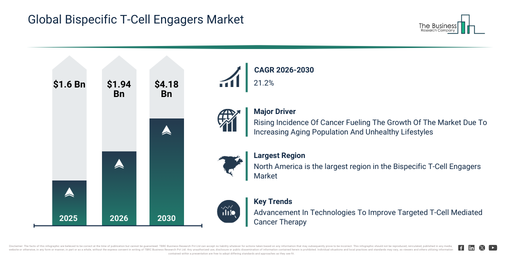
The bispecific t-cell engagers market size has experienced significant expansion in recent years. This market is projected to expand from $1.6 billion in 2025 to $1.94 billion by 2026, exhibiting a compound annual growth rate (CAGR) of 21.3%. Historical growth in this sector is primarily due to several factors, including the insufficient effectiveness of traditional cancer treatments, an increasing occurrence of hematologic cancers, enhanced comprehension of immune-oncology processes, swift regulatory clearances for bispecific antibodies, and a surge in funding for oncology research.
The bispecific t-cell engagers market size is set for substantial growth over the next few years, with projections indicating it will climb to $4.18 billion in 2030, demonstrating a compound annual growth rate (CAGR) of 21.2%. This expansion during the forecast period is attributed to factors such as the broadening of solid tumor indications, advancements in antibody engineering platforms, an increase in the clinical success rates of t-cell engagers, higher healthcare expenditure on cancer immunotherapy, and a rise in strategic partnerships and licensing deals. Prominent trends expected in this period include the increased adoption of bispecific t-cell engagers in hematologic malignancies, a greater focus on targeted immunotherapy and precision oncology, the expansion of clinical trials for solid tumor applications, growing investment in antibody engineering and novel formats, and an uptick in collaborations between biotech firms and research institutes.
Download the Free Sample Report to Explore Key Market Insights:
https://www.thebusinessresearchcompany.com/sample.aspx?id=27226&type=smp
What Major Growth Drivers Are Shaping The Outlook Of The Bispecific T-Cell Engagers Market?
The increasing occurrence of cancer is projected to fuel the expansion of the bispecific T-cell engagers market in the future. Cancer constitutes a set of illnesses marked by the uncontrolled multiplication and dissemination of atypical cells, capable of infiltrating and harming bodily tissues. This surge in cancer cases stems from elements like demographic aging and detrimental lifestyle choices, given that advancing age leads to a greater buildup of mutations, and unhealthy routines like smoking, an inadequate diet, and lack of physical activity elevate the risk of developing cancer. Bispecific T-cell engagers aid in cancer treatment by concurrently attaching to both T cells and cancerous cells, thereby linking the immune system directly to tumorous targets. This action stimulates the patient’s own T cells to identify, combat, and eliminate malignant cells with notable precision. For example, in February 2024, the World Health Organization (WHO), an intergovernmental organization based in Switzerland, reported an estimated 20 million new cancer cases in 2022, a figure anticipated to escalate by 77% to exceed 35 million cases by 2050. Consequently, the growing prevalence of cancer is propelling the expansion of the bispecific T-cell engagers market.
Which Segment Classifications Shape The Bispecific T-Cell Engagers Market?
The bispecific t-cell engagers market covered in this report is segmented –
1) By Product Type: Monoclonal Antibodies, Bispecific Antibodies, Other Product Types
2) By Application: Hematologic Malignancies, Solid Tumors, Other Applications
3) By End-User: Hospitals, Specialty Clinics, Research Institutes, Other End-Users
Subsegments:
1) By Monoclonal Antibodies: IgG1 Monoclonal Antibodies, IgG2 Monoclonal Antibodies, IgG4 Monoclonal Antibodies, Chimeric Monoclonal Antibodies, Humanized Monoclonal Antibodies
2) By Bispecific Antibodies: T Cell Engagers, Dual Specific Antibodies, Trispecific Antibodies, Bispecific IgG Antibodies, Tandem Single Chain Variable Fragment Antibodies
3) By Other Product Types: Fusion Proteins, Recombinant Proteins, Peptide Therapeutics
How Are Trends Impacting The Bispecific T-Cell Engagers Market?
Companies operating within the bispecific T-cell engagers market are prioritizing the development of sophisticated methods, such as enhancing cytolytic synapse formation, to improve the specific killing of cancer cells. Cytolytic synapse formation refers to the mechanism by which a T cell creates a specialized point of contact with a target tumor cell to deliver lethal signals, ultimately leading to the tumor cell’s destruction. As an illustration, in May 2024, Amgen Inc., a US-based biopharmaceutical company, introduced IMDELLTRA (tarlatamab-dlle), representing the first and only DLL3-targeting bispecific T-cell engager therapy approved by the US Food and Drug Administration (FDA) for extensive-stage small cell lung cancer (ES-SCLC). This therapeutic approach works by activating the patient’s own T cells to target DLL3-expressing tumor cells, thereby presenting a novel targeted immunotherapy alternative for patients who have experienced disease progression after receiving platinum-based chemotherapy.
Which Companies Are Expanding Their Footprint In The Bispecific T-Cell Engagers Market?
Major companies operating in the bispecific t-cell engagers market are Pfizer Incorporated, Johnson & Johnson, F. Hoffmann-La Roche AG, AbbVie Incorporated, Sanofi S.A., Amgen Incorporated, Regeneron Pharmaceuticals Incorporated, Ipsen S.A., Genmab A/S, Evotec SE, Akeso Inc., Immunocore Holdings Public Limited Company, MacroGenics Incorporated, Zymeworks Inc., Zenas BioPharma Limited, Candid Therapeutics Inc., BPS Bioscience Inc., Alloy Therapeutics Inc., AP Biosciences Inc., Medigene AG.
Read the full bispecific t-cell engagers market report here:
https://www.thebusinessresearchcompany.com/report/bispecific-t-cell-engagers-global-market-report
Which Regions Are Projected To Dominate The Bispecific T-Cell Engagers Market In The Coming Years?
North America was the largest region in the bispecific T-cell engagers market in 2025. Asia-Pacific is expected to be the fastest-growing region in the forecast period. The regions covered in the bispecific t-cell engagers market report are Asia-Pacific, South East Asia, Western Europe, Eastern Europe, North America, South America, Middle East, Africa.
Request A Tailored Bispecific T-Cell Engagers Market Research Report For Competitive Advantage:
https://www.thebusinessresearchcompany.com/customise?id=27226&type=smp
Browse Through More Reports Similar to the Global Bispecific T-Cell Engagers Market 2026, By The Business Research Company
Doors Market Report 2026
https://www.thebusinessresearchcompany.com/report/doors-global-market-report
Commercial Overhead Doors Market Report 2026
https://www.thebusinessresearchcompany.com/report/commercial-overhead-doors-global-market-report
Aluminum Doors And Windows Market 2026
https://www.thebusinessresearchcompany.com/report/aluminum-doors-and-windows-market
Get in touch with us:
The Business Research Company: https://www.thebusinessresearchcompany.com/
Americas +1 310-496-7795
Asia +44 7882 955267 & +91 8897263534
Europe +44 7882 955267
Email us at info@tbrc.info
Follow us on:
LinkedIn: https://in.linkedin.com/company/the-business-research-company
YouTube: https://www.youtube.com/channel/UC24_fI0rV8cR5DxlCpgmyFQ
Global Market Model: https://www.thebusinessresearchcompany.com/global-market-model