The Business Research Company’s 2026 market reports include new capabilities such as market attractiveness scoring and analysis, total addressable market analysis, company scoring matrix, interactive excel data dashboard, improved supply chain analysis, upcoming startups in the market, and overview of key products, aimed at improving the depth, usability, and strategic value of the insights delivered.
What Market Valuation Is Forecasted For The Chimeric Antibody Market By 2030 Starting From Its 2026 Size?
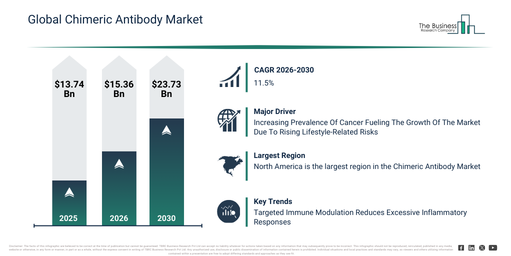
The chimeric antibody market has shown rapid expansion in recent years. It is anticipated to increase from $13.74 billion in 2025 to $15.36 billion in 2026, achieving a compound annual growth rate (CAGR) of 11.8%. This historical growth can be ascribed to several factors, including the early achievements of monoclonal antibody therapies, the reliance on murine antibody technologies, a rising prevalence of cancer, an increase in the incidence of autoimmune diseases, and expanding research efforts in immunology.
The chimeric antibody market size is projected to experience substantial growth over the next few years. This market is anticipated to reach $23.73 billion by 2030, exhibiting a compound annual growth rate (CAGR) of 11.5%. This projected growth is driven by advancements in antibody engineering techniques, an increase in approvals for biologic drugs, the expansion of personalized medicine, greater investment in biopharmaceutical R&D, and the expanding clinical pipeline of chimeric antibodies. Key trends foreseen during this period encompass the growing integration of chimeric antibodies into oncology therapies, their escalating application in the treatment of autoimmune and inflammatory diseases, a heightened demand for target-specific monoclonal antibody therapies, the broadening scope of recombinant DNA and phage display technologies, and their enhanced safety profile alongside reduced immunogenicity when contrasted with murine antibodies.
Download the Free Sample Report to Explore Key Market Insights:
https://www.thebusinessresearchcompany.com/sample.aspx?id=27253&type=smp
What Drivers Are Shaping The Future Growth Of The Chimeric Antibody Market?
The escalating incidence of cancer is anticipated to fuel the expansion of the chimeric antibody market. Cancer prevalence refers to the overall count of individuals, encompassing both newly and previously diagnosed cases, who are currently living with a history of cancer at a specific moment in time. This rise in cancer prevalence is attributed to lifestyle factors such as unhealthy dietary patterns, tobacco use, alcohol consumption, and exposure to environmental pollutants, all of which elevate the risk of developing various cancers. Chimeric antibodies improve cancer treatment approaches by providing highly targeted therapies, rendering them effective against specific tumor cells. They mitigate adverse effects by precisely attacking malignant cells, thereby enhancing patient outcomes and the efficiency of treatment. For example, in October 2025, according to the National Health Service (NHS), a UK-based government health agency, there were 354,820 new cancer diagnoses in 2023, averaging 972 per day, which represents an increase of 8,605 compared to 2022. Consequently, the growing prevalence of cancer is a primary factor driving the development of the chimeric antibody market.
Which Segment Categories Define The Chimeric Antibody Market?
The chimeric antibody market covered in this report is segmented –
1) By Type Of Antibody: Immunoglobulin G Chimeric Antibodies, Fragment Antigen-Binding Chimeric Antibodies, Single-Chain Variable Fragment Chimeric Antibodies
2) By Manufacturing Process: Recombinant Deoxyribonucleic Acid (DNA) Technology, Hybridoma Technology, Phage Display Technology
3) By Mode Of Administration: Intravenous (IV) Administration, Subcutaneous Administration, Intramuscular Administration
4) By Application: Cancer Therapy, Autoimmune Diseases, Infectious Diseases, Transplant Rejection
5) By End User: Pharmaceutical Companies, Research Institutes, Clinics And Hospitals
Subsegments:
1) By Immunoglobulin G Chimeric Antibodies: Full Length Immunoglobulin G (IgG), Engineered Immunoglobulin G 1 (IgG1), Engineered Immunoglobulin G4 (IgG4)
2) By Fragment Antigen-Binding Chimeric Antibodies: Bivalent Fragment Antigen-Binding (Fab) Fragments, Monovalent Fragment Antigen-Binding (Fab) Fragments, Conjugated Fragment Antigen-Binding (Fab) Fragments, Pegylated Fragment Antigen-Binding (Fab) Fragments
3) By Single-Chain Variable Fragment Chimeric Antibodies: Standard Single-Chain Fragment Variable, Tandem Single-Chain Fragment Variable, Bispecific Single-Chain Fragment Variable, Multivalent Single-Chain Fragment Variable
What Major Market Trends Are Driving Changes In The Chimeric Antibody Market?
Leading enterprises in the chimeric antibody market are prioritizing advanced therapeutic approaches, such as monoclonal antibodies, to enhance treatment results, improve patient survival figures, and manage critical health conditions. Monoclonal antibodies are laboratory-created proteins that emulate the immune system’s capability to combat detrimental pathogens, including viruses and inflammatory substances. For example, in June 2023, InflaRx N.V., a biopharmaceutical firm headquartered in Germany, commercially introduced Gohibic (vilobelimab). This is a chimeric monoclonal antibody designed to target C5a within the complement system, inhibiting C5a-mediated immune reactions to reduce extreme inflammation, and is prescribed for the treatment of COVID-19 in hospitalized adults when given within 48 hours of initiating invasive mechanical ventilation (IMV) or extracorporeal membrane oxygenation (ECMO). This pioneering treatment marks a substantial stride in addressing hyperinflammation in severe infections, providing a new therapeutic alternative for patients at high risk.
Who Are The Top Companies Competing In The Chimeric Antibody Market?
Major companies operating in the chimeric antibody market are Pfizer Inc., Johnson & Johnson, F. Hoffmann-La Roche Ltd., AbbVie Inc., Sanofi S.A., Bristol-Myers Squibb Company, AstraZeneca PLC, Novartis AG, Amgen Inc., Merck KGaA, BioNTech SE, Regeneron Pharmaceuticals Inc., Biogen Inc.
Read the full chimeric antibody market report here:
https://www.thebusinessresearchcompany.com/report/chimeric-antibody-global-market-report
Which Geographic Regions Are Influencing Demand In The Chimeric Antibody Market?
North America was the largest region in the chimeric antibody market in 2025. Asia-Pacific is expected to be the fastest-growing region in the forecast period. The regions covered in the chimeric antibody market report are Asia-Pacific, South East Asia, Western Europe, Eastern Europe, North America, South America, Middle East, Africa.
Request A Tailored Chimeric Antibody Market Research Report For Competitive Advantage:
https://www.thebusinessresearchcompany.com/customise?id=27253&type=smp
Browse Through More Reports Similar to the Global Chimeric Antibody Market 2026, By The Business Research Company
Home Healthcare Equipment Market Report 2026
https://www.thebusinessresearchcompany.com/report/home-healthcare-equipment-global-market-report
Computer Peripheral Equipment Market Report 2026
https://www.thebusinessresearchcompany.com/report/computer-peripheral-equipment-global-market-report
Mortuary Equipment Market Report 2026
https://www.thebusinessresearchcompany.com/report/mortuary-equipment-global-market-report
Get in touch with us:
The Business Research Company: https://www.thebusinessresearchcompany.com/
Americas +1 310-496-7795
Asia +44 7882 955267 & +91 8897263534
Europe +44 7882 955267
Email us at info@tbrc.info
Follow us on:
LinkedIn: https://in.linkedin.com/company/the-business-research-company
YouTube: https://www.youtube.com/channel/UC24_fI0rV8cR5DxlCpgmyFQ
Global Market Model: https://www.thebusinessresearchcompany.com/global-market-model