The Business Research Company’s 2026 market reports include new capabilities such as market attractiveness scoring and analysis, total addressable market analysis, company scoring matrix, interactive excel data dashboard, improved supply chain analysis, upcoming startups in the market, and overview of key products, aimed at improving the depth, usability, and strategic value of the insights delivered.
What Market Value Is Expected For The Tissue Engineering For Wound Care Market At The End Of The 2026–2030 Forecast Period?
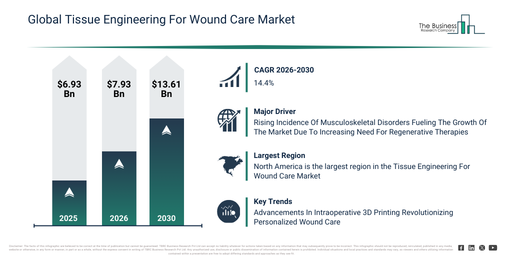
The market size for tissue engineering in wound care has experienced substantial expansion in recent years. It is projected to increase from $6.93 billion in 2025 to $7.93 billion in 2026, demonstrating a compound annual growth rate (CAGR) of 14.5%. Historically, this growth can be attributed to an aging population, the prevalence of diabetes, burn injuries, hospital wound care programs, and advances in biomaterials.
The market for tissue engineering in wound care is projected to experience substantial expansion over the upcoming years, with its valuation anticipated to reach $13.61 billion by 2030, demonstrating a compound annual growth rate (CAGR) of 14.4%. This projected growth is driven by factors such as an increase in chronic wound incidents, wider acceptance of regenerative medicine, the expansion of outpatient wound care services, advancements in biomaterial innovation, and escalating healthcare spending. Key trends anticipated during this period encompass the increasing application of bioengineered skin substitutes, the development of more sophisticated chronic wound management solutions, the integration of stem cell-based treatments, the broadening range of advanced wound care products, and an emphasis on accelerating tissue regeneration.
Download the Free Sample Report to Explore Key Market Insights:
https://www.thebusinessresearchcompany.com/sample.aspx?id=24412&type=smp
What Major Growth Drivers Are Shaping The Outlook Of The Tissue Engineering For Wound Care Market?
A growing incidence of musculoskeletal disorders is expected to drive the expansion of the tissue engineering for wound care market in the future. These conditions involve ailments affecting the muscles, bones, joints, tendons, or ligaments, leading to symptoms like pain, rigidity, or restricted mobility. The escalation in musculoskeletal disorders stems from increasingly inactive lifestyles, where prolonged sitting and decreased physical activity contribute to muscle atrophy and joint strain, resulting in persistent health problems. Tissue engineering for wound care is essential for musculoskeletal disorders due to its capacity to aid in the regeneration of compromised tissues, thereby assisting in the restoration of functionality and structure in regions where the body’s natural healing processes are inadequate. To illustrate this trend, data from January 2024, provided by the Office for Health Improvement and Disparities, a UK-based government public health agency, indicated that the proportion of individuals aged 16 and above reporting a long-term musculoskeletal (MSK) condition reached 18.4% in 2023, an increase from 17.6% in 2022. Consequently, the expanding occurrence of musculoskeletal disorders is set to propel the growth of the tissue engineering for wound care market.
What Segment Types Make Up The Tissue Engineering For Wound Care Market?
The tissue engineering for wound care market covered in this report is segmented –
1) By Product Material: Scaffold, Tissue Grafts, Other Products
2) By Type Of Wound: Chronic Wounds, Acute Wounds
3) By Application: Skin Regeneration, Soft Tissue Repair
4) By End-User: Hospitals, Specialty Centers And Clinics, Ambulatory Surgical Centers
Subsegments:
1) By Scaffold: Natural Scaffolds, Synthetic Scaffolds, Composite Scaffolds, Hydrogels, Nanofiber-Based Scaffolds
2) By Tissue Grafts: Autografts, Allografts, Xenografts, Bioengineered Skin Substitutes, Amniotic Tissue Grafts
3) By Other Products: Cell-Based Products, Growth Factors, Acellular Dermal Matrices, Collagen-Based Dressings, Stem Cell-Derived Biomaterials
Which Market Trends Are Creating New Opportunities In The Tissue Engineering For Wound Care Market?
Leading companies in the tissue engineering for wound care market are focused on developing cutting-edge technological solutions, such as intraoperative 3D printers, to facilitate the rapid creation of complex structures. Intraoperative 3D printers are advanced devices utilized during surgical procedures to generate customized implants, models, or tools in real-time, thereby enhancing precision and treatment tailored to individual patients. For instance, in September 2024, Tides Medical, a US-based biotechnology company, introduced APLICOR 3D, a personalized wound care intraoperative 3D printer. This technology transforms wound care by leveraging the patient’s own tissue, artificial intelligence, and 3D printing to create personalized skin grafts directly at the treatment location. This singular procedure caters to the distinct needs of each patient while simplifying supply chain logistics and inventory management, and decreasing the workload for physicians. After assessing the precise size, depth, and tissue volume necessary by scanning the wound with a specialized tablet, the healthcare provider sends the 3D file to the printer. Once fat is harvested and processed into bio-ink, the 3D printer then constructs the graft, facilitating effective wound closure in under one hour.
Who Are The Key Players Driving Competition In The Tissue Engineering For Wound Care Market?
Major companies operating in the tissue engineering for wound care market are Smith & Nephew plc, ConvaTec Group Plc, MTF Biologics, MiMedx Group Inc., LifeNet Health Inc., Kerecis LLC, Aroa Biosurgery Ltd., Tissue Regenix Group PLC, BioStem Technologies Inc., Organogenesis Holdings Inc., Integra LifeSciences Holdings Corporation, Osiris Therapeutics (Smith & Nephew), Stryker Corporation, Medline Industries LP, Mölnlycke Health Care AB, 3M Health Care, Cardinal Health Inc., Derma Sciences Inc., Acell Inc., Wright Medical Group N.V., Anika Therapeutics Inc., Regen Lab SA, Skye Biologics Inc., Human Regenerative Technologies LLC, StimLabs LLC
Read the full tissue engineering for wound care market report here:
Which Regions Are Projected To Dominate The Tissue Engineering For Wound Care Market In The Coming Years?
North America was the largest region in the tissue engineering for wound care market in 2025. The regions covered in the tissue engineering for wound care market report are Asia-Pacific, South East Asia, Western Europe, Eastern Europe, North America, South America, Middle East, Africa.
Request A Tailored Tissue Engineering For Wound Care Market Research Report For Competitive Advantage:
https://www.thebusinessresearchcompany.com/customise?id=24412&type=smp
Browse Through More Reports Similar to the Global Tissue Engineering For Wound Care Market 2026, By The Business Research Company
Tissue Engineering Market Report 2026
https://www.thebusinessresearchcompany.com/report/tissue-engineering-global-market-report
Biomaterial Wound Dressing Market Report 2026
https://www.thebusinessresearchcompany.com/report/biomaterial-wound-dressing-global-market-report
Wound Care Biologics Market Report 2026
https://www.thebusinessresearchcompany.com/report/wound-care-biologics-global-market-report
Get in touch with us:
The Business Research Company: https://www.thebusinessresearchcompany.com/
Americas +1 310-496-7795
Asia +44 7882 955267 & +91 8897263534
Europe +44 7882 955267
Email us at info@tbrc.info
Follow us on:
LinkedIn: https://in.linkedin.com/company/the-business-research-company
YouTube: https://www.youtube.com/channel/UC24_fI0rV8cR5DxlCpgmyFQ
Global Market Model: https://www.thebusinessresearchcompany.com/global-market-model