Global Fibroblast Growth Factors (FGFs) Market Forecast 2026–2035 Presenting Long-Term Industry Expansion Insights
The Business Research Company’s 2026 market reports include new capabilities such as market attractiveness scoring and analysis, total addressable market analysis, company scoring matrix, interactive excel data dashboard, improved supply chain analysis, upcoming startups in the market, and overview of key products, aimed at improving the depth, usability, and strategic value of the insights delivered.
What Is The Forecasted Market Value Of The Fibroblast Growth Factors (FGFs) Market Across 2026–2030?
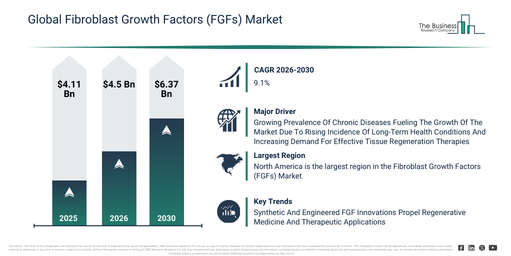
The market for fibroblast growth factors (fgfs) has experienced robust expansion over recent years. Projections indicate its size will increase from $4.11 billion in 2025 to $4.5 billion by 2026, demonstrating a compound annual growth rate (CAGR) of 9.4%. Historically, this growth can be ascribed to several factors, including the expansion of growth factor research programs, a rise in clinical trials utilizing fgfs, escalating demand for advanced biologics, advancements in oncology drug development, and enhanced recombinant protein manufacturing techniques.
The market for fibroblast growth factors (fgfs) is anticipated to experience substantial expansion over the coming years. This market is projected to reach $6.37 billion by 2030, demonstrating a compound annual growth rate (CAGR) of 9.1%. This expansion during the forecast period is attributable to several factors, including the rising adoption of therapies targeting fgfs, increased investments in the production of biologics, the broadening of regenerative medicine pipelines, the expanding application of precision oncology drugs, and a growing number of regulatory approvals for products based on fgfs. Key trends anticipated within the forecast timeframe encompass the escalating development of recombinant fgfs, their increasing utilization in oncology treatments, expanding applications in wound healing, the growth of fgf-based regenerative medicine, and an intensified focus on targeted fgf inhibitors.
Download the Free Sample Report to Explore Key Market Insights:
https://www.thebusinessresearchcompany.com/sample.aspx?id=24538&type=smp
What Primary Drivers Are Shaping The Development Of The Fibroblast Growth Factors (FGFs) Market?
An increasing incidence of chronic illnesses is anticipated to boost the expansion of the fibroblast growth factors (FGFs) market in the future. These conditions are long-term health issues that progress gradually and endure for considerable durations, frequently necessitating ongoing medical attention. The rise in chronic disease cases can be partially attributed to sedentary lifestyles, where extended periods of sitting and insufficient physical exercise elevate the likelihood of developing cardiac problems and diabetes. Fibroblast growth factors (FGFs) play a crucial role in managing chronic diseases by encouraging tissue repair and regeneration, thus proving beneficial in addressing long-term ailments. They facilitate improved healing and decelerate disease advancement, thereby enhancing patient results and overall quality of life. For example, data from June 2024, published by the National Health Service, a UK government body, indicated that 3,615,330 individuals registered with a general practitioner (GP) received a diagnosis of non-diabetic hyperglycemia or pre-diabetes (a state characterized by elevated blood sugar levels, not yet meeting the criteria for diabetes) in 2023. This represented an 18% surge from 3,065,825 instances recorded in 2022. Consequently, the increasing prevalence of chronic illnesses is acting as a significant impetus for the expansion of the fibroblast growth factors (FGFs) market.
What Segmentation Levels Are Considered In The Fibroblast Growth Factors (FGFs) Market?
The fibroblast growth factors (fgfs) market covered in this report is segmented –
1) By Product Type: Recombinant Fibroblast Growth Factor, Purified Fibroblast Growth Factor, Endogenous Fibroblast Growth Factor, Other Product Types
2) By Drug Type: Palifermin, Erdafitnib, Infigratinib, Futibatinib, Other Drug Types
3) By Application: Oncology, Hematology, Wound Healing, Dermatology, Cardiovascular Disease, Bone Disorders, Musculoskeletal Disorders, Tissue Regeneration, Other Applications
4) By End User: Pharmaceutical Companies, Research Institutes, Biotechnology Companies, Other End Users
Subsegments:
1) By Recombinant Fibroblast Growth Factor: Recombinant Fibroblast Growth Factor (FGF)-1, Recombinant Fibroblast Growth Factor (FGF)-2, Recombinant Fibroblast Growth Factor (FGF)-7, Recombinant Fibroblast Growth Factor (FGF)-10
2) By Purified Fibroblast Growth Factor: Purified Fibroblast Growth Factor (FGF)-1, Purified Fibroblast Growth Factor (FGF)-2, Purified Fibroblast Growth Factor (FGF)-7, Purified Fibroblast Growth Factor (FGF)-21
3) By Endogenous Fibroblast Growth Factor: Endogenous Fibroblast Growth Factor (FGF)-1, Endogenous Fibroblast Growth Factor (FGF)-2, Endogenous Fibroblast Growth Factor (FGF)-8, Endogenous Fibroblast Growth Factor (FGF)-23
4) By Other Product Types: Synthetic Fibroblast Growth Factors, Modified Fibroblast Growth Factors, Fusion Protein Fibroblast Growth Factors (FGFs), Fibroblast Growth Factors (FGFs) Derived From Stem Cells
Which Upcoming Trends Are Expected To Influence The Fibroblast Growth Factors (FGFs) Market?
Companies entering the fibroblast growth factors (FGFs) market are increasingly prioritizing the development of innovative solutions, such as synthetic peptide-based alternatives to natural growth factors. This strategic focus aims to reduce costs, improve consistency, and enhance performance across cell culture and regenerative medicine applications. Synthetic peptides are chemically synthesized amino acid sequences engineered to mimic the biological activity of natural FGFs by binding to the same receptors and triggering essential cellular signaling pathways. This approach supports reliable long-term cell proliferation, boosts stability, and enables precise receptor-specific activation. For example, in October 2024, PeptiGrowth Inc., a Japan-based biotechnology company, introduced PG-011, a synthetic FGFR1c agonist peptide. This product is designed to replace natural FGF2 for cultivating stem cells and other rapidly dividing cell types. PG-011 is characterized by its chemically defined, animal-component-free composition, offers greater stability than recombinant proteins, and activates receptors efficiently even at lower concentrations. These collective benefits contribute to improved cost control, ensure quality consistency, and enhance scalability for both research and emerging cell-based applications.
Which Leading Firms Are Contributing To The Growth Of The Fibroblast Growth Factors (FGFs) Market?
Major companies operating in the fibroblast growth factors (fgfs) market are Merck & Co. Inc., Thermo Fisher Scientific Inc., FUJIFILM Wako Pure Chemical Corporation, Lonza Group AG, Miltenyi Biotec B.V. & Co. KG, GenScript Biotech Corporation, 89bio Inc., R&D Systems Inc., ACROBiosystems Co. Ltd., Elabscience Biotechnology Inc., Cell Signaling Technology Inc., Proteintech Group Inc., Akero Therapeutics Inc., MedChemExpress LLC, Defined Bioscience Inc., Gold Biotechnology Inc. (GoldBio), Nucleus Biologics LLC, ZellBio GmbH, Affinity Biosciences Ltd.
Read the full fibroblast growth factors (fgfs) market report here:
How Does The Fibroblast Growth Factors (FGFs) Market Perform Across Major Global Regions?
North America was the largest region in the fibroblast growth factors (FGFs) market in 2025. Asia-Pacific is expected to be the fastest-growing region in the forecast period. The regions covered in the fibroblast growth factors (fgfs) market report are Asia-Pacific, South East Asia, Western Europe, Eastern Europe, North America, South America, Middle East, Africa.
Request A Tailored Fibroblast Growth Factors (FGFs) Market Research Report For Competitive Advantage:
https://www.thebusinessresearchcompany.com/customise?id=24538&type=smp
Browse Through More Reports Similar to the Global Fibroblast Growth Factors (FGFs) Market 2026, By The Business Research Company
Follicle Stimulating Hormone Global Market Report
https://www.thebusinessresearchcompany.com/report/follicle-stimulating-hormone-global-market-report
Hair Growth Serum Global Market Report
https://www.thebusinessresearchcompany.com/report/hair-growth-serum-global-market-report
Uterine Fibroids Treatment Global Market Report
https://www.thebusinessresearchcompany.com/report/uterine-fibroids-treatment-global-market-report
Get in touch with us:
The Business Research Company: https://www.thebusinessresearchcompany.com/
Americas +1 310-496-7795
Asia +44 7882 955267 & +91 8897263534
Europe +44 7882 955267
Email us at info@tbrc.info
Follow us on:
LinkedIn: https://in.linkedin.com/company/the-business-research-company
YouTube: https://www.youtube.com/channel/UC24_fI0rV8cR5DxlCpgmyFQ
Global Market Model: https://www.thebusinessresearchcompany.com/global-market-model