The Business Research Company’s 2026 market reports include new capabilities such as market attractiveness scoring and analysis, total addressable market analysis, company scoring matrix, interactive excel data dashboard, improved supply chain analysis, upcoming startups in the market, and overview of key products, aimed at improving the depth, usability, and strategic value of the insights delivered.
What Market Value Is Anticipated For The Persistent Epithelial Defect Management Market Over The Period 2026–2030?
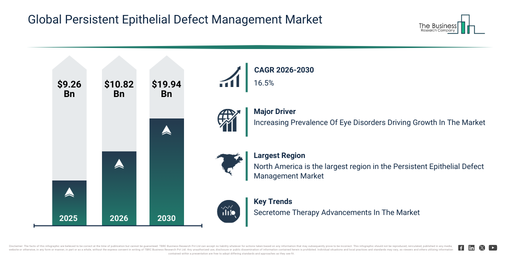
The persistent epithelial defect management market size has experienced rapid expansion in recent times. This market is projected to expand from $9.26 billion in 2025 to reach $10.82 billion by 2026, demonstrating a compound annual growth rate (CAGR) of 16.9%. Historically, this growth can be ascribed to factors such as restricted knowledge regarding persistent epithelial defects, a dependence on standard lubricating eye drops, the gradual integration of autologous serum therapy, insufficient availability of corneal specialists, and erratic patient follow-up and observation.
The persistent epithelial defect management market size is projected to experience swift expansion in the coming years. By 2030, this market is predicted to reach $19.94 billion, exhibiting a compound annual growth rate (CAGR) of 16.5%. This growth during the forecast period can be attributed to several factors, including developments in stem cell and biologic treatments, increased uptake of amniotic membrane transplantation, a greater preference for bandage contact lenses, heightened awareness regarding early corneal defect management, and the proliferation of hospital and specialized eye care centers. Key trends anticipated during this period encompass the increasing integration of AI-powered diagnostic and imaging solutions, a greater reliance on biologics and stem cell therapies, the incorporation of cloud-based patient monitoring systems, the creation of IoT-enabled eye care devices, and innovations in the automated production of ocular therapeutics.
Download the Free Sample Report to Explore Key Market Insights:
https://www.thebusinessresearchcompany.com/sample.aspx?id=21256&type=smp
Which Economic Or Industry Drivers Are Impacting The Persistent Epithelial Defect Management Market?
The persistent epithelial defect management market is anticipated to expand due to the growing occurrence of eye disorders. Eye disorders encompass various medical conditions impacting eye structure, function, or overall health, often resulting in vision problems, unease, or even blindness. Factors like an aging demographic, extended periods of screen use, and shifts in the environment contribute to the rise in eye disorder cases. Managing persistent epithelial defects is crucial in addressing eye disorders, as it aids healing, reduces inflammation, and guards against issues like infection or scarring. For example, data from December 2024 by the World Health Organization, a Switzerland-based intergovernmental organization, indicated that the combined prevalence of childhood myopia reached 5.23% in 2023, with females exhibiting a notably higher rate of 4.90% compared to males at 3.94%. Consequently, the expanding occurrence of eye disorders is a key impetus for the persistent epithelial defect management market’s growth.
How Is The Persistent Epithelial Defect Management Market Divided Into Its Major Segments?
The persistent epithelial defect management market covered in this report is segmented –
1) By Disease Type: Epithelial Or Limbal, Inflammatory Disease, Neurotrophic Disease, Other Disease Types
2) By Distribution Channel: Direct Sales, Online Pharmacy, Retail Pharmacy, Hospitals
3) By End User: Hospitals And Specialty Eye Clinics, Physician Offices, Ophthalmology Specialty Centers, Other End Users
Subsegments:
1) By Epithelial Or Limbal: Limbal Stem Cell Deficiency (LSCD), Limbal Transplantation, Conjunctival Transplantation
2) By Inflammatory Disease: Dry Eye Syndrome, Allergic Conjunctivitis, Uveitis
3) By Neurotrophic Disease: Herpes Simplex Virus (HSV) Keratitis, Corneal Nerve Damage Associated Keratopathy, Neurotrophic Keratopathy
4) By Other Disease Types: Chemical Burns, Trauma-Induced Defects, Congenital Corneal Opacities
How Are Trends Shaping The Direction Of The Persistent Epithelial Defect Management Market?
Leading firms within the persistent epithelial defect management market are concentrating on creating novel therapies, like secretome therapy, to hasten the healing process and enhance treatment results for persistent epithelial defects. Secretome therapy involves the utilization of bioactive molecules produced by cells, including proteins, lipids, and extracellular vesicles, with the aim of fostering tissue repair, adjusting immune responses, and addressing a range of illnesses. As an illustration, during April 2023, Kala Pharmaceuticals Inc., a biopharmaceutical firm located in the US, was granted U.S. Food and Drug Administration (FDA) Fast Track Designation for KPI-012, which is a human MSC-S therapy intended for persistent corneal epithelial defect. This drug’s multifaceted action mechanism seeks to tackle all fundamental causes related to persistent epithelial defect management by stimulating corneal healing through bioactive components like growth factors, protease inhibitors, and neurotrophic factors.
Who Are The Prominent Organizations Shaping The Persistent Epithelial Defect Management Market?
Major companies operating in the persistent epithelial defect management market are AbbVie Inc., Novartis AG, Johnson & Johnson Vision, RegeneRx Biopharmaceuticals Inc., Regeneron Pharmaceuticals Inc., Alcon Inc., Bausch Health Companies Inc., Hoya Vision Care, Santen Pharmaceutical Co. Ltd., Recordati Rare Diseases Inc., Dompé Farmaceutici S.p.A., TissueTech Inc., Ocular Therapeutix Inc., Amber Ophthalmics Inc., Noveome Biotherapeutics Inc., OcuNexus Therapeutics Inc., Lux Bio Inc., Eyenovia Inc., Kala Pharmaceuticals Inc., Aerie Pharmaceuticals Inc., EyePoint Pharmaceuticals Inc., Aldeyra Therapeutics Inc.
Read the full persistent epithelial defect management market report here:
What Are The Top-Performing Regions Within The Persistent Epithelial Defect Management Market?
North America was the largest region in the persistent epithelial defect management market in 2025. Asia-Pacific is expected to be the fastest-growing region in the forecast period. The regions covered in the persistent epithelial defect management market report are Asia-Pacific, South East Asia, Western Europe, Eastern Europe, North America, South America, Middle East, Africa.
Request A Tailored Persistent Epithelial Defect Management Market Research Report For Competitive Advantage:
https://www.thebusinessresearchcompany.com/customise?id=21256&type=smp
Browse Through More Reports Similar to the Global Persistent Epithelial Defect Management Market 2026, By The Business Research Company
Chemotherapy Induced Anemia Global Market Report
https://www.thebusinessresearchcompany.com/report/chemotherapy-induced-anemia-global-market-report
Aplastic Anemia Global Market Report
https://www.thebusinessresearchcompany.com/report/aplastic-anemia-global-market-report
Iron Deficiency Injectable Global Market Report
https://www.thebusinessresearchcompany.com/report/iron-deficiency-injectable-global-market-report
Get in touch with us:
The Business Research Company: https://www.thebusinessresearchcompany.com/
Americas +1 310-496-7795
Asia +44 7882 955267 & +91 8897263534
Europe +44 7882 955267
Email us at info@tbrc.info
Follow us on:
LinkedIn: https://in.linkedin.com/company/the-business-research-company
YouTube: https://www.youtube.com/channel/UC24_fI0rV8cR5DxlCpgmyFQ
Global Market Model: https://www.thebusinessresearchcompany.com/global-market-model