
Difficult-to-Express Proteins Market: Trends, Drivers, and Opportunities
The Business Research Company’s 2026 market reports feature enhanced tools like market attractiveness analysis, TAM assessment, and company scoring matrices, along with interactive dashboards, deeper supply chain insights, and startup coverage strengthening the depth, usability, and strategic value of insights.
How Will The Market Value Of The Difficult-to-Express Proteins Market Progress Between 2026 And 2030?
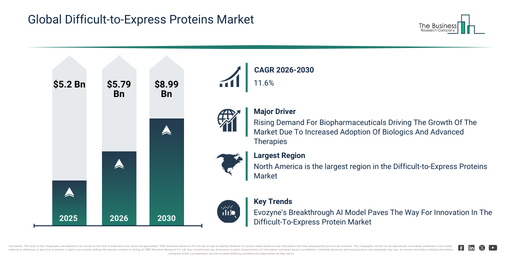
The market size for difficult-to-express proteins has witnessed swift expansion in recent years. This market is set to expand from $5.2 billion in 2025 to $5.79 billion in 2026, demonstrating a compound annual growth rate (CAGR) of 11.3%. Key drivers for this growth in the past have been the rise in biologics research, the limitations inherent in traditional expression systems, the broader scope of academic protein research, the increasing need for membrane proteins, and an uplift in biotech funding.
The market for difficult-to-express proteins is projected to experience significant expansion over the coming years. This market is anticipated to reach a value of $8.99 billion by 2030, demonstrating a compound annual growth rate (CAGR) of 11.6%. Factors contributing to this growth during the forecast period include the rise of protein therapeutics, advancements in expression technologies, increasing demand for structural biology research, a surge in pharmaceutical outsourcing, and the broadening scope of precision medicine research. Key trends observed during this period involve a heightened need for complex protein expression, the wider adoption of cell-free protein synthesis, an increase in the application of fusion and tag technologies, growing utility in drug discovery, and the implementation of sophisticated expression systems.
Access Your Free Sample Report For In-Depth Market Analysis:
https://www.thebusinessresearchcompany.com/report/difficult-to-express-proteins-global-market-report
What Key Drivers Are Fueling The Growth Of The Difficult-to-Express Proteins Market?
The anticipated expansion of the difficult to express proteins market is linked to the rising global need for biopharmaceutical products. This driving force stems from the escalating worldwide dependence on biologics, therapeutic proteins, and cutting-edge biopharma approaches for addressing numerous illnesses. The surge in demand is a consequence of a greater number of patients and medical institutions adopting precision medicine and biologics as alternatives to conventional small-molecule medications. The difficult to express proteins market facilitates this progression by allowing the manufacture of intricate proteins—including multi-domain proteins, antibody fragments, fusion proteins, and post-translationally modified proteins—essential for these innovative treatments. For example, reports from Sartorius, a global life science technology firm based in Germany, indicated in July 2025 that biopharmaceutical drug sales climbed by approximately 9% to reach USD 458 billion in 2024, an increase from the preceding year, thereby constituting 41% of the total pharmaceutical market, up from 40% in 2023. Consequently, the growing need for biopharmaceuticals is indeed propelling the expansion of the difficult to express proteins market.
What Segment Categories Shape The Difficult-to-Express Proteins Market Segment Landscape?
The difficult-to-express proteins market covered in this report is segmented –
1) By Protein: Proteases, Kinases, Membrane Proteins, Other Proteins
2) By Expression Of Difficult Proteins: Disulfide-bonded Protein Expression, Membrane Protein Expression, Toxic Protein Expression, Target Protein Insolubility
3) By Technology: Cell-free Protein Synthesis, Prokaryotic Expression Systems, Small Ubiquitin-like Modifier (SUMO) Fusion System, Gene Fusion Systems, Other Technologies
4) By Application: Drug Discovery, Protein Purification, Protein Therapeutics, Disease Diagnostics And Monitoring, Other Applications
Subsegments:
1) By Proteases: Serine Proteases, Cysteine Proteases, Aspartic Proteases, Metalloproteases
2) By Kinases: Receptor Tyrosine Kinases, Serine Or Threonine Kinases, Cyclin-Dependent Kinases
3) By Membrane Proteins: G-Protein Coupled Receptors (GPCRs), Ion Channels, Transporters
4) By Other Proteins: Transcription Factors, Structural Proteins, Enzymes
What Trends Are Influencing The Difficult-to-Express Proteins Market?
A significant trend gaining traction within the difficult-to-express protein market involves the creation of innovative technologies. Leading companies active in this market are prioritizing the advancement of novel technologies to maintain their competitive standing. As an illustration, during January 2023, Evozyne, a US-based biotechnology firm, introduced an inventive AI model named Protein Transformer Variational AutoEncoder, specifically for designing therapeutic proteins. This method establishes a robust framework for the efficient training and deployment of large language models within the field of biology. The resulting model represents a novel approach to deep learning, opening up fresh opportunities for the data-driven engineering of proteins possessing specific functionalities.
Who Are The Companies Operating Across The Difficult-to-Express Proteins Market Value Chain?
Major companies operating in the difficult-to-express proteins market are Thermo Fisher Scientific Inc., Merck KGaA, Lonza Group Ltd, Catalent Inc., Sartorius AG, Charles River Laboratories International Inc., Bio-Rad Laboratories Inc., Samsung Biologics Co. Ltd., Bio-Techne Corp., GenScript Biotech Corporation, Ajinomoto Bio-Pharma Services, Novasep Holding SAS, Rentschler Biopharma SE, BioLegend Inc., Codexis Inc., Enzo Biochem Inc., Sino Biological Inc., Horizon Discovery Ltd., Creative Biolabs Inc., OriGene Technologies Inc., Celonic AG, Cube Biotech GmbH, Lucigen Corporation, Batavia Biosciences Inc., Cytovance Biologics Inc., Alloy Therapeutics Inc., Aragen Bioscience Inc., Selexis SA, LifeSensors Inc., Bionova Scientific Inc.
Get The Full Difficult-to-Express Proteins Market Report:
https://www.thebusinessresearchcompany.com/report/difficult-to-express-proteins-global-market-report
Which Region Leads The Difficult-to-Express Proteins Market In Overall Market Size?
North America was the largest region in the difficult-to-express proteins market in 2025. Asia-Pacific is expected to be the fastest-growing region in the forecast period. The regions covered in the difficult-to-express proteins market report are Asia-Pacific, South East Asia, Western Europe, Eastern Europe, North America, South America, Middle East, Africa.
Request A Customized Difficult-to-Express Proteins Market Report For Competitive Insights:
https://www.thebusinessresearchcompany.com/report/difficult-to-express-proteins-global-market-report
Browse Through More Reports Similar to the Global Difficult-to-Express Proteins Market 2026, By The Business Research Company
Alternative Protein Market Report 2026
https://www.thebusinessresearchcompany.com/report/alternative-protein-global-market-report
Protein Engineering Market Report 2026
https://www.thebusinessresearchcompany.com/report/protein-engineering-global-market-report
Protein Expression Market Report 2026
https://www.thebusinessresearchcompany.com/report/protein-expression-global-market-report
Get in touch with us:
The Business Research Company: https://www.thebusinessresearchcompany.com/
Americas +1 310-496-7795
Asia +44 7882 955267 & +91 8897263534
Europe +44 7882 955267
Email us at info@tbrc.info
Follow us on:
LinkedIn: https://in.linkedin.com/company/the-business-research-company
YouTube: https://www.youtube.com/channel/UC24_fI0rV8cR5DxlCpgmyFQ
Global Market Model: https://www.thebusinessresearchcompany.com/global-market-model