Dysautonomia market trends influencing growth through 2030
The Business Research Company’s 2026 market reports feature enhanced tools like market attractiveness analysis, TAM assessment, and company scoring matrices, along with interactive dashboards, deeper supply chain insights, and startup coverage strengthening the depth, usability, and strategic value of insights.
By 2030, What Market Size Is The Dysautonomia (Autonomic Dysfunction) Market Expected To Reach Based On Its 2026 Value?
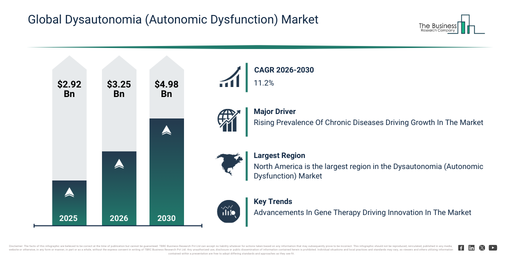
The market size for dysautonomia (autonomic dysfunction) has experienced rapid growth in recent years. It is anticipated to increase from $2.92 billion in 2025 to $3.25 billion in 2026, demonstrating a compound annual growth rate (CAGR) of 11.5%. The expansion observed in the historic period can be attributed to factors such as neurological disorder prevalence, the availability of diagnostic tests, the growth in autonomic research, the expansion of specialist clinics, and various patient advocacy initiatives.
The market size for dysautonomia (autonomic dysfunction) is anticipated to experience substantial growth in the coming years, projected to reach $4.98 billion by 2030, exhibiting a compound annual growth rate (CAGR) of 11.2%. This expected expansion can be attributed to the adoption of wearable monitoring, the development of personalized treatment protocols, the broadening of genetic research, the integration of digital health solutions, and an increased demand for long-term care. Key trends for the forecast period include a heightened awareness of autonomic nervous system disorders, a rise in comprehensive diagnostic testing, the advancement of multidisciplinary treatment approaches, the expansion of symptom management therapies, and a growing emphasis on chronic disease monitoring.
Access Your Free Sample Report For In-Depth Market Analysis:
What Factors Are Contributing To The Growth Of The Dysautonomia (Autonomic Dysfunction) Market?
The dysautonomia (autonomic dysfunction) market is anticipated to expand due to an increase in autoimmune and neurological disorders. These conditions involve damage to the central or peripheral nervous system by the immune system or disease processes, resulting in inflammation, nerve dysfunction, and compromised autonomic regulation. Factors contributing to the rise in these disorders include genetic predisposition, environmental influences, shifts in lifestyle, infectious agents, and enhanced diagnostic capabilities. The dysautonomia (autonomic dysfunction) market facilitates this development by assisting healthcare professionals in identifying early autonomic involvement in conditions like Sjögren’s syndrome, multiple sclerosis, Parkinson’s disease, and multiple system atrophy (MSA), which allows for improved monitoring and personalized treatment approaches. As an illustration, in March 2023, the Alzheimer’s Association, a US-based nonprofit voluntary health organization, reported that in 2023, around 6.7 million Americans aged 65 and older were living with Alzheimer’s dementia, a figure expected to climb to 13.8 million by 2060. Consequently, the growing incidence of autoimmune and neurological disorders is fueling the expansion of the dysautonomia (autonomic dysfunction) market.
How Is The Dysautonomia (Autonomic Dysfunction) Market Categorized Across Its Segment Groups?
The dysautonomia (autonomic dysfunction) market covered in this report is segmented –
1) By Type: Neurogenic Orthostatic Hypotension (NOH), Postural Orthostatic Tachycardia Syndrome (POTS), Multiple System Atrophy (MSA), Pure Autonomic Failure (PAF), Other Types
2) By Tests: Cardiovagal and Vasomotor Function Tests, Thermoregulatory Sweat Test (TST), Sympathetic Skin Response (SSR), Quantitative Sudomotor Axon Reflex Test, Other Tests
3) By Treatment: Physical Therapy, Exercise Therapy, Counseling, Other Treatments
4) By Distribution Channel: Hospital Pharmacy, Online Pharmacy, Retail Pharmacy
5) By End User: Hospitals, Clinics, Diagnostic Centers, Research Institutes
Subsegments:
1) By Neurogenic Orthostatic Hypotension (NOH): Primary NOH, Secondary NOH (due to Parkinson’s Disease, Diabetes, etc.), Pharmacological Management of NOH, Non-Pharmacological Interventions
2) By Postural Orthostatic Tachycardia Syndrome (POTS): Hyperadrenergic POTS, Hypovolemic POTS, Neuropathic POTS, Autoimmune POTS, Treatment With Beta-Blockers, Fludrocortisone, And Salt Supplements
3) By Multiple System Atrophy (MSA): MSA-P (Parkinsonism), MSA-C (Cerebellar), MSA-A (Autonomic), Disease-Modifying and Symptomatic Treatment
4) By Pure Autonomic Failure (PAF): Idiopathic PAF, Secondary PAF (due to neurodegenerative diseases), Autonomic Supportive Treatments
5) By Other Types: Familial Dysautonomia (FD), Diabetic Autonomic Neuropathy, Horner’s Syndrome, Autoimmune Autonomic Ganglionopathy, Chronic Fatigue Syndrome-related Dysautonomia
What Trends Are Shaping The Future Of The Dysautonomia (Autonomic Dysfunction) Market?
Leading companies in the dysautonomia (autonomic dysfunction) market are focusing on advancing gene therapy approaches, such as recombinant adeno-associated virus (rAAV) systems, to improve targeted gene delivery and enhance therapeutic outcomes for patients with genetic forms of dysautonomia. A recombinant adeno-associated virus refers to a modified, non-pathogenic viral vector engineered to deliver therapeutic genes into specific cells, enabling long-term expression of corrected or functional proteins without causing disease. For instance, in January 2025, Tikun Therapeutics Inc., a US-based biotechnology company, received U.S. Food and Drug Administration (FDA) approval for Orphan Drug and Rare Pediatric Disease Designations for rAAV2-U1a-hELP1, a gene therapy candidate for optic neuropathy in familial dysautonomia, and BPN-36964, a small-molecule splicing modulator for systemic treatment. These therapies aim to correct the underlying genetic defects responsible for familial dysautonomia, offering the potential for durable, disease-modifying benefits beyond symptomatic management.
Which Firms Are Influencing Competition In The Dysautonomia (Autonomic Dysfunction) Market?
Major companies operating in the dysautonomia (autonomic dysfunction) market are Teva Pharmaceutical Industries Ltd., Aurobindo Pharma Limited, Hikma Pharmaceuticals PLC, Cadila Healthcare Limited Zydus Cadila, Lupin Limited, Nemours Children’s Health Delaware, Aurora Health Care Inc., Camber Pharmaceuticals Inc., DyAnsys Inc., Mylan Pharmaceuticals Private Limited, Chelsea Therapeutics International Ltd., Tikun Therapeutics Inc., Pfizer Inc., Novartis AG, Takeda Pharmaceutical Company Limited, Eli Lilly and Company, GlaxoSmithKline plc, Merck and Co Inc., AstraZeneca plc, UCB S.A., Amgen Inc., Johnson and Johnson, Bausch Health Companies Inc., AbbVie Inc., Robinhood Therapeutics, Santhera Pharmaceuticals AG, Valeant Pharmaceuticals
Get The Full Dysautonomia (Autonomic Dysfunction) Market Report:
Which Region Has The Greatest Market Share In The Dysautonomia (Autonomic Dysfunction) Market?
North America was the largest region in the dysautonomia (autonomic dysfunction) market in 2025. Asia-Pacific is expected to be the fastest-growing region in the forecast period. The regions covered in the dysautonomia (autonomic dysfunction) market report are Asia-Pacific, South East Asia, Western Europe, Eastern Europe, North America, South America, Middle East, Africa.
Request A Customized Dysautonomia (Autonomic Dysfunction) Market Report For Competitive Insights:
Browse Through More Reports Similar to the Global Dysautonomia (Autonomic Dysfunction) Market 2026, By The Business Research Company
Panic Disorders Market Report 2026
https://www.thebusinessresearchcompany.com/report/panic-disorders-global-market-report
Dysphagia Supplement Market Report 2026
https://www.thebusinessresearchcompany.com/report/dysphagia-supplement-global-market-report
Duchenne Muscular Dystrophy Market Report 2026
https://www.thebusinessresearchcompany.com/report/duchenne-muscular-dystrophy-global-market-report
Get in touch with us:
The Business Research Company: https://www.thebusinessresearchcompany.com/
Americas +1 310-496-7795
Asia +44 7882 955267 & +91 8897263534
Europe +44 7882 955267
Email us at info@tbrc.info
Follow us on:
LinkedIn: https://in.linkedin.com/company/the-business-research-company
YouTube: https://www.youtube.com/channel/UC24_fI0rV8cR5DxlCpgmyFQ
Global Market Model: https://www.thebusinessresearchcompany.com/global-market-model