The Meibomian Gland Dysfunction Market Growth Driven By Increasing Eye Disorders And Digital Screen Exposure
The Business Research Company’s 2026 market reports feature enhanced tools like market attractiveness analysis, TAM assessment, and company scoring matrices, along with interactive dashboards, deeper supply chain insights, and startup coverage strengthening the depth, usability, and strategic value of insights.
How Is The Market Size Of The Meibomian Gland Dysfunction Market Expected To Change From 2026 To 2030?
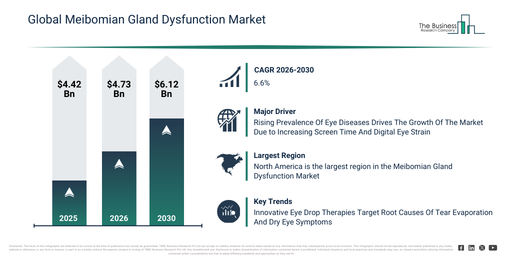
The meibomian gland dysfunction market size has shown significant growth in recent years. It is anticipated to expand from $4.42 billion in 2025 to $4.73 billion in 2026, achieving a compound annual growth rate (CAGR) of 7.0%. This historical growth can be linked to the increasing incidence of dry eye disease, higher screen time exposure, the growth of the aging population, wider clinical recognition of MGD, and the availability of basic treatment options.
The meibomian gland dysfunction market size is anticipated to experience robust expansion over the coming years. It is projected to reach $6.12 billion by 2030, exhibiting a compound annual growth rate (CAGR) of 6.6%. Factors contributing to this growth during the forecast period include the increased uptake of device-assisted therapies, augmented investments in ophthalmic care, heightened awareness regarding chronic eye conditions, the proliferation of home-use treatment devices, and a greater emphasis on personalized eye care. Key trends anticipated in the forecast period encompass a wider embrace of advanced diagnostic tools, an uptick in the utilization of device-based therapies, a developing preference for combination treatment approaches, the broadening of home-based management solutions, and an intensified focus on early disease detection.
Access Your Free Sample Report For In-Depth Market Analysis:
https://www.thebusinessresearchcompany.com/sample.aspx?id=24602&type=smp
Which Factors Are Influencing The Growth Of The Meibomian Gland Dysfunction Market?
The anticipated increase in eye disease occurrences is set to drive the expansion of the meibomian gland dysfunction (MGD) market. Eye disease encompasses any ailment or condition impacting the eye or visual system, thereby compromising its structure, operation, or general well-being. This surge in eye disease instances stems from extended screen use and digital eye fatigue, leading to symptoms like dryness, blurred vision, and lasting retinal damage due to sustained blue light exposure. Meibomian gland dysfunction exacerbates eye disease by destabilizing the tear film, which in turn causes inflammation, dryness, and an elevated susceptibility to ocular surface conditions. For example, reports from February 2025 by the US government agency, the National Institutes of Health (NIH), project that global myopia prevalence will reach 36.59% by 2040 and 39.80% by 2050, with over 740 million cases expected by 2050. Consequently, the growing incidence of eye disease is propelling the expansion of the meibomian gland dysfunction (MGD) market.
Which Segments Define The Meibomian Gland Dysfunction Market Segment Structure?
The meibomian gland dysfunction market covered in this report is segmented –
1) By Treatment Type: Medication, Surgery, Lifestyle Modifications
2) By Dysfunction Type: Obstructive Meibomian Gland Dysfunction, Evaporative Meibomian Gland Dysfunction, Mixed Meibomian Gland Dysfunction
3) By Disease Severity: Mild Meibomian Gland Dysfunction, Moderate Meibomian Gland Dysfunction, Severe Meibomian Gland Dysfunction
4) By Distribution channel: Hospitals And Clinics, Pharmacies, Online Retailers
5) By End-User: Hospitals, Ophthalmology Clinics, Home Care Settings
Subsegments:
1) By Medication: Topical Antibiotics, Topical Steroids, Lubricating Eye Drops, Topical Cyclosporine, Omega-3 Supplements
2) By Surgery: Meibomian Gland Probing, Intense Pulsed Light (IPL) Therapy, Thermal Pulsation Treatment, BlephEx
3) By Lifestyle Modifications: Warm Compress Therapy, Lid Hygiene, Dietary Adjustments, Blinking Exercises
Which Trends Are Influencing Demand In The Meibomian Gland Dysfunction Market?
Leading enterprises in the meibomian gland dysfunction market are concentrating on creating advanced therapies, specifically prescription eye drop solutions, to lessen tear evaporation and alleviate dry eye discomfort. These prescription eye drops, which include anti-inflammatory or antibiotic types, assist in managing meibomian gland dysfunction by diminishing inflammation, clearing glandular blockages, and enhancing the stability of the tear film. For example, in May 2023, Bausch + Lomb Corporation, an eye health company based in Canada, launched MIEBO (perfluorohexyloctane ophthalmic solution), a pioneering prescription eye drop intended for addressing dry eye disease (DED). MIEBO stands out as the initial and sole prescription eye drop designed to directly tackle tear evaporation, identified as the primary driver of DED, by creating a durable, protective film over the eye’s surface. Its unique water-free composition offers effective and prolonged relief, especially for individuals experiencing dry eye symptoms linked to Meibomian gland dysfunction.
Who Are The Established Players Within The Meibomian Gland Dysfunction Market?
Major companies operating in the meibomian gland dysfunction market are Johnson And Johnson, Alcon Inc., Bausch Lomb Corporation, Santen Pharmaceutical, Lumenis Ltd, Topcon Healthcare Solutions Inc, AFT Pharmaceuticals, Sight Sciences Inc, OASIS Medical Inc, OCuSOFT Inc, Novaliq GmbH, Scope Ophthalmics Ltd, Medmont International Pty Ltd, Azura Ophthalmics Ltd, BlephEx LLC, Bruder Healthcare Company, ESW Vision Inc, MiBo Medical Group Inc, Kala Pharmaceuticals Inc, Allergan Eye Care, TearScience Inc, Sun Pharmaceutical Industries Ltd
Get The Full Meibomian Gland Dysfunction Market Report:
https://www.thebusinessresearchcompany.com/report/meibomian-gland-dysfunction-global-market-report
Which Region Has The Greatest Market Share In The Meibomian Gland Dysfunction Market?
North America was the largest region in the meibomian gland dysfunction market in 2025. The regions covered in the meibomian gland dysfunction market report are Asia-Pacific, South East Asia, Western Europe, Eastern Europe, North America, South America, Middle East, Africa.
Request A Customized Meibomian Gland Dysfunction Market Report For Competitive Insights:
https://www.thebusinessresearchcompany.com/report/meibomian-gland-dysfunction-global-market-report
Browse Through More Reports Similar to the Global Meibomian Gland Dysfunction Market 2026, By The Business Research Company
Cardiovascular Monitoring And Diagnostic Devices And Equipment Market Report 2026
Congestive Heart Failure Treatment Devices Market Report
Anti Hypertensive Drugs Market Report
https://www.thebusinessresearchcompany.com/report/anti-hypertensive-drugs-global-market-report
Get in touch with us:
The Business Research Company: https://www.thebusinessresearchcompany.com/
Americas +1 310-496-7795
Asia +44 7882 955267 & +91 8897263534
Europe +44 7882 955267
Email us at info@tbrc.info
Follow us on:
LinkedIn: https://in.linkedin.com/company/the-business-research-company
YouTube: https://www.youtube.com/channel/UC24_fI0rV8cR5DxlCpgmyFQ
Global Market Model: https://www.thebusinessresearchcompany.com/global-market-model