The Business Research Company’s 2026 market reports feature enhanced tools like market attractiveness analysis, TAM assessment, and company scoring matrices, along with interactive dashboards, deeper supply chain insights, and startup coverage strengthening the depth, usability, and strategic value of insights.
How Large Will The Rare Hematology Market Be By 2030 Compared To Its 2026 Market Size?
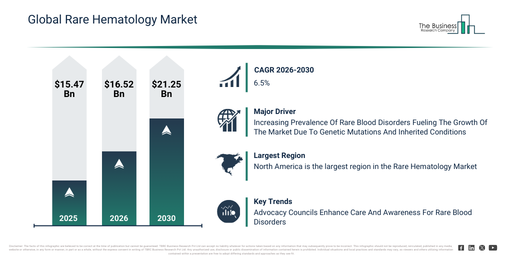
The rare hematology market has experienced robust growth in recent years. It is projected to expand from $15.47 billion in 2025 to $16.52 billion in 2026, demonstrating a compound annual growth rate (CAGR) of 6.8%. This historical growth is attributable to several factors, including the limited availability of effective therapies, expansion of rare disease research initiatives, increasing awareness of rare blood disorders, improvements in diagnostic laboratory capabilities, and growth in specialized hematology clinics.
The rare hematology market is anticipated to experience substantial expansion over the next few years. It is projected to reach $21.25 billion by 2030, demonstrating a compound annual growth rate (CAGR) of 6.5%. This growth during the forecast period can be attributed to several factors, including heightened investments in the advancement of gene therapy, a greater emphasis on precision medicine tailored for rare conditions, the proliferation of newborn and carrier screening initiatives, enhanced partnerships between research institutions and pharmaceutical firms, and breakthroughs in genomic sequencing technologies. Key trends anticipated during this period encompass the wider acceptance of gene and cell therapies, increased utilization of sophisticated genetic diagnostic tools, a sharpened focus on individualized treatment approaches, the enlargement of specialized facilities for rare diseases, and improved integration of digital patient monitoring systems.
Access Your Free Sample Report For In-Depth Market Analysis:
https://www.thebusinessresearchcompany.com/sample.aspx?id=28318&type=smp
What Key Factors Are Shaping The Rare Hematology Market Landscape?
The rising occurrence of rare blood disorders is anticipated to drive expansion within the rare hematology market in the future. These disorders are defined as infrequent medical ailments impacting the creation, operation, or longevity of blood cells or coagulation factors, resulting in conditions such as anemia, hemorrhagic issues, or hemolysis. The incidence of these conditions is growing, primarily attributed to genetic alterations and hereditary traits transmitted from parents to offspring. The rare hematology market facilitates this upward trend through the provision of specialized diagnostic tools and focused treatments designed to manage intricate and infrequent blood ailments, simultaneously mitigating complications and enhancing patient prognoses over time. As an illustration, in March 2024, data from the National Institute for Health and Care Excellence, a UK-based non-departmental public body, indicated that in 2022 and 2023, 2,069 individuals in the UK were identified with haemophilia B, comprising 374 with severe disease and 351 with moderate disease. Consequently, the escalating occurrence of rare blood disorders is a key impetus for the expansion of the rare hematology market.
How Is The Rare Hematology Market Broken Down By Segment Categories?
The rare hematology market covered in this report is segmented –
1) By Disease Type: Hemophilia, Sickle Cell Disease, Thalassemia, Myelodysplastic Syndromes, Other Disease Types
2) By Treatment Type: Gene Therapy, Stem Cell Transplantation, Blood Transfusion, Pharmacotherapy
3) By Diagnostic Technique: Laboratory Tests, Blood Tests, Bone Marrow Biopsies, Imaging Techniques, Magnetic Resonance Imaging (MRI) Scans, Ultrasounds, Genetic Testing, Carrier Screening, Whole Genome Sequencing
4) By Application: Pediatric, Adult
5) By End-User: Hospitals, Specialty Clinics, Research Institutes
Subsegments:
1) By Hemophilia: Hemophilia A, Hemophilia B, Hemophilia C, Acquired Hemophilia
2) By Sickle Cell Disease: Sickle Cell Anemia, Sickle Hemoglobin C Disease, Sickle Beta Thalassemia
3) By Thalassemia: Alpha Thalassemia, Beta Thalassemia
4) By Myelodysplastic Syndromes: Refractory Anemia (RA), Refractory Anemia With Ring Sideroblasts (RARS), Refractory Cytopenia With Multilineage Dysplasia (RCMD), Refractory Anemia With Excess Blasts (RAEB), Myelodysplastic Syndrome With Isolated Del(5Q), Unclassified Myelodysplastic Syndromes
5) By Other Disease Types: Aplastic Anemia, Paroxysmal Nocturnal Hemoglobinuria, Rare Coagulation Disorders
What Market Trends Are Affecting The Rare Hematology Market?
Major companies operating in the rare hematology market are focusing on developing innovative therapies and strategic initiatives, such as multi-stakeholder advocacy councils, with the goal of addressing unmet medical needs, enhancing patient support, and driving cross-indication solutions. Multi-stakeholder advocacy councils are defined as groups comprised of patients, caregivers, and experts who collaborate to improve care, awareness, and solutions for a specific health condition. For instance, in February 2023, Agios Pharmaceuticals Inc., a US-based biopharmaceutical company, introduced the Red Cell Revolution advocacy advisory council. This initiative brings together patients, caregivers, and healthcare professionals affected by rare hemolytic anemias such as pyruvate kinase deficiency, thalassemia, and sickle cell disease. Its primary goal is to strengthen community connections, generate published evidence, design practical solutions, and raise awareness of shared challenges. The initiative encompasses activities like sponsored podcasts, video content, and partnerships with organizations such as the National Organization for Rare Disorders to support health equity and education.
Which Players Are Present In The Rare Hematology Market Space?
Major companies operating in the rare hematology market are F. Hoffmann-La Roche Ltd, Pfizer Inc., Abbvie Inc., Bayer AG, Sanofi S.A., Novartis AG, Astrazeneca Plc, Bristol-Myers Squibb Company, Takeda Pharmaceutical Company Limited, Amgen Inc., CSL Behring LLC, Biogen Inc., Jazz Pharmaceuticals Plc, Octapharma AG, PharmaEssentia Corporation, Disc Medicine Inc., BioInvent International AB, Mustang Bio Inc., BlueSphere Bio Inc., Rallybio LLC
Get The Full Rare Hematology Market Report:
https://www.thebusinessresearchcompany.com/report/rare-hematology-global-market-report
Which Region Dominates The Rare Hematology Market By Market Share?
North America was the largest region in the rare hematology market in 2025. Asia-Pacific is expected to be the fastest-growing region in the forecast period. The regions covered in the rare hematology market report are Asia-Pacific, South East Asia, Western Europe, Eastern Europe, North America, South America, Middle East, Africa.
Request A Customized Rare Hematology Market Report For Competitive Insights:
https://www.thebusinessresearchcompany.com/report/rare-hematology-global-market-report
Browse Through More Reports Similar to the Global Rare Hematology Market 2026, By The Business Research Company
Neuroendocrine Tumor Treatment Market Report 2026
Rare Inflammatory Disease Treatment Market Report
Hormone Therapy Market Report
https://www.thebusinessresearchcompany.com/report/hormone-therapy-global-market-report
Get in touch with us:
The Business Research Company: https://www.thebusinessresearchcompany.com/
Americas +1 310-496-7795
Asia +44 7882 955267 & +91 8897263534
Europe +44 7882 955267
Email us at info@tbrc.info
Follow us on:
LinkedIn: https://in.linkedin.com/company/the-business-research-company
YouTube: https://www.youtube.com/channel/UC24_fI0rV8cR5DxlCpgmyFQ
Global Market Model: https://www.thebusinessresearchcompany.com/global-market-model