Increasing Cancer Incidence Fueling Expansion in Tumor Microenvironment Market
The Business Research Company’s 2026 market reports feature enhanced tools like market attractiveness analysis, TAM assessment, and company scoring matrices, along with interactive dashboards, deeper supply chain insights, and startup coverage strengthening the depth, usability, and strategic value of insights.
What Are The Market Size Estimates For The Tumor Microenvironment Market In 2026 And 2030?
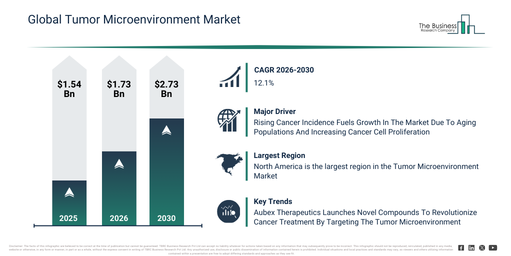
The tumor microenvironment market has experienced rapid expansion in recent years. This market is anticipated to grow from $1.54 billion in 2025 to $1.73 billion by 2026, exhibiting a compound annual growth rate (CAGR) of 12.4%. The growth observed in the past can be attributed to advancements in cancer biology research, a heightened understanding of tumor-immune interactions, the expansion of immuno-oncology pipelines, an increase in academic and clinical cancer research, and the availability of advanced laboratory technologies.
The tumor microenvironment market is anticipated to experience significant growth in the coming years. It is projected to reach $2.73 billion by 2030, demonstrating a compound annual growth rate (CAGR) of 12.1%. This projected growth can be attributed to factors such as increased investments in personalized oncology therapies, a rising demand for next-generation immunotherapies, the expansion of translational cancer research, growing collaborations between pharmaceutical companies and research institutions, and an increase in oncology clinical trial activities. Key trends during the forecast period involve a heightened focus on immune cell modulation strategies, the expanding development of TME-targeted therapies, increasing adoption of biomarker-based patient stratification, the broadening of combination immunotherapy approaches, and enhanced application of advanced molecular profiling.
Access Your Free Sample Report For In-Depth Market Analysis:
https://www.thebusinessresearchcompany.com/sample.aspx?id=24732&type=smp
What Major Factors Are Driving The Tumor Microenvironment Market Forward?
The increasing occurrence of cancer is projected to propel the expansion of the tumor microenvironment market moving forward. Cancer refers to a collection of illnesses defined by the uncontrolled proliferation and dissemination of atypical cells within the body. The escalating incidence of cancer is linked to aging populations, given that the likelihood of developing cancer increases with age due to prolonged exposure to environmental elements and a decline in the body’s capacity to repair cellular damage. The tumor microenvironment (TME) supports cancer by supplying vital nutrients, facilitating immune evasion, and boosting the proliferation and metastasis of cancer cells through signaling pathways and interactions with surrounding cells and the extracellular matrix. For example, in July 2024, the Australian Institute of Health and Welfare, an Australia-based government agency, stated that in Australia, the number of cancer cases diagnosed rose from 160,570 in 2022 to 164,694 in 2023, reflecting a notable increase over the year. Consequently, the rising incidence of cancer is a key driver for the growth of the tumor microenvironment market.
How Is Segmentation Applied In The Tumor Microenvironment Market Segment Analysis?
The tumor microenvironment market covered in this report is segmented –
1) By Cancer Type: Lung Cancer, Colorectal Cancer, Breast Cancer, Prostate Cancer, Bladder Cancer, Kidney Cancer, Other Cancer Types
2) By Target: T Cells, Tumor-Associated Macrophages (TAMs), Myeloid-Derived Suppressor Cells (MDSCs), Cancer-Associated Fibroblasts (CAFs), Regulatory T Cells (Tregs), Other Targets
3) By Therapy: Monoclonal Antibodies, Cytokines, Cancer Vaccines, Oncolytic Viruses, Adoptive Cell Therapies, Other Therapies
4) By End User: Biopharmaceutical Companies, Hospitals, Diagnostic Laboratories, Research Institutes, Contract Research Organizations, Other End Users
Subsegments:
1) By Lung Cancer: Non-Small Cell Lung Cancer (NSCLC), Small Cell Lung Cancer (SCLC)
2) By Colorectal Cancer: Colon Cancer, Rectal Cancer
3) By Breast Cancer: Hormone Receptor Positive Breast Cancer, Triple-Negative Breast Cancer, HER2-Positive Breast Cancer
4) By Prostate Cancer: Hormone-Sensitive Prostate Cancer, Castration-Resistant Prostate Cancer
5) By Bladder Cancer: Non-Muscle Invasive Bladder Cancer (NMIBC), Muscle Invasive Bladder Cancer (MIBC)
6) By Kidney Cancer: Renal Cell Carcinoma (RCC), Urothelial Carcinoma of the Renal Pelvis
7) By Other Cancer Types: Pancreatic Cancer, Head and Neck Cancer, Ovarian Cancer
Which Trends Are Impacting The Progress Of The Tumor Microenvironment Market?
Companies operating within the tumor microenvironment market are concentrating on developing innovative treatment options, such as targeted therapies, to boost treatment efficacy and overcome resistance mechanisms. Targeted treatments are therapeutic approaches designed to specifically identify and attack cancer cells based on unique molecular markers, without impacting most normal cells. For instance, in April 2024, Aubex Therapeutics Inc., a US-based biotechnology company, introduced a new class of substances aimed at revolutionizing cancer treatment by precisely targeting the tumor microenvironment (TME). These innovative compounds are engineered to interact with the complex network within the TME, which comprises cancer cells, immune cells, blood vessels, and stromal components. By modulating these interactions, Aubex’s approach strengthens the immune system’s ability to combat tumors and disrupts the processes that facilitate tumor growth and metastasis. This strategy intends to overcome resistance to conventional therapies, providing a promising alternative for patients who have not responded to existing treatment options.
Who Are The Companies Participating In The Tumor Microenvironment Market Environment?
Major companies operating in the tumor microenvironment market are Pfizer Inc., Johnson & Johnson, Merck & Co. Inc., AbbVie Inc., Bayer AG, Sanofi S.A., AstraZeneca plc, Novartis International AG, GlaxoSmithKline plc, Takeda Pharmaceutical Company Limited, Eli Lilly and Company, Gilead Sciences Inc., Amgen Inc., Boehringer Ingelheim GmbH, Regeneron Pharmaceuticals Inc., Genentech Inc., BeiGene Ltd., MacroGenics Inc., Arcus Biosciences Inc., Adaptimmune Therapeutics plc
Get The Full Tumor Microenvironment Market Report:
https://www.thebusinessresearchcompany.com/report/tumor-microenvironment-global-market-report
Which Region Is The Top Contributor To The Tumor Microenvironment Market By Share?
North America was the largest region in the tumor microenvironment market in 2025. Asia-Pacific is expected to be the fastest-growing region in the forecast period. The regions covered in the tumor microenvironment market report are Asia-Pacific, South East Asia, Western Europe, Eastern Europe, North America, South America, Middle East, Africa.
Request A Customized Tumor Microenvironment Market Report For Competitive Insights:
https://www.thebusinessresearchcompany.com/report/tumor-microenvironment-global-market-report
Browse Through More Reports Similar to the Global Tumor Microenvironment Market 2026, By The Business Research Company
Circulating Tumor Cells Market Report 2026
https://www.thebusinessresearchcompany.com/report/circulating-tumor-cells-global-market-report
Tumor Necrosis Factor Inhibitor Drugs Market Report
Tumor Infiltrating Lymphocytes Market Report
Get in touch with us:
The Business Research Company: https://www.thebusinessresearchcompany.com/
Americas +1 310-496-7795
Asia +44 7882 955267 & +91 8897263534
Europe +44 7882 955267
Email us at info@tbrc.info
Follow us on:
LinkedIn: https://in.linkedin.com/company/the-business-research-company
YouTube: https://www.youtube.com/channel/UC24_fI0rV8cR5DxlCpgmyFQ
Global Market Model: https://www.thebusinessresearchcompany.com/global-market-model