The Business Research Company’s 2026 market reports feature enhanced tools like market attractiveness analysis, TAM assessment, and company scoring matrices, along with interactive dashboards, deeper supply chain insights, and startup coverage strengthening the depth, usability, and strategic value of insights.
How Much Growth In Market Value Is Expected For The Mycosis Fungoides Treatment Market Between 2026 And 2030?
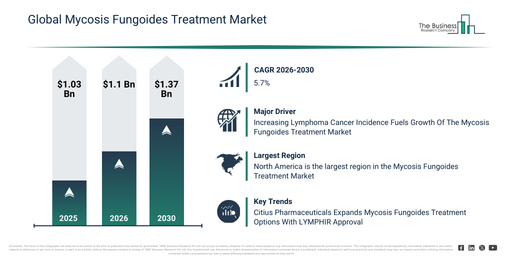
The mycosis fungoides treatment market size has demonstrated significant expansion in recent years. It is projected to expand from $1.03 billion in 2025 to $1.1 billion in 2026, exhibiting a compound annual growth rate (CAGR) of 6.7%. The growth witnessed during earlier periods is attributable to elements such as restricted treatment options, the rising prevalence of cutaneous t-cell lymphoma, a dependence on radiation therapy, instances of delayed diagnosis, and reliance on topical steroids.
The mycosis fungoides treatment market size is expected to show robust expansion over the next few years. It is forecast to grow to $1.37 billion by 2030, achieving a compound annual growth rate (CAGR) of 5.7%. The anticipated growth during this period stems from the advancement in targeted therapies, increasing application of immunotherapy, the proliferation of dermatology oncology centers, enhanced diagnostic capabilities, and a rise in investment dedicated to rare cancer research. Significant trends expected in the forecast period include the increasing uptake of combination therapy strategies, a greater reliance on topical steroids for managing early stages, a growing preference for targeted therapies and immunotherapy, the broadening of photodynamic and radiation therapy options, and an elevated demand for specialized dermatology and oncology clinics.
Access Your Free Sample Report For In-Depth Market Analysis:
https://www.thebusinessresearchcompany.com/sample.aspx?id=15613&type=smp
Which Key Drivers Are Affecting The Mycosis Fungoides Treatment Market Development?
An anticipated increase in lymphoma cancer cases is projected to fuel expansion within the mycosis fungoides treatment market. Lymphoma is defined as a malignancy affecting the lymphatic system, encompassing components like lymph nodes, the spleen, the thymus gland, and bone marrow. The growing occurrence of lymphoma cancer is attributed to several contributing elements, such as environmental factors, a rise in viral infections, an expanding elderly demographic, and various lifestyle choices. Therapies for mycosis fungoides, including topical corticosteroids, phototherapy, and systemic treatments, are employed for the management of cutaneous T-cell lymphomas. The objective of these treatments is to alleviate skin lesions, lessen symptoms, and regulate the advancement of the disease in individuals with lymphoma. For example, data from January 2024 provided by the American Cancer Society, a non-profit organization based in the United States, indicated that non-Hodgkin lymphoma (NHL) constituted approximately 4% of all cancers, making it one of the most prevalent cancers in the United States. Predictions for 2024 suggested around 80,620 individuals (comprising 44,590 males and 36,030 females) would receive an NHL diagnosis, with approximately 20,140 people (11,780 males and 8,360 females) succumbing to the disease. Consequently, the escalating incidence of lymphoma cancer is a key factor propelling the expansion of the mycosis fungoides treatment market.
Which Segment Types Are Examined In The Mycosis Fungoides Treatment Market Segment Study?
The mycosis fungoides treatment market covered in this report is segmented –
1) By Drug Type: Topical Steroids, Mechlorethamine
2) By Treatment Type: Photodynamic Therapy, Radiation Therapy, Targeted Therapy, Chemotherapy
3) By End-user: Hospitals, Private Clinics, Specialty Clinics
Subsegments:
1) By Topical Steroids: Corticosteroid Creams Or Ointments ( Hydrocortisone, Clobetasol), Topical Steroid Lotions
2) By Mechlorethamine: Topical Mechlorethamine ( Nitrogen Mustard Cream), Injectable Mechlorethamine
What Trends Are Transforming The Mycosis Fungoides Treatment Market?
Leading companies in the mycosis fungoides treatment market are concentrating on developing sophisticated solutions, such as targeted immunotherapy, to improve the effectiveness of treatment and patient quality of life. Targeted immunotherapy is designed to specifically attack malignant T-cells and regulatory T-cells while leaving healthy tissue intact, resulting in quicker disease control and fewer adverse effects. For instance, in August 2024, Citius Pharmaceuticals, a US-based biopharmaceutical company, announced the U.S. Food and Drug Administration (FDA)’s approval of LYMPHIR (denileukin diftitox-cxdl), which utilizes IL-2 receptor-targeted immunotherapy. This therapy is approved for adults suffering from relapsed or refractory cutaneous T-cell lymphoma, including mycosis fungoides, after at least one previous systemic treatment. LYMPHIR employs a novel mechanism of action that directly eliminates malignant T-cells and depletes Tregs to enhance the immune response. Clinical data demonstrated an objective response rate of 36% with a rapid median time to response of 1.4 months. The treatment reduced skin disease in 84% of patients and improved pruritus without cumulative toxicity. LYMPHIR offers a unique systemic option for Stage I-III patients and addresses the need for effective therapies in a population with limited treatment alternatives.
Which Players Are Part Of The Competitive Landscape Of The Mycosis Fungoides Treatment Market?
Major companies operating in the mycosis fungoides treatment market are Pfizer Inc., Merck & Co. Inc., Bristol Myers Squibb, Abbott Laboratories, Novartis AG, GlaxoSmithKline plc, Tocris Bioscience, Viatris Inc., Astellas Pharma Inc., Daiichi Sankyo Company, Takeda Pharmaceutical Company Limited, Bausch Health, Eisai Co. Ltd., Horizon Therapeutics plc, Varian Medical Systems, Kyowa Kirin Co. Ltd., Seattle Genetics Inc., Azurity Pharmaceuticals Inc., Innate Pharma S.A., Helsinn Therapeutics, Jubilant Cadista Pharmaceuticals Inc., Elorac Inc., Soligenix Inc., Ceptaris Therapeutics Inc.
Get The Full Mycosis Fungoides Treatment Market Report:
https://www.thebusinessresearchcompany.com/report/mycosis-fungoides-treatment-global-market-report
Which Region Dominates The Mycosis Fungoides Treatment Market By Market Share?
North America was the largest region in the mycosis fungoides treatment market in 2025. Asia-Pacific is expected to be the fastest-growing region in the forecast period. The regions covered in the mycosis fungoides treatment market report are Asia-Pacific, South East Asia, Western Europe, Eastern Europe, North America, South America, Middle East, Africa.
Request A Customized Mycosis Fungoides Treatment Market Report For Competitive Insights:
https://www.thebusinessresearchcompany.com/report/mycosis-fungoides-treatment-global-market-report
Browse Through More Reports Similar to the Global Mycosis Fungoides Treatment Market 2026, By The Business Research Company
In Vitro Diagnostics Market Report 2026
https://www.thebusinessresearchcompany.com/report/in-vitro-diagnostics-global-market-report
Immunoglobulin E Ige Allergy Blood Tests Market Report
Immunodiagnostics Market Report
https://www.thebusinessresearchcompany.com/report/immunodiagnostics-global-market-report
Get in touch with us:
The Business Research Company: https://www.thebusinessresearchcompany.com/
Americas +1 310-496-7795
Asia +44 7882 955267 & +91 8897263534
Europe +44 7882 955267
Email us at info@tbrc.info
Follow us on:
LinkedIn: https://in.linkedin.com/company/the-business-research-company
YouTube: https://www.youtube.com/channel/UC24_fI0rV8cR5DxlCpgmyFQ
Global Market Model: https://www.thebusinessresearchcompany.com/global-market-model