The Business Research Company’s 2026 market reports feature enhanced tools like market attractiveness analysis, TAM assessment, and company scoring matrices, along with interactive dashboards, deeper supply chain insights, and startup coverage strengthening the depth, usability, and strategic value of insights.
How Is The Market Size Of The Hypoprothrombinemia Treatment Market Expected To Change From 2026 To 2030?
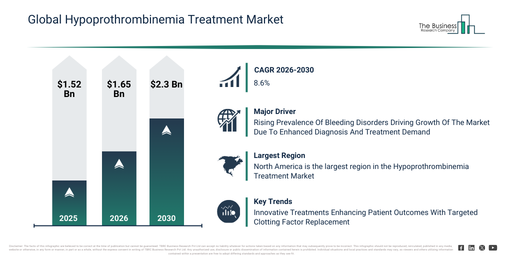
The hypoprothrombinemia treatment market size has shown strong expansion in recent years. It is forecast to rise from $1.52 billion in 2025 to $1.65 billion in 2026, growing at a compound annual growth rate (CAGR) of 8.9%. The market’s growth in preceding periods can be attributed to factors such as vitamin k deficiency prevalence, liver disease complications, anticoagulant overuse, existing hospital transfusion protocols, and inherited clotting disorders.
The hypoprothrombinemia treatment market is poised for significant expansion over the next few years. It is projected to reach $2.3 billion in 2030, exhibiting a compound annual growth rate (CAGR) of 8.6%. This anticipated growth during the forecast period is primarily attributed to advancements in recombinant clotting factors, enhancements in emergency care infrastructure, bleeding risks associated with an aging population, the adoption of precision hematology, and improved outpatient coagulation management. Key trends expected in the forecast period include the increased application of prothrombin complex concentrates, a growing reliance on rapid coagulation correction therapies, the expansion of vitamin K-based treatment protocols, elevated standards for emergency bleeding management, and the rising adoption of recombinant coagulation factors.
Access Your Free Sample Report For In-Depth Market Analysis:
https://www.thebusinessresearchcompany.com/sample.aspx?id=24566&type=smp
Which Factors Are Influencing The Growth Of The Hypoprothrombinemia Treatment Market?
The growing incidence of bleeding disorders is projected to fuel the expansion of the hypoprothrombinemia treatment market. These conditions are characterized by inadequate blood clotting, resulting in excessive or prolonged bleeding. The rise in their occurrence is largely attributed to advancements in diagnostic methods and heightened public awareness, facilitating more precise identification and reporting. Hypoprothrombinemia treatment addresses these disorders by restoring deficient prothrombin levels to enhance blood clotting. For example, in November 2024, the BMC Health Services Research, a UK-based journal focused on healthcare services, reported that between April 2022 and March 2023 in the United Kingdom, 6,662 males were identified with hemophilia A, with 5,032 being adults (18 and above), and 2,421 receiving either factor replacement therapy or emicizumab. During this same timeframe, 1,342 males were diagnosed with hemophilia B, including 1,022 adults, and 479 of them received factor replacement treatment. Consequently, this growing prevalence of bleeding disorders is anticipated to stimulate the expansion of the hypoprothrombinemia treatment market.
How Are Different Segments Classified In The Hypoprothrombinemia Treatment Market Segment Analysis?
The hypoprothrombinemia treatment market covered in this report is segmented –
1) By Type: Type I Deficiency Treatment, Type II Deficiency Treatment
2) By Drug Type: Vitamin K, Fresh Frozen Plasma, Prothrombin Complex Concentrates, Recombinant Prothrombin
3) By Indication Based: Vitamin K Deficiency, Liver Diseases, Cirrhosis, Hepatitis, Anticoagulant related Hypoprothrombinemia, Genetic Disorders, Malabsorption Syndromes
4) By Drug Delivery Method: Oral Delivery, Injectable Delivery, Intravenous, Intramuscular, Transfusion Based Delivery
5) By End User: Hospitals, Speciality Clinics, Homecare Settings
Subsegments:
1) By Type I Deficiency Treatment: Prothrombin Complex Concentrates (PCCs), Fresh Frozen Plasma (FFP), Recombinant Prothrombin, Plasma-derived Coagulation Factors
2) By Type II Deficiency Treatment: Vitamin K Therapy, Warfarin Reversal Agents, Liver Function Supportive Therapy, Anticoagulant Adjustment Therapies
Which Trends Are Contributing To Changes In The Hypoprothrombinemia Treatment Market?
Major companies involved in hypoprothrombinemia treatment are concentrating on innovative therapies, including non-activated four-factor prothrombin complex concentrate, to promptly restore clotting factor levels and reduce bleeding risks in patients needing immediate reversal of anticoagulation. Non-activated four-factor prothrombin complex concentrate (4F-PCC) is a plasma-derived therapy that contains clotting factors II, VII, IX, and X, employed to quickly reverse vitamin K antagonist effects and treat bleeding disorders such as hypoprothrombinemia. For instance, in January 2024, Octapharma USA, a US-based healthcare company and subsidiary of Octapharma AG, launched Balfaxar, a non-activated four-factor prothrombin complex concentrate (4F-PCC) recently approved by the FDA for the urgent reversal of vitamin K antagonist-induced coagulation deficiencies in adults requiring emergency surgery or invasive procedures. This therapy, which includes key vitamin K-dependent clotting factors and antithrombotic proteins, addresses critical requirements in hypoprothrombinemia management.
Who Are The Companies Driving Activity In The Hypoprothrombinemia Treatment Market?
Major companies operating in the hypoprothrombinemia treatment market are Biotest AG, Kedrion Biopharma, LFB S.A., Hualan Biological Engineering Inc., China Biologic Products Holdings Inc., Bio Products Laboratory (BPL), Kamada Ltd., Green Cross Corporation, Shanghai RAAS Blood Products Co. Ltd., SK Plasma Co. Ltd., Emergent BioSolutions Inc., Intas Pharmaceuticals Ltd., Bharat Serums and Vaccines Ltd., ZLB Behring (CSL Behring), Mitsubishi Tanabe Pharma Corporation
Get The Full Hypoprothrombinemia Treatment Market Report:
https://www.thebusinessresearchcompany.com/report/hypoprothrombinemia-treatment-global-market-report
Which Geographic Region Dominates The Hypoprothrombinemia Treatment Market?
North America was the largest region in the hypoprothrombinemia treatment market in 2025. Asia-Pacific is expected to be the fastest-growing region in the forecast period. The regions covered in the hypoprothrombinemia treatment market report are Asia-Pacific, South East Asia, Western Europe, Eastern Europe, North America, South America, Middle East, Africa.
Request A Customized Hypoprothrombinemia Treatment Market Report For Competitive Insights:
https://www.thebusinessresearchcompany.com/report/hypoprothrombinemia-treatment-global-market-report
Browse Through More Reports Similar to the Global Hypoprothrombinemia Treatment Market 2026, By The Business Research Company
Hypophosphatasia Treatment Market Report 2026
https://www.thebusinessresearchcompany.com/report/hypophosphatasia-treatment-global-market-report
Thalassemia Drugs Market Report 2026
https://www.thebusinessresearchcompany.com/report/thalassemia-drugs-global-market-report
Anemia And Other Blood Disorder Drugs Market Report 2026
Get in touch with us:
The Business Research Company: https://www.thebusinessresearchcompany.com/
Americas +1 310-496-7795
Asia +44 7882 955267 & +91 8897263534
Europe +44 7882 955267
Email us at: marketing@tbrc.info
Follow us on:
LinkedIn: https://in.linkedin.com/company/the-business-research-company
YouTube: https://www.youtube.com/channel/UC24_fI0rV8cR5DxlCpgmyFQ
Global Market Model: https://www.thebusinessresearchcompany.com/global-market-model