The Business Research Company’s 2026 market reports feature enhanced tools like market attractiveness analysis, TAM assessment, and company scoring matrices, along with interactive dashboards, deeper supply chain insights, and startup coverage strengthening the depth, usability, and strategic value of insights.
How Is The Market Size Of The Immunology Biosimilars Market Expected To Scale Between 2026 And 2030?
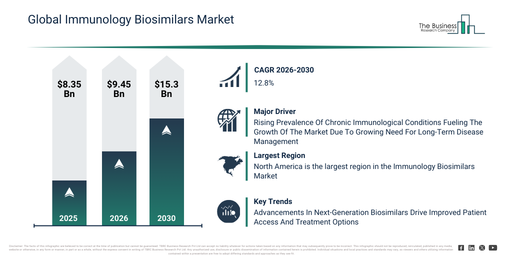
The immunology biosimilars market has experienced rapid expansion in recent years. Projections indicate a rise from $8.35 billion in 2025 to $9.45 billion in 2026, demonstrating a compound annual growth rate (CAGR) of 13.2%. This historical growth can be attributed to several factors, including the elevated cost of original biologics, the limited availability of biosimilar alternatives, the increasing prevalence of autoimmune diseases, growing adoption of biologics in hospital and clinical settings, and stringent regulatory approval processes for biosimilars.
The immunology biosimilars market size is projected to experience substantial expansion in the coming years, with an anticipated growth to $15.3 billion by 2030, at a compound annual growth rate (CAGR) of 12.8%. This growth during the forecast period can be attributed to the development of advanced biosimilar molecules, the expansion of homecare and outpatient treatment options, increasing regulatory harmonization, rising patient awareness and acceptance, and the growth of online and hospital pharmacy distribution channels. Major trends expected in the forecast period include the rising adoption of monoclonal antibody biosimilars, increasing use of fusion protein biosimilars, the expansion of recombinant protein therapies, a growing market for interferon-based treatments, and enhanced access to affordable immunology therapies.
Access Your Free Sample Report For In-Depth Market Analysis:
https://www.thebusinessresearchcompany.com/sample.aspx?id=25789&type=smp
What Significant Factors Are Influencing The Immunology Biosimilars Market Expansion?
A rising incidence of chronic immunological conditions is projected to boost the expansion of the immunology biosimilars market moving ahead. These conditions are persistent ailments where the immune system either wrongly targets the body’s own tissues or fails to offer adequate protection. The increase in such conditions stems from a growing population suffering from long-term immune system disorders, necessitating continuous therapy, proactive management, and sustained medical assistance. Immunology biosimilars aid in managing chronic immunological conditions by offering cost-effective and efficient treatment options, facilitating enduring disease control, and enhancing patient access to vital treatments for immune system irregularities. For example, in November 2023, the Multiple Sclerosis International Federation (MSIF), a UK-based international nonprofit organization focusing on global MS research and advocacy, estimated that 2.9 million people worldwide were afflicted with multiple sclerosis in 2023. Consequently, the expanding occurrence of chronic immunological conditions is stimulating growth within the immunology biosimilars market.
How Is The Immunology Biosimilars Market Organized By Segment Classification?
The immunology biosimilars market covered in this report is segmented –
1) By Drug Type: Monoclonal Antibodies, Fusion Proteins, Recombinant Proteins, Interferons, Other Biosimilar Immunomodulators
2) By Disease: Inflammatory Bowel Disease, Arthritis, Other Diseases
3) By Distribution Channel: Hospital Pharmacies, Retail Pharmacies, Online Pharmacies, Other Distribution Channels
4) By End User: Hospitals, Clinics, Homecare Settings, Ambulatory Surgical Centers (ASCs)
Subsegments:
1) By Monoclonal Antibodies: Anti-Tumor Necrosis Factor Agents, Anti-Interleukin-6 Agents, Anti-Cluster of Differentiation 20 Agents, Anti-Interleukin-12/23 Agents, Other Monoclonal Antibodies
2) By Fusion Proteins: Etanercept Biosimilars, Other Fusion Protein Biosimilars
3) By Recombinant Proteins: Recombinant Human Insulin, Recombinant Human Growth Hormone, Recombinant Human Erythropoietin, Other Recombinant Protein Biosimilars
4) By Interferons: Interferon Alpha, Interferon Beta, Interferon Gamma
5) By Other Biosimilar Immunomodulators: Interleukin Inhibitors, Janus Kinase Inhibitors, Other Immunomodulatory Biosimilars
What Trends Are Influencing The Immunology Biosimilars Market?
Leading companies in the immunology biosimilars market are concentrating on developing next-generation biosimilar innovations, which include anticipated interchangeability designation, advanced formulations with improved stability, and novel delivery systems, all aimed at providing patients with more accessible and effective treatment alternatives. This anticipated interchangeability designation indicates that the biosimilar is projected to meet regulatory benchmarks, thereby allowing its substitution for the reference biologic at the pharmacy level without the prescriber’s intervention. For instance, in February 2025, Sandoz Group AG, a pharmaceutical firm based in Switzerland, launched Pyzchiva (ustekinumab-ttwe), a biosimilar to Stelara, intended for the treatment of chronic autoimmune conditions such as plaque psoriasis, psoriatic arthritis, Crohn’s disease, and ulcerative colitis. This launch, a collaboration with Samsung Bioepis Co. Ltd., a biopharmaceutical company from South Korea, underscores Sandoz’s dedication to broadening access to immunology biosimilars by offering a cost-effective and patient-centric therapy featuring multiple dosing options, extended stability, and the unique characteristic of being re-refrigerable after initial refrigeration.
Who Are The Industry Participants Involved In The Immunology Biosimilars Market?
Major companies operating in the immunology biosimilars market are Pfizer Inc., Novartis AG, Amgen Inc., Sandoz Group AG, Fresenius Kabi AG, Intas Pharmaceuticals Ltd., Dr. Reddy’s Laboratories Ltd., Samsung Bioepis Co. Ltd., Gedeon Richter Plc, Celltrion Inc., Biocon Ltd., Innovent Biologics Inc., Biocad, Mabion S.A.
Get The Full Immunology Biosimilars Market Report:
https://www.thebusinessresearchcompany.com/report/immunology-biosimilars-global-market-report
Where Is The Immunology Biosimilars Market Most Concentrated Geographically?
North America was the largest region in the immunology biosimilars market in 2025. Asia-Pacific is expected to be the fastest-growing region in the forecast period. The regions covered in the immunology biosimilars market report are Asia-Pacific, South East Asia, Western Europe, Eastern Europe, North America, South America, Middle East, Africa.
Request A Customized Immunology Biosimilars Market Report For Competitive Insights:
https://www.thebusinessresearchcompany.com/report/immunology-biosimilars-global-market-report
Browse Through More Reports Similar to the Global Immunology Biosimilars Market 2026, By The Business Research Company
Biosimilar Market Report 2026
https://www.thebusinessresearchcompany.com/report/biosimilar-global-market-report
Biosimilar Market Report 2026
https://www.thebusinessresearchcompany.com/report/biosimilar-global-market-report
Bevacizumab Biosimilars Market Report 2026
https://www.thebusinessresearchcompany.com/report/bevacizumab-biosimilars-global-market-report
Get in touch with us:
The Business Research Company: https://www.thebusinessresearchcompany.com/
Americas +1 310-496-7795
Asia +44 7882 955267 & +91 8897263534
Europe +44 7882 955267
Email us at: marketing@tbrc.info
Follow us on:
LinkedIn: https://in.linkedin.com/company/the-business-research-company
YouTube: https://www.youtube.com/channel/UC24_fI0rV8cR5DxlCpgmyFQ
Global Market Model: https://www.thebusinessresearchcompany.com/global-market-model