The Business Research Company’s 2026 market reports feature enhanced tools like market attractiveness analysis, TAM assessment, and company scoring matrices, along with interactive dashboards, deeper supply chain insights, and startup coverage strengthening the depth, usability, and strategic value of insights.
What Is The Anticipated Rise In Market Value Of The Virtual Ward Market During The Forecast Period?
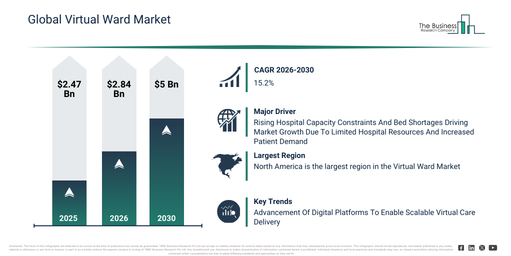
The virtual ward market has seen swift expansion in recent years. It is forecast to grow from $2.47 billion in 2025 to $2.84 billion in 2026, registering a compound annual growth rate (CAGR) of 14.9%. The market’s past growth can be attributed to several factors, including hospital capacity constraints, an uptick in remote monitoring pilots, the proliferation of telehealth services, an increase in chronic disease admissions, and the early adoption of home care digitization.
The virtual ward market is anticipated to experience significant expansion in the coming years. Projections indicate it will reach $5 billion by 2030, demonstrating a compound annual growth rate (CAGR) of 15.2%. Key factors contributing to this growth include escalating healthcare cost pressures, an expanding elderly demographic, wider reimbursement options for home care services, increased uptake of connected medical devices, and enhanced governmental backing for home-based treatment approaches. Prominent trends expected during this period involve the increasing embrace of hospital-at-home models, a surge in the utilization of continuous remote patient monitoring, the broadening of virtual nursing services, greater incorporation of clinical decision support tools, and the expanded implementation of home-based acute care initiatives.
Access Your Free Sample Report For In-Depth Market Analysis:
https://www.thebusinessresearchcompany.com/sample.aspx?id=33354&type=smp
Which Important Drivers Are Guiding The Virtual Ward Market Growth?
The expansion of the virtual ward market is anticipated in the upcoming years, driven by increasing hospital capacity limitations and a lack of available beds. These constraints emerge when healthcare systems lack adequate beds, personnel, or infrastructure to cater to patient needs. An aging demographic, requiring extended hospitalizations and more intricate care, is intensifying these pressures, leading to slower bed turnover and a heightened demand for inpatient services. Virtual wards mitigate these difficulties by allowing patients to access hospital-grade care at home, thus liberating physical beds, enhancing patient movement, and decreasing pressure on hospital resources. As an illustration, in January 2026, the Australian Institute of Health and Welfare (AIHW), an Australian-based government agency, reported an average of 67,300 public hospital beds available in 2023–24, which translates to 2.5 beds per 1,000 people. This limited bed availability, coupled with increasing healthcare demand, underscores the persistent capacity issues within the hospital framework. Consequently, increasing hospital capacity limitations and bed scarcity are projected to fuel the expansion of the virtual ward market.
How Are Different Segments Classified In The Virtual Ward Market Segment Analysis?
The virtual ward market covered in this report is segmented –
1) By Component: Hardware; Software; Services
2) By Service Type: Chronic Disease Management; Post-Operative Care; Preventive Care; Acute Care at Home; Virtual Nursing Services; Care Coordination Services
3) By Patient Demographics: Children; Adults; Senior Citizens
4) By Application: Cardiology; Neurology; Pulmonology; Oncology; Orthopedics; General Medicine; Geriatric Care
5) By End User: Patients; Hospitals; Clinics; Home Healthcare Providers; Insurance Companies; Government Healthcare Agencies
Subsegments:
1) By Hardware: Remote Patient Monitoring Devices; Wearable Health Sensors; Vital Sign Monitoring Equipment; Mobile Medical Tablets; Home Diagnostic Devices
2) By Software: Virtual Ward Management Platforms; Remote Monitoring Software; Patient Data Management Systems; Clinical Decision Support Software; Telehealth Integration Software
3) By Services: Remote Patient Monitoring Services; Virtual Clinical Care Services; Technical Support Services; Data Management Services; Care Coordination Services
Which Trends Are Shaping Growth In The Virtual Ward Market?
Leading companies in the virtual ward market are concentrating on developing advanced offerings, such as digital platforms. These platforms aim to enhance remote patient observation, facilitate real-time clinical decision-making, improve care coordination among healthcare teams, and reduce hospital admissions by delivering continuous, hospital-quality care in home-based environments. A digital platform is fundamentally a technology-driven system, typically accessed online, designed to enable interactions, transactions, or value exchange between two or more interdependent groups, including users, businesses, developers, or service providers. For example, in June 2025, Medway NHS Foundation Trust, a UK-based public healthcare provider, launched a new digital platform in partnership with health tech firm Feebris to scale its virtual hospital and virtual ward services, extending digital care beyond initial pilot programs. This platform incorporates configurable technology that supports virtual monitoring and hospital-at-home services across all clinical specialties, enables the remote capture of patient data, and considerably reduces hospital bed days and associated costs by facilitating recovery at home. It also supports the submission of pseudonymised data to national health data systems, fostering broader adoption and evidence generation for virtual care models. This solution enhances traditional care models by shifting service delivery from physical wards to digitally enabled patient environments, thereby improving efficiency and the overall patient experience.
Who Are The Companies Driving Activity In The Virtual Ward Market?
Major companies operating in the virtual ward market are Amazon.com Inc., UnitedHealth Group Incorporated, CVS Health Corporation, The Cigna Group Inc., Elevance Health Inc., Siemens AG, Roche Holding AG, HCA Healthcare Inc., Best Buy Co. Inc., Abbott Laboratories, Medtronic plc, Stryker Corporation, Koninklijke Philips N.V, GE Healthcare Technologies Inc., Boston Scientific Corporation, Baxter International Inc., ResMed Inc., DexCom Inc., Teladoc Health Inc., Masimo Corporation, iRhythm Technologies Inc.
Get The Full Virtual Ward Market Report:
https://www.thebusinessresearchcompany.com/report/virtual-ward-market-report
Which Region Is The Top Contributor To The Virtual Ward Market By Share?
North America was the largest region in the virtual ward market in 2025. Asia-Pacific is expected to be the fastest-growing region in the forecast period. The regions covered in the virtual ward market report are Asia-Pacific, South East Asia, Western Europe, Eastern Europe, North America, South America, Middle East, Africa.
Request A Customized Virtual Ward Market Report For Competitive Insights:
https://www.thebusinessresearchcompany.com/customise?id=33354&type=smp
Browse Through More Reports Similar to the Global Virtual Ward Market 2026, By The Business Research Company
Vertical Market Software Market Report 2026
https://www.thebusinessresearchcompany.com/report/vertical-market-software-global-market-report
Market Research Services Market Report 2026
https://www.thebusinessresearchcompany.com/report/market-research-services-global-market-report
Virtual Tourism Market Report 2026
https://www.thebusinessresearchcompany.com/report/virtual-tourism-global-market-report
Get in touch with us:
The Business Research Company: https://www.thebusinessresearchcompany.com/
Americas +1 310-496-7795
Asia +44 7882 955267 & +91 8897263534
Europe +44 7882 955267
Email us at info@tbrc.info
Follow us on:
LinkedIn: https://in.linkedin.com/company/the-business-research-company
YouTube: https://www.youtube.com/channel/UC24_fI0rV8cR5DxlCpgmyFQ
Global Market Model: https://www.thebusinessresearchcompany.com/global-market-model