Uncover key drivers, emerging technologies, and competitive movements shaping the implantable brain-computer interfaces market from 2026–2035 with trusted insights from The Business Research Company
What level of growth is expected in the Implantable Brain-Computer Interfaces Market between 2026 and 2030?
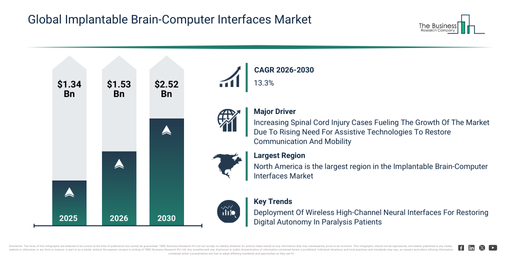
The implantable brain–computer interface market size has seen swift expansion over recent years. This market is set to increase from $1.34 billion in 2025 to $1.53 billion in 2026, registering a compound annual growth rate (CAGR) of 13.6%. The historical growth of this market can be attributed to several factors including a heightened demand for neuroprosthetics, the rising occurrence of neurological disorders, increased uptake of non-invasive brain–computer interfaces, a surge in research funding for neuroscience, and the broader deployment of brain–computer interfaces in rehabilitation.
The implantable brain–computer interface market is poised for significant expansion in the next few years. It is predicted to attain a value of $2.52 billion by 2030, growing at a compound annual growth rate (CAGR) of 13.3%. This expansion during the forecast period can be attributed to the increasing incorporation of artificial intelligence into brain–computer interfaces, rising financial commitments to neural interface innovation, a growing preference for minimally invasive brain–computer interfaces, an increase in assistive communication applications, and a heightened demand for robotic systems controlled by brain signals. Prominent developments expected in the forecast period include advancements in neural signal decoding technology, innovations in fully implantable brain–computer interfaces, the evolution of wireless brain–computer interface devices, continued research and development in brain–controlled prosthetics, and improvements in high-resolution neuroimaging techniques.
Access Your Free Sample Report for In-Depth Market Insights:
https://www.thebusinessresearchcompany.com/sample.aspx?id=30618&type=smp
Which Drivers Are Expected To Impact The Implantable Brain-Computer Interfaces Market During The Forecast Period?
A rise in spinal cord injury incidents is projected to drive the expansion of the implantable brain-computer interfaces market going forward. Spinal cord injuries involve damage, whether from trauma or other causes, to the spinal cord, leading to impaired communication between the brain and the rest of the body, frequently causing partial or total loss of motor and sensory capabilities. This increase in spinal cord injuries stems from more frequent falls among older demographics, given their elevated susceptibility to osteoporosis, difficulties with mobility, and domestic mishaps. Implantable brain-computer interfaces assist with the growing number of spinal cord injury cases by converting brain signals into commands for controlling assistive technology, such as wheelchairs or computers, thereby allowing paralyzed individuals to restore communication skills and autonomy. An example supporting this is the data from NeoMotion Assistive Solutions Private Limited, an India-based manufacturer of assistive mobility devices, which stated in June 2025 that the estimated prevalence of individuals living with spinal cord injury in the United States increased from around 302,000 in 2023 to approximately 308,620 in 2024. Consequently, the escalating number of spinal cord injury cases is fueling the expansion of the implantable brain-computer interfaces market.
Which Segments Are Driving Activity In The Implantable Brain-Computer Interfaces Market?
The implantable brain-computer interfaces market covered in this report is segmented –
1) By Component: Hardware, Software
2) By Type: Non-invasive Brain–Computer Interfaces, Partially Invasive Brain–Computer Interfaces, Fully Invasive Brain–Computer Interfaces
3) By Application: Healthcare And Rehabilitation, Communication And Control, Gaming And Entertainment, Smart Home And Automotive Control
4) By End User: Hospitals And Specialty Clinics, Research Centers And Academic Institutes, Home Care Settings, Other End Users
Subsegments:
1) By Hardware: Neural Electrodes, Signal Amplifiers, Data Acquisition Units, Wireless Transmitters, Power Supply Units
2) By Software: Signal Processing Software, Neural Decoding Software, Data Analysis Software, Control Interface Software, Feedback And Visualization Software
What Industry Trends Are Transforming The Implantable Brain-Computer Interfaces Market?
Leading companies in the implantable brain-computer interfaces market are concentrating on developing technologically advanced products, such as fully implantable, wireless brain-computer interface devices, with the goal of restoring communication capabilities for individuals experiencing severe neurological conditions. These implantable wireless brain-computer interface devices are defined as medical or neurotechnology tools surgically embedded within the brain that wirelessly record neural activity and/or stimulate neural circuits, enabling direct communication between the brain and external apparatus. For instance, in January 2024, Neuralink Corp., a US-based neurotechnology company, introduced the Telepathy into a human patient. This device is engineered to interpret neural activity, empowering individuals with quadriplegia or amyotrophic lateral sclerosis (ALS) to control a computer cursor or keyboard using their thoughts. The system additionally provides a pathway for restoring lost sensory and motor functions, marking a significant milestone in the clinical application of high-bandwidth brain-machine interfaces for medical rehabilitation.
Which Major Industry Participants Are Leading The Implantable Brain-Computer Interfaces Market Growth?
Major companies operating in the implantable brain-computer interfaces market are Medtronic plc, NeuroPace Inc., PINS Medical Co. Ltd., Neurosoft Ltd., Precision Neuroscience Corporation, Onward Medical N.V., NeuroOne Medical Technologies Corporation, Emotiv Systems Inc., NextMind S.A., Neuralink Corp., CorTec GmbH, Microprobes for Life Science Inc., Synchron Inc., Shanghai Rishena Medical Instrument Co. Ltd., Paradromics Inc., SceneRay Corporation Ltd., Blackrock Neurotech LLC, NeuroXess Inc., Inbrain Neuroelectronics S.L., BrainGate Company Inc.
Access The Complete Report For Deeper Market Insights:
Which Region Is Expected To Experience The Fastest Growth In The Implantable Brain-Computer Interfaces Market?
North America was the largest region in the implantable brain–computer interface market in 2025. Asia-Pacific is expected to be the fastest-growing region in the forecast period. The regions covered in the implantable brain-computer interfaces market report are Asia-Pacific, South East Asia, Western Europe, Eastern Europe, North America, South America, Middle East, Africa.
Request Your Customized Implantable Brain-Computer Interfaces Market Research Report for Competitive Advantage:
https://www.thebusinessresearchcompany.com/customise?id=30618&type=smp
Browse Through More Reports Similar to the Global Implantable Brain-Computer Interfaces Market 2026, By The Business Research Company
Brain Computer Interface Market Report 2026
https://www.thebusinessresearchcompany.com/report/brain-computer-interface-global-market-report
Brain And Neuroimaging Devices Market Report 2026
human machine interface global market report
https://www.thebusinessresearchcompany.com/report/human-machine-interface-global-market-report
Get in touch with us:
The Business Research Company: https://www.thebusinessresearchcompany.com/
Americas +1 310-496-7795
Asia +44 7882 955267 & +91 8897263534
Europe +44 7882 955267
Email us at marketing@tbrc.info
Follow us on:
LinkedIn: https://in.linkedin.com/company/the-business-research-company
YouTube: https://www.youtube.com/channel/UC24_fI0rV8cR5DxlCpgmyFQ
Global Market Model: https://www.thebusinessresearchcompany.com/global-market-model