The Business Research Company’s 2026 market reports feature advanced enhancements such as market attractiveness analysis, total addressable market evaluation, company benchmarking matrices, interactive Excel dashboards, expanded supply chain intelligence, emerging startup coverage, and detailed product insights, delivering more actionable and strategically valuable research.
How Does The Forecasted Market Size Of The Connective Tissue Disease Treatment Market Compare Between 2026 And 2030?
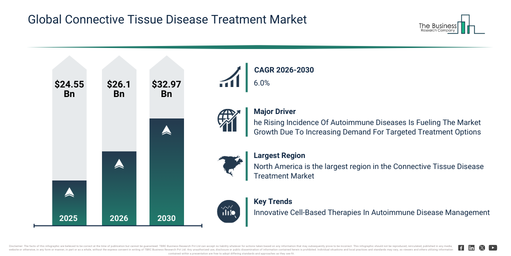
The connective tissue disease treatment market has demonstrated substantial expansion in recent years. This market is set to increase from $24.55 billion in 2025 to $26.1 billion in 2026, exhibiting a compound annual growth rate (CAGR) of 6.3%. The growth observed in prior periods can be attributed to several factors, including the limited availability of biologic therapies, a reliance on conventional DMARDs, the rising prevalence of autoimmune connective tissue diseases, a greater adoption of hospital-based treatments, and increased awareness of disease management programs.
The connective tissue disease treatment market is expected to experience significant expansion in the coming years, with its size projected to reach $32.97 billion in 2030, growing at a compound annual growth rate (CAGR) of 6.0%. This anticipated growth during the forecast period is driven by factors such as the advancement of targeted synthetic DMARDs and JAK inhibitors, increased investment in biologics and immunosuppressants, the expansion of homecare and outpatient treatment facilities, a rising emphasis on personalized medicine and patient-centric care, and the integration of digital health and telemedicine solutions. Key trends influencing this period include a greater adoption of biologics and targeted therapies, a growing preference for individualized treatment approaches, the broadening of homecare and outpatient treatment settings, an increasing demand for oral and injectable drug delivery methods, and a concerted focus on early diagnosis and comprehensive disease management programs.
Download A Free Sample Report For Comprehensive Market Insights:
https://www.thebusinessresearchcompany.com/sample.aspx?id=25726&type=smp
Which Drivers Are Advancing The Connective Tissue Disease Treatment Market Growth?
The increasing occurrence of autoimmune conditions is projected to drive the expansion of the connective tissue disease treatment market in the future. Autoimmune conditions are characterized by the body’s immune system erroneously targeting its own healthy tissues and organs. The growing prevalence of autoimmune diseases largely stems from a blend of genetic predisposition, rendering some individuals more susceptible to immune system dysfunctions, and environmental elements like infections, dietary habits, stress, and toxin exposure, which can initiate or aggravate these conditions. Treatment for connective tissue diseases aids in managing autoimmune disorders by addressing the fundamental immune system malfunction responsible for inflammation and tissue destruction, consequently easing symptoms, retarding disease progression, and enhancing the general quality of life for those suffering from conditions such as lupus, rheumatoid arthritis, and scleroderma. For example, in February 2024, data from Arthritis Australia, an Australia-based non-profit entity, indicated that approximately 562,378 Australians are anticipated to be living with RA in 2025, constituting 14% of all arthritis cases during that year. This figure is projected to increase by 33% to 748,721 people by 2040. This signifies an extra 186,343 Australians living with RA in 2040 as opposed to 2025. Consequently, the increasing prevalence of autoimmune diseases is fueling the expansion of the connective tissue disease treatment market.
What Key Segment Areas Are Included In The Connective Tissue Disease Treatment Market Assessment?
The connective tissue disease treatment market covered in this report is segmented –
1) By Drug Class: Anti-Inammatory Drugs, Immunosuppressants, Biologics And Targeted Therapy, Disease-Modifying Anti-Rheumatic Drugs (DMARDs), Other Drug Classes
2) By Disease Type: Systemic Lupus Erythematosus (SLE), Rheumatoid Arthritis (RA), Scleroderma, Dermatomyositis, Mixed Connective Tissue Disease (MCTD), Polymyositis, Sjögren’s Syndrome, Vasculitis, Antiphospholipid Syndrome (APS)
3) By Route Of Administration: Oral, Injectable, Topical
4) By Distribution Channel: Hospital Pharmacies, Retail Pharmacies, Online Pharmacies
5) By End-User: Hospitals, Clinics, Homecare Settings
Subsegments:
1) By Anti-Inflammatory Drugs: Nonsteroidal Anti-Inflammatory Drugs (NSAIDs), Systemic Corticosteroids
2) By Immunosuppressants: Calcineurin Inhibitors, Mammalian Target Of Rapamycin (mTOR) Inhibitors, Antimetabolites, Alkylating Agents
3) By Biologics And Targeted Therapy: Tumor Necrosis Factor (TNF) Inhibitors, Interleukin-6 (IL-6) Inhibitors, B-Cell Inhibitors, T-Cell Co-Stimulation Modulators, Janus Kinase (JAK) Inhibitors
4) By Disease-Modifying Anti-Rheumatic Drugs (DMARDs): Conventional Synthetic Disease-Modifying Anti-Rheumatic Drugs (DMARDs), Biologic Disease-Modifying Anti-Rheumatic Drugs (DMARDs), Targeted Synthetic Disease-Modifying Anti-Rheumatic Drugs (DMARDs)
5) By Other Drug Classes: Analgesics, Antimalarial Drugs, Antibiotics, Monoclonal Antibodies
Which Trends Are Supporting The Evolution Of The Connective Tissue Disease Treatment Market?
Leading companies within the connective tissue disease treatment market are concentrating on conducting clinical trials to develop innovative treatments, such as allogeneic CAR-NK cell therapy, with the goal of enhancing efficacy and addressing unmet needs in autoimmune conditions. Allogeneic CAR-NK cell therapy represents a treatment modality that uses natural killer (NK) cells derived from healthy donors, which are then genetically modified with a chimeric antigen receptor (CAR), to specifically target and destroy cells causing disease. It functions by boosting the immune system’s capacity to eliminate detrimental B-cells involved in autoimmune diseases, offering an option that could be safer and more accessible than conventional cell therapies. For instance, in July 2024, Nkarta Inc., a US-based clinical-stage biotechnology company, commenced the Ntrust-1 clinical trial to evaluate NKX019, an investigational allogeneic CAR-NK cell therapy, for the treatment of lupus nephritis. Furthermore, the company received FDA clearance to begin a separate trial (Ntrust-2) for systemic sclerosis, idiopathic inflammatory myopathy, and ANCA-associated vasculitis, with the objective of fulfilling significant unmet needs in autoimmune diseases by improving the safety, accessibility, and effectiveness of cell-based therapies through genetically engineered NK cells that selectively target CD19-expressing B-cells.
Which Key Players Are Active In The Connective Tissue Disease Treatment Market?
Major companies operating in the connective tissue disease treatment market are Pfizer Inc., F. Hoffmann-La Roche AG, AbbVie Inc., Sanofi S.A., Bristol Myers Squibb Company, AstraZeneca PLC, Novartis AG, GlaxoSmithKline (GSK) PLC, Eli Lilly and Company, Amgen Inc., Biogen Inc., Vertex Pharmaceuticals, UCB S.A., Hikma Pharmaceuticals PLC, Innovent Biologics Inc., RemeGen Co. Ltd, Kymera Therapeutics, Adicet Bio, Equillium Inc.
Access The Complete Connective Tissue Disease Treatment Market Report:
Which Region Commands The Largest Share Of The Connective Tissue Disease Treatment Market?
North America was the largest region in the connective tissue disease treatment market in 2025. Asia-Pacific is expected to be the fastest-growing region in the forecast period. The regions covered in the connective tissue disease treatment market report are Asia-Pacific, South East Asia, Western Europe, Eastern Europe, North America, South America, Middle East, Africa.
Access Connective Tissue Disease Treatment Market Report for Deeper Competitive Insights
https://www.thebusinessresearchcompany.com/sample.aspx?id=25726&type=smp
Browse Through More Reports Similar to the Global Connective Tissue Disease Treatment Market 2026, By The Business Research Company
Neurofibromatosis Treatment Market Report 2026
https://www.thebusinessresearchcompany.com/report/neurofibromatosis-treatment-global-market-report
Soft Tissue Repair Market Report 2026
https://www.thebusinessresearchcompany.com/report/soft-tissue-repair-global-market-report
Bleeding Disorders Treatment Market Report 2026
https://www.thebusinessresearchcompany.com/report/bleeding-disorders-treatment-global-market-report
Get in touch with us:
The Business Research Company: https://www.thebusinessresearchcompany.com/
Americas: +1 310-496-7795
Asia: +44 7882 955267 & +91 8897263534
Europe: +44 7882 955267
Email us at: marketing@tbrc.info
Follow us on:
LinkedIn: https://in.linkedin.com/company/the-business-research-company
YouTube: https://www.youtube.com/channel/UC24_fI0rV8cR5DxlCpgmyFQ
Global Market Model: https://www.thebusinessresearchcompany.com/global-market-model