The Business Research Company’s 2026 market reports feature advanced enhancements such as market attractiveness analysis, total addressable market evaluation, company benchmarking matrices, interactive Excel dashboards, expanded supply chain intelligence, emerging startup coverage, and detailed product insights, delivering more actionable and strategically valuable research.
What Is The Expected Market Value Outlook For The Immunology Biosimilars Market Through 2030?
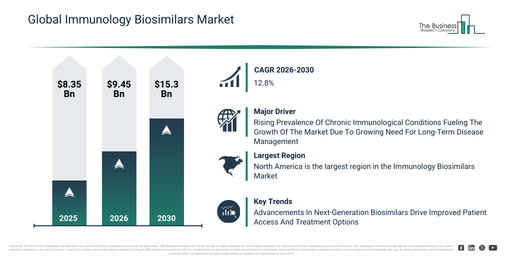
The immunology biosimilars market has experienced significant expansion recently. Its valuation is projected to increase from $8.35 billion in 2025 to $9.45 billion in 2026, demonstrating a compound annual growth rate (CAGR) of 13.2%. Historically, this expansion has been driven by factors such as the elevated costs associated with original biologics, the scarcity of alternative biosimilar options, the rising incidence of autoimmune conditions, the increasing integration of biologics in hospitals and clinical settings, and the rigorous regulatory approval processes for biosimilars.
The immunology biosimilars market is projected to experience substantial expansion in the coming years. This market is anticipated to reach a value of $15.3 billion by 2030, driven by a compound annual growth rate (CAGR) of 12.8%. Factors contributing to this growth over the projected period include the creation of sophisticated biosimilar molecules, a wider range of homecare and outpatient treatment options, greater alignment in regulations, increased patient knowledge and acceptance, and the proliferation of online and hospital pharmacy distribution networks. Key developments expected during this timeframe involve a surge in the adoption of monoclonal antibody biosimilars, broader application of fusion protein biosimilars, an increase in recombinant protein therapies, an expanding market for interferon-derived treatments, and improved availability of cost-effective immunology treatments.
Download A Free Sample Report For Comprehensive Market Insights:
https://www.thebusinessresearchcompany.com/sample.aspx?id=25789&type=smp
Which Major Factors Are Contributing To The Development Of The Immunology Biosimilars Market?
The expanding occurrence of chronic immunological conditions is projected to boost the growth of the immunology biosimilars market in the future. These conditions are persistent ailments where the immune system either wrongly targets the body’s own tissues or inadequately defends it. This increase is attributed to more individuals experiencing prolonged immune system dysfunctions necessitating continuous care, proactive management, and consistent medical assistance. Immunology biosimilars aid in managing chronic immunological conditions by offering economical and efficient treatment options, facilitating long-term disease control, and enhancing patient access to crucial therapies for immune system regulation. As an illustration, in November 2023, the Multiple Sclerosis International Federation (MSIF), a UK-based international nonprofit organization involved in global MS research and advocacy, reported that approximately 2.9 million people globally had multiple sclerosis in 2023. Consequently, the rising incidence of chronic immunological conditions is fueling expansion within the immunology biosimilars market.
Which Segment-Based Categories Are Covered In The Immunology Biosimilars Market?
The immunology biosimilars market covered in this report is segmented –
1) By Drug Type: Monoclonal Antibodies, Fusion Proteins, Recombinant Proteins, Interferons, Other Biosimilar Immunomodulators
2) By Disease: Inflammatory Bowel Disease, Arthritis, Other Diseases
3) By Distribution Channel: Hospital Pharmacies, Retail Pharmacies, Online Pharmacies, Other Distribution Channels
4) By End User: Hospitals, Clinics, Homecare Settings, Ambulatory Surgical Centers (ASCs)
Subsegments:
1) By Monoclonal Antibodies: Anti-Tumor Necrosis Factor Agents, Anti-Interleukin-6 Agents, Anti-Cluster of Differentiation 20 Agents, Anti-Interleukin-12/23 Agents, Other Monoclonal Antibodies
2) By Fusion Proteins: Etanercept Biosimilars, Other Fusion Protein Biosimilars
3) By Recombinant Proteins: Recombinant Human Insulin, Recombinant Human Growth Hormone, Recombinant Human Erythropoietin, Other Recombinant Protein Biosimilars
4) By Interferons: Interferon Alpha, Interferon Beta, Interferon Gamma
5) By Other Biosimilar Immunomodulators: Interleukin Inhibitors, Janus Kinase Inhibitors, Other Immunomodulatory Biosimilars
Which Trends Are Guiding The Development Of The Immunology Biosimilars Market?
Companies operating in the immunology biosimilars market are prioritizing the creation of next-generation biosimilar innovations, including anticipated interchangeability designation, advanced formulations that offer improved stability, and novel delivery systems, aiming to offer patients more accessible and effective treatment alternatives. Anticipated interchangeability designation indicates that the biosimilar is expected to fulfill regulatory requirements, allowing it to be swapped for the reference biologic at the pharmacy without needing intervention from the prescriber. For example, in February 2025, Sandoz Group AG, a pharmaceutical company based in Switzerland, in collaboration with Samsung Bioepis Co. Ltd., a biopharmaceutical company from South Korea, released Pyzchiva (ustekinumab-ttwe), a biosimilar to Stelara, intended for managing chronic autoimmune conditions such as plaque psoriasis, psoriatic arthritis, Crohn’s disease, and ulcerative colitis. This launch underscores Sandoz’s dedication to broaden access to immunology biosimilars by delivering a treatment that is cost-effective and patient-centric, featuring multiple dosing options, extended stability, and the distinctive capability to be re-refrigerated after initial refrigeration.
Who Are The Major Companies Operating In The Immunology Biosimilars Market?
Major companies operating in the immunology biosimilars market are Pfizer Inc., Novartis AG, Amgen Inc., Sandoz Group AG, Fresenius Kabi AG, Intas Pharmaceuticals Ltd., Dr. Reddy’s Laboratories Ltd., Samsung Bioepis Co. Ltd., Gedeon Richter Plc, Celltrion Inc., Biocon Ltd., Innovent Biologics Inc., Biocad, Mabion S.A.
Access The Complete Immunology Biosimilars Market Report:
https://www.thebusinessresearchcompany.com/report/immunology-biosimilars-global-market-report
Which Region Holds The Largest Share In The Immunology Biosimilars Market?
North America was the largest region in the immunology biosimilars market in 2025. Asia-Pacific is expected to be the fastest-growing region in the forecast period. The regions covered in the immunology biosimilars market report are Asia-Pacific, South East Asia, Western Europe, Eastern Europe, North America, South America, Middle East, Africa.
Access Immunology Biosimilars Market Report for Deeper Competitive Insights
https://www.thebusinessresearchcompany.com/sample.aspx?id=25789&type=smp
Browse Through More Reports Similar to the Global Immunology Biosimilars Market 2026, By The Business Research Company
Biosimilar Market Report 2026
https://www.thebusinessresearchcompany.com/report/biosimilar-global-market-report
Biosimilar Market Report 2026
https://www.thebusinessresearchcompany.com/report/biosimilar-global-market-report
Bevacizumab Biosimilars Market Report 2026
https://www.thebusinessresearchcompany.com/report/bevacizumab-biosimilars-global-market-report
Get in touch with us:
The Business Research Company: https://www.thebusinessresearchcompany.com/
Americas: +1 310-496-7795
Asia: +44 7882 955267 & +91 8897263534
Europe: +44 7882 955267
Email us at: marketing@tbrc.info
Follow us on:
LinkedIn: https://in.linkedin.com/company/the-business-research-company
YouTube: https://www.youtube.com/channel/UC24_fI0rV8cR5DxlCpgmyFQ
Global Market Model: https://www.thebusinessresearchcompany.com/global-market-model