The Business Research Company’s 2026 market reports feature advanced enhancements such as market attractiveness analysis, total addressable market evaluation, company benchmarking matrices, interactive Excel dashboards, expanded supply chain intelligence, emerging startup coverage, and detailed product insights, delivering more actionable and strategically valuable research.
How Much Larger Will The 3D Neuroscience Market Become By 2030 Compared To 2026?
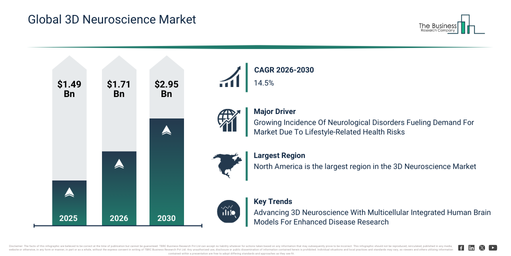
The three-dimensional (3D) neuroscience market size has witnessed rapid expansion in recent years. It is anticipated to grow from $1.49 billion in 2025 to $1.71 billion in 2026, at a compound annual growth rate (CAGR) of 14.8%. The historical growth can be ascribed to the increasing adoption of three-dimensional (3D) brain modeling techniques, a rising demand for advanced neurological research tools, its expanding application in drug discovery and neuropharmacology, the development of imaging and visualization technologies, and an intensified focus on comprehending complex neural networks.
The three-dimensional (3D) neuroscience market is projected to experience significant expansion over the next few years, with its size expected to reach $2.95 billion by 2030, demonstrating a compound annual growth rate (CAGR) of 14.5%. This growth during the forecast period is primarily driven by the increasing integration of three-dimensional (3D) models with artificial intelligence (AI) analytics, a rise in investment within personalized neuroscience research, wider adoption in disease modeling and therapeutic development, the expansion of high-resolution imaging and data acquisition platforms, and an elevated demand for predictive and translational neuroscience studies. Concurrently, major developments foreseen include technology-driven innovations in three-dimensional (3D) neural tissue modeling, advancements in artificial intelligence (AI)-enabled data analysis, the evolution of organoid and lab-grown neural systems, increasing research and development in imaging and simulation platforms, and breakthroughs in integrated neuroscience modeling and visualization tools.
Download A Free Sample Report For Comprehensive Market Insights:
https://www.thebusinessresearchcompany.com/sample.aspx?id=30491&type=smp
Which Core Factors Are Supporting The Expansion Of The 3D Neuroscience Market?
The expanding incidence of neurological ailments is anticipated to drive the advancement of the 3D neuroscience market in the future. These conditions are health issues impacting the brain, spinal cord, and nerves, thereby disturbing typical nervous system operations and resulting in difficulties with movement, thought processes, perception, conduct, or general bodily management. The rising occurrence of neurological disorders is linked to detrimental lifestyle choices, such as inadequate nutrition, lack of exercise, smoking, excessive drinking, and persistent stress. 3D neuroscience offers improved comprehension of brain architecture and function, facilitating more accurate diagnoses and tailored therapies for individuals suffering from neurological conditions. For instance, in April 2024, according to the National Institutes of Health (NIH), a US-based government agency, an estimated 6.9 million Americans aged 65 and older are currently living with Alzheimer’s dementia, and this figure is projected to nearly double to 13.8 million by 2060. Consequently, the growing prevalence of neurological disorders acts as a significant catalyst for the 3D neuroscience market.
How Is The 3D Neuroscience Market Structured Across Different Market Segments?
The 3D neuroscience market covered in this report is segmented –
1) By Component: Instruments And Consumables, Software And Services
2) By Technology: Brain Imaging, Neuro-Microscopy, Electrophysiology, Neurophotonic Analysis, Other Technologies
3) By Scale Of Analysis: Macro-Scale Connectomics (MSC), Meso-Scale Connectomics (MeSC), Micro-Scale Connectomics (MiSC), Nanoscale Or Synaptic Analysis (NSA)
4) By Application: Disease Modeling And Drug Discovery, Brain Mapping And Connectomics, Developmental Neuroscience, Diagnostics And Surgical Planning
5) By End-User: Hospitals, Diagnostic Laboratories, Research and Academic Institutes, Other End-Users
Subsegments:
1) By Instruments And Consumables: Imaging Devices, Microelectrodes, Sensors, Reagents, Laboratory Consumables
2) By Software And Services: Data Analysis Software, Visualization Software, Modeling And Simulation Software, Technical Support Services, Training And Consultation Services
What Trends Are Affecting The 3D Neuroscience Market Dynamics?
Leading companies active in the 3D neuroscience market are directing their attention towards creating sophisticated 3D human brain tissue platforms, including multicellular integrated brain models, with the goal of improving disease modeling, accelerating drug testing, and delivering more physiologically relevant outcomes. Multicellular integrated brain models are characterized as three-dimensional constructs grown in labs from induced pluripotent stem cells, which incorporate multiple significant brain cell types. This design permits an exhaustive investigation into cellular interactions, pathology, and drug responses. As an illustration, in November 2025, Massachusetts Institute of Technology (MIT), a US-based research institution, introduced Multicellular Integrated Brains (miBrains), a flexible 3D human brain tissue system. This platform integrates six major brain cell types, facilitates genetic engineering for individualized disease studies, and can be scaled to support extensive research projects, thereby enhancing the provision and applicability of complex in vitro models for neuroscience research.
Who Are The Companies Shaping The 3D Neuroscience Market Landscape?
Major companies operating in the 3D neuroscience market are Siemens Healthineers AG, Merck KGaA, Koninklijke Philips N.V., GE Healthcare Technologies Inc., Corning Incorporated, Bruker Corporation, STEMCELL Technologies Inc., Greiner Bio-One International GmbH, American Type Culture Collection, Cellink AB, Aspect Biosystems Ltd., InSphero AG, Axion BioSystems Inc., Emulate Inc., Mimetas B.V., NeuroNexus Technologies Inc., Tessara Therapeutics Inc., TheWell Bioscience Inc., Kirkstall Ltd., Pelobiotech GmbH, 3D Biotek LLC, Mightex Systems Inc., Advanced BioMatrix Inc.
Access The Complete 3D Neuroscience Market Report:
https://www.thebusinessresearchcompany.com/report/3d-neuroscience-market-report
Which Area Represents The Largest Portion Of The 3D Neuroscience Market?
North America was the largest region in the three dimensional (3D) neuroscience market in 2025. Asia-Pacific is expected to be the fastest-growing region in the forecast period. The regions covered in the 3D neuroscience market report are Asia-Pacific, South East Asia, Western Europe, Eastern Europe, North America, South America, Middle East, Africa.
Access a Customized 3D Neuroscience Market Report for Deeper Competitive Insights
https://www.thebusinessresearchcompany.com/sample.aspx?id=30491&type=smp
Get in touch with us:
The Business Research Company: https://www.thebusinessresearchcompany.com/
Americas: +1 310-496-7795
Asia: +44 7882 955267 & +91 8897263534
Europe: +44 7882 955267
Email us at: marketing@tbrc.info
Follow us on:
LinkedIn: https://in.linkedin.com/company/the-business-research-company
YouTube: https://www.youtube.com/channel/UC24_fI0rV8cR5DxlCpgmyFQ
Global Market Model: https://www.thebusinessresearchcompany.com/global-market-model