Enhanced with market attractiveness analysis, total addressable market evaluation, company benchmarking matrices, interactive Excel dashboards, expanded supply chain intelligence, emerging startup coverage, and detailed product insights, The Business Research Company’s 2026 market reports deliver more actionable and strategically valuable research.
The aerosol drug delivery devices sector has experienced significant growth in recent years, driven by increasing health concerns and technological advancements. Forecasts indicate that this market will continue to expand rapidly as innovations and rising demand in respiratory care propel it forward. Let’s explore the current market size, key growth factors, major players, and emerging trends shaping this industry.
Current Market Size and Growth Forecast for Aerosol Drug Delivery Devices
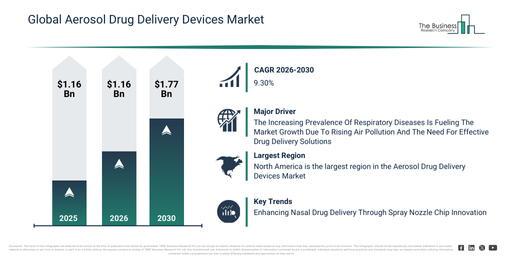
The market for aerosol drug delivery devices has been expanding robustly. It is projected to grow from $41.55 billion in 2025 to $45.54 billion in 2026, representing a compound annual growth rate (CAGR) of 9.6%. Looking ahead, the market is expected to reach $64.94 billion by 2030, with a slightly moderated CAGR of 9.3%. This sustained growth is attributed to various factors, such as rising cases of asthma and COPD, continued use of traditional inhalers, growth in hospital-based respiratory care, an increase in pharmaceutical aerosol products, and heightened awareness about pulmonary drug delivery methods.
Download A Free Sample Report For Comprehensive Market Insights:
https://www.thebusinessresearchcompany.com/sample.aspx?id=25690&type=smp
Rising Demand in Aerosol Drug Delivery Devices Market Driven by Innovation
The forecast period will see strong market expansion due to the advancement of smart inhalers and digital monitoring technologies. Additionally, the increase in homecare and self-administration therapies, along with the application of aerosol drugs beyond respiratory illnesses, is boosting demand. Progress in aerosolization techniques and formulation science, along with growing regulatory approvals for inhaled medications, further contribute to this upward trend.
The market is also being influenced by emerging trends such as wider adoption of inhalation therapies, a surge in portable and homecare aerosol device demand, and a focus on optimizing particle size for better drug delivery. Furthermore, smart and connected inhalation devices are gaining traction, supported by the rising prevalence of chronic respiratory diseases worldwide.
https://www.thebusinessresearchcompany.com/report/aerosol-drug-delivery-devices-global-market-report
Aerosol Drug Delivery Devices Market Regional Distribution: Which Areas Drive Market Expansion?
Health Trends Fueling Aerosol Drug Delivery Devices Market Growth
One of the primary factors driving revenue in the aerosol drug delivery devices market is the growing incidence of respiratory illnesses. These conditions affect the lungs and respiratory system, leading to difficulty in breathing and requiring effective treatment solutions. Increasing air pollution levels, including exposure to particulate matter, nitrogen dioxide, and ozone, irritate the respiratory tract, causing chronic diseases such as asthma, bronchitis, and chronic obstructive pulmonary disease (COPD).
How Respiratory Diseases Boost Aerosol Drug Delivery Use
Aerosol drug delivery devices play a crucial role in treating respiratory disorders by administering medication directly to the lungs. This targeted delivery ensures faster therapeutic effects, reduces systemic side effects, and improves patient adherence through non-invasive methods. For example, in November 2024, data from the Australian Institute of Health and Welfare revealed that respiratory conditions accounted for 7.2% of the total disease burden in Australia, contributing to 8.5% of disability-causing illnesses and 5.8% of premature deaths in 2023. Such statistics underscore the increasing need for effective aerosol drug delivery solutions.
Breaking Down the Aerosol Drug Delivery Devices Market Segments
The aerosol drug delivery devices market is classified into several key categories:
1) By Product Type:
– Metered Dose Inhalers (MDIs)
– Dry Powder Inhalers (DPIs)
– Nebulizers
– Smart Inhalers
– Other Product Types
2) By Component:
– Delivery Devices
– Compressor Units
– Medication Containers
– Accessories and Consumables
3) By Application:
– Asthma
– Chronic Obstructive Pulmonary Disease
– Cystic Fibrosis
– Non-Respiratory Diseases
– Diabetes
– Analgesia
– Parkinson’s Disease
4) By Distribution Channel:
– Hospital Pharmacies
– Retail Pharmacies
– Online Pharmacies
– Other Distribution Channels
5) By End User:
– Hospitals
– Homecare Settings
– Pharmaceutical Companies
– Research Institutions
– Other End Users
The market is further divided into specific subcategories, such as types of MDIs including conventional, breath-actuated, and pressurized inhalers; DPIs split into single-dose, multi-dose, and reservoir types; nebulizers categorized as jet, ultrasonic, and mesh varieties; smart inhalers differentiated by Bluetooth, sensor-based, and app-connected models; and other devices like soft mist inhalers, nasal sprays, and disposable inhalers.
Technological Innovations Shaping Aerosol Drug Delivery Devices Market
Leading companies are focusing on breakthrough technologies to improve drug delivery precision and patient comfort. One notable advancement is spray nozzle chip technology, a micro-engineered system that produces a fine, uniform aerosol mist to enhance medication delivery efficiency and nasal cavity coverage.
For instance, in October 2024, Aero Pump GmbH from Germany collaborated with Netherlands-based Resyca B.V. to introduce the Ultra Soft Nasal Pump Spray. This device uses spray nozzle chip technology to create a gentle and consistent aerosol mist, improving drug delivery in applications such as nose-to-brain therapies and nasal vaccinations. The technology enables slow-moving aerosol particles to reach deeper areas within the nasal passage, enhancing absorption in difficult-to-access regions like the olfactory zone.
Top Companies Leading the Aerosol Drug Delivery Devices Market
The aerosol drug delivery devices market features several key players including Merck And Co Inc, Novartis AG, AstraZeneca PLC, GSK PLC, Boehringer Ingelheim Pharma GmbH And Co KG, Koninklijke Philips NV, Teva Pharmaceutical Industries Ltd, Omron Healthcare Inc, AptarGroup Inc, Chiesi Farmaceutici SPA, Cipla Inc, Gerresheimer AG, Drive DeVilbiss Healthcare LLC, Beximco Pharmaceuticals Limited, Aerogen Limited, PARI GmbH, Pneuma Respiratory Inc, Iconovo AB, Vectura Group Ltd, MannKind Corporation, Trudell Medical International, and InspiRx Inc.
Regional Outlook on Aerosol Drug Delivery Devices Market Expansion
North America held the largest share of the aerosol drug delivery devices market in 2025. However, the Asia-Pacific region is expected to witness the fastest growth during the forecast period. The market analysis covers several regions including Asia-Pacific, South East Asia, Western Europe, Eastern Europe, North America, South America, the Middle East, and Africa, providing a broad perspective on global market trends and opportunities.
Get in touch with us:
The Business Research Company: https://www.thebusinessresearchcompany.com/
Americas: +1 310-496-7795
Asia: +44 7882 955267 & +91 8897263534
Europe: +44 7882 955267
Email us at: marketing@tbrc.info
Follow us on:
LinkedIn: https://in.linkedin.com/company/the-business-research-company
YouTube: https://www.youtube.com/channel/UC24_fI0rV8cR5DxlCpgmyFQ
Global Market Model: https://www.thebusinessresearchcompany.com/global-market-model