Alimentary Tract Implant Market Growth Is Accelerating As Industry Transformation Continues
Delivering more actionable and strategically valuable research, The Business Research Company’s 2026 market reports feature market attractiveness analysis, total addressable market evaluation, company benchmarking matrices, interactive Excel dashboards, expanded supply chain intelligence, emerging startup coverage, and detailed product insights.
The alimentary tract implant market has witnessed considerable growth over the past few years, driven by various health and technological factors. As the demand for advanced digestive treatments continues to climb, this sector is set to experience further expansion. Let’s explore the market’s size, key growth drivers, segments, innovations, leading companies, and regional dynamics shaping its future.
Current Market Size and Expected Growth Trajectory for the Alimentary Tract Implant Market
The alimentary tract implant market has demonstrated strong growth recently, with revenues projected to increase from $5.13 billion in 2025 to $5.49 billion in 2026. This represents a compound annual growth rate (CAGR) of 7.0%. Factors contributing to this historic growth include rising obesity rates, an increase in metabolic disorders, advancements in endoscopic surgical techniques, greater demand for non-pharmaceutical treatment options, and the expansion of healthcare infrastructure worldwide.
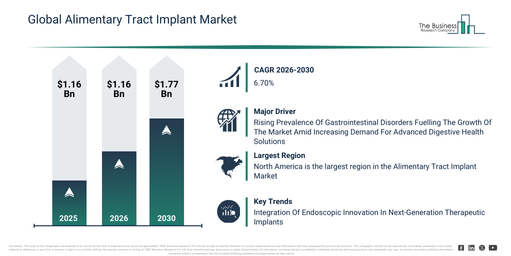
Looking ahead, the market is expected to continue its upward trend, reaching $7.12 billion by 2030 at a CAGR of 6.7%. The forecasted growth is fueled by a rising number of diabetes management implants, increased popularity of minimally invasive procedures, innovations in implant materials, precision treatment methods, and the aging global population. Key trends anticipated to influence the market include minimally invasive digestive implants, bariatric and metabolic devices, endoscopic implant procedures, neuromodulation therapies targeting gastrointestinal disorders, and improvements in the long-term biocompatibility of implant materials.
Download A Free Sample Report For Comprehensive Market Insights:
https://www.thebusinessresearchcompany.com/sample.aspx?id=30189&type=smp
Rising Prevalence of Digestive Disorders as a Primary Growth Driver in the Alimentary Tract Implant Market
One of the main catalysts for the alimentary tract implant market’s expansion is the growing incidence of gastrointestinal disorders. These encompass a broad range of conditions affecting the digestive system, including the stomach, intestines, and related organs, which often result in symptoms such as inflammation, pain, obstructions, or motility issues.
The surge in gastrointestinal disorders is largely linked to unhealthy dietary patterns, notably the increased consumption of processed and high-fat foods. Such diets disrupt the balance of gut microbiota, contributing to digestive dysfunction. As a result, there is rising demand for advanced implantable solutions to manage obesity, fecal incontinence, gastrointestinal blockages, and other chronic digestive ailments. For example, in September 2025, the UK Health Security Agency reported a 27% increase in laboratory-confirmed Campylobacter infections in England, highlighting the growing burden of digestive health challenges that propel the market forward.
Segment Overview Highlighting Growth Opportunities in the Alimentary Tract Implant Market
This report divides the alimentary tract implant market into several critical segments:
1) Implant Type: This includes Bariatric Restriction and Balloons, Gastric Electrical Stimulation or Neuromodulation devices, Gastrointestinal Stents or Endoluminal Scaffolds, and Continence or Anal Sphincter Implants.
2) Procedure Approach: Key categories are Endoscopic or Transoral procedures, Laparoscopic Bariatric surgeries, Open or Revision surgeries, and Colorectal or Perineal Implantations.
3) Indication: Segments are focused on Obesity or Metabolic Control, Motility Disorders, Management of Gastrointestinal Stricture, Obstruction or Leak, and Restoration of Continence or Fecal Incontinence.
Within these, the report further breaks down subcategories such as types of bariatric balloons (gastric bands, adjustable and non-adjustable gastric balloons), various neuromodulation devices (implantable gastric stimulators, vagal nerve stimulators), stent types (esophageal, gastric, duodenal, colonic, biliary), and continence devices (artificial anal sphincters, sacral nerve stimulators).
https://www.thebusinessresearchcompany.com/report/global-alimentary-tract-implant-market-report
Alimentary Tract Implant Market Leading Geography: Which Region Generates The Most Revenue?
Innovations and Technological Advances Shaping the Alimentary Tract Implant Market
Leading companies in the alimentary tract implant sector are increasingly focusing on minimally invasive and high-precision technologies to improve treatment outcomes and patient safety. Minimally invasive endoscopic procedures, which use flexible endoscopes equipped with imaging and surgical instruments, allow surgeons to treat internal digestive organs without external incisions, enabling real-time visualization and intervention.
For instance, in December 2024, Boston Scientific introduced the Apollo ESG System and the Orbera365 Intragastric Balloon System. Both utilize advanced endoscopic technology to provide incision-free access and treatment for weight loss and gastrointestinal conditions. These products incorporate durable, biocompatible materials and real-time imaging capabilities, resulting in shorter recovery times, fewer complications, and enhanced clinical efficiency.
Key Industry Players Driving the Alimentary Tract Implant Market
Several major companies hold significant positions in the alimentary tract implant market, including Medtronic Public Limited Company, Boston Scientific Corporation, Cook Group Incorporated, B. Braun Melsungen AG, Allurion Technologies Incorporated, ReShape Lifesciences Incorporated, Spatz Medical Limited, Hobbs Medical Incorporated, MICRO-TECH (Nanjing) Company Limited, M.I.Tech Company Limited, ELLA-CS s.r.o., BVM Medical Limited, EndoGastric Solutions Inc., EnteroMedics Inc., Inspire Medical Systems Inc., Coloplast A/S, Axonics Inc., Medica S.p.A., Taewoong Medical Co. Ltd., and S&G Biotech Incorporated. These organizations are pivotal in driving innovation and expanding market reach.
Regional Market Leadership and Emerging Growth Areas for the Alimentary Tract Implant Market
In 2025, North America was the largest regional market for alimentary tract implants, reflecting strong healthcare infrastructure and high adoption rates. However, the Asia-Pacific region is forecasted to experience the fastest growth during the coming years, driven by increasing healthcare investments and a rising burden of digestive disorders. The market analysis also covers other key regions including South East Asia, Western Europe, Eastern Europe, South America, the Middle East, and Africa, providing a comprehensive global perspective.
Get in touch with us:
The Business Research Company: https://www.thebusinessresearchcompany.com/
Americas: +1 310-496-7795
Asia: +44 7882 955267 & +91 8897263534
Europe: +44 7882 955267
Email us at: marketing@tbrc.info
Follow us on:
LinkedIn: https://in.linkedin.com/company/the-business-research-company
YouTube: https://www.youtube.com/channel/UC24_fI0rV8cR5DxlCpgmyFQ
Global Market Model: https://www.thebusinessresearchcompany.com/global-market-model