Antimicrobial Hospital Textiles Market Expected To Reach $17.4 Billion By 2030 As Growth Accelerates At 9.3% CAGR
Enhanced with market attractiveness analysis, total addressable market evaluation, company benchmarking matrices, interactive Excel dashboards, expanded supply chain intelligence, emerging startup coverage, and detailed product insights, The Business Research Company’s 2026 market reports deliver more actionable and strategically valuable research.
The market for antimicrobial hospital textiles has witnessed significant growth recently, driven by increasing concerns around hospital-acquired infections and advancements in healthcare infrastructure. As hospitals and medical centers prioritize hygiene and infection control, the demand for innovative textiles that inhibit microbial growth continues to rise. This report examines the current market scenario, key growth drivers, prominent companies, trends, and regional insights shaping the future of antimicrobial hospital textiles.
Antimicrobial Hospital Textiles Market Size and Growth Forecast
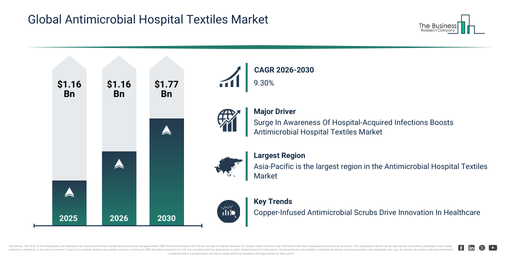
The antimicrobial hospital textiles market has seen a strong upward trajectory and is projected to expand from $11.13 billion in 2025 to $12.18 billion in 2026, registering a compound annual growth rate (CAGR) of 9.4%. This growth during the historical period is primarily fueled by increased concerns about hospital-acquired infections, the expansion of healthcare facilities, greater use of medical uniforms and linens, heightened hygiene awareness, and the availability of advanced antimicrobial fabric technologies. Looking ahead, the market is expected to reach $17.4 billion by 2030, maintaining a CAGR of 9.3%. Factors contributing to this forecasted growth include rising demand for sustainable medical textiles, a stronger emphasis on reusable hospital products, stricter infection prevention protocols, wider adoption of cutting-edge antimicrobial materials, and heightened regulatory focus on hospital hygiene standards. Key trends expected to influence market evolution include increased use of antimicrobial treatments, growing demand for infection-control fabrics, broader application of reusable antimicrobial textiles, expansion in ICU and surgical textile use, and a greater focus on patient safety and sanitation.
Download A Free Sample Report For Comprehensive Market Insights:
https://www.thebusinessresearchcompany.com/sample.aspx?id=7981&type=smp
Primary Drivers Boosting the Antimicrobial Hospital Textiles Market
Growing awareness about hospital-acquired infections is a major factor propelling the antimicrobial hospital textiles market. These infections, contracted during medical care by healthcare professionals, affect various parts of the body including the digestive and urinary tracts, skin, lungs, and bloodstream. Antimicrobial textiles play a vital role in curbing the spread of these infections by inhibiting bacterial growth on hospital fabrics. For instance, in June 2025, the Australian Institute of Health and Welfare reported that during 2023–24, hospital-acquired complications occurred in 150,000 hospitalizations out of 12.6 million total hospital stays, highlighting the critical need for infection control measures.
Expanding Healthcare Infrastructure and Hygiene Awareness
The increase in healthcare infrastructure development and the rising usage of medical uniforms and linens further accelerate market growth. As hospitals and clinics expand, the demand for antimicrobial textiles that meet high hygiene standards rises accordingly. Moreover, the availability of antimicrobial fabric technologies has enabled healthcare providers to adopt more effective infection control solutions, reinforcing the overall market expansion.
Antimicrobial Hospital Textiles Market Regional Distribution: Which Areas Drive Market Expansion?
Comprehensive Segmentation of the Antimicrobial Hospital Textiles Market
This market is categorized into several segments for better clarity and analysis. By product type, it includes cotton, polyester, polyamide, and other types of fabrics. Usability is divided into disposable and reusable textiles. The market is also segmented by FDA class into Class I and Class II products. Hospital departments utilizing these textiles include general wards, surgical rooms, infectious disease wards, ICUs, and other hospital units. Application areas cover medical uniforms and apparel, upholstery, surgical textiles, incontinence care garments, and other uses. Further subcategories break down cotton into conventional, organic, and blended types; polyester into regular, recycled, and blended; polyamide into nylon 6, nylon 66, and blended variants; and other fabric types include polyethylene, polypropylene, acrylic, and cellulose acetate.
Innovations and Trends Shaping the Future of Antimicrobial Hospital Textiles
Leading companies in this space are innovating by incorporating technologies such as copper-infused medical scrubs to enhance infection control in healthcare settings. These scrubs combine copper with natural fibers like cotton, bamboo, and linen, providing durable antimicrobial properties. Unlike traditional scrubs that require frequent laundering or surface disinfection, these fabrics actively reduce microbial presence. For example, in June 2023, Swiss Precision Active, a Switzerland-based eco-healthtech firm, introduced its CopperActive antimicrobial scrub line at the FIME Miami Fair. This product features a patented copper–natural fiber blend, verified by SGS and other labs for its ability to kill or inhibit harmful bacteria over time. Additionally, these scrubs are lightweight, moisture-wicking, odor-resistant, and maintain their antimicrobial effectiveness even after multiple washes, making them ideal for high-risk hospital environments focused on minimizing pathogen transmission.
Key Players and Competitive Landscape of the Antimicrobial Hospital Textiles Market
The antimicrobial hospital textiles market includes several major companies such as Sinterama S.p.A., Trevira GmbH, PurThread Technologies Inc., LifeThreads LLC, Thai Acrylic Fiber Co. Ltd., Herculite Products Inc., Toyobo Co. Ltd., Baltex Group Limited, Microban International Ltd., Sciessent LLC, BASF SE, Lonza Group AG, BioCote Limited, Resil Chemicals Pvt. Ltd., Archroma Management LLC, HeiQ Materials AG, Milliken & Company, Vestagen Technical Textiles Inc., Copper Clothing Ltd., Applied Silver Inc., 3M Company, Ahlstrom-Munksjö Oyj, American Dawn Inc., Medline Industries Inc., Angelica Corporation, Hospital Specialty Company Inc., BSN Medical Inc., and Cramer Products Inc. These organizations are actively competing to develop advanced antimicrobial textiles and expand their market share through innovation and strategic partnerships.
Regional Market Distribution and Development in Antimicrobial Hospital Textiles
In 2025, Asia-Pacific emerged as the largest region for antimicrobial hospital textiles and is anticipated to be the fastest-growing market during the forecast period. The report covers various global regions including Asia-Pacific, South East Asia, Western Europe, Eastern Europe, North America, South America, the Middle East, and Africa, providing a detailed understanding of geographical market dynamics and growth potential.
Get in touch with us:
The Business Research Company: https://www.thebusinessresearchcompany.com/
Americas: +1 310-496-7795
Asia: +44 7882 955267 & +91 8897263534
Europe: +44 7882 955267
Email us at: marketing@tbrc.info
Follow us on:
LinkedIn: https://in.linkedin.com/company/the-business-research-company
YouTube: https://www.youtube.com/channel/UC24_fI0rV8cR5DxlCpgmyFQ
Global Market Model: https://www.thebusinessresearchcompany.com/global-market-model