Delivering more actionable and strategically valuable research, The Business Research Company’s 2026 market reports feature market attractiveness analysis, total addressable market evaluation, company benchmarking matrices, interactive Excel dashboards, expanded supply chain intelligence, emerging startup coverage, and detailed product insights.
The leukapheresis device market is experiencing rapid growth driven by advances in medical technology and increasing demand for specialized treatments. As the prevalence of blood disorders rises and research activity expands, this market is set to evolve significantly in the coming years. Here, we explore the current market size, factors fueling expansion, key players, and emerging trends shaping the future of leukapheresis devices.
Leukapheresis Device Market Size and Projected Growth Outlook
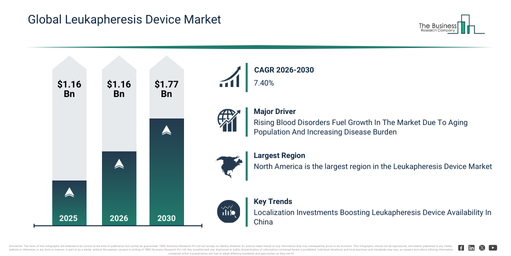
The leukapheresis device market has seen marked growth recently, with its size expected to increase from $0.7 billion in 2025 to $0.76 billion in 2026, representing a compound annual growth rate (CAGR) of 8.6%. This expansion during the historical period has been driven by factors such as the rising incidence of leukemia and autoimmune diseases, the growing adoption of stem cell therapies, improvements in blood cell separation technologies, an increase in clinical research activities, and the expansion of hospital-based apheresis services. Moving forward, the market is forecasted to reach $1.01 billion by 2030, growing at a CAGR of 7.4%. Key contributors to this anticipated growth include heightened demand for portable leukapheresis devices, the integration of artificial intelligence and automation in equipment, growth in biopharmaceutical research, regulatory approvals for next-generation devices, and increased investment in precision medicine. Important trends expected to influence the market include the development of personalized leukapheresis treatments, minimally invasive apheresis techniques, portable and point-of-care device options, real-time monitoring system integration, and enhanced automation to improve workflow efficiency.
Download A Free Sample Report For Comprehensive Market Insights:
https://www.thebusinessresearchcompany.com/sample.aspx?id=25807&type=smp
Rising Blood Disorders as a Major Growth Catalyst in the Leukapheresis Device Market
The increasing prevalence of blood-related disorders is a key driver supporting the leukapheresis device market’s expansion. These conditions affect blood cell function or structure, disrupting oxygen transport, immune defenses, or coagulation processes. An aging global population contributes significantly to the rise in these disorders, such as anemia, leukemia, and other hematological diseases, which predominantly affect older adults. Leukapheresis devices play a crucial role by selectively removing excess or abnormal white blood cells from the bloodstream. This helps manage symptoms and reduce complications in illnesses like leukemia and autoimmune diseases.
Highlighting this trend, the Leukaemia Foundation of Australia reported in March 2024 that about 19,500 Australians were diagnosed with blood cancers including leukemia, lymphoma, and myeloma, with nearly 43% facing substantial out-of-pocket treatment costs. Furthermore, 42% of patients took more than three months off work, underscoring both the growing incidence and the financial burdens associated with these diseases. This situation is fuelling demand for leukapheresis devices as a therapeutic solution.
Access The Complete Leukapheresis Device Market Report:
https://www.thebusinessresearchcompany.com/report/leukapheresis-device-global-market-report
Leukapheresis Device Market Segmentation by Product Types and End Users
This report breaks down the leukapheresis device market into multiple segments to provide detailed insights. By device type, the market includes therapeutic leukapheresis systems, cytapheresis devices, stem cell collection units, research application systems, leukapheresis columns and cell separators, disposables, and general apheresis devices. Components are segmented into machines, blood collection sets, medical consumables, and filters. End users consist of hospitals, academic research institutes, pharmaceutical and biotechnology companies, blood component providers, and blood centers.
Further subcategories include therapeutic leukapheresis devices for leukemia treatment, sepsis management, and autoimmune disease care. Cytapheresis covers plateletpheresis, lymphapheresis, and erythrocytapheresis systems. Stem cell collection devices include peripheral blood stem cell collectors, umbilical cord blood collection systems, and bone marrow stem cell apheresis units. Research applications feature cell separation technologies used for development and clinical trials. Leukapheresis columns and separators encompass adsorption columns, membrane-based systems, and centrifugal separators. Disposables involve tubing, needles, catheters, and collection bags. Apheresis devices include continuous flow, portable/mobile, and intermittent flow machines.
How Regional Manufacturing Efforts Are Transforming the Leukapheresis Device Market
Leading companies in the leukapheresis device field are increasingly investing in regional manufacturing capabilities to improve access to high-quality devices and support local healthcare infrastructure. Establishing production facilities closer to key markets enables more efficient supply chains, reduces reliance on imports, and lowers costs for advanced blood collection and separation technologies. For example, in November 2024, Terumo Blood and Cell Technologies partnered with its China-based subsidiary, Terumo Medical Products (Hangzhou) Co., Ltd., to launch localized manufacturing in Hangzhou. This initiative focuses on producing widely used leukapheresis devices such as the Trima Accel Automated Blood Collection System and the Spectra Optia Apheresis System, which are essential for therapeutic apheresis, stem cell collection, and blood component separation across China.
Market Competition and Key Players in the Leukapheresis Device Sector
The leukapheresis device market features competition among several prominent companies, including Fresenius SE and Co. KGaA, Asahi Kasei Medical Co. Ltd, Baxter International Inc., Grifols S.A., TERUMO BCT INC., Kaneka Corporation, Nikkiso Co. Ltd, Haemonetics Corporation, Miltenyi Biotec GmbH, Macopharma, B. Braun Melsungen AG, Kawasumi Laboratories Inc., Beijing Zksk Technology Co. Ltd, Puriblood Medical Co. Ltd, Fresenius Kabi AG, JMS Co. Ltd, HemaCare Corporation, Medica Group PLC, LivaNova PLC, Cytiva, BioSafe Group SA, and Terumo Corporation. These organizations are continually innovating and expanding their portfolios to meet evolving clinical needs.
North America Leads the Leukapheresis Device Market by Market Share
In 2025, North America held the leading position in the global leukapheresis device market. The report covers various geographic regions including Asia-Pacific, South East Asia, Western Europe, Eastern Europe, North America, South America, the Middle East, and Africa, offering a comprehensive view of regional market dynamics and future growth opportunities.
Get in touch with us:
The Business Research Company: https://www.thebusinessresearchcompany.com/
Americas: +1 310-496-7795
Asia: +44 7882 955267 & +91 8897263534
Europe: +44 7882 955267
Email us at: marketing@tbrc.info
Follow us on:
LinkedIn: https://in.linkedin.com/company/the-business-research-company
YouTube: https://www.youtube.com/channel/UC24_fI0rV8cR5DxlCpgmyFQ
Global Market Model: https://www.thebusinessresearchcompany.com/global-market-model