Low Vision And Blind Aids Products Market Forecast Reveals Where Future Industry Value Will Be Created
Delivering more actionable and strategically valuable research, The Business Research Company’s 2026 market reports feature market attractiveness analysis, total addressable market evaluation, company benchmarking matrices, interactive Excel dashboards, expanded supply chain intelligence, emerging startup coverage, and detailed product insights.
The market for low vision and blind aids products has witnessed remarkable growth recently, driven by advances in technology and increased awareness of visual impairments. With ongoing innovations and expanding applications, this sector is set to continue its strong upward trajectory in the coming years. Let’s explore the current market size, key growth drivers, segment breakdowns, technological trends, major players, and regional dynamics shaping this industry.
Market Expansion and Projected Growth of the Low Vision and Blind Aids Products Market
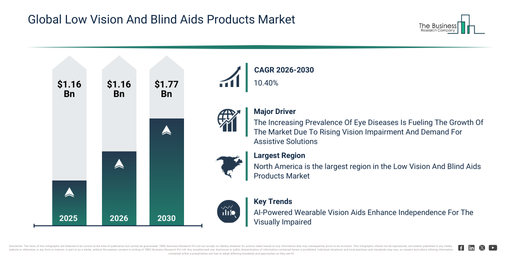
The low vision and blind aids products market has seen rapid expansion over recent years. It is forecasted to increase from $3.32 billion in 2025 to $3.68 billion in 2026, marking a compound annual growth rate (CAGR) of 10.8%. This historic growth is largely fueled by the rising prevalence of visual impairments, greater public awareness of available aids, supportive government initiatives for people with disabilities, technological progress in optical devices, and early adoption by educational institutions. Looking ahead, the market is expected to continue growing swiftly, reaching $5.46 billion by 2030 with a CAGR of 10.4%. Factors contributing to future growth include the integration of artificial intelligence (AI) into vision aids, the rise of wearable technologies, growing demand for portable electronic devices, expansion of online retail channels, and heightened focus on inclusive education and employment. Emerging trends forecasted to dominate the market include personalized vision enhancement solutions, voice-activated assistive tools, mobile accessibility features, smart navigation aids for both indoor and outdoor mobility, and affordable, inclusive low vision technologies.
Download A Free Sample Report For Comprehensive Market Insights:
https://www.thebusinessresearchcompany.com/sample.aspx?id=25812&type=smp
Key Factors Propelling Demand in the Low Vision and Blind Aids Products Market
One of the primary drivers boosting this market is the increasing prevalence of eye diseases worldwide. These conditions affect the structure or function of the eyes, often leading to impaired vision or blindness. The surge in eye-related disorders is closely linked to lifestyle changes such as prolonged screen time, which causes eye strain and accelerates vision problems. Low vision and blind aids products help individuals with these conditions by maximizing the use of their remaining vision or providing non-visual alternatives for accessing information. These aids play a crucial role in improving daily activities, mobility, and independence for people with permanent vision loss. For example, in May 2024, the Centers for Disease Control and Prevention (CDC) reported that over 90 million Americans aged 40 and above currently face vision challenges. Projections indicate that by 2050, vision impairment and blindness in the U.S. will increase by 150%, with diabetic retinopathy cases rising by 72%, cataracts by 87%, and glaucoma and macular degeneration expected to double. Such alarming statistics underscore the critical need for low vision and blind aids, which in turn is driving market expansion.
Additional Market Drivers Shaping Future Opportunities
Alongside the rise in eye diseases, increasing incorporation of advanced technologies like AI in vision aids is accelerating the market’s growth. Wearable devices equipped with smart features are gaining popularity for their ability to provide real-time assistance and improved functionality. Moreover, the expansion of online sales channels has made these products more accessible to a wider audience. There is also growing emphasis on creating inclusive environments within education and employment sectors, which further stimulates demand for assistive vision products. These factors combined are expected to significantly contribute to the market’s rapid development over the next few years.
Access The Complete Low Vision And Blind Aids Products Market Report:
Breaking Down the Low Vision and Blind Aids Products Market Segments
This market is categorized into multiple key segments to better understand opportunities and focus areas:
1) By Product Type: Optical Aids, Non-Optical Aids, Electronic Aids, Assistive Software, Wearable Technology
2) By Age Group: Children, Adults, Seniors, Teenagers, Middle-Aged
3) By Distribution Channel: Online Stores, Retail Pharmacies, Specialized Medical and Assistive Device Retailers, Specialty Stores, Direct Sales
4) By Application: Blind Schools, Disabled Persons Federations and Hospitals, Enterprises and Social Organizations
5) By End-User: Individuals, Healthcare Professionals, Educational Institutions, Community Organizations, Government Agencies
These categories further include subsegments such as:
– Optical Aids: Magnifying Glasses, Telescopic Glasses, Spectacle-Mounted Magnifiers, Handheld Magnifiers, Stand Magnifiers
– Non-Optical Aids: Braille Books, Large Print Materials, Tactile Graphics, Signature Guides, Writing Templates
– Electronic Aids: Video Magnifiers, Digital Readers, Screen Enlargers, Electronic Braille Displays, Talking Devices
– Assistive Software: Screen Readers, Screen Magnification Software, Text-To-Speech Software, Optical Character Recognition (OCR) Tools, Navigation and Mapping Software
– Wearable Technology: Smart Glasses, AI-Powered Vision Aids, Wearable Cameras, Voice-Enabled Smart Devices, Haptic Feedback Wearables
Innovations Transforming the Low Vision and Blind Aids Product Market
Leading companies in this market are heavily investing in advanced technologies to enhance the independence and quality of life for visually impaired users. A notable example is the development of AI-powered wearable vision aids—smart, head-mounted devices that combine artificial intelligence with vision enhancement to assist users in interpreting visual information, performing daily tasks, and navigating their surroundings more effectively. For instance, in August 2024, Eyedaptic, a US-based provider specializing in vision enhancement, introduced the EYE6 with Ivy. This innovative product utilizes multimodal generative AI and large language model technology to help individuals with age-related macular degeneration and other retinal disorders. It can read text, identify objects, and interpret environments in 99 languages, offering a lightweight, smart glasses solution that blends high-definition visual augmentation with an interactive AI assistant designed to enable greater autonomy and ease in everyday activities.
Key Industry Players and Competitive Landscape in the Low Vision and Blind Aids Sector
The low vision and blind aids products market features several prominent companies shaping its trajectory. These include Eschenbach Optik GmbH, Tobii Dynavox, OrCam Inc., Vispero, HumanWare, Freedom Scientific, MaxiAids, Enhanced Vision, Dolphin Computer Access, Zoomax, IRIS Vision, SELVAS Healthcare Inc., LS&S LLC, LVI Low Vision International, VisionAid, Eurobraille, HHW Care Products India Private Limited, Nippon Telesoft Co. Ltd., Help Tech GmbH & Co. KG, eSight Corporation, Vuzix Corporation, and Aira Tech Corp. These firms compete by innovating technologies, expanding product portfolios, and enhancing global reach to better serve the growing population of visually impaired individuals.
Regional Market Analysis Highlighting Geographic Leaders
In 2025, North America held the largest share of the low vision and blind aids products market, establishing itself as a key revenue leader. Meanwhile, the Asia-Pacific region is anticipated to experience the fastest growth during the forecast period, driven by increasing healthcare infrastructure and growing awareness of vision impairment solutions. Other important regions analyzed in the market report include South East Asia, Western Europe, Eastern Europe, South America, the Middle East, and Africa, providing a comprehensive global perspective on market trends and opportunities.
Get in touch with us:
The Business Research Company: https://www.thebusinessresearchcompany.com/
Americas: +1 310-496-7795
Asia: +44 7882 955267 & +91 8897263534
Europe: +44 7882 955267
Email us at: marketing@tbrc.info
Follow us on:
LinkedIn: https://in.linkedin.com/company/the-business-research-company
YouTube: https://www.youtube.com/channel/UC24_fI0rV8cR5DxlCpgmyFQ
Global Market Model: https://www.thebusinessresearchcompany.com/global-market-model