Predictive Biomarkers Market Growth Through 2030 Creates New Strategic Opportunities
Delivering more actionable and strategically valuable research, The Business Research Company’s 2026 market reports feature market attractiveness analysis, total addressable market evaluation, company benchmarking matrices, interactive Excel dashboards, expanded supply chain intelligence, emerging startup coverage, and detailed product insights.
The predictive biomarkers market is witnessing steady growth driven by rapid advancements in medical research and technology. As the importance of personalized healthcare rises, predictive biomarkers are becoming essential tools in early disease detection and tailored treatment strategies. Let’s explore the current market size, key factors influencing growth, prominent industry players, and emerging trends shaping this evolving sector.
Predictive Biomarkers Market Size and Growth Expectations
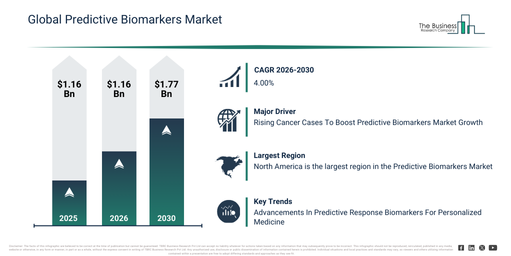
The predictive biomarkers market has steadily expanded over recent years and is projected to continue this trend. The market size is expected to increase from $20.96 billion in 2025 to $21.88 billion in 2026, reflecting a compound annual growth rate (CAGR) of 4.4%. Looking ahead, it is forecasted to reach $25.65 billion by 2030 with a CAGR of 4.0%. Historical growth is primarily driven by advancements in genomic research, expanding use of targeted therapies, rising cancer prevalence, growth in molecular diagnostics, and supportive regulatory frameworks. Future growth will be influenced by innovations in multi-omics technologies, broader adoption of personalized medicine, increased pharmaceutical R&D investments, demand for predictive treatment outcomes, and greater integration of biomarkers into routine clinical care. Key trends expected to shape the market include expanded applications in precision oncology, increased use in drug response stratification, greater reliance on biomarker-driven clinical trial designs, rising uptake of companion diagnostics, and efforts toward standardizing biomarker validation processes.
Download A Free Sample Report For Comprehensive Market Insights:
https://www.thebusinessresearchcompany.com/sample.aspx?id=20595&type=smp
Rising Cancer Incidence as a Major Growth Catalyst
One of the primary drivers propelling the predictive biomarkers market is the increasing incidence of cancer worldwide. Cancer, characterized by uncontrolled cell proliferation and the potential to spread throughout the body, is becoming more prevalent due to factors such as aging populations, lifestyle shifts, and heightened exposure to risk factors including tobacco use, unhealthy diets, and environmental pollution. Predictive biomarkers play a crucial role in identifying patients who are likely to benefit from specific therapies, facilitating more precise and effective treatment approaches. For example, the International Agency for Research on Cancer (IARC), a specialized cancer research agency within the World Health Organization (WHO), reported nearly 20 million new cancer cases and about 10 million cancer-related deaths in 2022. Furthermore, projections suggest that new cancer cases could rise to 35 million annually by 2050, marking a 77% increase from 2022 figures. This escalating cancer burden significantly contributes to the growing demand for predictive biomarkers.
Key Segments and Revenue Drivers in the Predictive Biomarkers Market
This report segments the predictive biomarkers market by indication, application, and end user to provide a comprehensive overview:
1) Indication categories include Cancer, Metabolic Diseases, Cardiovascular Disorders, Immunological Disorders, and Other Indications.
2) Application areas encompass Screening, Analysis, Diagnosis, Prediction, and Monitoring.
3) End users cover Diagnostic Centers, Contract Research Organizations, Academic Research Institutes, Pharmaceutical and Biotechnology Companies, and other users.
Access The Complete Predictive Biomarkers Market Report:
https://www.thebusinessresearchcompany.com/report/predictive-biomarkers-global-market-report
Within the cancer category, subtypes analyzed include Breast Cancer, Lung Cancer, Prostate Cancer, Colorectal Cancer, Ovarian Cancer, Leukemia and Lymphoma, Melanoma, Pancreatic Cancer, Kidney Cancer, and Head and Neck Cancer. The metabolic disease segment covers Type 1 and 2 Diabetes, Obesity, Metabolic Syndrome, Non-Alcoholic Fatty Liver Disease (NAFLD), Dyslipidemia, and Insulin Resistance. Cardiovascular disorders include Atherosclerosis, Coronary Artery Disease, Heart Failure, Myocardial Infarction, Arrhythmia, Hypertension, Stroke, and Peripheral Arterial Disease. Immunological disorders involve Autoimmune Diseases, Inflammatory Bowel Disease (IBD), Multiple Sclerosis, Psoriasis, Allergic Diseases, Asthma, Chronic Obstructive Pulmonary Disease (COPD), and Immunodeficiency Disorders. Other indications cover Neurological Disorders, Infectious Diseases, Renal Diseases, Osteoarthritis, Genetic Disorders, and Respiratory Disorders.
Technological Innovations Driving Market Transformation
Leading companies in the predictive biomarkers field are increasingly leveraging technological breakthroughs to accelerate biomarker development and gain a competitive edge. A prominent innovation is the use of artificial intelligence (AI) for biomarker discovery, which enables the analysis of vast and complex datasets to pinpoint predictive biomarkers that traditional approaches might miss. For example, in July 2024, Scipher Medicine, Inc., a US-based precision immunology company, introduced PRoBeNet (Predictive Response Biomarkers using Network Medicine). This AI-powered platform aims to speed up the identification of predictive response biomarkers for complex diseases by integrating therapy-targeted proteins with disease-specific molecular signatures. PRoBeNet has been validated for autoimmune conditions such as rheumatoid arthritis, ulcerative colitis, and Crohn’s disease, and its application extends to other complex diseases and various drug development stages.
Leading Players Steering Competition in the Predictive Biomarkers Space
The predictive biomarkers market features several prominent organizations that are driving innovation and competition. Key companies operating in this space include Johnson & Johnson Services Inc, F Hoffmann-La Roche Ltd, Thermo Fisher Scientific Inc, Abbott Laboratories, Danaher Corporation, Merck KGaA, Siemens Healthcare GmbH, Agilent Technologies Inc, PerkinElmer Inc, Illumina Inc, Bio-Rad Laboratories Inc, QIAGEN GmbH, Almac Group Limited, ArcherDX Inc, Luminex Corporation, Guardant Health Inc, Meso Scale Diagnostics LLC, Myriad Genetics Inc, NanoString Technologies Inc, Fujirebio Inc, Asuragen Inc, Biognosys AG, Epigenomics AG, OncoCyte Corporation, and Biomarker Technologies Inc.
Regional Market Dynamics Highlighting Growth Opportunities
In 2025, North America was the largest regional market for predictive biomarkers, supported by strong healthcare infrastructure and investment in biomedical research. Meanwhile, Europe is expected to experience the fastest growth during the coming years. The overall regional analysis includes Asia-Pacific, Southeast Asia, Western Europe, Eastern Europe, North America, South America, the Middle East, and Africa, offering a broad perspective on global market opportunities and trends.
Get in touch with us:
The Business Research Company: https://www.thebusinessresearchcompany.com/
Americas: +1 310-496-7795
Asia: +44 7882 955267 & +91 8897263534
Europe: +44 7882 955267
Email us at: marketing@tbrc.info
Follow us on:
LinkedIn: https://in.linkedin.com/company/the-business-research-company
YouTube: https://www.youtube.com/channel/UC24_fI0rV8cR5DxlCpgmyFQ
Global Market Model: https://www.thebusinessresearchcompany.com/global-market-model