
GI Stool Testing Market Growth Outlook Reveals A CAGR Of 7.1% And A Market Value Of $1.98 Billion By 2030
Delivering more actionable and strategically valuable research, The Business Research Company’s 2026 market reports feature market attractiveness analysis, total addressable market evaluation, company benchmarking matrices, interactive Excel dashboards, expanded supply chain intelligence, emerging startup coverage, and detailed product insights.
GI Stool Testing Market Expansion Outlook: What Revenue Opportunities Lie Ahead?
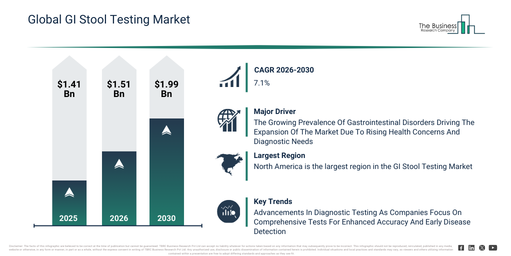
The market for gastrointestinal stool testing has witnessed robust expansion recently. Projections indicate a rise from $1.41 billion in 2025 to $1.51 billion in 2026, reflecting a compound annual growth rate (CAGR) of 7.4%. Factors contributing to this growth during the historical period include an increase in gastrointestinal disorders, advancements in diagnostic laboratory capabilities, the early adoption of microbiology testing, a growing emphasis on colorectal cancer screening, and heightened public awareness regarding healthcare.
The examination of gastrointestinal (GI) stool testing is projected for substantial expansion over the coming years, reaching an estimated market valuation of $1.99 billion by the year 2030, propelled by a compound annual growth rate (CAGR) of 7.1%. This projected expansion is fueled by several key factors, including the increasing prevalence of tailored gut health assessments, the burgeoning field of at-home diagnostic solutions, the incorporation of artificial intelligence for data analysis, a greater emphasis on proactive health management, and heightened public consciousness regarding digestive well-being. Key developments anticipated within this timeframe encompass a rising preference for non-invasive diagnostic approaches, expanded utilization of microbiome-centric testing, increased deployment of molecular diagnostic techniques, a wider availability of at-home stool testing kits, and enhanced capabilities for the early identification of GI ailments.
Download A Free Sample Report For Comprehensive Market Insights:
https://www.thebusinessresearchcompany.com/sample.aspx?id=23410&type=smp
GI Stool Testing Market Growth Momentum: Which Factors Are Influencing Demand?
The escalating occurrence of digestive system ailments is anticipated to fuel the expansion of the GI stool testing market in the future. Digestive disorders encompass conditions affecting the gastrointestinal tract, such as the stomach and intestines, manifesting in symptoms like nausea, diarrhea, constipation, and abdominal discomfort. This surge in gastrointestinal issues is primarily attributed to suboptimal dietary patterns, including heightened consumption of processed foods, excessive sugar intake, and diets low in fiber, which collectively disrupt the gut microbiome, compromise digestive health, and foster conditions like acid reflux, irritable bowel syndrome (IBS), and inflammatory bowel disease (IBD). GI stool testing becomes essential for these disorders to identify infections, inflammation, or digestive imbalances by detecting pathogens (bacteria, viruses, parasites), gut inflammation markers, and deficiencies in digestive enzymes, thereby facilitating precise diagnoses and tailored treatments. For example, the Centers for Disease Control and Prevention in the US reported in September 2024 that between 2024 and 2025, norovirus outbreaks in NoroSTAT-participating states reached 1,676, a significant increase from the 729 outbreaks recorded in the corresponding period of the previous season. Consequently, the growing prevalence of gastrointestinal disorders acts as a catalyst for the expansion of the GI stool testing market.
Enhanced access to healthcare facilities is poised to accelerate the GI stool testing market’s growth. Healthcare infrastructure encompasses the essential physical, technological, and organizational components for delivering medical services, such as hospitals, clinics, specialized equipment, and digital health platforms. This expansion of healthcare infrastructure is primarily propelled by an increasing global population and an aging demographic, where greater life expectancy and a higher incidence of diseases necessitate more medical facilities and advanced technologies to ensure adequate healthcare accessibility and improved patient outcomes. The development of healthcare infrastructure directly contributes to more accessible and accurate GI stool testing by improving laboratory capabilities, advancing diagnostic technologies, and enhancing the expertise of medical professionals, which leads to quicker, more precise identification of gastrointestinal disorders, ultimately enabling prompt treatment and better patient prognoses. Illustratively, The Health Foundation, an independent UK charity, noted in November 2024 that the Department of Health and Social Care (DHSC) anticipates increased spending, rising from $227.6 billion in 2023/24 to $238.6 billion in 2024/25 and $250.6 billion in 2025/26, signifying an average annual real-term growth rate of 3.3%. Therefore, the expanding reach of healthcare infrastructure is a key driver for the GI stool testing market’s growth.
GI Stool Testing Market Segmentation And Category Breakdown
The gi stool testing market covered in this report is segmented –
1) By Type: Immunoassay Test, Molecular Diagnostic Test, Chromatography-Based Test, Microbiological Culture Test, Enzyme-Linked Immunosorbent Assay (ELISA)
2) By Sample Type: Fecal Samples, Serum Samples
3) By Equipment: Automated Analyzers, Benchtop Instruments, Portable Devices
4) By Application: Diagnosis Of Gastrointestinal Disorders, Screening For Colorectal Cancer, Monitoring Of Inflammatory Bowel Disease (IBD), Detection Of Gastrointestinal Infections, Evaluation Of Digestive Health
5) By End User: Hospital, Diagnostic Centre And Laboratory, Academic Institution, Research Centre Organization, Homecare, Other End Users
Subsegments:
1) By Immunoassay Test: Rapid Immunoassay, Lateral Flow Assay, Fluorescent Immunoassay
2) By Molecular Diagnostic Test: Polymerase Chain Reaction (PCR), Nucleic Acid Amplification Test (NAAT), Next-Generation Sequencing (NGS)
3) By Chromatography-Based Test: Gas Chromatography (GC), Liquid Chromatography (LC), Thin-Layer Chromatography (TLC)
4) By Microbiological Culture Test: Aerobic Culture, Anaerobic Culture, Selective Media Culture
5) By Enzyme-Linked Immunosorbent Assay (ELISA): Direct ELISA, Indirect ELISA, Sandwich ELISA, Competitive ELISA
GI Stool Testing Market Trends Reshaping Industry Growth
The prominent entities within the GI stool testing market are concentrating their efforts on sophisticated testing methodologies, including all-encompassing diagnostic examinations, with the objective of enhancing precision, accelerating results, and facilitating the early identification of illnesses. An all-inclusive diagnostic examination represents a sophisticated medical instrument designed to simultaneously evaluate a multitude of health indicators, thereby providing a comprehensive appraisal of a particular ailment. As an illustration, in November 2024, EmeritusDX, a diagnostics firm based in the United States, introduced GI Detect, an extensive diagnostic test engineered to assist medical practitioners in pinpointing gastrointestinal ailments. This innovative test employs a solitary stool sample for the detection of 26 microorganisms, including bacteria, viruses, and parasites, all linked to disturbances within the digestive system. The GI Detect test, boasting a 24-hour processing period, empowers swift and well-informed clinical judgments. Beyond its extensive pathogen identification capabilities, the test also screens for Helicobacter pylori along with its damaging factors VacA, cagA, and babA, in addition to prevalent gastrointestinal parasites like Cryptosporidium, Entamoeba histolytica, and Giardia lamblia. This all-encompassing methodology guarantees the precise and prompt diagnosis of gastrointestinal infections.
GI Stool Testing Market Competitive Analysis Of Major Industry Participants
Major companies operating in the gi stool testing market are Thermo Fisher Scientific Inc., Abbott Laboratories Inc., Hologic Inc., Biomerieux SA, Bio-Rad Laboratories Inc., Meridian BioScience Inc., Diasorin SPA, ELITechGroup, Genova Diagnostics Inc., US BioTek Laboratories LLC, Doctor’s Data Inc., Diagnostic Solutions Laboratory LLC, Functional Medical Institute Pvt. Ltd., Walk-In Lab LLC, ScheBo Biotech AG, Qiagen NV, Roche Diagnostics, Siemens Healthineers, QuidelOrtho Corporation, Biohit Oyj, Exact Sciences Corporation
Access The Complete GI Stool Testing Market Report:
https://www.thebusinessresearchcompany.com/report/gi-stool-testing-global-market-report
GI Stool Testing Market Geographic Analysis: Where Is Demand Growing The Fastest?
North Americawas the largest region in the GI stool testing market in 2025. Asia-Pacificis expected to be the fastest-growing region in the forecast period. The regions covered in the gi stool testing market report are Asia-Pacific, South East Asia, Western Europe, Eastern Europe, North America, South America, Middle East, Africa.
Get in touch with us:
The Business Research Company: https://www.thebusinessresearchcompany.com/
Americas: +1 310-496-7795
Asia: +44 7882 955267 & +91 8897263534
Europe: +44 7882 955267
Email us at: marketing@tbrc.info
Follow us on:
LinkedIn: https://in.linkedin.com/company/the-business-research-company
YouTube: https://www.youtube.com/channel/UC24_fI0rV8cR5DxlCpgmyFQ
Global Market Model: https://www.thebusinessresearchcompany.com/global-market-model

