Paroxysmal Nocturnal Hemoglobinuria (PNH) Treatment Market Expected To Reach $11.32 Billion By 2030 As Growth Accelerates At 13.2% CAGR
Through market attractiveness analysis, total addressable market evaluation, company benchmarking matrices, interactive Excel dashboards, expanded supply chain intelligence, emerging startup coverage, and detailed product insights, The Business Research Company’s 2026 market reports provide more actionable and strategically valuable research.
Paroxysmal Nocturnal Hemoglobinuria (PNH) Treatment Market Size And Revenue Forecast Through 2030
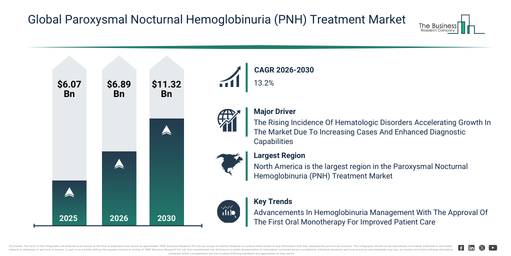
The market for paroxysmal nocturnal hemoglobinuria (pnh) treatments has experienced substantial expansion recently, with projections indicating a rise from $6.07 billion in 2025 to $6.89 billion by 2026, reflecting a compound annual growth rate of 13.4%. This historical growth trajectory was largely influenced by a scarcity of effective targeted therapies, a prevailing dependence on supportive care and blood transfusions, diagnostic delays stemming from the condition’s rarity, the significant peril of life-threatening thrombosis, and an absence of established, long-term treatment guidelines.
The market for paroxysmal nocturnal hemoglobinuria treatments is poised for substantial expansion over the coming years, projecting a reach of $11.32 billion by 2030 with a compound annual growth rate of 13.2%. This projected increase is largely fueled by advancements in next-generation complement inhibitors, a broadening array of oral and subcutaneous treatment options in clinical development, a heightened commitment to innovative treatments for rare diseases, enhanced diagnostic capabilities via sophisticated testing methods, and more comprehensive insurance coverage for rare blood disorders. Key developments anticipated during this period encompass a greater acceptance of complement C5 inhibitor therapies, a discernible move towards longer-lasting and subcutaneous drug delivery systems, the advancement of alternative pathway inhibitors, the exploration of combined and dual complement inhibition approaches, and more effective management of clot-related and bone marrow issues.
Download A Free Sample Report For Comprehensive Market Insights:
https://www.thebusinessresearchcompany.com/sample.aspx?id=23469&type=smp
Paroxysmal Nocturnal Hemoglobinuria (PNH) Treatment Market Growth Drivers: What Factors Are Accelerating Expansion?
The rising rates of blood-related conditions are anticipated to fuel the expansion of the market for treating paroxysmal nocturnal hemoglobinuria (PNH) in the future. Hematologic disorders encompass a wide spectrum of ailments affecting the blood and the organs responsible for its production, characterized by issues with red cells, white cells, platelets, bone marrow, and the clotting mechanisms, potentially resulting in conditions like anemia, bleeding or clotting problems, or cancers. Factors such as an aging global population and inherited vulnerabilities contribute to the growing occurrence of these blood disorders, with genetic alterations being particularly significant as they can initiate aberrant blood cell development, ultimately causing diverse hematologic problems. Treatments for PNH play a crucial role in managing hematologic disorders by providing specific interventions that alleviate the destruction of red blood cells driven by the complement system, decrease the risk of blood clots, and enhance patient longevity. For example, data from Cancer Research UK in July 2024 indicated projected figures for new leukemia cases, another hematologic disorder, in the United Kingdom, with numbers expected to rise from roughly 12,400 during the 2023-2025 period to approximately 14,500 by 2038-2040. Consequently, the escalating prevalence of hematologic disorders serves as a key driver for the growth observed in the paroxysmal nocturnal hemoglobinuria (PNH) treatment sector.
Paroxysmal Nocturnal Hemoglobinuria (PNH) Treatment Market Segment Analysis: What Are The Major Market Categories?
The paroxysmal nocturnal hemoglobinuria (pnh) treatment market covered in this report is segmented –
1) By Treatment Type: Complement C5 Inhibitors, Anti-Complement Component 5a Receptor (C5aR) Monoclonal Antibodies, Alternative Pathway Inhibitors, Hematopoietic Stem Cell Transplantation, Other Therapies
2) By Route Of Administration: Intravenous, Subcutaneous, Oral
3) By Market Availability: Approved, In Pipeline, Investigational
4) By End-Use: Hospitals, Specialty Clinics, Homecare Settings, Other End-Users
Subsegments:
1) By Complement: C5 InhibitorsEculizumab (Soliris), Ravulizumab (Ultomiris), Emerging C5 Inhibitors, Biosimilars Of C5 Inhibitors,
2) By Anti-Complement Component 5a Receptor Monoclonal Antibodies: Avacopan (Tavneos), Other Investigational C5aR mAbs, Monotherapy vs Combination Therapy, Clinical Trial Phase (Phase I, II, III)
3) By Alternative Pathway Inhibitors: C3 Inhibitors, Factor B Inhibitors, Factor D Inhibitors, Targeting Complement Amplification, Combination Therapies And Dual Inhibition
4) By Hematopoietic Stem Cell Transplantation (HSCT): Autologous HSCT vs. Allogeneic HSCT, Pre-Transplant Conditioning Therapies, Post-Transplant Immunosuppressive Therapies
5) By Other Therapies: Immunosuppressive Therapy, Supportive Care, Anticoagulation Therapy, Gene Therapy
Paroxysmal Nocturnal Hemoglobinuria (PNH) Treatment Market Trends: What Is Shaping Future Industry Growth?
Leading entities within the paroxysmal nocturnal hemoglobinuria (PNH) therapeutic arena are concentrating their efforts on pioneering advancements like oral Factor B inhibitors, intending to present a new treatment modality that boosts therapeutic outcomes and simplifies PNH management for patients. These oral Factor B inhibitors function as precision-engineered small-molecule agents designed to specifically impede Factor B within the alternative complement cascade, thereby moderating the immune system’s excessive response and diminishing inflammation associated with complement-driven pathologies. A significant development occurred in December 2023 when Novartis AG, a pharmaceutical giant headquartered in Switzerland, secured FDA authorization for Fabhalta (iptacopan), establishing it as the inaugural oral monotherapy available for PNH. This innovative Factor B inhibitor introduces a more holistic strategy for managing complement-mediated red blood cell destruction by intervening at an earlier juncture in the alternative complement pathway, leading to better hemoglobin concentrations and a decreased reliance on blood transfusions, thus revolutionizing the therapeutic paradigm for this uncommon blood disorder.
Paroxysmal Nocturnal Hemoglobinuria (PNH) Treatment Market Leading Companies Driving Competitive Growth
Major companies operating in the paroxysmal nocturnal hemoglobinuria (pnh) treatment market are F. Hoffmann-La Roche Ltd, Novartis AG, Mayo Clinic, Cleveland Clinic Foundation, Johns Hopkins Medicine, Memorial Sloan Kettering Cancer Center, Stanford Health Care, University of California San Francisco (UCSF) Health, Emory Healthcare, Cedars-Sinai Medical Center, Duke University Health System, Mount Sinai Health System, Dana-Farber Cancer Institute, Swedish Orphan Biovitrum, Alnylam Pharmaceuticals, BioCryst Pharmaceuticals, Apellis Pharmaceuticals, Omeros Corporation, Takeda Pharmaceutical Company, Sanofi S A, Pfizer Inc, Akari Therapeutics Plc, NovelMed Therapeutics, Ionis Pharmaceuticals, Johnson & Johnson, Biogen Inc.
Access The Complete Paroxysmal Nocturnal Hemoglobinuria (PNH) Treatment Market Report:
Paroxysmal Nocturnal Hemoglobinuria (PNH) Treatment Market Largest Region By Revenue And Market Share
North Americawas the largest region in the paroxysmal nocturnal hemoglobinuria (PNH) treatment market in 2025. Asia-Pacificis expected to be the fastest-growing region in the forecast period. The regions covered in the paroxysmal nocturnal hemoglobinuria (pnh) treatment market report are Asia-Pacific, South East Asia, Western Europe, Eastern Europe, North America, South America, Middle East, Africa.
Get in touch with us:
The Business Research Company: https://www.thebusinessresearchcompany.com/
Americas: +1 310-496-7795
Asia: +44 7882 955267 & +91 8897263534
Europe: +44 7882 955267
Email us at: marketing@tbrc.info
Follow us on:
LinkedIn: https://in.linkedin.com/company/the-business-research-company
YouTube: https://www.youtube.com/channel/UC24_fI0rV8cR5DxlCpgmyFQ
Global Market Model: https://www.thebusinessresearchcompany.com/global-market-model