Delivering more actionable and strategically valuable research, The Business Research Company’s 2026 market reports feature market attractiveness analysis, total addressable market evaluation, company benchmarking matrices, interactive Excel dashboards, expanded supply chain intelligence, emerging startup coverage, and detailed product insights.
Secondary Antibodies Market Forecast: What Market Value Is Expected By 2030?
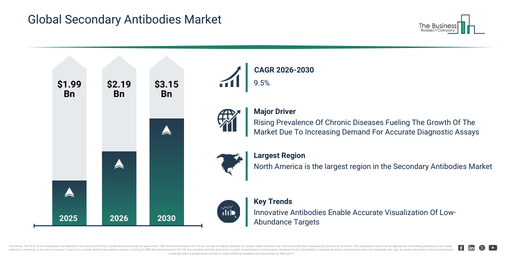
The market for secondary antibodies has experienced robust expansion lately, projected to climb from $1.99 billion in 2025 to $2.19 billion in 2026, demonstrating a compound annual growth rate of 9.8%. This historical growth trajectory is underpinned by burgeoning immunoassay-based research, the proliferation of life science laboratories, intensified utilization of techniques like western blotting and ELISA, ongoing enhancements in antibody purification methodologies, and a surge in funding for biomedical research.
The market for secondary antibodies is poised for substantial expansion over the upcoming years, projecting a valuation of $3.15 billion by 2030, driven by a compound annual growth rate of 9.5%. This anticipated growth stems from a confluence of factors including escalating needs in high-throughput diagnostic applications, a broader embrace of precision medicine research, augmented investments in the fields of proteomics and genomics, a greater integration of automated assay platforms, and ongoing advancements in antibody engineering. Key developments expected to shape this market during the forecast period involve a heightened demand for secondary antibodies with high cross-adsorption capabilities, increased utilization of antibodies tagged with fluorophores, wider adoption in multiplex assay formats, an expansion in the manufacturing of recombinant secondary antibodies, and a more pronounced emphasis on improving signal sensitivity and specificity.
Download A Free Sample Report For Comprehensive Market Insights:
https://www.thebusinessresearchcompany.com/sample.aspx?id=30383&type=smp
Secondary Antibodies Market Growth Drivers And Industry Catalysts
The increasing incidence of long-term health conditions is anticipated to be a primary driver for the expansion of the secondary antibodies market. These chronic ailments, characterized by their gradual onset and enduring nature, necessitate ongoing medical intervention. A contributing factor to the escalating numbers of individuals with chronic diseases is the trend towards sedentary lifestyles, where extended periods of sitting and insufficient exercise heighten the susceptibility to conditions like cardiovascular issues and diabetes. Secondary antibodies play a crucial role in managing these persistent diseases by facilitating the accurate identification of specific biological markers, thereby becoming indispensable tools for diagnostic testing and tracking the advancement of illness. Their use enhances the precision and reliability of tests, contributing to timely and effective therapeutic choices. Illustrating this trend, in June 2024, data from the National Health Service, a UK governmental body, revealed that 3,615,330 individuals registered with a general practitioner (GP) received a diagnosis of non-diabetic hyperglycemia or pre-diabetes in 2023, representing a significant jump of 18% from the 3,065,825 cases reported in 2022. Consequently, the growing burden of chronic diseases is effectively fueling the growth trajectory of the secondary antibodies market.
Secondary Antibodies Market Segment Landscape And Growth Potential
The secondary antibodies market covered in this report is segmented –
1) By Product Type: Monoclonal, Polyclonal, Other Product Types
2) By Host Species: Goat, Rabbit, Donkey, Mouse, Other Host Species
3) By Conjugate Type: Enzyme-Conjugated, Fluorophore-Conjugated, Unconjugated, Other Conjugate Types
4) By Application: Western Blotting, Immunohistochemistry, Enzyme-Linked Immunosorbent Assay (ELISA), Flow Cytometry, Other Applications
5) By End-User: Pharmaceutical And Biotechnology Companies, Academic And Research Institutes, Hospitals And Diagnostic Centers, Contract Research Organizations (CROs)
Subsegments:
1) By Monoclonal: Recombinant Monoclonal Secondary Antibody, Hybridoma Derived Monoclonal Secondary Antibody, Species Specific Monoclonal Secondary Antibody, Isotype Specific Monoclonal Secondary Antibody, Light Chain Specific Monoclonal Secondary Antibody
2) By Polyclonal: Affinity Purified Polyclonal Secondary Antibody, Cross Adsorbed Polyclonal Secondary Antibody, Highly Cross Adsorbed Polyclonal Secondary Antibody, Species Specific Polyclonal Secondary Antibody, Isotype Specific Polyclonal Secondary Antibody
3) By Other Product Types: Fragment Antigen Binding Secondary Antibody, Fc Fragment Specific Secondary Antibody, Single Domain Antibody Secondary Reagent, Nanobody Based Secondary Reagent, Pre Adsorbed Secondary Antibody
#Secondary Antibodies Market Trends Influencing Long-Term Demand
In the secondary antibodies sector, leading enterprises are prioritizing the creation of cutting-edge offerings like recombinant monoclonal antibodies. This strategic move aims to elevate experimental consistency, sharpen specificity, and diminish variations between production batches. Recombinant monoclonal antibodies are generated within a meticulously controlled cellular system, employing precisely defined genetic sequences to guarantee exceptional uniformity and an uninterrupted supply. As a concrete example, Proteintech Group Inc., a United States firm renowned for producing and distributing premium antibodies, proteins, and ELISA kits, introduced its Multi-rAb Recombinant Secondary Antibodies in October 2023. These antibodies deliver enhanced reliability and consistency in performance, stemming from their production via controlled recombinant methods, thereby sidestepping the inherent variability associated with animal-derived products. They facilitate superior signal detection with greater clarity in immunoassays, empowering researchers to discern targets present in low quantities with improved resolution. Ultimately, this advancement contributes to more dependable experimental outcomes in techniques like immunofluorescence and western blotting, bolstering the validity of scientific findings.
Secondary Antibodies Market Competitive Landscape: Who Are The Leading Companies?
Major companies operating in the secondary antibodies market are Thermo Fisher Scientific Inc., Merck KGaA, Agilent Technologies Inc., Bio-Techne Corporation, Miltenyi Biotec GmbH, GenScript Biotech Corporation, Promega Corporation, Sino Biological Inc., Cell Signaling Technology Inc., Fortis Life Sciences, OriGene Technologies Inc., Becton Dickinson and Company, GeneTex Inc., Proteintech Group Inc., Santa Cruz Biotechnology Inc., Creative Diagnostics Inc., Jackson ImmunoResearch Laboratories Inc., SouthernBiotech LLC, MyBioSource Inc., Biotium Inc.
Access The Complete Secondary Antibodies Market Report:
https://www.thebusinessresearchcompany.com/report/global-secondary-antibodies-market-report
Secondary Antibodies Market Regional Analysis: Which Region Leads By Revenue?
North Americawas the largest region in the secondary antibodies market in 2025. Asia-Pacificis expected to be the fastest-growing region in the forecast period. The regions covered in the secondary antibodies market report are Asia-Pacific, South East Asia, Western Europe, Eastern Europe, North America, South America, Middle East, Africa.
Get in touch with us:
The Business Research Company: https://www.thebusinessresearchcompany.com/
Americas: +1 310-496-7795
Asia: +44 7882 955267 & +91 8897263534
Europe: +44 7882 955267
Email us at: marketing@tbrc.info
Follow us on:
LinkedIn: https://in.linkedin.com/company/the-business-research-company
YouTube: https://www.youtube.com/channel/UC24_fI0rV8cR5DxlCpgmyFQ
Global Market Model: https://www.thebusinessresearchcompany.com/global-market-model