H2 Antagonists Market Forecast Highlights Expansion From $19.56 Billion To $25.13 Billion Through 2030
Enhanced with market attractiveness analysis, total addressable market evaluation, company benchmarking matrices, interactive Excel dashboards, expanded supply chain intelligence, emerging startup coverage, and detailed product insights, The Business Research Company’s 2026 market reports deliver more actionable and strategically valuable research.
H2 Antagonists Market CAGR Analysis And Future Market Development
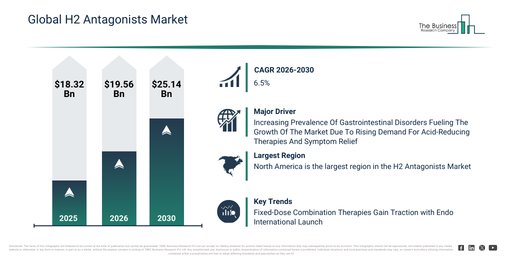
The market for H2 antagonists has experienced robust expansion in recent years. The market value is projected to rise from $18.32 billion in 2025 to $19.56 billion in 2026, reflecting a compound annual growth rate (CAGR) of 6.8%. This historic growth was driven by the widespread occurrence of peptic ulcers, an increase in GERD cases, greater acceptance of over-the-counter medications, the broadening of hospital pharmacy operations, and heightened public awareness of gastrointestinal conditions.
The h2 antagonists market is projected to experience robust expansion over the coming years, reaching a valuation of $25.14 billion by 2030 with a compound annual growth rate of 6.5%. This anticipated growth during the forecast period is driven by factors such as an aging demographic, increasing demand for affordable acid-reducing medications, a rise in self-medication practices, the expansion of online pharmacies, and the management of chronic gastroesophageal reflux disease (GERD). Key developments shaping the forecast period include sustained demand for acid suppression therapies, the growing over-the-counter availability of h2 antagonists, their broader application in treating mild GERD and ulcers, the introduction of liquid and injectable formulations, and a rising preference for cost-effective acid control options.
Download A Free Sample Report For Comprehensive Market Insights:
H2 Antagonists Market Expansion Supported By Key Demand Factors
The growing frequency of gastrointestinal problems is anticipated to boost the H2 antagonists market in the coming period. Gastrointestinal (GI) disorders encompass health issues affecting the digestive system, such as the esophagus, stomach, intestines, liver, pancreas, and gallbladder. This rise in GI disorders is driven by unhealthy eating patterns, which trigger excessive stomach acid secretion and irritate the digestive tract. By lowering stomach acid production, H2 antagonists are effective in managing GI ailments, particularly for conditions like acid reflux and ulcers. They improve patient well-being through rapid symptom relief and support prolonged digestive health. For example, in March 2024, the World Health Organization (WHO), a United Nations specialized agency based in Switzerland, reported that diarrheal diseases cause about 1.7 billion cases annually, leading to around 443,832 deaths in children under 5 and an additional 50,851 deaths among children aged 5 to 9. Consequently, the rising incidence of gastrointestinal disorders is fueling the expansion of the H2 antagonists market.
Increased healthcare spending is expected to drive the growth of the H2 antagonists market moving forward. Healthcare expenditure denotes the total funds allocated to medical services, treatments, facilities, research, and public health programs aimed at enhancing or preserving health outcomes. This spending rise is attributed to the growing burden of chronic diseases, which demand continuous therapy and management, thereby elevating medical costs over time. Healthcare expenditure supports the H2 antagonist market by enabling greater investment in advanced therapies and improved access to medications. It fosters research and development, resulting in enhanced drug formulations and superior patient outcomes. As an illustration, in December 2024, the Centers for Medicare and Medicaid Services (CMS), a U.S. federal agency, noted that national health expenditures (NHE) climbed by 7.5% to $4.9 trillion in 2023, representing 17.6% of gross domestic product (GDP). Furthermore, from 2023 to 2032, average NHE is predicted to rise at an annual rate of 5.6%, pushing the health spending share of GDP from 17.3% in 2022 to 19.7% in 2032. Hence, the escalating healthcare expenditure is propelling the H2 antagonists market forward.
H2 Antagonists Market Segment Outlook: Which Categories Are Expanding The Fastest?
The h2 antagonists market covered in this report is segmented –
1) By Drug Type: Prescription H2 Antagonists, Over-The-Counter H2 Antagonists
2) By Indication: Gastroesophageal Reflux Disease (GERD), Peptic Ulcer Disease, Zollinger-Ellison Syndrome, Other Indications
3) By Dosage Form: Tablets, Capsules, Injectable Solutions, Liquid Formulations
4) By Distribution Channel: Retail Pharmacies, Hospital Pharmacies, Online Pharmacies, Drug Stores
Subsegments:
1) By Prescription H2 Antagonists: Gastroesophageal Reflux Disease (GERD), Peptic Ulcers, Zollinger-Ellison Syndrome
2) By Over-The-Counter (OTC) H2 Antagonist: Heartburn, Occasional Acid Reflux, Indigestion
H2 Antagonists Market Growth Trends Influencing Competitive Dynamics
Leading firms in the H2 antagonists sector are concentrating their efforts on creating advanced treatment options, particularly fixed-dose combination drugs, aimed at boosting patient compliance and minimizing gastrointestinal adverse effects. A fixed-dose combination product integrates two or more active substances into a single dosage unit, streamlining therapeutic protocols, fostering better adherence to treatment, and lowering the likelihood of side effects in comparison to taking several distinct medications. For example, in March 2024, Endo International plc, a pharmaceutical entity based in the United States, released ibuprofen-famotidine 800 mg/26.6 mg tablets, a generic version of the previously marketed brand combination known as Duexis. This innovative medication features 800 mg of the non-steroidal anti-inflammatory drug ibuprofen alongside 26.6 mg of the H2-receptor antagonist famotidine, formulated to alleviate symptoms associated with rheumatoid arthritis and osteoarthritis (through ibuprofen) while concurrently lowering the risk of NSAID-induced upper gastrointestinal ulcers (via famotidine). Notable attributes include its fixed-dose co-formulation in a single tablet, which simplifies the treatment plan compared to separately administering an NSAID and a gastroprotective agent; its suitability for patients needing long-term NSAID therapy with concurrent ulcer risk management; and the advantage of offering a cost-effective generic option in the U.S. market.
H2 Antagonists Market Key Companies And Competitive Benchmarking
Major companies operating in the h2 antagonists market are Aurobindo Pharma Limited, Cipla Limited, Lupin Limited, Alkem Laboratories Limited, Intas Pharmaceuticals Limited, Mylan N.V. (Viatris Inc.), Glenmark Pharmaceuticals Limited, Hikma Pharmaceuticals PLC, Zydus Lifesciences Limited, Wockhardt Limited, Sandoz International GmbH, Alembic Pharmaceuticals Limited, Micro Labs Limited, IPCA Laboratories Limited, Emcure Pharmaceuticals Limited
Access The Complete H2 Antagonists Market Report:
H2 Antagonists Market Regional Analysis And Leading Geography
North America was the largest region in the H2 receptor antagonists market in 2025. Asia-Pacific is expected to be the fastest-growing region in the forecast period. The regions covered in the h2 antagonists market report are Asia-Pacific, South East Asia, Western Europe, Eastern Europe, North America, South America, Middle East, Africa.
Get in touch with us:
The Business Research Company: https://www.thebusinessresearchcompany.com/?utm_source=BlogsPR&utm_medium=Paid&utm_campaign=home_page_test
Americas: +1 310-496-7795
Asia: +44 7882 955267 & +91 8897263534
Europe: +44 7882 955267
Email us at: marketing@tbrc.info
Follow us on:
LinkedIn: https://in.linkedin.com/company/the-business-research-company
YouTube: https://www.youtube.com/channel/UC24_fI0rV8cR5DxlCpgmyFQ
Global Market Model: https://www.thebusinessresearchcompany.com/global-market-model