Inotropic Agents Market Outlook Highlights The Next Major Growth Opportunities
Enhanced with market attractiveness analysis, total addressable market evaluation, company benchmarking matrices, interactive Excel dashboards, expanded supply chain intelligence, emerging startup coverage, and detailed product insights, The Business Research Company’s 2026 market reports deliver more actionable and strategically valuable research.
Inotropic Agents Market Size Outlook: How Fast Will Revenue Grow Through 2030?
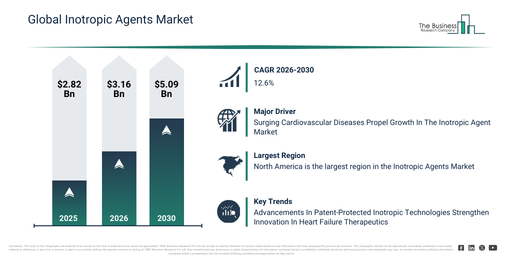
The market for inotropic agents has experienced swift expansion in recent years, with projections indicating an increase from $2.82 billion in 2025 to $3.16 billion in 2026, reflecting a compound annual growth rate of 11.8%. This historical growth was driven by progress in cardiac research, a higher incidence of heart failure cases, better hospital facilities, greater access to positive inotropic medications, and increased awareness of cardiovascular conditions.
Over the coming years, the inotropic agents market is anticipated to experience rapid expansion. By 2030, its value is projected to reach $5.09 billion, driven by a compound annual growth rate of 12.6%. This forecasted growth is fueled by several factors, including the rise of personalized medicine, the creation of innovative inotropic agents, the integration of digital health tools, the broadening of homecare services, and the uptake of minimally invasive drug delivery methods. Key trends shaping the market during this period involve tailored inotropic therapies, the emergence of new drug formulations, the growth of cardiac care provided at home, a heightened emphasis on managing heart failure, and the increasing use of minimally invasive delivery systems for medications.
Download A Free Sample Report For Comprehensive Market Insights:
Inotropic Agents Market Growth Drivers: What Factors Are Accelerating Expansion?
The increasing occurrence of cardiovascular diseases is fueling demand within the inotropic agent market. Cardiovascular diseases (CVDs) encompass disorders related to the vascular system and heart function. Inotropic agents are employed in managing these conditions to enhance heart contractility and performance, address cardiac shock, and regulate heart rate by enabling more forceful contractions, which in turn improves blood circulation. This mechanism thereby stimulates growth in the inotropic agent market. For example, in September 2025, the British Heart Foundation, a UK charity, reported that across the United Kingdom, over 7.6 million people—including more than 4 million men and over 3.6 million women—are currently living with cardiovascular disease. Projections suggest that, driven by an aging population and better survival rates, the number of affected individuals could rise by roughly 1 million by 2030 and by about 2 million by 2040. Consequently, the escalating prevalence of cardiovascular diseases is advancing the inotropic agent market forward.
Inotropic Agents Market Driver: The Impact Of Rising Healthcare Expenditure On The Inotropic Agents Market
Growth in the inotropic agents market is anticipated to be driven by escalating healthcare expenditure. Healthcare expenditure denotes the aggregate funds allocated to healthcare services and associated goods and activities within a given healthcare system or economy over a specified timeframe. Increased healthcare spending positively impacts the adoption of inotropic agents by fostering innovation, supporting research and development, improving diagnostic capabilities, and ensuring wider availability of advanced cardiac treatment. For instance, in April 2025, the Office for National Statistics (ONS), a UK-based independent producer of official statistics, reported that total healthcare expenditure rose by 6.5% in nominal terms and 2.4% in real terms between 2023 and 2024, while healthcare’s share of GDP remained unchanged at 11.1% in 2024. Hence, rising healthcare expenditures are propelling the expansion of the inotropic agents market.
Inotropic Agents Market Segment Breakdown: Which Categories Generate The Most Revenue?
The inotropic agents market covered in this report is segmented –
1) By Type: Positive Inotropic Drugs, Negative Inotropic Drugs, Other Types
2) By Route Of Administration: Oral, Parenteral, Other Routes Of Administration
3) By Indication: Heart Attack, Heart Failure, Angina, Arrhythmia, Other Indications
4) By Distribution Channel: Hospital Pharmacy, Retail Pharmacy, Other Distribution Channels
5) By End User: Hospital, Homecare, Specialty Centers, Other End Users
Subsegments:
1) By Positive Inotropic Drugs: Cardiac Glycosides, Catecholamines, Phosphodiesterase Inhibitors
2) By Negative Inotropic Drugs: Beta Blockers, Calcium Channel Blockers
3) By Other Types: Mixed Inotropic Drugs, Experimental Inotropic Agents
Inotropic Agents Market Trends: What Is Shaping Future Industry Growth?
Major players within the inotropic agents sector are placing a strong emphasis on broadening their intellectual property holdings as a strategy to strengthen product distinctiveness, safeguard innovative drug mechanisms, and spur progress in sophisticated cardiac treatments. In this context, patent expansion involves the deliberate pursuit of patent filings, regulatory protections, and formulation rights aimed at facilitating the advancement and eventual launch of next-generation inotropic medications. As an example, in October 2024, Windtree Therapeutics Inc., a biotechnology firm headquartered in the United States, reported notable advancements in the patent coverage for istaroxime, its pioneering investigational inotropic candidate featuring a dual mechanism designed to improve both systolic contraction and diastolic relaxation. The organization submitted national-phase patent applications in key global markets such as the United States, Germany, France, Italy, Japan, and China for an intravenous version of istaroxime developed to address pre-cardiogenic shock and cardiogenic shock, thereby reaffirming its dedication to bringing novel therapies to patients with critical heart conditions.
Inotropic Agents Market Key Players And Strategic Industry Positioning
Major companies operating in the inotropic agents market are Pfizer Inc., Novartis AG, Boehringer Ingelheim International GmbH, AstraZeneca plc, Johnson & Johnson, Bayer AG, Merck & Co. Inc., Bristol-Myers Squibb Company, Cipla Ltd., Eli Lilly and Company, Sanofi S.A., Baxter International Inc., Hikma Pharmaceuticals plc, Sun Pharmaceuticals Industries Ltd., Cadila Pharmaceuticals Ltd., AbbVie Inc., Amgen Inc., Daiichi Sankyo Company Limited, Eisai Co. Ltd., Fresenius Kabi AG, GlaxoSmithKline plc, Intas Pharmaceuticals Ltd., Lupin Limited, Regeneron Pharmaceuticals Inc., Roche Holding AG
Access The Complete Inotropic Agents Market Report:
Inotropic Agents Market Geographic Analysis: Where Is Demand Growing The Fastest?
North America was the largest region in the inotropic agents market in 2025. Asia-Pacific is expected to be the fastest-growing region in the global inotropic agents market report during the forecast period. The regions covered in the inotropic agents market report are Asia-Pacific, South East Asia, Western Europe, Eastern Europe, North America, South America, Middle East, Africa.
Get in touch with us:
The Business Research Company: https://www.thebusinessresearchcompany.com/?utm_source=BlogsPR&utm_medium=Paid&utm_campaign=home_page_test
Americas: +1 310-496-7795
Asia: +44 7882 955267 & +91 8897263534
Europe: +44 7882 955267
Email us at: marketing@tbrc.info
Follow us on:
LinkedIn: https://in.linkedin.com/company/the-business-research-company
YouTube: https://www.youtube.com/channel/UC24_fI0rV8cR5DxlCpgmyFQ
Global Market Model: https://www.thebusinessresearchcompany.com/global-market-model