Pegfilgrastim Biosimilars Market Trends Are Creating New Opportunities For Industry Leaders
Through market attractiveness analysis, total addressable market evaluation, company benchmarking matrices, interactive Excel dashboards, expanded supply chain intelligence, emerging startup coverage, and detailed product insights, The Business Research Company’s 2026 market reports provide more actionable and strategically valuable research.
Pegfilgrastim Biosimilars Market Value Analysis: What Growth Is Expected Over The Forecast Period?
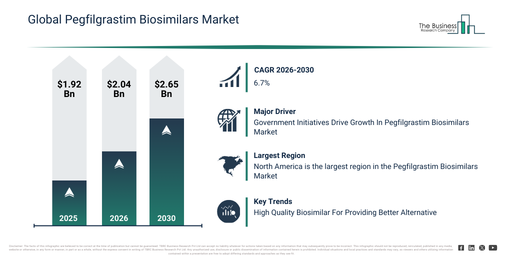
The market for pegfilgrastim biosimilars has shown robust expansion in recent years, with its value projected to increase from $1.92 billion in 2025 to $2.04 billion in 2026, reflecting a compound annual growth rate (CAGR) of 6.3%. This historical growth has been driven primarily by the high expense associated with the original pegfilgrastim product, along with a restricted supply of biosimilar alternatives, a steadily expanding population of cancer patients, a rising frequency of chemotherapy treatments, and heightened awareness regarding effective strategies for managing neutropenia.
The pegfilgrastim biosimilars market is anticipated to experience robust expansion over the coming years, projected to reach $2.65 billion by 2030 with a compound annual growth rate (CAGR) of 6.7%. This forecasted growth is driven by factors such as the introduction of new biosimilars, heightened utilization in supportive oncology care, broader access through hospital and retail pharmacy networks, governmental incentives promoting biosimilar use, and increased funding for stem cell transplantation therapies. Key trends shaping this period encompass the growing adoption of pegfilgrastim biosimilars for supportive cancer treatment, the widening of distribution channels across hospitals and retail pharmacies, a stronger emphasis on mitigating chemotherapy-induced neutropenia, expanded applications in hematopoietic and peripheral blood stem cell transplants, and rising financial commitments to managing chronic and severe congenital neutropenia.
Download A Free Sample Report For Comprehensive Market Insights:
Pegfilgrastim Biosimilars Market Growth Drivers And Industry Catalysts
Government-led efforts to advance biosimilar development are anticipated to boost the pegfilgrastim biosimilars market. Due to their cost-effectiveness, various national governments are placing greater emphasis on biosimilar creation. The U.S. Food and Drug Administration (FDA) introduced a Biosimilar Action Plan aimed at broadening available treatment options. The Australian government has reinforced its dedication through the Biosimilar Awareness Initiative, notably by granting $5 million to the Generic and Biosimilar Medicines Association to enhance overall biosimilar education and support activities that encourage proper dispensing, prescription, and usage of biosimilar medicines. Consequently, these governmental initiatives for biosimilar development foster increased production and awareness, which in turn sustains the expansion of the pegfilgrastim biosimilars market.
A rising prevalence of cancer is projected to drive growth in the pegfilgrastim biosimilars market moving forward. Cancer encompasses a set of diseases marked by the uncontrolled proliferation and spread of abnormal cells. The growing incidence of cancer is largely attributed to an aging population, as advanced age represents the most significant risk factor for developing most cancers, with the majority of cases observed in individuals over 65. Pegfilgrastim biosimilars help reduce infection risks in cancer patients during chemotherapy by stimulating white blood cell production. For example, in October 2025, data from the UK-based government health agency, the National Health Service (NHS), revealed 354,820 new cancer diagnoses in 2023, averaging 972 per day, which is 8,605 more than in 2022. As a result, the increasing occurrence of cancer is propelling the pegfilgrastim biosimilars market forward.
Pegfilgrastim Biosimilars Market Segment Breakdown: Which Categories Generate The Most Revenue?
The pegfilgrastim biosimilars market covered in this report is segmented –
1) By Application: Chemotherapy Treatment, Transplantation, Other Applications
2) By Distribution Channel: Hospital Pharmacies, Retail Pharmacies, Mail-Order Pharmacies
3) By Route of Administration: Prefilled Syringes (PFS), On-body Injectors (OBI), Other Routes
Subsegments:
1) By Chemotherapy Treatment: Supportive Care for Cancer Patients, Reduction of Chemotherapy-Induced Neutropenia
2) By Transplantation: Hematopoietic Stem Cell Transplantation, Peripheral Blood Stem Cell Transplantation
3) By Other Applications: Treatment of Chronic Neutropenia, Treatment of Severe Congenital Neutropenia
Pegfilgrastim Biosimilars Market Trends Influencing Long-Term Demand
Leading firms within the pegfilgrastim biosimilars market are investing heavily in biopharmaceutical innovations, particularly the creation of premium biosimilars, to offer cancer patients safer, more effective, and budget-friendly alternatives to original biologic treatments. These high-grade biosimilars are designed to closely mirror the reference product in terms of structure, function, safety, and effectiveness. A notable example occurred in February 2023 when Fresenius Kabi, a German healthcare organization specializing in pharmaceuticals and medical devices, introduced Stimufend—its first pegfilgrastim biosimilar in the United States. This product is intended to prevent and manage chemotherapy-induced neutropenia, supplied as a 6 mg/0.6 mL solution in a single-use pre-filled syringe equipped with an integrated needle guard. Through the integration of sophisticated biosimilar development with a convenient delivery system, Stimufend marks a technological leap forward, enhancing the availability of high-quality biologic medicines.
Pegfilgrastim Biosimilars Market Key Players And Strategic Industry Positioning
Major companies operating in the pegfilgrastim biosimilars market are Amgen, Mylan N.V., Sandoz (a Novartis division), Teva Pharmaceutical Industries Ltd., Biocon, Pfizer, Celltrion Healthcare, Coherus BioSciences, Gedeon Richter, Fresenius Kabi, Hetero Labs, Intas Pharmaceuticals, LG Chem, Merck KGaA, Zydus Cadila, Aurobindo Pharma, Apotex Inc., Dr. Reddy’s Laboratories, Stada Arzneimittel AG, Shanghai Henlius Biotech, Alvotech, EirGenix, Kye Pharmaceuticals, CinnaGen, Boryung Pharmaceutical, Sinopharm
Access The Complete Pegfilgrastim Biosimilars Market Report:
Pegfilgrastim Biosimilars Market Regional Outlook: Where Are The Largest Opportunities Located?
North America was the largest region in the pegfilgrastim biosimilars market in 2025. Middle East is expected to be the fastest growing region in the global pegfilgrastim biosimilars market share during the forecast period. The regions covered in the pegfilgrastim biosimilars market report are Asia-Pacific, South East Asia, Western Europe, Eastern Europe, North America, South America, Middle East, Africa.
Get in touch with us:
The Business Research Company: https://www.thebusinessresearchcompany.com/?utm_source=BlogsPR&utm_medium=Paid&utm_campaign=home_page_test
Americas: +1 310-496-7795
Asia: +44 7882 955267 & +91 8897263534
Europe: +44 7882 955267
Email us at: marketing@tbrc.info
Follow us on:
LinkedIn: https://in.linkedin.com/company/the-business-research-company
YouTube: https://www.youtube.com/channel/UC24_fI0rV8cR5DxlCpgmyFQ
Global Market Model: https://www.thebusinessresearchcompany.com/global-market-model