Peptide Based Metabolic Disorders Therapeutics Market Forecast Highlights Expansion From $39.05 Billion To $63.7 Billion Through 2030
Delivering more actionable and strategically valuable research, The Business Research Company’s 2026 market reports feature market attractiveness analysis, total addressable market evaluation, company benchmarking matrices, interactive Excel dashboards, expanded supply chain intelligence, emerging startup coverage, and detailed product insights.
Peptide Based Metabolic Disorders Therapeutics Market Expected To Reach $63.7 Billion By 2030 At 13% CAGR
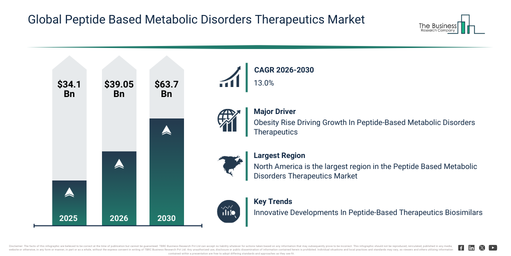
The market for peptide-based metabolic disorder therapeutics has experienced strong expansion in recent years. Projected to rise from $34.1 billion in 2025 to $39.05 billion in 2026, this reflects a compound annual growth rate (CAGR) of 14.5%. Historical growth has been driven by several factors, including the growing incidence of type 2 diabetes, the initial effectiveness of treatments like liraglutide and exenatide, increasing clinical evidence supporting peptide-based drugs, higher obesity levels in developed countries, and a deeper comprehension of metabolic pathways.
The market for peptide-based metabolic disorder therapeutics is projected to experience robust expansion in the coming years. By 2030, it is anticipated to reach a valuation of $63.7 billion, reflecting a compound annual growth rate (CAGR) of 13.0%. This forecasted growth is driven by several factors, including the escalating global burden of obesity, the increased utilization of semaglutide and next-generation peptides, and heightened investment in drug development pipelines for metabolic conditions. Furthermore, a growing need for effective long-term weight management solutions alongside progress in peptide drug delivery systems contributes to this expansion. Key developments shaping the market in the near future encompass the widespread adoption of GLP-1 receptor agonist therapies, a heightened emphasis on utilizing peptides for obesity management, and the development of long-acting injectable peptide formulations. The market is also seeing a rising application of combination peptide therapies and an increasing demand for metabolic treatments that prioritize patient convenience.
Download A Free Sample Report For Comprehensive Market Insights:
Peptide Based Metabolic Disorders Therapeutics Market Demand Drivers: What Is Fueling Industry Growth?
The anticipated expansion of the peptide-based metabolic disorders therapeutic market is being driven by the growing incidence of obesity. This medical condition involves an excessive buildup of body fat that endangers health, with rising cases linked to sedentary habits, poor nutrition, genetic factors, and environmental influences that encourage high-calorie diets and limited physical activity. Therapeutics for metabolic disorders utilizing peptides are designed to address conditions like obesity by employing peptides to regulate metabolic processes, enhance insulin sensitivity, and curb appetite, thus improving patient outcomes and diminishing the chronic health risks tied to these disorders. For example, data from the Office for Health Improvement and Disparities, a UK government department, indicates that between 2022 and 2023, 25.4% of women were documented as obese in early pregnancy, with this figure slightly rising to 26.2% from 2023 to 2024. Consequently, the escalating prevalence of obesity is fueling the market for peptide-based metabolic disorder therapeutics.
Peptide Based Metabolic Disorders Therapeutics Market Segmentation And Category Breakdown
The peptide based metabolic disorders therapeutics market covered in this report is segmented –
1) By Drug Type: Liraglutide, Exenatide, Other Drug Type
2) By Application: Lysosomal Storage Diseases, Diabetes, Obesity, Hypercholesterolemia, Other Applications
3) By Distribution Channel: Hospital Pharmacies, Retail Pharmacies, Online Pharmacies
Subsegments:
1) By Liraglutide: Brand: Saxenda, Brand: Victoza, Generic Liraglutide, Liraglutide For Type 2 Diabetes, Liraglutide For Obesity
2) By Exenatide: Brand: Byetta, Brand: Bydureon, Exenatide For Type 2 Diabetes, Extended-Release Exenatide, Generic Exenatide
3) By Other Drug Type: Semaglutide, Dulaglutide, Albiglutide, Lixisenatide, GLP-1 Receptor Agonists, Pramlintide, Other Peptide-Based Drugs For Metabolic Disorders
Peptide Based Metabolic Disorders Therapeutics Market Innovation Trends: Which Developments Are Transforming The Industry?
Key players in the major market for peptide-based metabolic disorder therapeutics are actively developing innovative peptide-focused treatments, including biosimilars for anti-diabetic use, aiming to address unmet medical needs and expand the range of therapeutic options for patients. Peptide-based anti-diabetic biosimilars represent pharmaceutical products designed to replicate existing peptide therapies for diabetes, delivering comparable efficacy and safety to established medications while potentially reducing treatment expenses through competitive pricing approaches. For example, in January 2024, Glenmark Pharmaceuticals Ltd., a pharmaceutical company headquartered in India, introduced Lirafit, a biosimilar version of the well-known anti-diabetic medication Liraglutide, within India. This product falls under the category of glucagon-like peptide-1 receptor agonists (GLP-1 RAs). Such drugs imitate the function of the natural GLP-1 hormone, which plays an essential part in controlling blood glucose levels. Clinical trials have confirmed that this biosimilar effectively reduces glycemic markers, supports weight loss, and improves cardiovascular safety—key advantages for managing diabetes along with related conditions like obesity and cardiovascular disease.
Peptide Based Metabolic Disorders Therapeutics Market Competitive Analysis Of Major Industry Participants
Major companies operating in the peptide based metabolic disorders therapeutics market are Novo Nordisk A/S, Eli Lilly and Company, Sanofi S.A., AstraZeneca PLC, Boehringer Ingelheim International GmbH, Ipsen S.A., Pfizer Inc., Merck & Co. Inc., Johnson & Johnson, AbbVie Inc., GlaxoSmithKline plc, Takeda Pharmaceutical Company Limited, Teva Pharmaceutical Industries Ltd., Amgen Inc., Regeneron Pharmaceuticals Inc., Roche Holding AG, Novartis AG, Bristol-Myers Squibb Company, Vertex Pharmaceuticals Incorporated, Amarin Corporation plc
Access The Complete Peptide Based Metabolic Disorders Therapeutics Market Report:
Peptide Based Metabolic Disorders Therapeutics Market Regional Analysis And Leading Geography
North America was the largest region in the peptide based metabolic disorders therapeutics market in 2025. Asia-Pacific is expected to be the fastest-growing region in the forecast period. The regions covered in the peptide based metabolic disorders therapeutics market report are Asia-Pacific, South East Asia, Western Europe, Eastern Europe, North America, South America, Middle East, Africa.
Get in touch with us:
The Business Research Company: https://www.thebusinessresearchcompany.com/?utm_source=BlogsPR&utm_medium=Paid&utm_campaign=home_page_test
Americas: +1 310-496-7795
Asia: +44 7882 955267 & +91 8897263534
Europe: +44 7882 955267
Email us at: marketing@tbrc.info
Follow us on:
LinkedIn: https://in.linkedin.com/company/the-business-research-company
YouTube: https://www.youtube.com/channel/UC24_fI0rV8cR5DxlCpgmyFQ
Global Market Model: https://www.thebusinessresearchcompany.com/global-market-model