Rituximab Biosimilars Market Trends Are Creating New Opportunities For Industry Leaders
Delivering more actionable and strategically valuable research, The Business Research Company’s 2026 market reports feature market attractiveness analysis, total addressable market evaluation, company benchmarking matrices, interactive Excel dashboards, expanded supply chain intelligence, emerging startup coverage, and detailed product insights.
Rituximab Biosimilars Market Value Expansion And Long-Term Growth Outlook
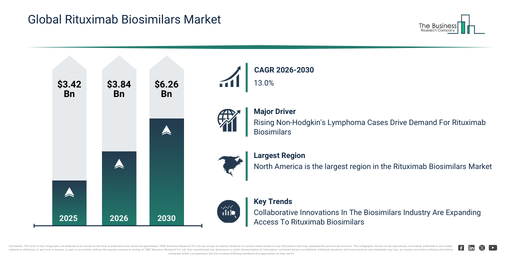
The rituximab biosimilars market has seen considerable expansion over the last few years. Valued at $3.42 billion in 2025, projections indicate it will reach $3.84 billion by 2026, reflecting a compound annual growth rate (CAGR) of 12.5%. This historical growth has been largely driven by the high price of the original rituximab, a surge in non-Hodgkin’s lymphoma cases, more frequent diagnoses of chronic lymphocytic leukemia, heightened public understanding of managing autoimmune conditions, and restricted availability of sophisticated biologic therapies.
The market for rituximab biosimilars is projected to experience rapid expansion in the coming years. By 2030, its value is anticipated to reach $6.26 billion, driven by a compound annual growth rate (CAGR) of 13.0%. This forecasted growth is fueled by several factors, including the introduction of new biosimilar formulations, the broadening of subcutaneous delivery options, a surge in adoption within emerging markets, heightened government and insurance backing for biosimilars, and their integration into hospital and specialty pharmacy programs. Key trends shaping the forecast period encompass the growing uptake of rituximab biosimilars for treating oncology and autoimmune conditions, the expansion of subcutaneous administration alongside pre-filled delivery systems, an increasing preference for cost-effective monoclonal antibody alternatives, the rising utilization of antibody-drug conjugates (ADCs) in targeted therapies, and the improvement of distribution channels across hospital and retail pharmacy settings.
Download A Free Sample Report For Comprehensive Market Insights:
Rituximab Biosimilars Market Development Factors: Which Trends Are Supporting Demand?
The anticipated expansion of the rituximab biosimilars market is significantly influenced by the escalating incidence of non-Hodgkin’s lymphoma (NHL). Non-Hodgkin’s lymphoma is defined as a cancer originating in white blood cells, particularly lymphocytes, which are integral to the immune system. Its growing prevalence is primarily driven by higher occurrence rates, especially within aging demographics, along with contributions from lifestyle and environmental influences. Rituximab biosimilars function by specifically binding to and eliminating CD20-positive B cells, thereby decreasing tumor load, enhancing immune system regulation, and offering a more affordable and accessible therapeutic choice for patients with NHL, which in turn improves overall treatment results and quality of life. As an example, the American Cancer Society, a cancer advocacy group based in the US, reported in January 2024 that around 80,620 individuals (44,590 males and 36,030 females) were projected to receive an NHL diagnosis, with an estimated 20,140 fatalities (11,780 males and 8,360 females), and that the lifetime risk of developing this cancer is roughly 1 in 42 for men and 1 in 52 for women. Consequently, the increasing frequency of non-Hodgkin’s lymphoma is fueling growth within the rituximab biosimilars market.
The increasing occurrence of autoimmune conditions is projected to drive forward the expansion of the rituximab biosimilars market. Such autoimmune conditions encompass disorders where the immune system mistakenly attacks its own healthy tissues, viewing them as foreign invaders. Rituximab biosimilars are employed in managing these diseases by targeting specific B cells, thereby mitigating inflammation and dampening autoimmune responses. For instance, data from Arthritis Australia, a non-profit entity based in Australia, indicated in February 2024 that an estimated 562,378 Australians will be affected by rheumatoid arthritis (RA) in 2025, representing 14% of all arthritis cases that year. By 2040, this figure is predicted to climb by 33%, reaching 748,721 individuals, meaning an additional 186,343 Australians will have RA in 2040 compared to 2025. As a result, the heightened prevalence of autoimmune diseases is spurring the growth of the rituximab biosimilars market.
Rituximab Biosimilars Market Categorization By Product Type And Application
The rituximab biosimilars market covered in this report is segmented –
1) By Route Of Administration: Subcutaneous, Intravenous
2) By Application: Non-Hodgkin’s Lymphoma, Chronic Lymphocytic Leukemia, Rheumatoid Arthritis, Other Applications
3) By Distribution Channel: Hospital Pharmacy, Retail Pharmacy, Mail Order
Subsegments:
1) By Subcutaneous: Pre-filled Syringes, Injection Pens
2) By Intravenous: IV Infusion Solutions, IV Push Formulations
Rituximab Biosimilars Market Transformation Trends: Which Innovations Are Driving Change?
Key players in the rituximab biosimilars market are concentrating on advancing innovative solutions by forming strategic partnerships, aiming to improve treatment availability and deliver cost-effective options for patients dealing with a range of immune and cancer-related disorders. These collaborations with seasoned partners enable companies to streamline commercialization, pool regulatory and distribution know-how, and efficiently launch biosimilars, thereby boosting patient access and market reach. For example, in July 2023, Dr. Reddy’s Laboratories joined forces with its collaborator Fresenius Kabi to bring its proposed rituximab biosimilar to the U.S. market. Such an alliance is designed to introduce a more affordable and easier-to-access rituximab alternative, benefiting patients afflicted with diseases like rheumatoid arthritis, non-Hodgkin’s lymphoma, chronic lymphocytic leukemia, pemphigus vulgaris, granulomatosis with polyangiitis, and microscopic polyangiitis. The introduction of this biosimilar in the United States could significantly expand the availability of this critical treatment for these conditions.
Rituximab Biosimilars Market Company Landscape And Strategic Competition
Major companies operating in the rituximab biosimilars market are Novartis AG, Pfizer, BIOCAD, Shanghai Henlius Biotech Inc., Innovent Biologics Inc., Cadila Pharmaceuticals, Hetero Drugs Limited, Dr. Reddy’s Laboratories, Shanghai Fosun Pharmaceutical (Group) Co. Ltd., Reliance Life Sciences India, Zenotech Laboratories, Celltrion, Biocad, MABION S.A., Amgen, Teva Pharmaceuticals, Celltrion Healthcare, Coherus BioSciences, Aryogen Biopharma, TR-Pharm, Hikma Pharmaceuticals plc.
Access The Complete Rituximab Biosimilars Market Report:
Rituximab Biosimilars Market Regional Outlook: Where Are The Largest Opportunities Located?
North America was the largest region in the rituximab biosimilars market in 2025. Middle East is expected to be the fastest-growing region in the rituximab biosimilars market report during the forecast period. The regions covered in the rituximab biosimilars market report are Asia-Pacific, South East Asia, Western Europe, Eastern Europe, North America, South America, Middle East, Africa.
Get in touch with us:
The Business Research Company: https://www.thebusinessresearchcompany.com/?utm_source=BlogsPR&utm_medium=Paid&utm_campaign=home_page_test
Americas: +1 310-496-7795
Asia: +44 7882 955267 & +91 8897263534
Europe: +44 7882 955267
Email us at: marketing@tbrc.info
Follow us on:
LinkedIn: https://in.linkedin.com/company/the-business-research-company
YouTube: https://www.youtube.com/channel/UC24_fI0rV8cR5DxlCpgmyFQ
Global Market Model: https://www.thebusinessresearchcompany.com/global-market-model