Tenosynovitis Drugs Market Expansion Is Opening New Pathways For Strategic Investment
Through market attractiveness analysis, total addressable market evaluation, company benchmarking matrices, interactive Excel dashboards, expanded supply chain intelligence, emerging startup coverage, and detailed product insights, The Business Research Company’s 2026 market reports provide more actionable and strategically valuable research.
Tenosynovitis Drugs Market Growth Potential: How Will Market Size Change Through 2030?
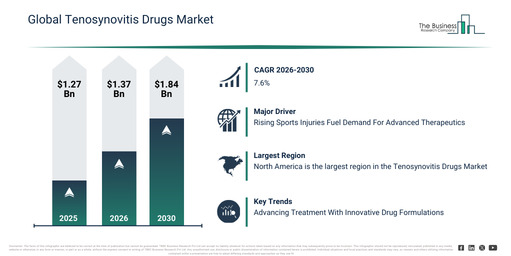
The tenosynovitis therapeutics market experienced robust expansion over the past few years, with projections indicating an increase from $1.27 billion in 2025 to $1.37 billion in 2026, reflecting a compound annual growth rate (CAGR) of 7.7%. This historical growth has been driven by a rise in workplace-related injuries, the broad use of nonsteroidal anti-inflammatory drugs (NSAIDs), the proliferation of orthopedic healthcare centers, age-related musculoskeletal conditions in the elderly population, and the growing preference for outpatient management strategies.
The tenosynovitis drugs market is anticipated to experience robust expansion over the coming years. Its value is projected to reach $1.84 billion by 2030, achieving a compound annual growth rate (CAGR) of 7.6%. This forecasted growth is driven by factors such as a rise in workplace-related injuries, higher levels of sports participation, a shift toward minimally invasive procedures, growing demand for pain relief medications, and the expansion of outpatient orthopedic services. Key trends influencing the market during this period include an increasing prevalence of repetitive strain injuries, wider application of anti-inflammatory treatments, greater adoption of injectable corticosteroids, broader availability of conservative musculoskeletal therapies, and a heightened emphasis on early pain management strategies.
Download A Free Sample Report For Comprehensive Market Insights:
Tenosynovitis Drugs Market Expansion Drivers: What Is Shaping Future Growth?
The growing occurrence of sports injuries is anticipated to fuel expansion in the tenosynovitis drugs market in the coming period. Sports injuries encompass physical harm sustained during athletic activities or exercise, ranging from minor sprains and strains to more serious fractures or dislocations. These injuries arise from a variety of causes, including overuse, incorrect technique, insufficient warm-up or stretching, and collisions with other players or objects. Tenosynovitis drugs address sports injuries by reducing inflammation in tendons and relieving pain, thereby promoting faster recovery and enhanced mobility. For example, in November 2023, Howden Group Holdings Ltd, a UK-based insurance intermediary, reported that the severity of ankle injuries in the English Premier League rose by 170% from October 2022 to January 2023, with calf or shin injuries increasing by 200% and hamstring injuries by 130%, following the FIFA World Cup Qatar 2022. Consequently, the rising incidence of sports injuries is propelling the growth of the tenosynovitis drugs market.
An increase in healthcare expenditure is set to drive the expansion of the tenosynovitis drugs market in the future. Healthcare expenditure denotes the total financial resources allocated to medical goods and services aimed at maintaining and improving population health. This spending is climbing as an aging population demands more frequent medical care and long-term health services. Greater healthcare expenditure enhances the uptake and outcomes of tenosynovitis drugs by broadening access, improving diagnosis and treatment delivery, and supporting research and care services. For instance, in April 2025, the Office for National Statistics, a UK-based government department, noted that total healthcare spending grew by 6.5% in nominal terms and by 2.4% in real terms after adjusting for inflation between 2023 and 2024. Hence, the rising healthcare expenditure is fostering the growth of the tenosynovitis drugs market.
Tenosynovitis Drugs Market Segment Breakdown: Which Categories Generate The Most Revenue?
The tenosynovitis drugs market covered in this report is segmented –
1) By Drug Type: Nonsteroidal Anti-Inflammatory Drugs (NSAIDS), Corticosteroids, Antibiotics, Other Drug Types
2) By Indication: De Quervain Tenosynovitis, Stenosing Tenosynovitis, Trigger Finger, Other Indications
3) By Route Of Administration: Oral, Injectable, Topical
4) By Distribution Channel: Hospital Pharmacies, Retail Pharmacies, Online Pharmacies
Subsegments:
1) By Nonsteroidal Anti-Inflammatory Drugs (NSAIDs): Ibuprofen, Naproxen, Diclofenac, Celecoxib
2) By Corticosteroids: Prednisone, Methylprednisolone, Dexamethasone, Triamcinolone
3) By Antibiotics: Penicillins, Cephalosporins, Fluoroquinolones, Macrolides
4) By Other Drug Types: Disease-Modifying Anti-Rheumatic Drugs (DMARDs), Biologics, Analgesics
Tenosynovitis Drugs Market Strategic Trends: What Is Defining The Next Phase Of Growth?
Prominent players in the tenosynovitis drugs market are placing significant emphasis on developing advanced drug formulations, including those with delayed-release characteristics for non-steroidal anti-inflammatory drugs (NSAIDs), to improve gastrointestinal tolerance and deliver precise anti-inflammatory effects. This specific type of formulation is engineered so that the active component, such as naproxen, is not released until it reaches a later point within the gastrointestinal system. A notable example occurred in July 2024 when ANI Pharmaceuticals Inc., a pharmaceutical company headquartered in the United States, announced it had obtained approval from the U.S. Food and Drug Administration (FDA) for its abbreviated new drug application (ANDA) and subsequently introduced Naproxen delayed-release tablets, USP, to the market. This newly available medication serves as a more affordable generic alternative to the reference listed drug (RLD), EC-Naprosyn, while offering identical therapeutic advantages. By delaying the release of the medication, this formulation is intended to provide prolonged pain relief and simultaneously minimize gastric irritation, making it a particularly useful option for treating inflammatory conditions like arthritis, tendonitis, and tenosynovitis.
Tenosynovitis Drugs Market Key Players And Strategic Industry Positioning
Major companies operating in the tenosynovitis drugs market are Pfizer Inc., Roche Holding AG, Bayer AG, Sanofi S.A., AstraZeneca plc, GSK plc, Takeda Pharmaceutical Company Limited, Eli Lilly and Company, Amgen Inc., Teva Pharmaceutical Industries Ltd., Sun Pharmaceutical Industries Ltd., Perrigo Company plc, Cipla Limited, Dr. Reddy’s Laboratories Ltd., Aurobindo Pharma Limited, Endo International plc, Lupin Limited, Mallinckrodt Pharmaceuticals, Zydus Cadila Healthcare, AdvaCare Pharma.
Access The Complete Tenosynovitis Drugs Market Report:
Tenosynovitis Drugs Market Largest Region: Which Geography Holds The Highest Market Share?
North America was the largest region in the tenosynovitis drugs market in 2025. The regions covered in the tenosynovitis drugs market report are Asia-Pacific, South East Asia, Western Europe, Eastern Europe, North America, South America, Middle East, Africa.
Get in touch with us:
The Business Research Company: https://www.thebusinessresearchcompany.com/?utm_source=BlogsPR&utm_medium=Paid&utm_campaign=home_page_test
Americas: +1 310-496-7795
Asia: +44 7882 955267 & +91 8897263534
Europe: +44 7882 955267
Email us at: marketing@tbrc.info
Follow us on:
LinkedIn: https://in.linkedin.com/company/the-business-research-company
YouTube: https://www.youtube.com/channel/UC24_fI0rV8cR5DxlCpgmyFQ
Global Market Model: https://www.thebusinessresearchcompany.com/global-market-model