Enhanced with market attractiveness analysis, total addressable market evaluation, company benchmarking matrices, interactive Excel dashboards, expanded supply chain intelligence, emerging startup coverage, and detailed product insights, The Business Research Company’s 2026 market reports deliver more actionable and strategically valuable research.
Traumatic Brain Injury Biomarkers Market Growth Potential: How Will Market Size Change Through 2030?
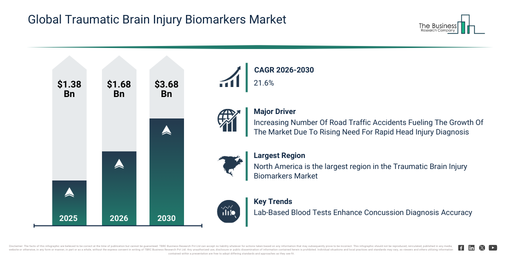
The market for traumatic brain injury biomarkers has experienced remarkable expansion in recent years. It is projected to increase from $1.38 billion in 2025 to $1.68 billion in 2026, reflecting a compound annual growth rate (CAGR) of 21.9%. This historical growth has been driven by factors such as the limited availability of standardized TBI biomarkers, dependence on traditional imaging methods, rising awareness of the consequences of traumatic brain injuries, the expansion of hospital-based diagnostic services, and initial investigations into protein and genetic biomarkers.
The traumatic brain injury biomarkers market is anticipated to witness exponential expansion over the coming years. By 2030, its value is projected to reach $3.68 billion, with a compound annual growth rate (CAGR) of 21.6%. This forecasted growth is driven by advancements in high-sensitivity protein and genetic assays, the incorporation of metabolomic biomarkers into TBI assessment, the development of personalized monitoring and prognosis tools, broader adoption by hospitals and diagnostic labs, and increased investment in TBI biomarker research and clinical trials. Key trends expected during this period include the growing use of blood-based and CSF-based biomarker testing, a stronger emphasis on early TBI diagnosis and prognosis, the creation of multiplex biomarker panels for both proteins and genetics, expansion of tools for tracking treatment response, and the integration of research-derived biomarkers into routine clinical use.The traumatic brain injury biomarkers market is projected to experience explosive growth over the coming years, reaching $3.68 billion by 2030 at a CAGR of 21.6%. This expansion in the forecast period results from several factors, including progress in high-sensitivity protein and genetic assays, the inclusion of metabolomic biomarkers in TBI evaluation, the growth of personalized monitoring and prognosis instruments, increased adoption by hospitals and diagnostic laboratories, and higher investment in TBI biomarker research and clinical trials. Major trends expected during the forecast period consist of greater utilization of blood-based and CSF-based biomarker testing, a heightened focus on early TBI diagnosis and prognosis, the creation of multiplex protein and genetic biomarker panels, the expansion of monitoring tools for treatment response, and the incorporation of research-derived biomarkers into clinical settings.
Download A Free Sample Report For Comprehensive Market Insights:
Traumatic Brain Injury Biomarkers Market Industry Drivers: What Is Driving Revenue Growth?
The growing frequency of road traffic accidents is anticipated to boost the expansion of the traumatic brain injury biomarkers market in the coming period. Road traffic accidents are defined as unforeseen, unintended incidents that result in injury, harm, or damage, frequently demanding urgent medical intervention. The incidence of such accidents is climbing due to a sharp rise in private vehicle use, driven by urbanization and motorization. Biomarkers for traumatic brain injury play a crucial role in road traffic accident care by facilitating quick and precise evaluation of head injuries. They aid in early diagnosis through the detection of specific blood proteins, enabling clinicians to make prompt treatment choices and enhance patient outcomes in emergency settings. For example, in October 2025, a report from the National Highway Traffic Safety Administration (NHTSA), a US-based national safety organization, indicated that the United States experienced 6,138,359 police-reported motor-vehicle crashes, leading to 40,901 fatalities and 2,442,581 injuries, underscoring a substantial trauma load. Consequently, the rising number of road traffic accidents is fueling growth in the traumatic brain injury biomarkers market.
The increasing embrace of personalized medicine is set to drive the traumatic brain injury biomarkers market forward in the future. Personalized medicine is a healthcare strategy that customizes treatments for individual patients by considering their genetic, environmental, and lifestyle factors to enhance outcomes and improve care quality. The growing demand for this approach stems from progress in genomic technologies, which allow for accurate detection of genetic differences and tailored interventions for each person. Biomarkers for traumatic brain injury support personalized medicine by pinpointing specific biological markers associated with brain injuries. They facilitate customized treatment plans based on individual reactions, boosting recovery results and refining clinical decision-making for every patient. As an illustration, in February 2024, the Personalized Medicine Coalition (PMC), a US-based nonprofit organization, reported that the U.S. Food and Drug Administration (FDA) approved 26 new personalized medicines in 2023, a notable rise from the 12 approvals in 2022. Hence, the growing adoption of personalized medicine is propelling the expansion of the traumatic brain injury biomarkers market.
Traumatic Brain Injury Biomarkers Market Segment Landscape And Growth Potential
The traumatic brain injury biomarkers market covered in this report is segmented –
1) By Type: Protein Biomarkers, Genetic Biomarkers, Metabolomic Biomarkers
2) By Sample Type: Blood-based, Cerebrospinal Fluid (CSF)-Based, Urine-Based
3) By Application: Diagnosis, Prognosis, Monitoring Treatment Response
4) By End Use: Hospitals And Clinics, Diagnostic Laboratories, Research Institutes
Subsegments:
1) By Protein Biomarkers: Glial Fibrillary Acidic Protein (GFAP), Ubiquitin C-Terminal Hydrolase L1 (UCH-L1), S100 Calcium Binding Protein B (S100B), Neuron-Specific Enolase (NSE)
2) By Genetic Biomarkers: Apolipoprotein E (APOE) Genotyping, Brain-Derived Neurotrophic Factor (BDNF) Polymorphism, Interleukin-6 (IL-6) Gene Variants, Tumor Necrosis Factor-Alpha (TNF-a) Polymorphism
3) By Metabolomic Biomarkers: Lactate, Creatine, Choline, N-Acetylaspartate (NAA)
Traumatic Brain Injury Biomarkers Market Growth Trends: What Is Influencing The Future Outlook?
Key industry players in the traumatic brain injury biomarker market are channeling their efforts into creating novel solutions, like a laboratory-based blood test, designed to enhance the precision and efficiency of concussion assessment and diagnosis. This type of blood test serves as a diagnostic instrument that quantifies particular biomarkers in the bloodstream, indicating the existence and extent of brain damage, which allows for more prompt and objective clinical evaluations. A case in point is Abbott Laboratories, a healthcare firm based in the United States, which introduced the Alinity i and Architect i1000SR laboratory tests in June 2025. These assays measure two critical biomarkers—glial fibrillary acidic protein (GFAP) and ubiquitin carboxy-terminal hydrolase (UCH)-L1—to aid healthcare providers in assessing potential concussions within a 12-hour window post-injury. Moreover, they produce lab outcomes in only 18 minutes, facilitate quicker triage decisions in emergency rooms, and decrease the need for non-essential CT scans. This breakthrough gives physicians a trustworthy approach for spotting patients with possible traumatic brain injuries, and it marks a notable step forward in broadening access to quicker, evidence-informed treatment within emergency departments.
Traumatic Brain Injury Biomarkers Market Competitive Landscape: Who Are The Leading Companies?
Major companies operating in the traumatic brain injury biomarkers market are F. Hoffmann-La Roche Ltd, Thermo Fisher Scientific Inc., Abbott Laboratories, Siemens Healthineers AG, BioMérieux S.A., DiaSorin S.p.A., Abcam Limited, Fujirebio Inc., Meso Scale Diagnostics (MSD), Olink Holding AB, Quanterix Corporation, OriGene Technologies Inc., BioDirection Inc., BrainBox Solutions Inc., NeuroTrauma Sciences LLC, Banyan Biomarkers Inc.
Access The Complete Traumatic Brain Injury Biomarkers Market Report:
Traumatic Brain Injury Biomarkers Market Geographic Landscape: Which Region Dominates Industry Growth?
North America was the largest region in the traumatic brain injury biomarkers market in 2025. Asia-Pacific is expected to be the fastest-growing region in the forecast period. The regions covered in the traumatic brain injury biomarkers market report are Asia-Pacific, South East Asia, Western Europe, Eastern Europe, North America, South America, Middle East, Africa.
Get in touch with us:
The Business Research Company: https://www.thebusinessresearchcompany.com/?utm_source=BlogsPR&utm_medium=Paid&utm_campaign=home_page_test
Americas: +1 310-496-7795
Asia: +44 7882 955267 & +91 8897263534
Europe: +44 7882 955267
Email us at: marketing@tbrc.info
Follow us on:
LinkedIn: https://in.linkedin.com/company/the-business-research-company
YouTube: https://www.youtube.com/channel/UC24_fI0rV8cR5DxlCpgmyFQ
Global Market Model: https://www.thebusinessresearchcompany.com/global-market-model