Afluria Quadrivalent Market Forecast Reveals Where Future Industry Value Will Be Created
Delivering more actionable and strategically valuable research, The Business Research Company’s 2026 market reports feature market attractiveness analysis, total addressable market evaluation, company benchmarking matrices, interactive Excel dashboards, expanded supply chain intelligence, emerging startup coverage, and detailed product insights.
Afluria Quadrivalent Market Size And Revenue Forecast Through 2030
The historic expansion was driven by several factors, including the shortcomings associated with trivalent influenza vaccines, frequent outbreaks involving multiple flu strains, increasing rates of hospitalizations caused by influenza, well-established vaccination schedules, and immunization initiatives led by the public sector.
The uptick seen during the forecast period can be linked to the need for more comprehensive strain protection, a rise in immunizations among healthcare workers, the expansion of vaccination efforts for children, increased purchases by government entities, and breakthroughs in how vaccines are administered. Key developments shaping this period encompass a growing preference for quadrivalent flu shots, wider coverage against various influenza strains, more frequent vaccination of vulnerable groups, stronger public sector immunization campaigns, and progress in the techniques used to formulate vaccines.
Download A Free Sample Report For Comprehensive Market Insights:
Afluria Quadrivalent Market Opportunity Drivers: What Is Creating New Revenue Potential?
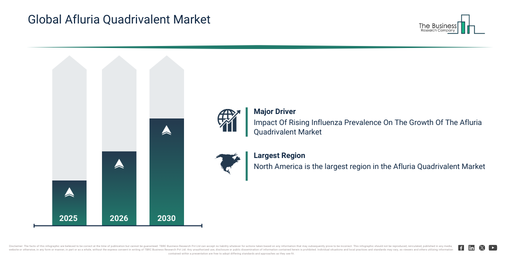
The anticipated rise in influenza cases is set to boost the afluria quadrivalent market in the coming period. Influenza, a contagious respiratory illness triggered by influenza viruses, can cause symptoms ranging from mild to severe, such as fever, cough, and body pain. This increase in influenza prevalence stems from factors like the virus’s annual mutations, seasonal weather patterns, and insufficient vaccination rates in some communities. Afluria Quadrivalent helps address this growing threat by guarding against four circulating flu strains, thus lowering infection risks and lessening the effects of seasonal epidemics. For example, in November 2024, the UK Health Security Agency, a government body in the United Kingdom, reported that influenza positivity rates during week 46 rose to a weekly average of 3.9%, compared to 3.3% in the prior week. The highest rates were seen among children aged 5 to 14, with the weekly average climbing to 11.6% from 8.8% in week 45. Consequently, the growing prevalence of influenza will fuel expansion in the afluria quadrivalent market.
Rising birth rates are anticipated to drive the growth of the afluria quadrivalent market in the future. This upward trend in births is influenced by elements like enhanced healthcare services, government initiatives, and shifts in social perspectives. A larger number of newborns expands the pediatric population needing immunization. As birth rates climb, healthcare systems must provide vaccines to more children to prevent influenza, thereby raising demand for products such as Afluria Quadrivalent. For instance, the Australian Bureau of Statistics, a government agency based in Australia, noted in October 2024 that 24,737 Aboriginal and Torres Strait Islander births were registered in 2023, an increase of 349 babies compared to 2022. Therefore, increasing birth rates are propelling the growth of the afluria quadrivalent market.
Increased healthcare spending is predicted to propel the expansion of the afluria quadrivalent market moving forward. Healthcare expenditure reflects the total amount devoted to medical services, treatments, and resources, supported by governments, insurers, and individuals to guarantee accessible and high-quality care. Afluria Quadrivalent gains from this rise in funding, as it facilitates wider availability of seasonal influenza vaccination. For example, in May 2024, the Office for National Statistics, a UK government department, indicated that total healthcare expenditure grew by 5.6% in nominal terms from 2022 to 2023, a notable acceleration compared to the 0.9% increase recorded in 2022. Hence, rising healthcare expenditure is fueling the growth of the afluria quadrivalent market.
Afluria Quadrivalent Market Segmentation And Category Breakdown
The afluria quadrivalent market covered in this report is segmented –
1) By Clinical Indication: Seasonal Influenza Prophylaxis, High-Risk Population Immunization, Pediatric Influenza Prophylaxis, Healthcare Worker Immunization
2) By Route Of Administration: Injection, Nasal Spray
3) By Age Group: Adults, Geriatric, Pediatrics
4) By Distribution Channel: Hospital And Retail Pharmacies, Government Suppliers, Other Channels
5) By End-User: Hospitals, Public, Private, Clinics, Other End-Users
Afluria Quadrivalent Market Competitive Analysis Of Major Industry Participants
Major companies operating in the afluria quadrivalent market are Seqirus Inc.
Access The Complete Afluria Quadrivalent Market Report:
Afluria Quadrivalent Market Geographic Landscape: Which Region Dominates Industry Growth?
North America was the largest region in the afluria quadrivalent market in 2025. Asia-Pacific is expected to be the fastest-growing region in the forecast period. The regions covered in the afluria quadrivalent market report are Asia-Pacific, Western Europe, Eastern Europe, North America, South America, Middle East, Africa.
Get in touch with us:
The Business Research Company: https://www.thebusinessresearchcompany.com/?utm_source=BlogsPR&utm_medium=Paid&utm_campaign=home_page_test
Americas: +1 310-496-7795
Asia: +44 7882 955267 & +91 8897263534
Europe: +44 7882 955267
Email us at: marketing@tbrc.info
Follow us on:
LinkedIn: https://in.linkedin.com/company/the-business-research-company
YouTube: https://www.youtube.com/channel/UC24_fI0rV8cR5DxlCpgmyFQ
Global Market Model: https://www.thebusinessresearchcompany.com/global-market-model