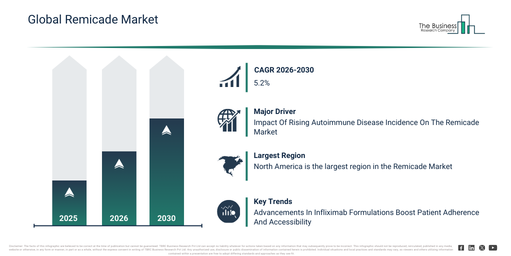
Enhanced with market attractiveness analysis, total addressable market evaluation, company benchmarking matrices, interactive Excel dashboards, expanded supply chain intelligence, emerging startup coverage, and detailed product insights, The Business Research Company’s 2026 market reports deliver more actionable and strategically valuable research.
Remicade Market Size And Revenue Forecast Through 2030
The market for Remicade has experienced notable expansion over the past few years. Valued at $2656.87 million in 2025, it is projected to reach $2803.31 million by 2026, reflecting a compound annual growth rate (CAGR) of 5.5%. This upward trajectory during the historical period has been driven by a rise in autoimmune disorder cases, broader adoption of biologic therapies within clinical settings, the proliferation of hospital-based infusion centers, enhanced diagnostic capabilities for inflammatory conditions, and the strengthening of specialty pharmaceutical distribution networks.
Forecasts indicate a robust expansion in the remicade market over the coming years. By 2030, its valuation is projected to reach $3433.68 million, reflecting a compound annual growth rate of 5.2%. This upward trajectory during the forecast period is driven by several factors, including a heightened demand fueled by biosimilar competition, increased capital flows into biologics manufacturing, the broadening of home infusion care frameworks, an intensified emphasis on personalized autoimmune therapies, and breakthroughs in monoclonal antibody innovation. Key developments shaping this period encompass the growing utilization of TNF-alpha inhibitor therapies, a more widespread acceptance of biologic treatments for autoimmune conditions, an increasing inclination toward drugs that ensure long-term disease management, the expansion of specialty infusion services, and a sharper focus on therapeutic results centered around patient needs.
Download A Free Sample Report For Comprehensive Market Insights:
Remicade Market Expansion Supported By Key Demand Factors
The growing frequency of autoimmune disorders is anticipated to boost the remicade market in the coming years. Autoimmune diseases occur when the immune system mistakenly targets and attacks the body’s own healthy cells, tissues, or organs, viewing them as foreign invaders. This uptick in autoimmune cases is driven by genetic factors, environmental shifts, increased exposure to pollutants, lifestyle choices, and heightened diagnostic awareness. Remicade (infliximab) helps manage these conditions by blocking tumor necrosis factor-alpha (TNF-a), a key inflammatory cytokine involved in illnesses like rheumatoid arthritis, Crohn’s disease, and ulcerative colitis. For example, in April 2025, data from GOV.UK, a UK government public health agency, showed that in 2024, the prevalence of adults aged 16 and over self-reporting a long-term musculoskeletal (MSK) condition was 17.9%, with females (20.0%) having a higher rate than males (15.6%). Consequently, the rising prevalence of autoimmune diseases fuels expansion in the remicade market.
Remicade Market Segments: Where Are The Largest Growth Opportunities?
The remicade market covered in this report is segmented –
1) By Disease Indication: Crohn’s disease, Rheumatoid arthritis, Ankylosing spondylitis, Psoriatic arthritis, Ulcerative Colitis, Plaque psoriasis
2) By Route Of Administration: Subcutaneous, Intravenous, Parenteral
3) By End Use: Hospitals, Clinics, Ambulatory Care, Home Care
Remicade Market Growth Trends Influencing Competitive Dynamics
Leading players in the Remicade (infliximab) market are channeling their efforts into creating advanced solutions like subcutaneous versions of biologic therapies, aimed at addressing the growing need for enhanced patient ease, better treatment consistency, and more time-saving options compared to standard intravenous administration. These subcutaneous biologics enable patients to deliver maintenance doses from home, cutting down on visits to infusion centers and delivering a more convenient choice relative to traditional IV treatments. A notable example is the March 2024 launch of Zymfentra (infliximab-dyyb) by Celltrion USA, Inc., a US-based biopharmaceutical firm, marking the first FDA-authorized subcutaneous formulation of infliximab. Intended as a maintenance therapy for adults dealing with moderate-to-severe active ulcerative colitis (UC) and Crohn’s disease (CD), which are together referred to as inflammatory bowel disease (IBD), it is approved for use after IV induction with an infliximab product, presenting a user-friendly, self-administered path for ongoing disease management.
Remicade Market Major Participants And Competitive Dynamics
Major companies operating in the remicade market are Janssen Biotech Inc.
Access The Complete Remicade Market Report:
Remicade Market Geographic Landscape: Which Region Dominates Industry Growth?
North America was the largest region in the remicade market in 2025. Asia-Pacific is expected to be the fastest-growing region in the forecast period. The regions covered in the remicade market report are Asia-Pacific, Western Europe, Eastern Europe, North America, South America, Middle East, Africa.
Get in touch with us:
The Business Research Company: https://www.thebusinessresearchcompany.com/?utm_source=BlogsPR&utm_medium=Paid&utm_campaign=home_page_test
Americas: +1 310-496-7795
Asia: +44 7882 955267 & +91 8897263534
Europe: +44 7882 955267
Email us at: marketing@tbrc.info
Follow us on:
LinkedIn: https://in.linkedin.com/company/the-business-research-company
YouTube: https://www.youtube.com/channel/UC24_fI0rV8cR5DxlCpgmyFQ
Global Market Model: https://www.thebusinessresearchcompany.com/global-market-model