Disability Devices Market To Witness 5.5% CAGR Growth Through 2030: Key Industry Drivers
Featuring market attractiveness scoring, total addressable market sizing, company benchmarking matrices, interactive Excel dashboards, deeper supply chain intelligence, emerging startup tracking, and granular product-level insights, The Business Research Company’s 2026 market reports are built to deliver research that is both more actionable and more strategically valuable.
Disability Devices Market Value Growth And Long-Term Outlook
The disability devices market size has exhibited strong growth over recent years. Its expansion is projected to move from $25.38 billion in 2025 to $26.87 billion in 2026, demonstrating a compound annual growth rate (CAGR) of 5.9%. The market’s historical growth can be attributed to a limited supply of advanced disability devices, the high cost associated with assistive technology, a reliance on conventional mobility aids, an increasing elderly population, and low awareness concerning cognitive and communication aids.
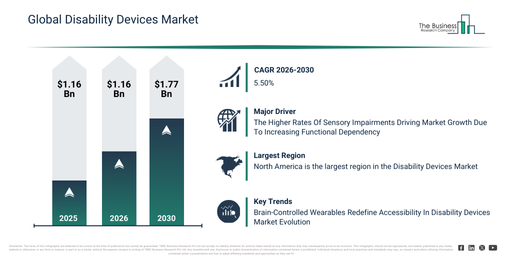
The disability devices market is projected to experience robust expansion over the coming years. Its valuation is anticipated to reach $33.33 billion by 2030, demonstrating a compound annual growth rate (CAGR) of 5.5%. This growth during the forecast period is primarily driven by advancements in smart and connected disability technologies, augmented governmental backing and insurance provisions, an expansion in rehabilitation facilities and home-based care services, a heightened emphasis on accessible and inclusive education, and the creation of AI-driven vision and hearing solutions. Significant trends expected during this period include a greater uptake of intelligent mobility devices, an increasing need for vision and hearing aids, the incorporation of tools for cognitive and communication assistance, a rise in the deployment of environmental control and home automation systems, and a focus on designing disability devices that are both customizable and ergonomic.
Get A Free Sample Report With In-Depth Market Insights:
Disability Devices Market Growth Factors Behind Sustained Expansion
The rising incidence of sensory impairments is anticipated to drive growth within the disability devices market. Sensory impairments refer to the partial or complete absence of one or more senses, predominantly impacting vision, hearing, or other sensory functions, thereby substantially limiting an individual’s capability to perceive, interpret, or react to environmental stimuli. The elevated rates of sensory impairments are primarily fueled by factors such as an aging demographic, chronic health conditions, and increased exposure to environmental risks, as these circumstances frequently degrade sensory functions over time and become more prevalent with advancing age, resulting in a greater occurrence of impairments. Disability devices are crucial in addressing the increasing burden of sensory impairments by improving functional capabilities, supporting independence, and enhancing the overall quality of life for affected individuals. For instance, in November 2024, according to The Hull Joint Strategic Needs Assessment (JSNA) by the Hull City Council, a UK-based unitary authority, sensory impairment accounts for 6.0% of healthy life years lost, with a higher burden in older age, rising from 2.5% in those under 50 to 12.9% in people aged 70+ in Hull. Additionally, serious visual impairment among those 75+ is expected to climb from 2,100 to 3,100 by 2040 due to aging. Therefore, the greater prevalence of sensory impairments is propelling the expansion of the disability devices market.
Disability Devices Market Segmentation: How Does The Market Break Down By Category?
The disability devices market covered in this report is segmented –
1) By Device Type: Vision Aids, Hearing Aids, Mobility Aids, Other Device Types
2) By Material: Plastic, Metal, Wood, Fabric
3) By Application: Home Care Settings, Hospitals, Ambulatory Care Centers And Rehabilitation Centers
4) By End User: Elderly, Physically Challenged, Visually Impaired, Hearing Impaired
Subsegments:
1) By Vision Aids: Magnifiers, Braille Readers, Screen Reading Software, Smart Glasses
2) By Hearing Aids: Behind-The-Ear (BTE), In-The-Ear (ITE), Receiver-In-Canal (RIC), Cochlear Implants
3) By Mobility Aids: Wheelchairs, Walkers And Rollators, Crutches, Mobility Scooters
4) By Other Device Types: Communication Aids, Cognitive Aids, Environmental Control Devices, Prosthetic Devices
Disability Devices Market Industry Trends Fueling Future Revenue Growth
Major companies in the disability devices market are prioritizing the development of advanced technologies, such as brain-controlled assistive wearables, aiming to improve accessibility and enhance user autonomy through intuitive, non-invasive control mechanisms. A brain-controlled assistive wearable is defined as a device that leverages neural and physiological signals, allowing individuals with physical or motor impairments to interact with digital systems using non-verbal, movement-based commands. For example, in March 2024, AAVAA Inc., a Canada-based neurotechnology company, released its Brain-Computer Interface (BCI) System for Smart Glasses. This system empowers users to operate digital devices by interpreting brain and biosignals derived from eye movements, facial gestures, and head motion. Its design, featuring lightweight sensors and computational efficiency, facilitates seamless integration into eyewear, thus offering enhanced usability across assistive, smart home, augmented reality, and virtual reality applications.
Disability Devices Market Competitive Landscape: Which Companies Lead The Industry?
Major companies operating in the disability devices market are Medline Industries LP, Sonova Holding AG, William Demant Holding A/S, GN Store Nord A/S, Ottobock SE & Co. KGaA, Hollister Inc., Cochlear Ltd., Arjo AB, Invacare Corporation, GN Hearing A/S, MED−EL Elektromedizinische Geräte Gesellschaft m.b.H., DRIVE MEDICAL GMBH & CO. KG, Permobil AB, Pride Mobility Products Corporation, Steeper Group, GF Health Products Inc., WHILL Inc., Carex Health Brands Inc., Merits Health Products, MEYRA Group, Hearing Health & Technology Matters LLC, Magic Mobility Pty Ltd, LEVO AG, Batec Mobility S.L., BetterLiving.
View The Full Disability Devices Market Report:
Disability Devices Market Regional Outlook: Where Is Opportunity Concentrated?
North America was the largest region in the disability devices market in 2025. Asia-Pacific is expected to be the fastest-growing region in the forecast period. The regions covered in the disability devices market report are Asia-Pacific, South East Asia, Western Europe, Eastern Europe, North America, South America, Middle East, Africa.
Reach Out To Our Team:
The Business Research Company: https://www.thebusinessresearchcompany.com/
Americas: +1 310-496-7795
Asia: +44 7882 955267 & +91 8897263534
Europe: +44 7882 955267
Email us at: marketing@tbrc.info
Follow us on:
LinkedIn: https://in.linkedin.com/company/the-business-research-company
YouTube: https://www.youtube.com/channel/UC24_fI0rV8cR5DxlCpgmyFQ
Global Market Model: https://www.thebusinessresearchcompany.com/global-market-model