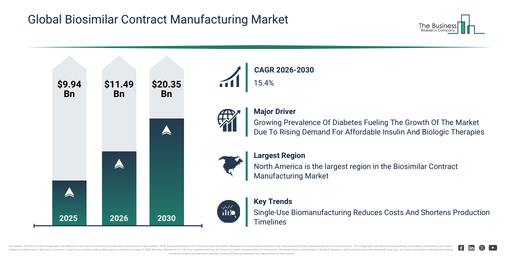
Featuring market attractiveness scoring, total addressable market sizing, company benchmarking matrices, interactive Excel dashboards, deeper supply chain intelligence, emerging startup tracking, and granular product-level insights, The Business Research Company’s 2026 market reports are built to deliver research that is both more actionable and more strategically valuable.
Biosimilar Contract Manufacturing Market Size Forecast: How Big Could The Market Get By 2030?
The biosimilar contract manufacturing market has seen substantial growth recently. Its value is projected to rise from $9.94 billion in 2025 to $11.49 billion in 2026, exhibiting a compound annual growth rate (CAGR) of 15.7%. Historically, this expansion can be attributed to the expiration of reference biologic patents, the early adoption of biosimilar development initiatives, an increase in contract manufacturing partnerships, developing regulatory guidance for biosimilars, and the growing prevalence of chronic diseases.
The biosimilar contract manufacturing sector is projected to experience swift expansion over the coming years, anticipated to reach $20.35 billion in 2030 at a compound annual growth rate (CAGR) of 15.4%. This anticipated growth during the forecast period stems from factors such as a rise in biosimilar approvals worldwide, the escalating need to lower biologic treatment expenses, the expansion of biosimilar product pipelines, increasing capital expenditure in large-scale production facilities, and improvements in process optimization techniques. Key developments expected over the forecast period encompass a surge in the outsourcing of biosimilar production, a heightened demand for economical manufacturing platforms, a greater emphasis on analytical and quality control provisions, the broadening of mammalian cell-based manufacturing capabilities, and a strengthened adherence to regulatory standards.
Get A Free Sample Report With In-Depth Market Insights:
Biosimilar Contract Manufacturing Market Expansion Drivers: What’s Shaping Future Growth?
The expanding incidence of diabetes is projected to drive the growth of the biosimilar contract manufacturing market moving forward. Diabetes prevalence indicates the percentage of individuals in a population living with diabetes at a specific time, signifying ongoing treatment requirements and a lifelong demand for therapy. The rise in diabetes prevalence stems from increasingly sedentary lifestyles and inadequate dietary habits, which contribute to obesity, insulin resistance, and a higher occurrence of type 2 diabetes. Biosimilar contract manufacturing supports diabetes management by enabling the efficient, large-scale, and cost-effective production of biosimilar insulin and related biological products. It ensures consistent quality and adherence to regulatory standards, thereby making advanced therapies more accessible to patients. This improves treatment affordability and expands global access to vital diabetes care. For example, in June 2024, the National Health Service, a UK-based government department, reported that 3,615,330 individuals registered with a general practitioner (GP) were diagnosed with non-diabetic hyperglycemia or pre-diabetes in 2023, representing an 18% increase from 3,065,825 cases in 2022. Thus, the increasing prevalence of diabetes is fueling the expansion of the biosimilar contract manufacturing market.
Biosimilar Contract Manufacturing Market Breakdown By Product Type And Application
The biosimilar contract manufacturing market covered in this report is segmented –
1) By Product Type: Monoclonal Antibodies, Insulin, Erythropoietin, Granulocyte Colony-Stimulating Factor, Other Product Types
2) By Service Type: Process Development, Analytical And Quality Control, Fill And Finish Operations, Packaging, Other Service Types
3) By Source: Mammalian, Non-mammalian
4) By Application: Oncology, Autoimmune Diseases, Blood Disorders, Growth Hormone Deficiency, Other Applications
5) By End-Use: Pharmaceutical Companies, Biotech Companies
Subsegments:
1) By Monoclonal Antibodies: Chimeric Monoclonal Antibodies, Humanized Monoclonal Antibodies, Fully Human Monoclonal Antibodies, Bispecific Monoclonal Antibodies
2) By Insulin: Rapid Acting Insulin, Short Acting Insulin, Intermediate Acting Insulin, Long Acting Insulin, Premixed Insulin
3) By Erythropoietin: Alpha Erythropoietin, Beta Erythropoietin, Darbepoetin Alfa, Continuous Erythropoietin Receptor Activators
4) By Granulocyte Colony-Stimulating Factor: Filgrastim, Pegfilgrastim, Lenograstim, Long Acting Granulocyte Colony-Stimulating Factor
5) By Other Product Types: Interferons, Interleukins, Fusion Proteins, Enzyme Therapeutics, Hormonal Biologics
Biosimilar Contract Manufacturing Market Strategic Trends: What Defines The Next Growth Phase?
Major companies within the biosimilar contract manufacturing sector are prioritizing the establishment of advanced production sites, such as mirrored single-use facilities, to enhance the pace of technology transfer, scaling operations, and commercial dependability. Mirrored single-use plants are characterized by identical production environments that utilize disposable bioprocess tools and integrated digital platforms, facilitating rapid operational shifts, uniform quality across various locations, and a decreased risk of contamination. For example, in September 2025, Rezon Bio, a contract development and manufacturing organization situated in Poland, inaugurated two single-use biomanufacturing sites with mirrored capabilities, spanning from cell line development to commercial GMP provision. This strategy enables quicker technology transfer and adaptable scale-up for biosimilars, reducing operational interruptions, while simultaneously improving consistency between batches through standardized suites, integrated analytical tools, and automated logistics. Furthermore, it decreases the overall cost for sponsors by lessening cleaning validation requirements, shortening development and manufacturing schedules, and mitigating expansion risks.
Biosimilar Contract Manufacturing Market Company Landscape And Competitive Strategy
Major companies operating in the biosimilar contract manufacturing market are Thermo Fisher Scientific Inc., Biocon Limited, Lonza Group AG, Samsung Biologics Co. Ltd., WuXi Biologics (Cayman) Inc., Laboratorios Farmacéuticos Rovi S.A., Vetter Pharma-Fertigung GmbH & Co. KG, National Resilience Inc., Porton Pharma Solutions Co. Ltd., Syngene International Limited, Rentschler Biopharma SE, Boehringer Ingelheim International GmbH, Enzene Biosciences Ltd., Prestige Biologics Co. Ltd., Mabion S.A., HALIX B.V., BioConnection B.V., BioCina Pty Ltd, Mycenax Biotech Inc., Polpharma Biologics S.A.
View The Full Biosimilar Contract Manufacturing Market Report:
Biosimilar Contract Manufacturing Market Regional Outlook: Where Is Opportunity Concentrated?
North America was the largest region in the biosimilar contract manufacturing market in 2025. Asia-Pacific is expected to be the fastest-growing region in the forecast period. The regions covered in the biosimilar contract manufacturing market report are Asia-Pacific, South East Asia, Western Europe, Eastern Europe, North America, South America, Middle East, Africa.
Reach Out To Our Team:
The Business Research Company: https://www.thebusinessresearchcompany.com/
Americas: +1 310-496-7795
Asia: +44 7882 955267 & +91 8897263534
Europe: +44 7882 955267
Email us at: marketing@tbrc.info
Follow us on:
LinkedIn: https://in.linkedin.com/company/the-business-research-company
YouTube: https://www.youtube.com/channel/UC24_fI0rV8cR5DxlCpgmyFQ
Global Market Model: https://www.thebusinessresearchcompany.com/global-market-model